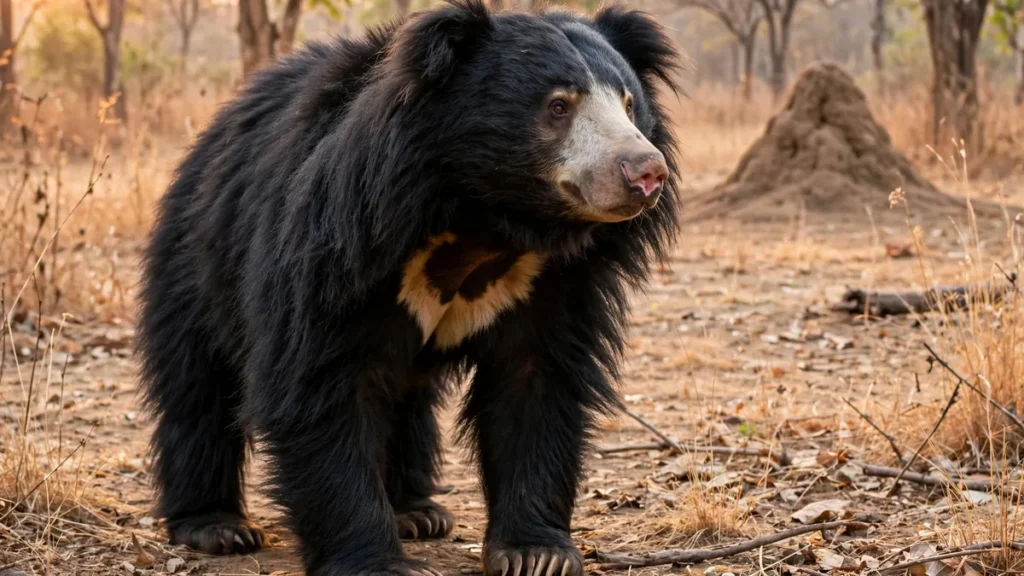
The sloth bear species is a single species, Melursus ursinus, a shaggy black bear of the forests and grasslands of the Indian subcontinent. If you are asking how many sloth bear species there are, the answer is one, and it is the most insect-eating of all the bears: it rips open termite mounds with its long curved claws and sucks the insects up through a gap left by its missing front teeth.
The sloth bear is not a sloth at all. Early naturalists saw its long claws and missing front teeth and grouped it with the slow tree mammals of South America, and the name stuck, but the sloth bear is a true bear, and the only species in its genus, Melursus.
Key takeaways
- There is one sloth bear species, Melursus ursinus, the only species in the genus Melursus.
- An adult is about 1.4 to 1.9 metres long, stands 60 to 92 centimetres at the shoulder, and weighs about 55 to 145 kilograms.
- It is the most insect-eating bear in the world, feeding mainly on termites and ants, sucked up through a gap left by its missing upper front teeth.
- It lives mainly in India, with smaller populations in Sri Lanka and the lowlands of Nepal, and it is extinct in Bangladesh.
- It is listed as Vulnerable on the IUCN Red List, threatened by the loss of its forest home and conflict with people.
What makes a sloth bear a sloth bear
A sloth bear is covered in long, shaggy black fur, with a thick mane around the neck and shoulders. Across its chest sits a pale cream mark shaped like a V or a Y, and its long snout is pale and almost bare of fur, with a protruding lower lip and wide nostrils that it can close at will. Its eyes are small, because a sloth bear finds its food mostly by smell, not by sight.
Its front paws carry long, sickle-shaped claws up to about 10 centimetres long, built for digging into hard termite mounds and climbing trees. It has no upper middle incisors, and that gap is the secret of its feeding: the bear presses its lips to the broken mound and sucks the insects up in loud, snorting bursts. Like the brown bear, it is a true bear of the family Ursidae, but no other bear feeds like this.
The sloth bear species and its relatives
The sloth bear belongs to Melursus, a genus with just one species, which has two recognised subspecies. The Indian sloth bear lives across India and Nepal and is the larger of the two, while the Sri Lankan sloth bear lives only on Sri Lanka and is smaller.
The sloth bear is one of eight living bear species. The giant panda is another specialist feeder, but it eats bamboo where the sloth bear eats insects. Among bears, the sloth bear is the only one that regularly carries its young on its back, and the only one whose diet is built around termites and ants.

| Type | Animal | Where it lives | Best-known food | Length or Weight |
|---|---|---|---|---|
| Genus | Sloth bears (genus Melursus) | Indian subcontinent | Termites, ants and fruit | About 1.4 to 1.9 m long |
| Species | Sloth bear (Melursus ursinus) | India, Sri Lanka and Nepal | Termites, ants and fruit | About 55 to 145 kg |
| Species | Indian sloth bear (Melursus ursinus ursinus) | India and Nepal | Termites, ants and fruit | About 80 to 145 kg |
| Species | Sri Lankan sloth bear (Melursus ursinus inornatus) | Sri Lanka | Termites, ants and fruit | About 55 to 95 kg |
| Species | Brown bear (Ursus arctos) | Europe, Asia and North America | Plants, berries and fish | About 100 to 300 kg |
| Species | American black bear (Ursus americanus) | North America | Berries, nuts and insects | About 60 to 300 kg |
| Species | Giant panda (Ailuropoda melanoleuca) | Central China | Bamboo | About 70 to 125 kg |
How sloth bears live
Sloth bears are omnivores, but insects are the heart of the diet. Termites and ants make up the bulk of what they eat for much of the year, and a bear can dig deep into the ground to reach a large colony. The feeding sounds are so loud that they can carry for a hundred metres through the forest. Fruit such as mango, fig and jackfruit, and honey from bees’ nests, make up much of the rest.
Sloth bears are mainly solitary and mainly nocturnal, foraging alone at night and resting by day in a cave or a dense thicket. They climb well, and their sense of smell is excellent: they find termite mounds by scent, while their sight and hearing are poor, so a surprised bear can be dangerous at close range.
Sloth bears mate in spring and early summer, in India usually from April to June, and give birth near the start of winter, most often in December or January. After a gestation of about six to seven months, the female gives birth to one or two cubs, occasionally three, in a den. The cubs are born blind and weigh only a few hundred grams, and they begin to ride on their mother’s back when they are a few weeks old. They stay with her for about two to three years, longer than the cubs of most other bears, so a female raises a litter only once every two to three years. A sloth bear can live for about 20 years in the wild and up to 40 years in human care.
Where sloth bears live
Sloth bears live across the Indian subcontinent, with by far the largest population in India and smaller ones in Sri Lanka and the Terai lowlands of southern Nepal. They are considered extinct in Bangladesh, and their presence in Bhutan is uncertain, with no recent records. Within India they are the most widespread bear species, though they are absent from the high mountains, the north-western deserts and the broad unforested plains of the south.
Sloth bears use a wide range of habitats, including dry and moist deciduous forest, savanna, tall grassland and scrub, usually below about 1,500 metres. They favour rocky country with caves and dense cover for shelter, and plenty of termite mounds and fruiting trees for food. The sloth, the animal it was wrongly named after, is not related at all: sloths live in the trees of Central and South America, while the sloth bear walks the forest floor of Asia.
The sloth bear is listed as Vulnerable on the IUCN Red List, assessed in 2016, and its population is declining. No reliable global population figure exists, because the bears are shy, nocturnal and hard to count, but numbers are falling as forests are cut and broken into smaller pieces. The species is on CITES Appendix I, which bans commercial international trade, and it is protected by law in India. Sloth bears were once taken from the wild and trained as performing “dancing bears”, a practice made illegal in India in 1972 and ended when the last dancing bears were rescued in 2009.
Best seasons for sloth bear watching
The best time to watch sloth bears is the dry season, from about November to May, when the forest is thinner, water is scarce and the bears come out earlier to feed. The best hours are the early morning and the late afternoon, when a bear may be seen digging at a termite mound. The Daroji Sloth Bear Sanctuary in Karnataka and the forests of Satpura National Park in Madhya Pradesh are among the best-known places to see them, and a local guide is essential.
Staying safe around sloth bears
A sloth bear is a wild animal and should be watched from a distance, never approached or fed. Because its sight and hearing are poor, a bear that is surprised at close range, especially a mother with cubs on her back, can charge in defence. Never come between a mother and her cubs, and never leave food out, since bears that learn to eat human food lose their fear of people. If you meet one, back away slowly and quietly, and in a reserve always follow the guide’s instructions and stay on the marked paths.
Sloth bear watching checklist
A little preparation turns a forest walk in India into a real chance of seeing a sloth bear at a termite mound.
- A visit to the Daroji Sloth Bear Sanctuary in Karnataka or Satpura National Park in Madhya Pradesh, with a guide.
- A dry-season trip, from about November to May, when the forest is thin and the bears feed earlier in the day.
- An early morning or late afternoon start, when sloth bears are most active.
- Binoculars, because a bear digging at a mound may be a long way off.
- Quiet feet and patience, because a sloth bear that hears you will slip away into cover.
- Sturdy walking shoes and long sleeves, for rocky ground and thorns.
- A field guide to the mammals of India, for telling a sloth bear from other bears.
Frequently asked questions
How many sloth bear species are there?
There is one sloth bear species, Melursus ursinus, the only species in the genus Melursus, with two recognised subspecies: the Indian sloth bear of India and Nepal, and the smaller Sri Lankan sloth bear.
Is a sloth bear related to a sloth?
No. The sloth bear is a true bear, and it is not related to sloths at all. Early naturalists thought it was a kind of sloth because of its long curved claws and its missing front teeth, and the name stuck, but sloths are tree mammals of Central and South America, while the sloth bear is an Asian bear.
What does a sloth bear eat?
Sloth bears eat mainly termites and ants, sucked up through the gap left by their missing upper front teeth after ripping the mound open with their long claws. They also eat fruit such as mango, fig and jackfruit, flowers, honey and honeycomb, and occasionally eggs and small animals.
Why do sloth bear cubs ride on their mother’s back?
Sloth bear cubs ride on their mother’s back from a few weeks old, and the sloth bear is the only bear that does this. Riding on the mother’s back keeps the cubs safe from predators, and they stay with her for about two to three years.
How is this guide different from the sea lion guide?
This guide covers the sloth bear, one species of shaggy black bear that lives in the forests of India and eats termites and ants, while our sea lion species guide covers sea lions, marine mammals of the Pacific coasts that eat fish and squid. Sloth bears dig at termite mounds on the forest floor, and sea lions swim and haul out on rocky shores.
Are sloth bears endangered?
Sloth bears are listed as Vulnerable on the IUCN Red List, which is one step below Endangered, and their population is considered to be declining. Their greatest threats are the loss of their forest home and conflict with people, and they are on CITES Appendix I, which bans commercial international trade.
Conclusion
The sloth bear species is a reminder that a bear does not have to be big and fierce to be remarkable: Melursus ursinus, one species in its own genus, has traded the usual bear diet for a life of digging and sucking up termites, and it carries its cubs on its back like no other bear on Earth.
If you go looking for one, go in the dry season, go quietly, and listen for loud snorting from a termite mound in the scrub. Watch it rip the mound open with those long claws and you will see why this shaggy bear earned a name all of its own.