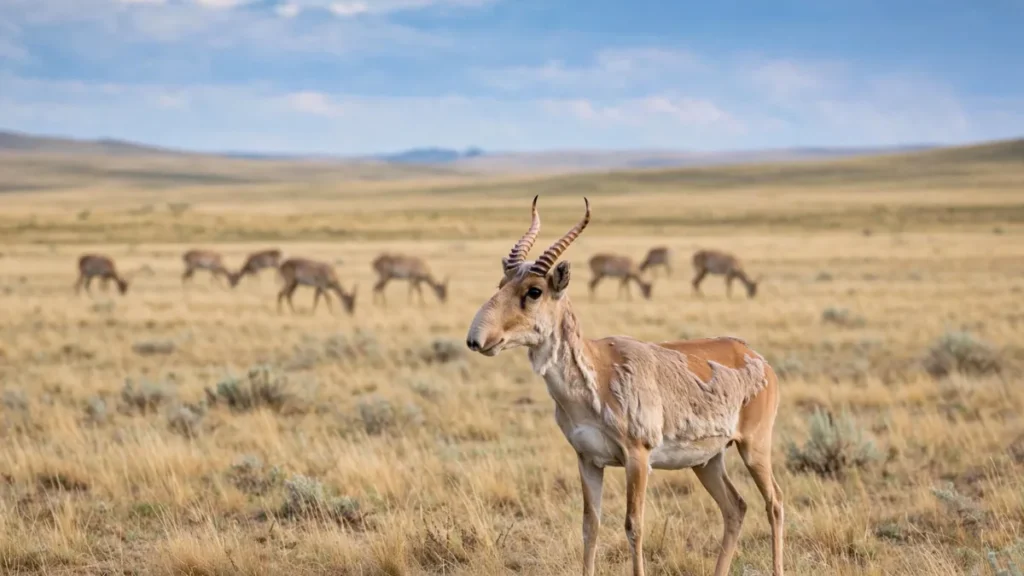
The saiga antelope species is a single species, Saiga tatarica, a medium-sized antelope of the open steppes of Central Asia, famous for its swollen, trunk-like nose. If you are asking how many saiga antelope species there are, the answer is one, although the Mongolian saiga of western Mongolia is sometimes split off as a separate species, Saiga mongolica, and it is far rarer than the main population. The saiga is one of the great recovery stories of modern conservation: hunted to fewer than 50,000 animals by the early 2000s, it now numbers in the millions again in Kazakhstan.
The saiga gets its name from its nose, a soft, flexible proboscis that hangs over its mouth like a small trunk. It warms freezing winter air before it reaches the lungs and filters out the dust kicked up by thousands of running hooves in summer. No other antelope looks like it.
Key takeaways
- There is one saiga antelope species, Saiga tatarica, with two subspecies: the nominate form across Kazakhstan, Russia and Uzbekistan, and the Mongolian saiga in western Mongolia.
- An adult stands about 60 to 80 centimetres at the shoulder, measures about 100 to 140 centimetres from head to body, and weighs roughly 26 to 69 kilograms, with males larger than females.
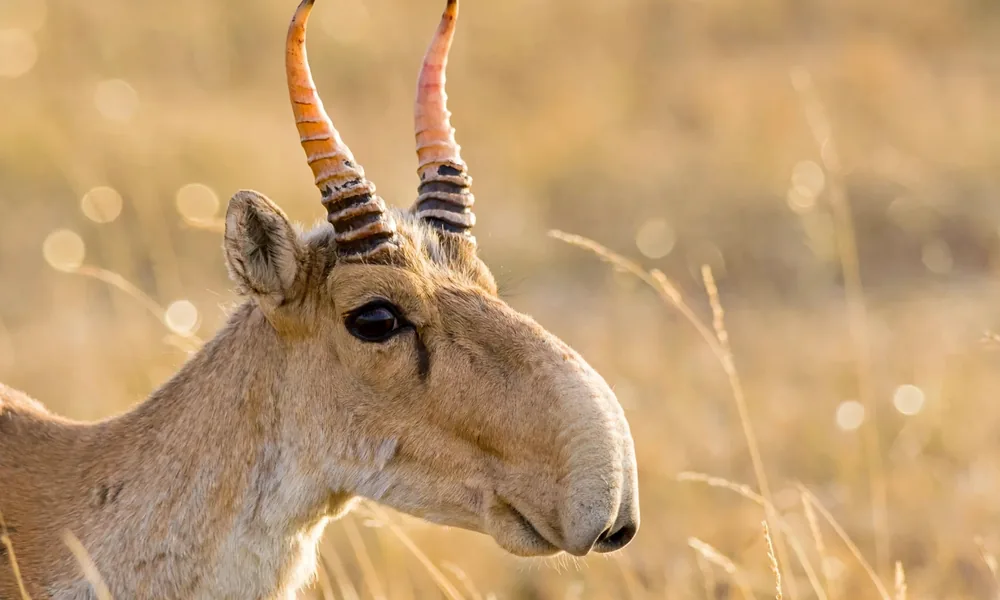
- Only males carry horns, a pair of amber, lyre-shaped horns about 28 to 38 centimetres long, and females are hornless.
- Saigas are nomadic herd animals that migrate hundreds of kilometres across the steppe, and a herd can number in the thousands during migration and calving.
- The species is listed as Near Threatened after a 2023 reassessment, down from Critically Endangered, but the Mongolian subspecies is still listed as Endangered.
What makes a saiga antelope a saiga antelope
A saiga antelope is recognised first by its nose. The proboscis is a soft, inflatable swelling above the mouth, with the nostrils pointing downwards, and inside it a maze of mucous passages warms, moistens and cleans the air. In winter, when the steppe can fall to minus 40 degrees, that warming matters; in summer, when a galloping herd raises clouds of dust, the filtering matters just as much.
A saiga has a stocky body on long, slender legs, a short tail, and a coat that changes with the seasons: short and pale sandy-brown in summer, thick and much paler, almost whitish, in winter. Males carry a pair of translucent amber horns, ringed and gently curved like a lyre, while females have no horns at all. Like the gazelle, another swift antelope of open country, it is built for running, and a frightened saiga can reach about 80 kilometres per hour.
The saiga antelope species and its relatives
The saiga antelope belongs to Saiga, a genus with a single living species, Saiga tatarica, in the family Bovidae, the cattle, goats, sheep and antelopes. Two subspecies are recognised: Saiga tatarica tatarica, the nominate form that lives across Kazakhstan, Russia and Uzbekistan, and Saiga tatarica mongolica, the Mongolian saiga of western Mongolia, which some authorities raise to a full species, Saiga mongolica.
The saiga is an antelope of the open steppe, and its closest ecological neighbours are the gazelles and other dry-country antelopes of Central Asia. The impala of Africa is a distant cousin in the same family, a grassland antelope that also lives in large herds and relies on speed, though it never developed a nose like the saiga.
| Type | Animal | Where it lives | Best-known food | Length or Weight |
|---|---|---|---|---|
| Genus | Saiga (genus Saiga) | Central Asian steppe and semi-desert | Grasses, herbs and lichens | About 60 to 80 cm at the shoulder |
| Species | Saiga antelope (Saiga tatarica) | Kazakhstan, Russia, Uzbekistan and Mongolia | Grasses, saltworts and lichens | About 26 to 69 kg |
| Subspecies | Mongolian saiga (Saiga tatarica mongolica) | Western Mongolia, Shargyn Gobi | Grasses and steppe shrubs | Smaller than the nominate form, about 20 to 30 kg |
| Species | Impala (Aepyceros melampus) | Savannas of eastern and southern Africa | Grasses, leaves and shrubs | About 40 to 76 kg |
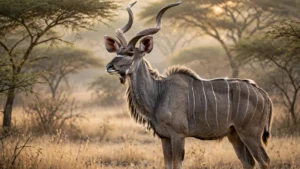
| Species | Greater kudu (Tragelaphus strepsiceros) | Woodlands of eastern and southern Africa | Leaves, shoots and fruit | About 120 to 300 kg |
| Species | Common eland (Taurotragus oryx) | Savannas and plains of Africa | Leaves, grasses and fruit | About 300 to 900 kg |
How saiga antelopes live
Saiga antelopes are herbivores that graze and browse on well over a hundred plant species, chiefly grasses, saltworts, sagebrush and lichens. They get much of their water from the plants they eat, and they feed mostly in the morning and evening, resting through the heat of the day.
Saigas are nomadic, moving in herds that can number from a few dozen animals to many thousands, especially during migration and at calving time. They undertake seasonal movements of hundreds of kilometres across the open steppe, following the rain and the fresh grass, and they have no fixed home range. During the rut, from late November to late December, each adult male tries to hold a harem of roughly five to ten females, driving rivals away with his roaring calls and, when needed, with his horns.
After a gestation of about five months, females give birth in May, usually to twins, and the calves stay hidden in the grass, crouched and still, for four to eight days before they start to follow the herd. Twins are the norm rather than the exception, and that high birth rate is the engine of the saiga recovery. Saigas live for about six to ten years in the wild, and males usually live shorter lives than females.
Where saiga antelopes live
Saiga antelopes live on the treeless steppes and semi-deserts of Central Asia, in Kazakhstan, Russia, Uzbekistan and Mongolia. The main population is split into four groups: the Ural population in western Kazakhstan, the Betpak-Dala population in central Kazakhstan, the Ustyurt population between Kazakhstan and Uzbekistan, and a smaller population in Kalmykia and Astrakhan in Russia. The Mongolian saiga lives apart, in the Shargyn Gobi desert of western Mongolia.
The saiga once ranged across the whole Eurasian steppe, from the foothills of the Carpathians in the west to Mongolia in the east, and in the Ice Age it ranged much further still. Hunting for meat, hides and horns cut it back again and again: in the early 1990s there were about a million saigas, but poaching after the break-up of the Soviet Union crashed the population to under 50,000 by the mid-2000s. Horns are prized in traditional Chinese medicine, and because only males carry them, poaching left some herds with too few males to breed.
Then came the recovery. Anti-poaching patrols, protected areas and a run of good years brought the Kazakhstan population back to about 1.9 million by 2022, about 2.8 million by 2024, with later estimates above 3.9 million. The IUCN reassessed the species in 2023 and moved it from Critically Endangered, where it had sat since 2002, to Near Threatened. The recovery is fragile, though: in May 2015 about 200,000 saigas, more than 60 per cent of the Betpak-Dala population, died in three weeks from haemorrhagic septicaemia, a disease caused by the bacterium Pasteurella multocida. The Mongolian saiga, numbering a little over 25,000 animals, is still listed as Endangered, and the species is on CITES Appendix II, with a zero-export quota for wild specimens, so the horn trade is tightly controlled.
Best seasons for saiga antelope watching
The best time to watch saiga antelopes is May, during the calving season, when huge herds gather on the steppe and thousands of calves are born within a few days of each other. The Korgalzhyn Reserve in Kazakhstan is the best-known place to see them, and the spring migration in April and May and the autumn movement in September and October are the other good windows, when herds are on the move and visible for hours at a time.
Staying safe around saiga antelopes
A saiga antelope is a wild animal and should be watched from a distance, never approached or chased. Saigas are nervous and fast, and a herd that is pushed will stampede, which can injure calves and exhaust the animals. In a reserve, follow the guide’s instructions, stay with the vehicle or on the marked routes, and use binoculars rather than walking closer. Never touch a dead animal, and report any carcass to the reserve staff.
Saiga antelope watching checklist
A little preparation turns a long drive across the Kazakh steppe into a real chance of seeing thousands of saigas at once.
- A visit to the Korgalzhyn Reserve or another protected steppe area in Kazakhstan, arranged with a local guide.
- A May trip, timed for the calving season, when the herds gather in their thousands.
- Binoculars and a spotting scope, because saigas are nervous and keep their distance on open ground.
- A camera with a long zoom lens, for close views of the bulbous nose without disturbing the herd.
- Warm, windproof clothing in layers, because the steppe is cold at dawn even in late spring.
- Sun protection and plenty of water, because the steppe has no shade and the sun is fierce by midday.
- A field guide to Central Asian mammals, for telling a saiga from the gazelles that share the steppe.
Frequently asked questions
How many saiga antelope species are there?
There is one saiga antelope species, Saiga tatarica, with two subspecies: the nominate form across Kazakhstan, Russia and Uzbekistan, and the Mongolian saiga in western Mongolia. Some authorities split the Mongolian saiga off as a separate species, Saiga mongolica.
Why does a saiga antelope have such a big nose?
The saiga’s swollen, trunk-like nose is a proboscis full of winding mucous passages that warm freezing winter air, filter dust from the air in summer, and moisten the air before it reaches the lungs. It also deepens the roaring calls males make during the rut.
What does a saiga antelope eat?
Saiga antelopes are herbivores that eat well over a hundred plant species, chiefly grasses, saltworts, summer cypress, sagebrush and steppe lichens. They feed mostly in the morning and evening and get much of their water from their food.
How many saiga antelopes are left in the wild?
Kazakhstan’s population recovered from under 50,000 in the mid-2000s to about 1.9 million by 2022 and about 2.8 million by 2024, with later estimates above 3.9 million. The Mongolian saiga is far rarer, at a little over 25,000 animals.
How is this guide different from the red kangaroo guide?
This guide covers the saiga antelope, one species of steppe antelope from Central Asia that lives in nomadic herds, eats grasses and lichens, and is famous for its bulbous trunk-like nose, while our red kangaroo species guide covers the red kangaroo, a hopping marsupial of the Australian outback that lives in mobs, eats grasses and shrubs, and raises its young in a pouch. Saigas run in herds across the Eurasian steppe, and red kangaroos bound across the red deserts of Australia.
Are saiga antelopes endangered?
The species as a whole is listed as Near Threatened on the IUCN Red List, after being downlisted from Critically Endangered in 2023 following the recovery in Kazakhstan. The Mongolian saiga is still listed as Endangered, and the species remains vulnerable to poaching for its horns and to sudden mass die-offs from disease.
Conclusion
The saiga antelope species shows how quickly a wild animal can fall and how quickly it can come back: Saiga tatarica, hunted to fewer than 50,000 animals by the early 2000s, and now numbering in the millions again on the steppes of Kazakhstan.
If you go looking for one, go in May, go with a guide, and look for a herd moving like a river across the grass. Watch a male lift his strange, swollen nose into the wind, and you will see why this odd little antelope became one of the great conservation stories of our time.