The slow loris species belong to the genus Nycticebus, a group of about eight recognised species of small nocturnal primates that live in the forests of South and Southeast Asia. If you are asking how many slow loris species there are, the answer is about eight in Nycticebus, or nine counting the pygmy slow loris, which some authorities place in its own genus, and every one of them is threatened: slow lorises are the only venomous primates in the world, and among the most trafficked primates on Earth.
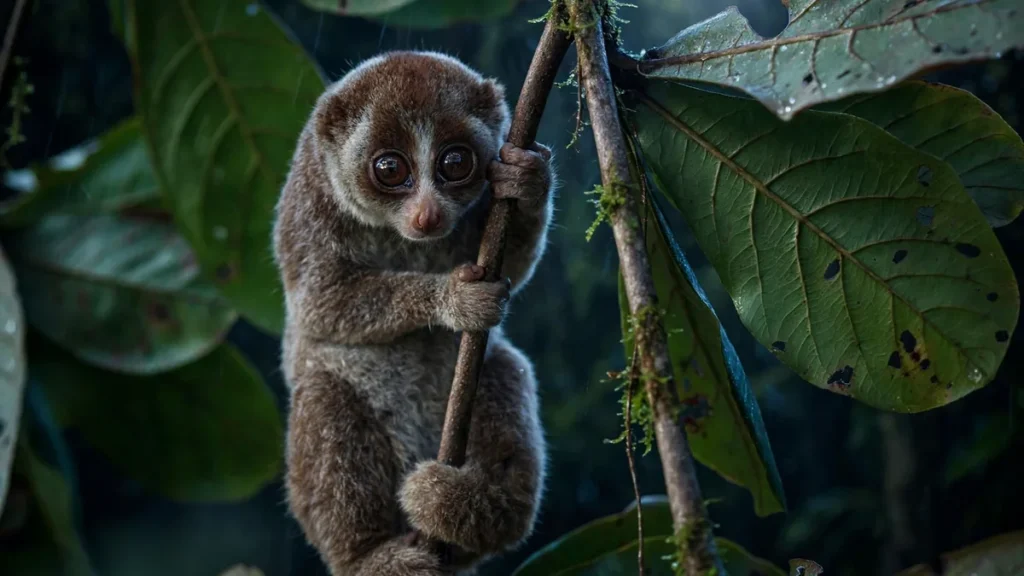
A slow loris is a small, round-headed animal with huge forward-facing eyes and a pale face marked with dark patches around the eyes. It moves slowly and deliberately through the trees and almost never leaps, and it is active only at night, sleeping curled in a ball in dense foliage by day. It is not a pet, and it should never be kept as one: its venomous bite can cause a severe allergic reaction in people, and sellers routinely pull out its teeth before it is sold.
Key takeaways
- Slow lorises are the genus Nycticebus, with about eight recognised species, or nine counting the pygmy slow loris.
- They are small nocturnal primates, about 18 to 38 centimetres long and roughly 265 grams to just over 2 kilograms, with huge round eyes.
- They are the only venomous primates in the world, producing a toxin from a gland near the elbow that becomes venom with saliva.
- They live in the tropical forests of South and Southeast Asia, from north-eastern India to Sumatra, Java, Borneo and the Philippines.
- Every slow loris species is threatened, from Vulnerable to Critically Endangered, and all are on CITES Appendix I.
What makes a slow loris a slow loris
A slow loris has a round head, a short muzzle and enormous forward-facing eyes that help it see in the dark. Its coat is dense and soft, in shades of brown, grey, reddish or cream, and most species have a dark stripe down the back and dark patches around the eyes. Its tail is hidden in the fur, and its second finger is much shorter than the others, while the thumb and big toe are set wide apart, giving it a powerful grip.
The slow loris’s most remarkable feature is its venom. A gland on the inside of the elbow, called the brachial gland, produces an oily secretion, and when the loris licks the gland and mixes the secretion with its saliva, the result is a venomous bite that can cause pain, swelling and, in some people, anaphylactic shock. Mothers even coat their infants with the secretion to protect them from predators. Like the loris, its close relative the slender loris of India and Sri Lanka, it is a strepsirrhine primate, but no other primate in the world is venomous.
The slow loris species and their relatives
The slow loris genus, Nycticebus, holds about eight recognised species. The eight are the Bengal, Sunda, Javan, Bornean, Kayan, Philippine, Bangka and Hiller’s slow lorises, and a ninth, the pygmy slow loris, was placed in its own genus, Xanthonycticebus, by some researchers in 2022. The Bengal is the largest, at up to about 2 kilograms, while the pygmy is the smallest, at roughly 120 to 500 grams.
Slow lorises belong to the family Lorisidae, along with the slender lorises and the pottos of Africa, and they are strepsirrhine primates. The ring-tailed lemur is a distant cousin, but it is a daytime animal that lives in troops on the ground, where a slow loris is a solitary night animal that almost never leaves the trees. Among the slow lorises, the Javan and Bangka species are Critically Endangered, the Bengal, Sunda and pygmy species are Endangered, and the Bornean, Kayan and Philippine species are Vulnerable.

| Type | Animal | Where it lives | Best-known food | Length or Weight |
|---|---|---|---|---|
| Genus | Slow lorises (genus Nycticebus) | South and Southeast Asia | Tree gum and insects | About 18 to 38 cm long |
| Species | Sunda slow loris (Nycticebus coucang) | Malay Peninsula, Sumatra and Singapore | Tree gum and insects | About 600 to 685 g |
| Species | Bengal slow loris (Nycticebus bengalensis) | India and mainland Southeast Asia | Tree gum and nectar | About 1 to 2.1 kg |
| Species | Javan slow loris (Nycticebus javanicus) | Java, Indonesia | Tree gum and insects | About 600 to 900 g |
| Species | Bornean slow loris (Nycticebus borneanus) | Borneo | Tree gum and insects | About 265 to 700 g |
| Species | Philippine slow loris (Nycticebus menagensis) | Borneo and the Philippines | Tree gum and insects | About 265 to 700 g |
| Species | Pygmy slow loris (Xanthonycticebus pygmaeus) | Vietnam, Laos, Cambodia and China | Tree gum and insects | About 120 to 500 g |
How slow lorises live
Slow lorises are omnivores, but tree gum is the staple of the diet. They use a toothcomb, a set of forward-pointing lower teeth, to gouge bark and lick up the gum, and they also eat nectar, fruit, insects, spiders, bird eggs and occasionally small vertebrates.
Slow lorises are nocturnal and arboreal, and they move with slow, deliberate climbing, always holding on with at least three limbs and almost never leaping. By day they sleep curled in a tight ball in a tree fork or dense foliage, often alone but sometimes with others. They are largely solitary foragers, though their home ranges overlap, and some species live in small family groups.
After a gestation of about six months, roughly 185 to 197 days, a female usually gives birth to a single infant, though twins are common in the pygmy. The infant is born fully furred and with its eyes open. Young are weaned at about five to nine months. A slow loris can live for up to about 20 years in human care, though its lifespan in the wild is poorly documented.
Where slow lorises live
Slow lorises live in the tropical forests of South and Southeast Asia, from Assam in north-eastern India to Sumatra, Java, Borneo and the Philippines. They prefer evergreen rainforest with a continuous dense canopy, but they also live in bamboo and secondary forest. The Bengal slow loris has the widest range, while the Javan slow loris lives only on Java and the Bangka slow loris only on Bangka and parts of Borneo.
Slow lorises depend on unbroken canopy, because they almost never come down to the ground, so forest cut into separate pieces by logging, farming and roads is a serious threat. Oil palm and rubber plantations have replaced large areas of their forest, and the animals are caught in large numbers for the pet trade and traditional medicine. The Little Fireface Project, a research and conservation programme based in Java, studies the Javan slow loris in the wild and works with local people to protect it.
Every slow loris species is threatened, from Vulnerable to Critically Endangered, and all populations are declining. The Javan slow loris has lost at least four fifths of its population over about 24 years. All slow lorises were moved to CITES Appendix I in 2007, which bans commercial international trade. Viral videos of slow lorises being tickled or fed rice balls have fuelled demand for them as pets, but the animals in those videos are usually stressed and many die soon after being sold.
Best seasons for slow loris watching
The best time to watch slow lorises is the dry season, when the nights are clearer, and the best hours are the first few hours after dark, when the animals leave their sleeping places and begin to feed. Slow lorises are found by their eye shine, the reflection of a torch in their huge eyes, so a guided night walk is the only realistic way to see one. Danum Valley in Malaysian Borneo and the forests of Java are among the best-known places, and a local guide with a red light is essential.
Staying safe around slow lorises
A slow loris is a wild animal and should be watched from a distance, never touched or fed. Its bite is venomous and can cause a severe allergic reaction, including anaphylactic shock, in people, and a threatened loris will raise its arms and lick its brachial gland to arm its bite. Never buy a slow loris, never support a show that uses one, and never share videos of pet slow lorises. If you see a slow loris for sale or in distress, report it to the local wildlife authorities, and on a night walk follow the guide’s instructions and keep your light dim and red.
Slow loris watching checklist
A little preparation turns a night walk in a Southeast Asian rainforest into a real chance of seeing a slow loris.
- A guided night walk in a protected forest, such as Danum Valley in Borneo or the forests of Java.
- A dry-season trip, when the nights are clear and the trails are easier to walk.
- A red-filtered torch, for spotting eye shine without disturbing the animals.
- An early start after dark, when slow lorises leave their sleeping places and begin to feed.
- Quiet feet and patience, because a slow loris freezes when it feels watched.
- Long sleeves, long trousers and insect repellent, for the mosquitoes of the night forest.
- A field guide to the primates of Southeast Asia, for telling a slow loris from other small primates.
Frequently asked questions
How many slow loris species are there?
There are about eight recognised species in the genus Nycticebus: the Bengal, Sunda, Javan, Bornean, Kayan, Philippine, Bangka and Hiller’s slow lorises. A ninth, the pygmy slow loris, was placed in its own genus, Xanthonycticebus, by some researchers in 2022, so counts of eight and nine both appear.
Are slow lorises venomous?
Yes. Slow lorises are the only venomous primates in the world. They produce a toxin from a gland near the elbow, mix it with saliva, and deliver it in a bite that can cause anaphylactic shock.
What does a slow loris eat?
Slow lorises eat mainly tree gum and sap, obtained by gouging bark with their toothcomb and licking up the flow, along with nectar, fruit, insects, spiders, bird eggs and occasionally small vertebrates. Gum is the staple of the diet, which is why they are sometimes called exudativores.
Can a slow loris be kept as a pet?
No. A slow loris is a wild, nocturnal and venomous animal, and it is not a pet. Keeping one is illegal in most range countries, and all slow lorises are on CITES Appendix I, which bans commercial international trade. Sellers routinely pull out a pet loris’s teeth, without anaesthetic, to stop it biting, and many animals die from the infection and stress that follow.
How is this guide different from the sloth bear guide?
This guide covers the slow loris, a group of about eight small nocturnal primates that live in the trees of Southeast Asia and eat tree gum, while our sloth bear species guide covers the sloth bear, one species of shaggy black bear that lives in the forests of India and eats termites and ants.
Are slow lorises endangered?
Yes. Every slow loris species is threatened, from Vulnerable to Critically Endangered, and all populations are declining. The Javan and Bangka species are Critically Endangered, the Bengal, Sunda and pygmy species are Endangered, and the Bornean, Kayan and Philippine species are Vulnerable.
Conclusion
The slow loris species show how much can hide in a small animal that moves slowly through the dark: about eight species in Nycticebus, the only venomous primates in the world, feeding on tree gum in the forests of South and Southeast Asia, and every one of them threatened.
If you go looking for one, go after dark, go quietly, and look for two bright eyes shining back from the canopy. Watch it lick gum from a wounded branch and you will see why it is worth protecting in the wild.