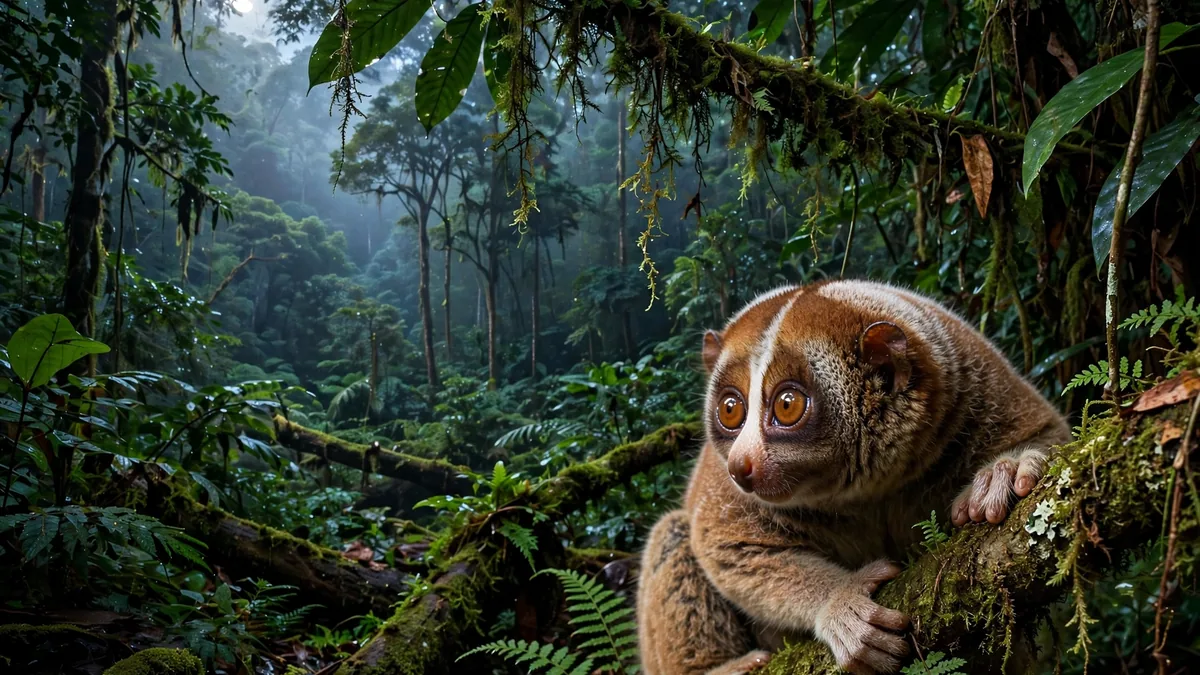
Loris species are the slow-moving, wide-eyed primates of Asia, and there are eleven recognised loris species in the current taxonomy. If you are wondering how many loris species there are, the answer is eleven: two slender lorises, eight slow lorises and one pygmy slow loris, all nocturnal tree-dwellers of South and South-East Asia. They are also the only primates known to be venomous, and every one is threatened in the wild.
Key takeaways
- Eleven loris species are currently recognised: two slender lorises, eight slow lorises and one pygmy slow loris.
- Slow lorises are the only known venomous primates, with a toxin from a gland on the inner arm mixed with saliva.
- Lorises are nocturnal and arboreal, moving slowly through the trees with a very strong grip.
- They live in the forests of South and South-East Asia, from India and Sri Lanka to Borneo, Java and the Philippines.
- All loris species are threatened, and the illegal pet trade is a major danger.
What makes a loris a loris
A loris is a small, tailless or nearly tailless primate with a round head, a short muzzle and enormous forward-facing eyes built for the dark. Lorises are strictly nocturnal, sleeping curled in a ball in dense foliage or a tree hollow by day and waking at dusk to feed. Their fur is soft and woolly, usually grey-brown or reddish-brown, with a dark back stripe and dark eye rings like a mask.
Lorises move in a way no other primate does, creeping along branches at a slow, deliberate pace, one hand at a time, and freezing completely still when they sense danger. Their grip is extraordinary: a loris can hang from a branch by its feet alone and hold on for a very long time without tiring, and a spine with extra vertebrae lets the body twist like a snake. Like other nocturnal animals, they depend on large eyes and smell more than on speed.
What sets lorises apart from every other primate is venom. Slow lorises carry a gland on the inside of the elbow, the brachial gland, which produces an oily secretion. When threatened, a loris raises its arms, licks the gland and mixes the secretion with saliva, creating a venom it delivers with a bite through a comb of sharp lower teeth. The main venom protein closely resembles Fel d 1, the major allergen of the domestic cat, and a bite can cause severe pain and, rarely, anaphylaxis. Slender lorises do not share this venom system.
The loris species
The eleven loris species fall into three genera: the slender lorises (Loris) of India and Sri Lanka, the slow lorises (Nycticebus) of South-East Asia, and the pygmy slow loris, once placed in Nycticebus but now given its own genus, Xanthonycticebus, which is why older guides sometimes give a total of ten species instead of eleven.
The red slender loris of Sri Lanka is a slim, long-limbed animal of about 20 to 25 centimetres that feeds mostly on insects, especially ants. The grey slender loris, its cousin, lives in the dry forests and scrub of India and Sri Lanka and is slightly larger and paler. The Sunda slow loris, the best-known slow loris, lives in Peninsular Malaysia, Sumatra and Singapore; it is a stocky animal of about 30 centimetres, eating insects, tree gum, fruit and nectar. The Bengal slow loris, the largest of all at up to about two kilograms, ranges from north-eastern India and Bangladesh through Myanmar, Thailand and southern China. The pygmy slow loris, the smallest at about 25 centimetres, lives east of the Mekong in Vietnam, Laos, Cambodia and southern China.

The Javan slow loris lives only on Java and is critically endangered, as is the Bangka slow loris, found only on Bangka Island off Sumatra. The Bornean slow loris is found in Borneo, the Kayan slow loris along the Kayan River in northern Borneo, the Philippine slow loris in the Philippines and northern Borneo, and the Sumatran slow loris in the highlands of Sumatra. Each island species is separated from its neighbours by sea or rivers, which is how so many similar lorises came to exist side by side.
How lorises live
A loris night begins at dusk, when the animal uncurls from its sleeping ball and starts to move through the canopy, hand over hand, testing each branch before putting its weight on it. It rarely leaps. This slowness is a hunting strategy: insects, sleeping birds and small lizards do not notice a loris creeping towards them, and it can snatch prey with a sudden grab of both hands. Slow lorises also eat tree gum, scraping bark with their toothcomb to make sap flow, and they lick nectar and eat soft fruit in season.
Lorises have few natural enemies: owls, eagles, snakes and clouded leopards can all take one, and the venom is one answer to that threat. Another is stillness: a loris frozen against a branch, its masked face and mottled fur breaking up its outline, is very hard to spot. Many of the predator animals that hunt in Asian forests at night look for movement, and a loris that does not move is almost invisible. The greatest danger comes from people: lorises are caught in large numbers for the illegal pet trade, where their teeth are often clipped out so they cannot bite, which frequently kills them. Forest loss has also broken their habitat into fragments, leaving many populations isolated in small patches of forest.
Where lorises live
Lorises live only in South and South-East Asia, in a band of tropical and subtropical forest from India and Sri Lanka in the west to the Philippines in the east. Slender lorises are the westernmost, living in the dry forests, scrub and even gardens of southern India and Sri Lanka. Slow lorises live further east, in the rainforests and monsoon forests of Myanmar, Thailand, Laos, Vietnam, Cambodia, Malaysia, Indonesia and southern China.
Within that range, lorises are creatures of the trees. They prefer dense, continuous canopy where they can travel branch to branch without coming to the ground, and do best in primary rainforest with old trees that produce gum and fruit. The rainforest animals of South-East Asia share this dependence on unbroken canopy, and when the forest is cut into fragments, lorises are among the first to disappear. Borneo alone holds three slow loris species, separated by rivers and mountains, while Java and Bangka each have a single species found nowhere else. This is why the species count has grown: animals once thought to be one widespread species turned out to be several, each confined to its own island or river basin. The forest animals of Asia show the same pattern again and again, with isolation producing new species.
| Type | Animal | Where it lives | Best-known food | Length |
|---|---|---|---|---|
| Species | Sunda slow loris | Peninsular Malaysia, Sumatra, Singapore | Insects, tree gum, fruit | About 30 cm |
| Species | Bengal slow loris | North-east India, Bangladesh, Myanmar, Thailand, southern China | Tree gum, insects, fruit | About 35 cm |
| Species | Pygmy slow loris | Vietnam, Laos, Cambodia, southern China | Insects, tree gum, nectar | About 25 cm |
| Species | Javan slow loris | Java, Indonesia | Tree gum, insects, fruit | About 30 cm |
| Species | Bornean slow loris | Borneo | Insects, tree gum, fruit | About 28 cm |
| Species | Philippine slow loris | Philippines and northern Borneo | Insects, tree gum, fruit | About 27 cm |
| Species | Red slender loris | Sri Lanka | Insects, especially ants | About 22 cm |
| Species | Grey slender loris | India and Sri Lanka | Insects, especially ants | About 24 cm |
Best seasons for loris watching
The dry season is the best time to look for lorises in most of South-East Asia, roughly November to April, when the rain eases and forest trails are passable. Lorises are active all year, since their forests have no real winter, but the dry months make night walks easier and the animals easier to find. Whatever the season, the time of night matters more than the time of year: the best watching is in the first few hours after dark, when lorises leave their sleeping sites and begin to feed. A red torch is the best way to spot them: their eyes shine back brightly, two round orange dots in the dark canopy.
Staying safe around lorises
Lorises are wild animals, and they deserve respect: a slow loris bite is genuinely dangerous. Never try to touch a loris, never pick one up and never let one climb on you. The venom can cause severe pain, swelling and, rarely, anaphylactic shock, and a bite needs medical attention. Pet lorises often have their teeth clipped, a sign of the illegal trade: report the animal to the authorities rather than handling it. Keep a sensible distance and watch with binoculars or a zoom lens rather than crowding in close, and if you find an injured loris, or one offered for sale, contact a local wildlife rescue group or the forest authorities.
Loris watching checklist
- Look for dense, unbroken canopy with old trees that produce gum and fruit.
- Watch in the first few hours after dark, when lorises leave their sleeping sites to feed.
- Scan the branches with a red torch for two round eyes shining back.
- Listen for soft rustling and quiet calls, rather than loud movement.
- Look for a slow shape creeping hand over hand, and a masked face with dark eye rings.
- Use binoculars or a zoom lens, and never block a branch or a feeding tree.
- Do not touch, pick up or feed lorises, and never buy one as a pet.
- Leave no trace: keep to marked paths.
Frequently asked questions
How many loris species are there?
Eleven: two slender lorises, eight slow lorises and one pygmy slow loris. Older guides sometimes say ten, because the pygmy slow loris was once counted in the slow loris genus Nycticebus.
How is this guide different from the sloth species guide?
This guide covers the lorises of Asia, nocturnal primates with large eyes, a strong grip and, in the slow lorises, venom, while the sloth species guide covers the tree mammals of Central and South America, which are not primates and hang upside down by day.
Are lorises venomous?
Slow lorises are venomous, the only primates known to be venomous. They mix an oily secretion from a gland inside the elbow with saliva to make a venom they deliver with a bite, which can cause severe pain and, rarely, anaphylactic shock. Slender lorises do not have this venom system.
Why do lorises move so slowly?
Lorises move slowly because stealth is their hunting strategy: a slow creep lets them approach insects, sleeping birds and small lizards without being noticed, and freezing still makes them almost invisible to predators.
Where is the best place to see a loris?
In a protected rainforest at night, on a guided walk with a red torch, in the first hours after dark. Good areas include the rainforests of Borneo and Sumatra, and the dry forests of Sri Lanka and southern India.
Are lorises endangered?
Yes, all loris species are threatened. The Javan and Bangka slow lorises are critically endangered, and the Bengal, Sunda, Sumatran and pygmy slow lorises and the red slender loris are endangered. Habitat loss and the illegal pet trade are the main threats, and the grey slender loris is near threatened.
Conclusion
Loris species, all eleven, are a reminder that the slowest animals in the forest can be among the most remarkable: small, wide-eyed primates that hunt by stealth and carry the only venom known in a primate. They have survived millions of years in the forests of Asia by being quiet, careful and almost invisible.
The next step is to protect the forests they depend on and to leave the pet trade alone: support a loris rescue centre, and if you ever watch a loris in the wild, do it quietly, at a distance, with a red torch and patience.