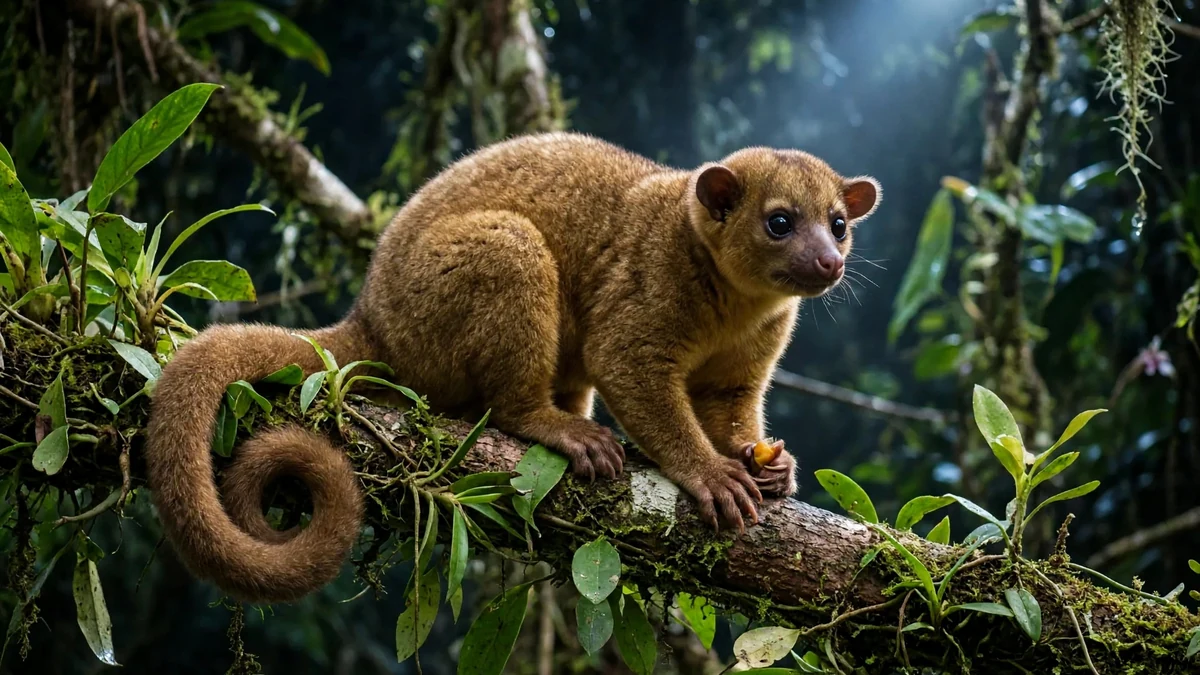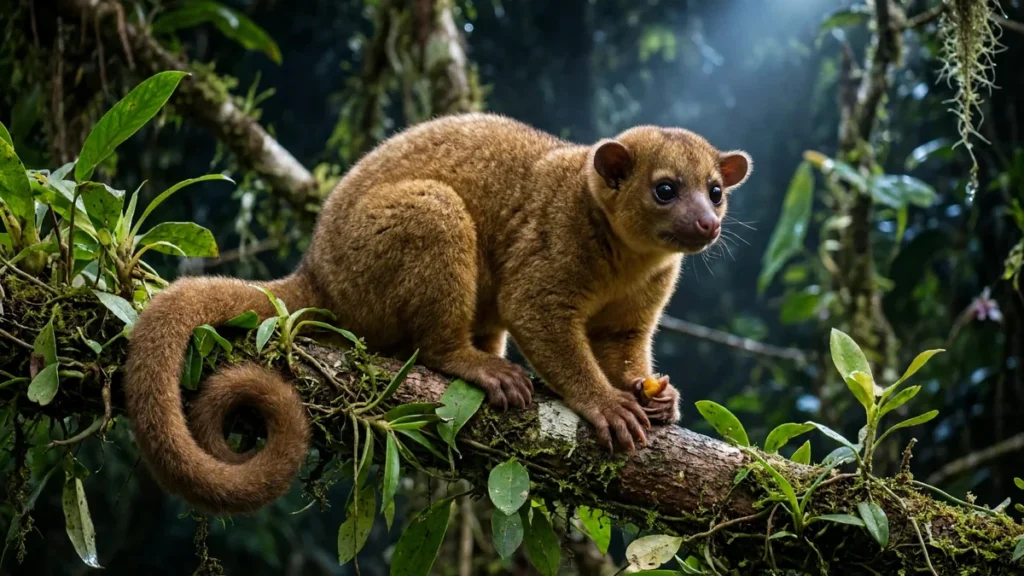
The kinkajou species is a single species, Potos flavus, a nocturnal tree-dweller of the Central and South American rainforests that is often called the honey bear. If you are asking how many kinkajou species there are, the answer is one: there is only one kinkajou species in the world, and every kinkajou alive today belongs to it.
The kinkajou belongs to the procyonid family, the same family as the raccoon and the coati, yet it lives almost entirely in the trees. It sleeps by day in a hollow tree, wakes at dusk, and spends the night moving through the canopy from one fruiting tree or flowering plant to the next.
Key takeaways
- There is only one kinkajou species, Potos flavus, the only living member of its genus.
- Kinkajous are nocturnal, tree-dwelling procyonids of the Central and South American rainforests.
- The prehensile tail works like a fifth hand, gripping branches and supporting the animal while it feeds.
- A tongue up to about 13 centimetres long reaches nectar deep inside flowers, making the kinkajou a pollinator as well as a fruit eater.
- Kinkajous are listed as Least Concern, but numbers fall as rainforest is cleared and animals are taken for the pet trade.
What makes a kinkajou a kinkajou
A kinkajou is a small mammal with golden-brown woolly fur, large forward-facing eyes, small rounded ears and a short muzzle. Its body measures roughly 40 to 60 centimetres, with a tail about the same length again, and it usually weighs between 2 and 3 kilogrammes. Its short legs end in sharp, curved claws that grip bark.
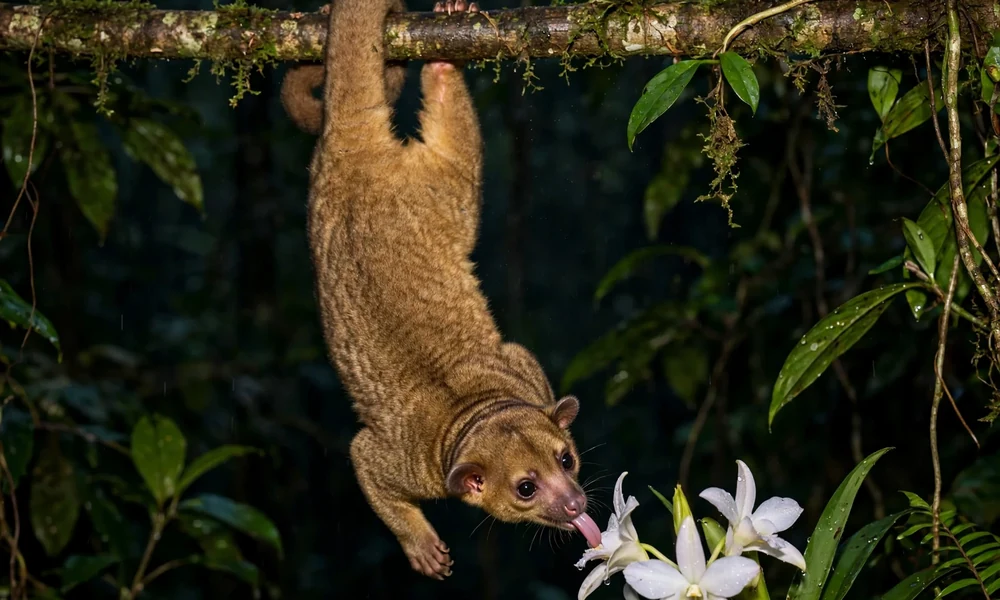
The tail defines the kinkajou: long, muscular and fully prehensile, it wraps around a branch and holds the animal’s whole weight while it feeds. The kinkajou can hang upside down from its tail, and its hind feet rotate through 180 degrees, letting it climb down a trunk headfirst. Its tongue reaches up to about 13 centimetres to lap nectar from deep flowers, and fruit is its main food, with flowers, insects and honey besides. Honey raiding earned it the name honey bear.
The kinkajou species and its relatives
Potos flavus is the only kinkajou species, and the only living member of the genus Potos. A handful of regional forms have been described, but they are all the same species, and no second kinkajou species is recognised. It sits in the family Procyonidae alongside raccoons, coatis, olingos, ringtails and cacomistles.
The olingo is most often confused with the kinkajou, being a similar size and colour and living in the same forests, but its tail is not prehensile. Coatis and raccoons are close cousins that spend far more time on the ground, while ringtails and cacomistles are smaller climbers of drier country. The binturong and the red panda are not procyonids, but both are tree-dwelling fruit eaters, and the binturong also has a prehensile tail.
| Type | Animal | Where it lives | Best-known food | Length |
|---|---|---|---|---|
| Species | Kinkajou (Potos flavus) | Central and South American rainforests | Fruit and flower nectar | 40 to 60 cm body, tail about the same |
| Close relative | Olingo | Central and South American rainforests | Fruit and nectar | 35 to 48 cm body |
| Close relative | Coati | Central and South America | Fruit and small animals | 41 to 67 cm body |
| Close relative | Raccoon | North and Central America | Almost anything, from fruit to crayfish | 40 to 70 cm body |
| Close relative | Ringtail | South-western North America | Small animals and fruit | 30 to 42 cm body |
| Close relative | Cacomistle | Mexico and Central America | Fruit and small animals | 38 to 47 cm body |
| Close relative | Binturong | South-east Asian rainforests | Figs and other fruit | 61 to 96 cm body |
| Close relative | Red panda | Himalayan mountain forests | Bamboo | 50 to 64 cm body |
How kinkajous live
Kinkajous are creatures of the night. They sleep by day in a tree hollow and emerge at dusk to feed. Mostly solitary, they follow regular routes through the canopy, visiting fruiting trees and flowering plants they have learned over time, and may cover a considerable distance in a night without touching the ground. Like other nocturnal animals, they rely on darkness for cover and are rarely seen by day.
Fruit makes up most of the diet, and the kinkajou spreads seeds in its droppings as it moves from tree to tree. Flowers come second, and the kinkajou is a genuine pollinator: as it pushes its tongue into a flower for nectar, pollen sticks to its face and fur and is carried to the next flower. Leaves, insects and the odd small vertebrate round out the diet, and honey is taken when a wild beehive can be reached.
Breeding can happen at any time of year, and after a gestation of about 112 to 118 days the female gives birth to a single baby in a tree hollow. The young kinkajou rides on its mother’s back through the canopy and is weaned at about four months old. Kinkajous live for around 20 years in the wild, and more than 30 years in captivity.
Where kinkajous live
The kinkajou’s range runs from southern Mexico through Central America and into South America, reaching Brazil, Bolivia and Peru. It lives in tropical lowland rainforest and in mountain forest up to about 2,500 metres, wherever the canopy is tall and unbroken. It is one of the characteristic rainforest animals of the Americas, most common in mature forest with old trees, hollow trunks for dens and a steady supply of fruit and flowers.
Continuous canopy is the key requirement. A kinkajou can leap a small gap, but it avoids open ground and will not cross cleared land, so a road or a felled strip can cut its home range in two. Like many other forest animals, it depends on the forest staying standing and connected.
The species is listed as Least Concern, but its numbers are falling. The main pressure is the loss of rainforest to farming, logging and settlement, which removes food trees and den sites, while hunting and the pet trade add to the decline in some countries.
Best seasons for kinkajou watching
There is no closed season, because kinkajous are active all year in the tropics, but the dry season is usually the best time to look for them. Trails are drier and easier to walk at night, rain is less likely to cut a walk short, and fruiting trees draw animals to predictable spots.
The wet season has its own rewards: more trees are in flower, which brings kinkajous to the blossom, and the forest is at its greenest. The trade-off is muddy trails, heavier rain and more insects, and night walks may be cancelled when storms pass through. Whichever season you choose, the best hours are the first few after dusk and the hour before dawn.
Good places to try include the lowland forests of Costa Rica, Panama and Belize, and the Amazon lodges of Peru and Ecuador, where guided night walks are part of the stay. Canopy walkways give a view into the treetops where kinkajous feed, and a local guide makes a real difference, because kinkajous are quiet and well hidden.
Staying safe around kinkajous
A kinkajou is a wild animal with sharp teeth and strong claws, and it can bite hard if cornered or handled. Keep your distance, never touch one or offer it food, because feeding teaches wild animals to approach people and can lead to bites. If one comes close, stay still and quiet and let it pass.
Like other wild mammals, kinkajous can carry diseases, and any bite or scratch should be washed at once and checked by a doctor without delay. Admire from a distance. Avoid flash photography too, because a bright flash can dazzle a nocturnal animal and disturb its feeding.
The pet trade is the other safety issue, and it is the animal that pays for it. Kinkajous are sometimes sold as exotic pets, but they make poor ones: active all night, needing a large climbing space, and liable to bite when stressed. Keeping one is illegal in many places, and rescued animals fill sanctuaries across the Americas.
Kinkajou watching checklist
A little preparation turns a night walk into a real chance of seeing a kinkajou, so pack for the dark, the rain and the insects.
- A torch with a red filter, which lets you spot eye shine without dazzling a nocturnal animal.
- Binoculars with good low-light performance, for picking a kinkajou out of the canopy.
- Long sleeves, long trousers and insect repellent, because night walks bring mosquitoes.
- Waterproof jacket and sturdy, quiet footwear for muddy forest trails after rain.
- A booked local guide who knows the feeding trees, the calls and the night routes.
- A plan to be out just after dusk, when kinkajous leave their dens to feed.
- Patience and silence, because kinkajous are quiet animals and a noisy group will send them away.
Frequently asked questions
How many kinkajou species are there?
There is one kinkajou species, Potos flavus. It is the only living member of the genus Potos, and although a handful of regional forms have been described, they are all the same species. No second kinkajou species is recognised.
Is a kinkajou a monkey?
No. A kinkajou is a carnivoran mammal in the family Procyonidae, closer to the raccoon and the coati than to any primate. Its prehensile tail evolved separately from the tails of monkeys, so it looks like a monkey at first glance but is built differently, with claws rather than nails.
Why is the kinkajou called a honey bear?
The name comes from raiding wild beehives for honey, combined with a sweet tooth for nectar and ripe fruit. It is not a bear; the name is a nickname, not a scientific label. Its scientific name, Potos flavus, means yellowish, a reference to its golden-brown fur.
Can you keep a kinkajou as a pet?
No. A kinkajou is a nocturnal wild animal that needs a large, tall space with branches to climb, stays awake all night, and can bite hard when stressed. Keeping one is illegal in many places, and many pet kinkajous end up in rescue centres when they grow too strong to handle.
How is this guide different from the raccoon species guide?
This guide covers the single kinkajou species, a tree-dwelling nectar and fruit eater of the Central and South American rainforests, while our raccoon species guide covers the raccoons of the genus Procyon, ground-dwelling omnivores of North and Central America, famous for their masked faces and ringed tails. The two animals are cousins in the same family, but they live very different lives.
Are kinkajous endangered?
Kinkajous are listed as Least Concern, so they are not classed as endangered, but their numbers are declining. Rainforest clearance removes food trees and den sites, and hunting and the pet trade take animals in some countries. Protecting large areas of unbroken forest is the most important step for keeping them healthy.
Conclusion
The kinkajou species shows how much specialisation one animal can hold: Potos flavus, with a tail that works like a fifth hand, a tongue long enough to drink from deep flowers, and a life spent almost entirely in the treetops after dark. It pollinates flowers, spreads seeds and moves through the canopy with a quiet skill few other mammals can match.
If you go looking for one, go at night, go with a guide, and go quietly. Watch a kinkajou feed in the canopy and you will understand why the honey bear has earned its place in the rainforest, and why keeping its forest standing matters most.