The red kangaroo species is a single species, Osphranter rufus, the largest living marsupial in the world and the largest land mammal native to Australia. If you are asking how many red kangaroo species there are, the answer is one, and it is a desert specialist that can hop at more than 35 miles an hour, leap 25 feet in a single bound, and go for months without drinking.
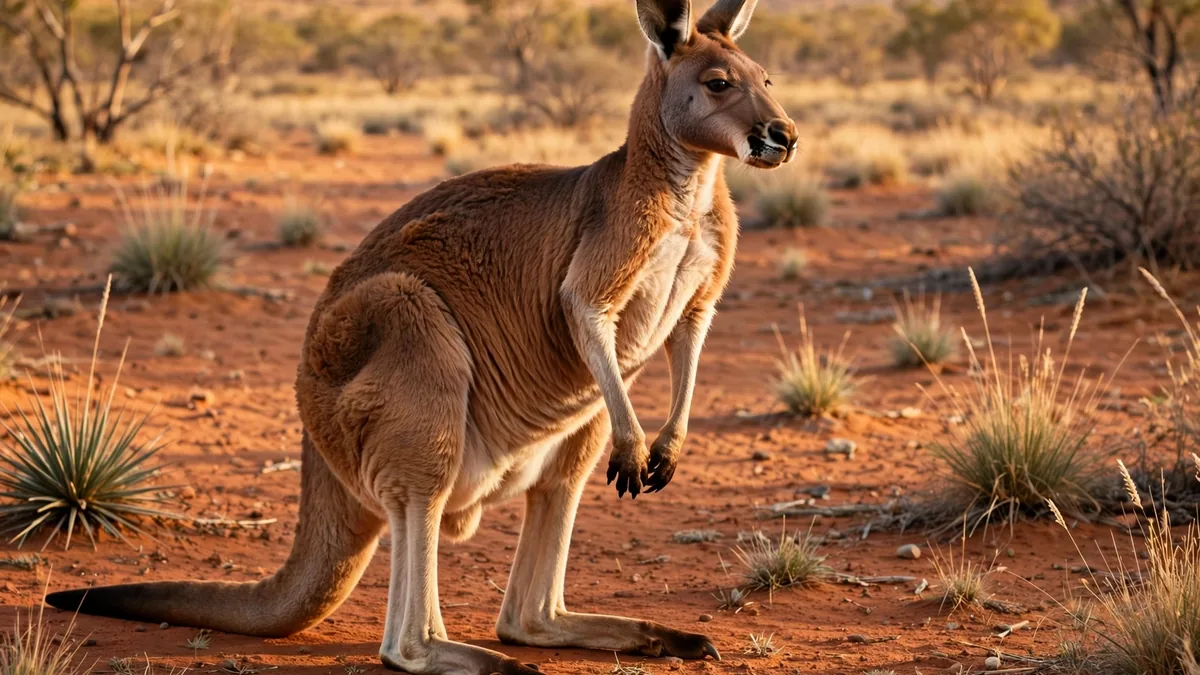
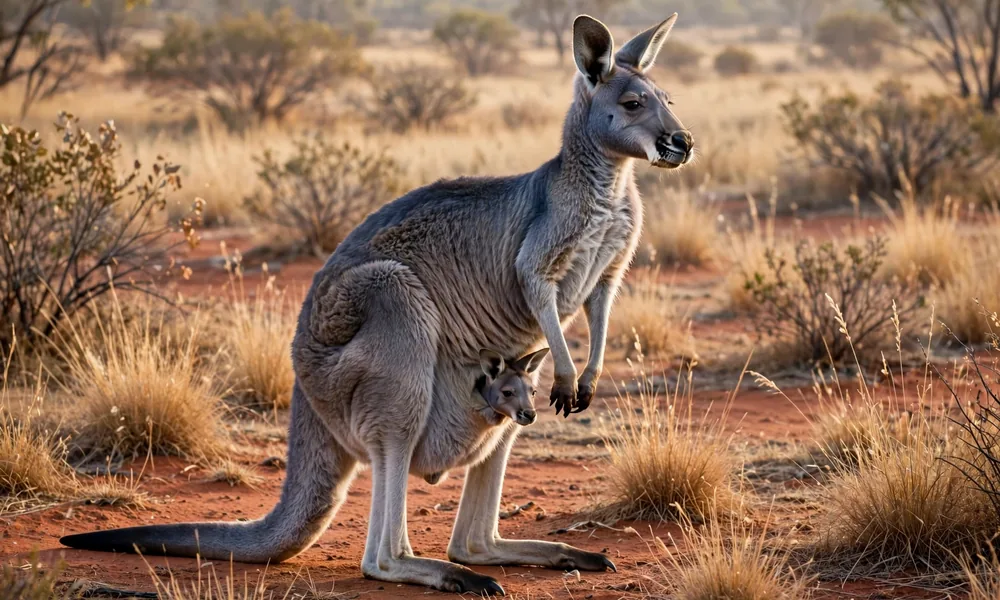
A big male red kangaroo stands taller than most people, up to about two metres, with rust-red fur, long pointed ears and powerful hind legs. Females are smaller and blue-grey, and a newborn joey is smaller than a cherry.
Key takeaways
- There is one red kangaroo species, Osphranter rufus, formerly placed in the genus Macropus, and it is the largest living marsupial.
- A male is about 1.3 to 1.6 metres long, with a tail of up to 1.2 metres, and weighs roughly 55 to 90 kilograms, while females weigh about 18 to 40 kilograms.
- Red kangaroos hop at more than 35 miles an hour and cover up to 25 feet in a single leap.
- They live in the arid and semi-arid grasslands, shrublands and deserts of inland Australia, gathering in loose groups called mobs.
- The species is listed as Least Concern, with millions of animals, though numbers swing sharply with rain and drought.
What makes a red kangaroo a red kangaroo
A red kangaroo is easy to recognise once you know what to look for. The male has short red-brown fur that fades to pale buff underneath, a square muzzle with black and white markings on the face, and long pointed ears. The female is smaller and blue-grey with a brown tinge. Both sexes have a long muscular tail, small forearms, and hind legs built like springs.
The red kangaroo is the biggest of all the kangaroos, and the biggest marsupial alive today. An average animal stands about 1.5 metres tall, and the largest confirmed male reached about 2.1 metres and 91 kilograms. Like the koala and the wombat, other Australian marsupials, it raises its young in a pouch, but the red kangaroo lives in the open desert and moves by hopping.
The red kangaroo species and its relatives
The red kangaroo belongs to Osphranter, a genus of four species that includes the wallaroos as well as the red kangaroo. For many years it was known as Macropus rufus, and that is still the name on the National Geographic profile, but genetic work led to the red kangaroo, the wallaroos and the antilopine kangaroo being moved into Osphranter. The grey kangaroos stayed in Macropus.
All four of the great kangaroos belong to the family Macropodidae, the big-footed marsupials. The red kangaroo is the largest of them all, larger than its grey cousins, the eastern and western grey kangaroos, while the antilopine kangaroo of the tropical north is the smallest of the four. The common wallaroo, or euro, lives in rocky country across much of Australia.
| Type | Animal | Where it lives | Best-known food | Length or Weight |
|---|---|---|---|---|
| Genus | Wallaroos and red kangaroo (genus Osphranter) | Australia | Grasses and shrubs | About 18 to 90 kg |
| Species | Red kangaroo (Osphranter rufus) | Arid inland Australia | Grasses and forbs | Males about 55 to 90 kg |
| Species | Eastern grey kangaroo (Macropus giganteus) | Eastern Australia and Tasmania | Grasses | Males up to about 66 kg |
| Species | Western grey kangaroo (Macropus fuliginosus) | Southern Australia | Grasses and shrubs | Males up to about 54 kg |
| Species | Common wallaroo (Osphranter robustus) | Rocky country across Australia | Grasses and shrubs | Males up to about 47 kg |
| Species | Antilopine kangaroo (Osphranter antilopinus) | Tropical northern Australia | Grasses | Males about 30 to 49 kg |
How red kangaroos live
Red kangaroos are herbivores and selective grazers. Green grass makes up most of the diet, with forbs and young shoots, and in dry times they turn to saltbush and other shrubs. In central Australia, green grass made up 75 to 95 per cent of what they ate. They can survive for months without drinking standing water, taking what they need from the plants they eat, and they feed mostly at dawn and dusk.
Hopping is the red kangaroo’s great trick. Its legs work like a rubber band: the Achilles tendon stretches as the animal lands and releases its energy to throw it forward again, so hopping gets more efficient the faster the animal goes. A red kangaroo can reach speeds of over 35 miles an hour, and a big male can cover up to 25 feet in one leap and jump up to 3 metres high. At slow speeds it walks on all fours, using its tail as a fifth limb.
Red kangaroos gather in loose groups called mobs, usually of two to ten animals, often a large male with several females and their young. Large males, known as boomers, sometimes fight over mates, leaning back on their sturdy tails and boxing with their hind legs. Females are smaller and faster than males.
Reproduction is built for the desert. After a pregnancy of only about 33 days, a female gives birth to a single joey about two centimetres long and weighing less than a gram, smaller than a cherry. The newborn climbs through its mother’s fur into her pouch and fastens onto a teat, where it stays for about 235 days before leaving the pouch for good, though it keeps suckling until it is about a year old. A female can pause the development of her next embryo, a trick called embryonic diapause, until her current joey has left the pouch. Red kangaroos have been recorded living to about 22 or 23 years in the wild, though most live far shorter lives.
Where red kangaroos live
Red kangaroos live across the arid and semi-arid interior of mainland Australia, in open grassy plains, shrublands and deserts, with scattered trees for shade. They avoid the wet far north, the far south-west and the east coast, and they are most common in the rangelands of western New South Wales, Queensland and South Australia. Clearing land and adding water points for livestock has helped them, and their range has grown.
The red kangaroo is listed as Least Concern on the IUCN Red List, after an assessment in 2015, and its numbers are stable overall, though they swing sharply with the weather. A 2017 estimate put the population at about 5.8 million, while later surveys counted more than 10 million in the harvest areas alone. They are commercially harvested for meat and skins, yet the population remains one of the largest of any big mammal on earth. Dingoes hunt adults, while foxes, feral cats and wedge-tailed eagles take joeys.
Best seasons for red kangaroo watching
The best time to watch red kangaroos is the cooler months, from about April to September, when the days are mild and the animals feed for longer. The best hours are the first light after dawn and the last light before dusk, when mobs come out of the shade to graze. After good rain the grass is green and the mobs gather in larger numbers.
Sturt National Park in New South Wales, the Flinders Ranges in South Australia and the country around Uluru are all good places to see red kangaroos. Look for them in open grassland near trees that give shade.
Staying safe around red kangaroos
A red kangaroo is a wild animal and should be watched from a distance, never approached or fed. A large male can be dangerous: it can stand taller than a person, kick with powerful hind legs, and slash with the sharp claw on its foot. Keep at least 25 metres away, use binoculars, and never try to touch a joey.
Feeding kangaroos teaches them to approach people, which puts both the animals and visitors at risk, and human food can make them ill. If one stands tall or thumps its foot, back away slowly and do not turn and run. Take extra care driving at dawn and dusk, when kangaroos cross roads in the half-light.
Red kangaroo watching checklist
A little preparation turns a drive through the outback into a real chance of seeing the world’s largest marsupial at close quarters.
- A visit to the outback of New South Wales, Queensland or South Australia.
- An early morning or late evening start, when mobs come out of the shade to graze in the open.
- Binoculars, because red kangaroos feed in wide open country and keep their distance from people.
- A camera with a zoom lens, for close views of a big red male without approaching the mob.
- Water, sun protection and a hat, because the outback is dry, hot and exposed.
- A slow, careful drive at dawn and dusk, when kangaroos cross the roads.
- A field guide to Australian mammals, for telling a red kangaroo from the grey kangaroos and wallaroos.
Frequently asked questions
How many red kangaroo species are there?
There is one red kangaroo species, Osphranter rufus, though it was long known as Macropus rufus, and that is still the name on the National Geographic profile. Genetic work moved it into the genus Osphranter, along with the wallaroos and the antilopine kangaroo.
How big is a red kangaroo?
A red kangaroo is the largest living marsupial. Males grow to a head and body length of 1.3 to 1.6 metres, with a tail adding up to 1.2 metres, and weigh about 55 to 90 kilograms. Females are much smaller, at 85 to 105 centimetres long and 18 to 40 kilograms.
How fast can a red kangaroo hop?
A red kangaroo can reach speeds of over 35 miles an hour, and a big male can cover up to 25 feet in one leap and jump up to 3 metres high. Its legs store energy as it lands and release it as it bounds forward.
What does a red kangaroo eat?
Red kangaroos are herbivores that eat mainly green grasses and forbs, with saltbush and other shrubs in dry times. They can go for months without drinking standing water, getting what they need from the plants they eat.
How is this guide different from the pronghorn guide?
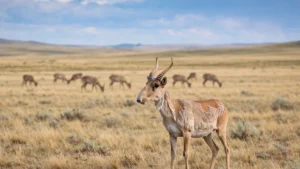
This guide covers the red kangaroo, one species of hopping marsupial that lives in the deserts of inland Australia and raises its joey in a pouch, while our pronghorn species guide covers the pronghorn, a fast-running hoofed mammal of the open plains of western North America that eats sagebrush and prairie plants. Red kangaroos hop across red sand in mobs, and pronghorns race across grassland in herds.
Are red kangaroos endangered?
No. The red kangaroo is listed as Least Concern on the IUCN Red List, with millions of animals and a stable population overall. Numbers swing sharply with rain and drought, and the animals are commercially harvested for meat and skins, yet they remain one of the most abundant large mammals in Australia.
Conclusion
The red kangaroo species is a desert masterpiece: Osphranter rufus, the largest marsupial alive, a grazer that turns dry grass into speed, a mother that carries her cherry-sized baby in a pouch. Millions of them hop across the red centre.
If you go looking for one, go at dawn, go after rain, and look for movement in the open grass. Watch a mob bounding away in great leaps, and you will see why this animal has become the emblem of the outback.