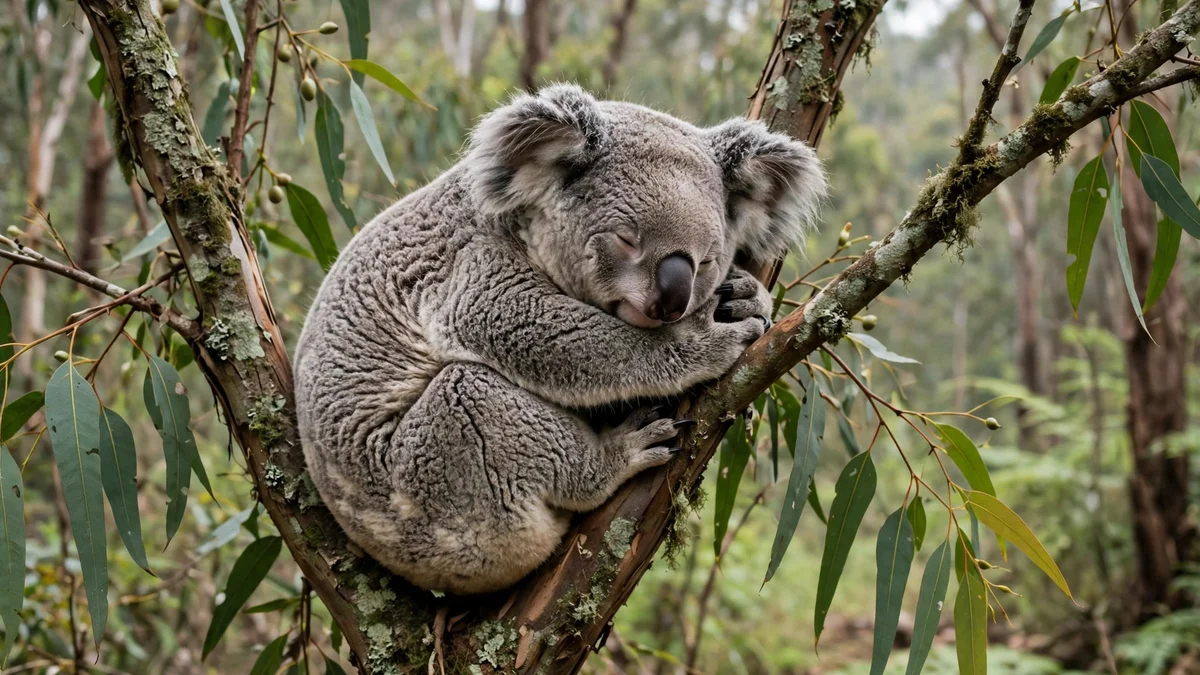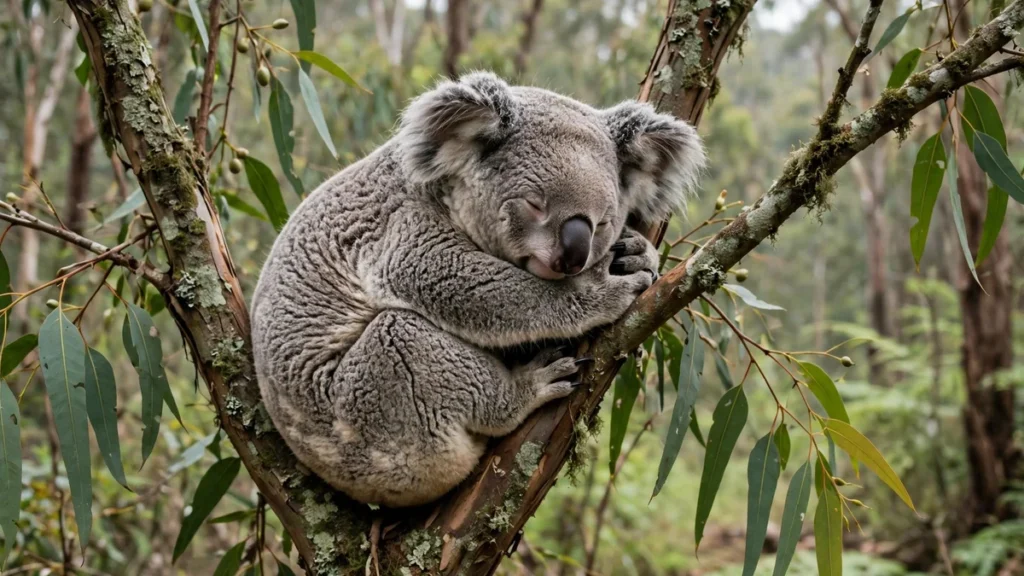
Koala species are a short list, because there is only one koala species in the world: Phascolarctos cinereus, the grey, tree-dwelling marsupial of eastern Australia. If you are wondering how many koala species there are, the answer is one, and that single species is not a bear at all, even though it is often called a koala bear. The koala spends most of its life high in a eucalyptus tree, eating almost nothing but eucalyptus leaves and sleeping for up to 20 hours a day.
Key takeaways
- There is only one koala species, Phascolarctos cinereus, and it lives in the eucalyptus forests of eastern Australia.
- Koalas are marsupials, not bears, and they are close relatives of wombats, kangaroos and possums.
- Koalas eat almost only eucalyptus leaves, which are low in energy and poisonous to most other animals.
- Koalas sleep for up to 20 hours a day, because their leaf diet gives them very little energy.
- Koala joeys eat pap, a soft food from the mother, before eating leaves, and koalas are endangered in parts of eastern Australia.
What makes a koala a koala
A koala is a stocky, grey marsupial built for life in the trees. It is about 60 to 85 centimetres long, with a large head, a big black nose and large fluffy ears. Its strong arms and sharp claws help it grip branches, and it rarely comes down to the ground.
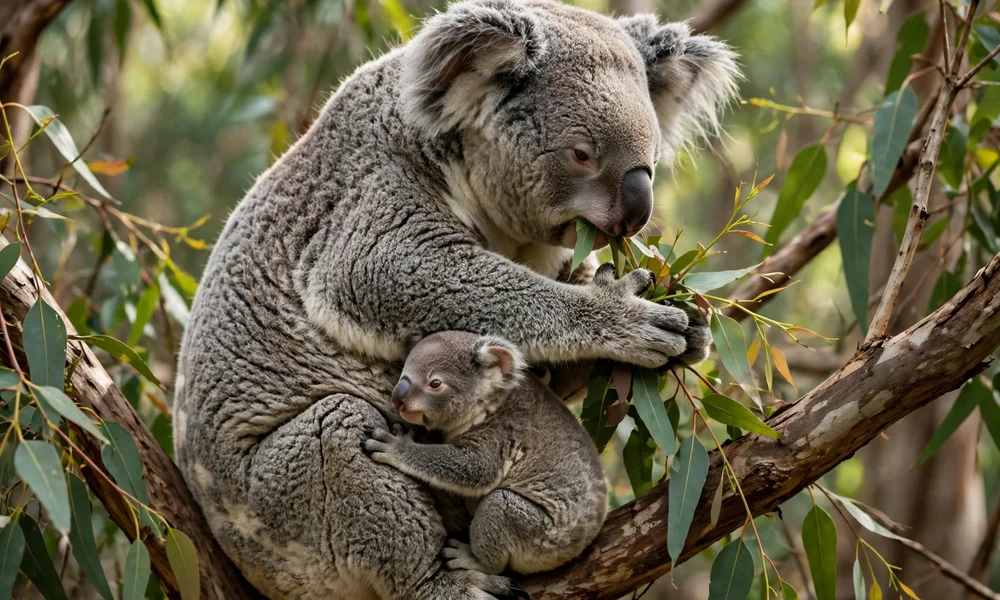
Koalas are marsupials, which means their young are born tiny and finish growing in the mother’s pouch. A newborn joey is about the size of a jelly bean, blind and hairless, and it crawls into the pouch, where it stays for about six months. The pouch opens towards the back, and when the joey is ready it rides on its mother’s back.
The koala’s body is shaped by its food. Eucalyptus leaves are tough, low in energy and full of oils that are poisonous to most animals. A koala has a very large liver that breaks down those toxins and a long gut that ferments the leaves slowly. A koala gets most of its water from the leaves, so it rarely drinks.
The one koala species
There is only one koala species, Phascolarctos cinereus, in its own family, Phascolarctidae. Northern koalas tend to be smaller and paler than southern ones, but these are differences within one species.
Koalas are not bears, even though their round ears, stout body and soft grey fur make them look bear-like at first glance. Bears are placental mammals, while koalas are marsupials, and the two groups have been separate for more than 100 million years. The name koala bear is only a nickname from the early days of European settlement.
The koala’s closest relatives
The wombat is the koala’s closest living relative, a sturdy marsupial that lives on the ground in southern and eastern Australia. Wombats dig long burrows with strong claws, eat grasses, roots and bark, and carry their young in a backward-opening pouch, just like a koala.
The red kangaroo is a much larger and more distant cousin, the biggest marsupial in the world. Red kangaroos hop across the dry plains of inland Australia on powerful hind legs, grazing on grasses and shrubs, while koalas sit still in trees eating leaves.
The Tasmanian devil is another marsupial cousin, a stocky, black-furred scavenger that lives only on the island of Tasmania. It has a powerful bite and a loud screech, and it is active mainly at night.
The quokka is a small marsupial about the size of a cat, best known from Rottnest Island off Western Australia, where it is famous for its friendly face. Quokkas eat leaves, grasses and stems, live in family groups and carry their young in a pouch.
The common brushtail possum is a tree-dwelling marsupial that shares the koala’s forests and sometimes even its trees. It is about the size of a cat, with a bushy tail it uses for balance and a taste for leaves, flowers, fruit and bark. It eats a far wider range of foods than koalas.
The sugar glider is a tiny gliding possum, about the size of a mouse, with a flap of skin between its front and back legs that lets it glide from tree to tree. It eats nectar, sap, insects and gum, lives in family groups in tree hollows, and is active at night.
The ringtail possum is another tree-dwelling cousin, smaller than a koala, with a long tail that curls into a ring and grips branches like a fifth hand. Ringtail possums live in family groups, build nests called dreys from leaves and bark, and eat leaves, flowers and fruit.
How koalas live: leaves, sleep and joeys
A koala eats almost only eucalyptus leaves, and it is fussy about which ones it chooses. The leaves are low in protein and high in fibre, so a koala eats slowly, chewing each leaf carefully, while its liver and long gut work hard to break the toxins down.
Sleep is the koala’s answer to a low-energy diet. A koala sleeps for up to 20 hours a day, curled in the fork of a tree or wedged between branches, and it is most active at night, when it moves between trees, feeds and calls to other koalas. Koalas are among the nocturnal animals of Australia, feeding and moving mainly after dark and resting through the heat of the day.
Koala joeys have a remarkable first food. After about six months in the pouch, a joey begins to eat pap, a special soft food that the mother produces from her own digestive system. Pap is rich in the bacteria a joey needs to digest eucalyptus leaves, and the joey eats it for a few weeks before it can eat leaves on its own. After pap, the joey starts to nibble leaves, leaves the pouch at about seven months, and rides on its mother’s back until it is about a year old.
Where koalas live
Koalas live only in eastern Australia, in the eucalyptus forests and woodlands that stretch from north Queensland down through New South Wales and Victoria into south-eastern South Australia. They need forests with the right kinds of eucalyptus trees, and they live in home ranges that can cover several hectares, with a few favourite trees where they feed and sleep.
Koalas are endangered in parts of eastern Australia, in Queensland, New South Wales and the Australian Capital Territory. The main threats are the loss of eucalyptus forest to housing, roads and farming, bushfires, drought, disease, and attacks by dogs, and cars on roads that cut through their forests. Conservation work now focuses on protecting eucalyptus forests, planting corridors of trees so koalas can move safely, and treating sick koalas in wildlife hospitals. The forest animals of eastern Australia depend on the same woodlands.
| Animal | Type | Where it lives | Best-known food |
|---|---|---|---|
| Koala | Species | Eucalyptus forests of eastern Australia | Eucalyptus leaves |
| Wombat | Close relative | Southern and eastern Australia | Grasses, roots and bark |
| Red kangaroo | Close relative | Dry plains of inland Australia | Grasses and shrubs |
| Tasmanian devil | Close relative | Tasmania only | Carrion and small animals |
| Quokka | Close relative | Rottnest Island and south-western Australia | Leaves, grasses and stems |
| Common brushtail possum | Close relative | Forests and towns across Australia | Leaves, flowers, fruit and bark |
| Sugar glider | Close relative | Forests of eastern and northern Australia | Nectar, sap and insects |
| Ringtail possum | Close relative | Forests of eastern Australia | Leaves, flowers and fruit |
Best seasons for koala watching
Autumn and winter are the best seasons for koala watching in eastern Australia, from about April to September, when the weather is cooler and koalas are more active during the day. In the cooler months, koalas move between trees more often and spend less time curled up asleep in the heat.
Summer is the hardest season for koala watching, because the heat sends koalas deep into the shade, where they curl up and sleep for most of the day. If you go in summer, watch in the early morning or late afternoon, when the air is cooler and koalas may stir to feed.
Staying safe around koalas
Koalas are wild animals, and they deserve respect and distance. Never try to pick up a koala, never climb a tree to reach one, and never corner a koala on the ground, because a frightened koala has sharp claws and teeth and can scratch or bite. Keep a sensible distance, using binoculars to watch up close.
If you find a koala on the ground, sick or injured, do not handle it yourself. Call a local wildlife rescue group or a wildlife hospital, and watch from a distance until help arrives. Koalas on the ground are at risk from dogs and cars, so keep dogs away and slow down on roads through eucalyptus forest, especially at night. Never feed a koala, because human food can harm it.
Koala watching checklist
- Look up into the forks of eucalyptus trees for a grey ball of fur, ears first.
- Watch in the early morning or late afternoon, and in the cooler months from April to September.
- Listen at night for the deep bellow of a male koala.
- Use binoculars to watch from a distance, and never climb a tree to reach a koala.
- Keep dogs on a lead, do not feed koalas, and do not touch a koala or a joey.
- Leave no trace: take your rubbish home.
Frequently asked questions
How many koala species are there?
There is only one koala species, Phascolarctos cinereus. Koalas in the north tend to be smaller and paler, while koalas in the south tend to be larger with thicker fur, but these are differences within one species, not separate species.
How is this guide different from the kangaroo species guide?
This guide covers the koala, a single tree-dwelling marsupial species that eats eucalyptus leaves and sleeps up to 20 hours a day, while the kangaroo species guide covers hopping ground grazers that live on the open plains and eat grasses and shrubs.
Are koalas bears?
No, koalas are not bears. They are marsupials, close relatives of wombats, kangaroos and possums, while bears are placental mammals. The name koala bear is only a nickname from the early days of European settlement.
Why do koalas sleep so much?
Koalas sleep for up to 20 hours a day because eucalyptus leaves give them very little energy. The leaves are low in protein, high in fibre and full of toxins, so a koala saves energy by resting.
What is pap, and why do joeys eat it?
Pap is a special soft food that a mother koala produces from her own digestive system, and a joey eats it for a few weeks after leaving the pouch. Pap is rich in the bacteria a joey needs to digest eucalyptus leaves, so the joey can later digest leaves on its own.
Where is the best place to see a koala?
The best place to see a koala is a eucalyptus forest in eastern Australia in the cooler months, from April to September, in the early morning or late afternoon. Look up into the forks of eucalyptus trees for a grey ball of fur.
Conclusion
The koala species, the only one there is, is one of Australia’s most familiar animals, and one of its most unusual: a marsupial that took to the trees and spends up to 20 hours a day asleep in the branches.
The next step is to visit a eucalyptus forest in eastern Australia on a cool morning, look up into the trees for a grey ball of fur, and remember that the animal you are watching is the only koala species in the world, a marsupial, not a bear.