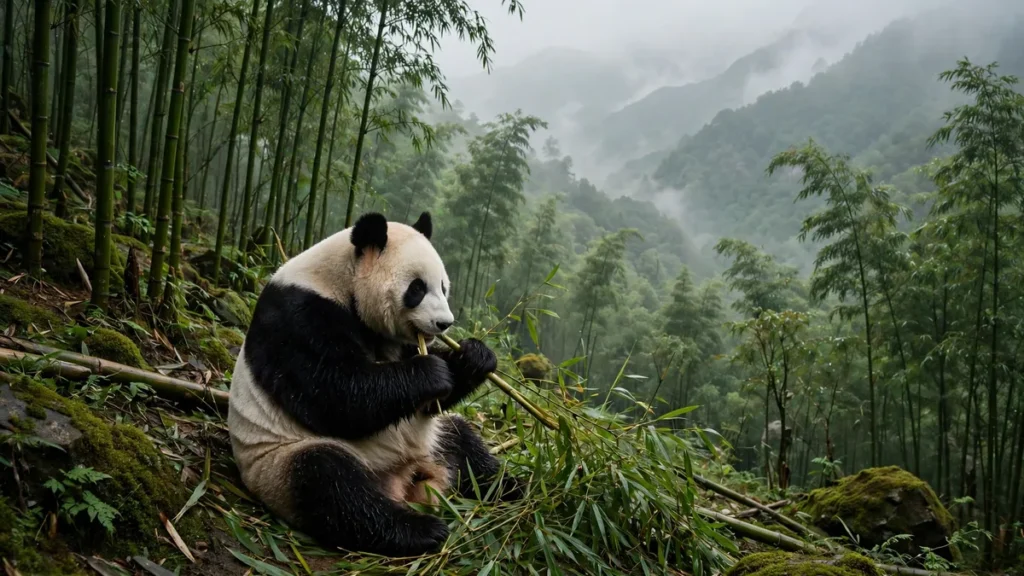
The giant panda species is a single species, Ailuropoda melanoleuca, a true bear of the misty mountains of central China that eats almost nothing but bamboo. If you are asking how many giant panda species there are, the answer is one: there is only one giant panda species in the world, and every giant panda alive today belongs to it.
The giant panda belongs to the bear family, Ursidae, and it is one of the most recognisable animals on Earth, with black ears, black eye patches, black shoulders and legs, and a white face and body.
Key takeaways
- There is only one giant panda species, Ailuropoda melanoleuca, and it is a true bear.
- Giant pandas eat almost nothing but bamboo, with bamboo making up about 99 percent of their diet.
- Wild giant pandas live only in the mountains of Sichuan, Shaanxi and Gansu in central China.
- About 1,864 giant pandas were counted in the wild in the 2014 national census, with more living in captivity.
- Giant pandas are listed as Vulnerable, after being downlisted from Endangered in 2016.
What makes a giant panda a giant panda
A giant panda is a large bear with a round head, small black ears, a short tail, and the famous black and white coat that makes it easy to recognise at a glance. Its body measures roughly 120 to 190 centimetres, with a tail about 10 to 15 centimetres long, and it usually weighs between 70 and 125 kilogrammes, with males slightly heavier than females.
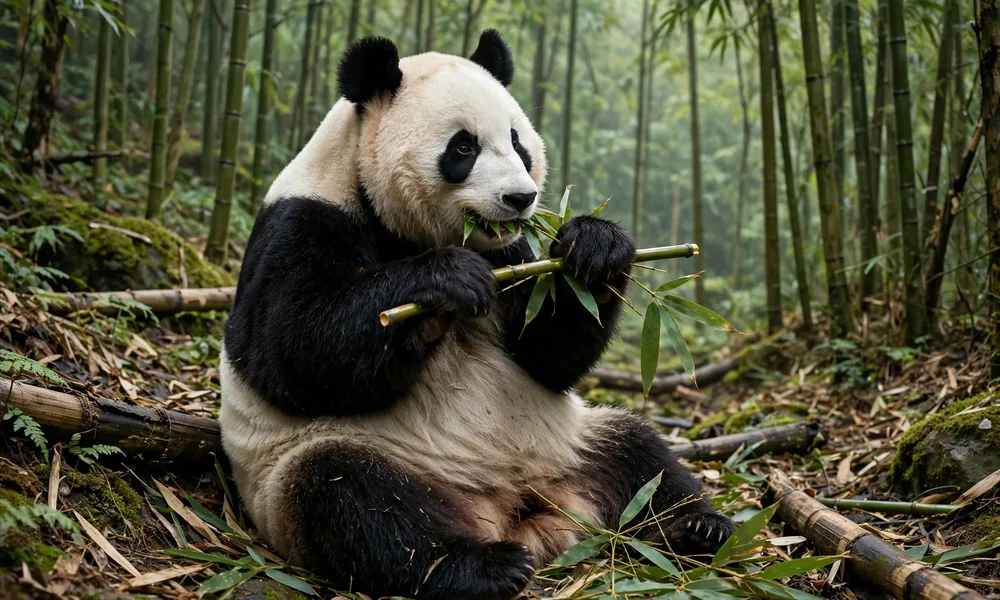
The false thumb defines the giant panda: an enlarged wrist bone that works like a thumb and lets the animal grip bamboo stems firmly while it strips the leaves. Its jaws are wide and strong, with large flat teeth for crushing tough bamboo, and its gut is still that of a meat eater, so it must eat a great deal of bamboo every day to get enough energy.
The giant panda species and its relatives
Ailuropoda melanoleuca is the only giant panda species, and it is not split into formally recognised subspecies. The Qinling panda, which lives in the Qinling Mountains of Shaanxi, is sometimes proposed as a separate subspecies, Ailuropoda melanoleuca qinlingensis, because it is smaller, with a browner coat and a smaller skull, but this is not accepted by all scientists, and it remains a proposal rather than a settled fact.
The spectacled bear of South America is the giant panda’s closest living relative, being the only other bear with a largely plant-based diet, while the American black bear and the brown bear are larger, more wide-ranging bears that eat a varied diet of plants and animals. The red panda is not a bear at all, but it shares the giant panda’s bamboo diet and its mountain forests, and the two animals are often confused by visitors.
| Type | Animal | Where it lives | Best-known food | Weight |
|---|---|---|---|---|
| Species | Giant panda (Ailuropoda melanoleuca) | Mountains of central China | Bamboo | 70 to 125 kg |
| Proposed subspecies | Qinling panda | Qinling Mountains, Shaanxi | Bamboo | Smaller than other pandas |
| Close relative | Spectacled bear | Andes Mountains, South America | Fruit, leaves and bromeliads | 100 to 200 kg |
| Close relative | American black bear | Forests of North America | Berries, nuts and insects | 60 to 300 kg |
| Close relative | Brown bear | North America, Europe and Asia | Berries, fish and roots | 100 to 700 kg |
| Close relative | Cave bear (extinct) | Europe and Asia in the Ice Age | Plants and roots | About 500 kg |
| Close relative | Red panda | Mountain forests of the Himalayas | Bamboo | 3 to 6 kg |
How giant pandas live
Giant pandas are creatures of the bamboo forest. A giant panda lives alone, holding a home range in the mountain forest that it marks with scent and shares only loosely with other pandas, and the males and females come together only briefly to mate. Like other forest animals, the panda spends much of its life among the trees, climbing well and resting in hollow trees and rock crevices.
Bamboo makes up almost the whole diet, and the panda eats the leaves, stems and shoots of several bamboo species, choosing the parts that are softest and most nutritious at each season. It also eats a little grass, wild fruit and small animals from time to time, but these make up only a tiny share of what it eats. Because bamboo is low in energy, the panda must eat almost constantly and rest between meals to save energy.
Breeding happens in spring, and after a gestation of about 95 to 160 days the female gives birth to one or two cubs in a den, usually in a hollow tree or a cave. The cubs are born tiny and pink, weighing only about 100 grammes, and they stay with their mother for about 18 months. Giant pandas live for around 15 to 20 years in the wild, and more than 30 years in captivity.
Where giant pandas live
The giant panda’s range is now small, limited to the mountain forests of Sichuan, Shaanxi and Gansu in central China, where bamboo grows thickly on the slopes between about 1,200 and 3,100 metres above sea level. It lives in cool, damp mountain forest with dense bamboo undergrowth, and it needs large areas of unbroken forest to find enough bamboo through the year. It is one of the characteristic Asian animals of China, most common in the reserves of Sichuan, where the bamboo forests are largest.
Cool mountain forest is the key requirement. A giant panda needs bamboo in every season, so it moves up and down the slopes as different bamboo species come into leaf and shoot. It depends on the forest staying connected, like the Asian elephant, another large mammal of Asian forests that needs room to roam.
The species is listed as Vulnerable, and its numbers have risen slowly in recent years. The main pressure has been the loss of forest to farming and logging, which breaks the bamboo forest into small patches, while roads and settlements divide the remaining habitat. About 1,864 pandas were counted in the wild in the 2014 national census, and the population has grown since then, helped by a large network of reserves and a ban on logging in panda habitat.
Best seasons for giant panda watching
There is no closed season, because giant pandas are active all year in the mountains of China, but spring and autumn are usually the best times to look for them. The weather is mild, the bamboo shoots are fresh, and the pandas are at their most active. In Sichuan the best months are often March to May and September to November.
The summer has its own rewards: the forest is at its greenest, the bamboo is lush, and the cubs born in the summer are growing fast. Whichever season you choose, the best hours are the early morning and the late afternoon, when the pandas feed most actively.
Good places to try include the reserves around Chengdu, where the pandas are well protected, and the Wolong and Bifengxia reserves, where visitors can watch pandas in large enclosures that look like natural forest. Wild pandas are shy and hard to find, so a visit to a reserve gives the best chance of a good sighting.
Staying safe around giant pandas
A giant panda is a wild animal with strong jaws and sharp claws, and it can hurt a person, though pandas almost never attack people. Keep your distance, never enter a panda enclosure without a keeper, and never try to touch or feed a panda. If you meet a panda in the wild, stand still, stay quiet and back away slowly, and never run, because running can startle the animal.
Like other wild mammals, giant pandas can carry diseases, and any bite or scratch should be washed at once and checked by a doctor without delay. Admire from a distance. Avoid flash photography too, because a bright flash can startle a panda and disturb its feeding.
Giant panda watching checklist
A little preparation turns a reserve visit into a real chance of seeing a giant panda, so pack for cool mountain weather and early mornings.
- Binoculars with good low-light performance, for picking a panda out of the bamboo.
- A camera with a long lens, because pandas should always be watched from a distance.
- Warm layers and waterproof clothing, because the mountains are cool and damp all year.
- Water and snacks for long walks, because the best sightings come after hours of searching.
- A booked local guide who knows the reserves, the bamboo stands and the feeding grounds.
- A plan to be out in the early morning, when pandas are most active and the light is at its best.
- Patience and silence, because pandas are quiet animals and a noisy group will send them away.
Frequently asked questions
How many giant panda species are there?
There is one giant panda species, Ailuropoda melanoleuca. The Qinling panda is sometimes proposed as a subspecies, but it is not formally recognised by all scientists, and it is still the same species. No second giant panda species is recognised.
Why do giant pandas eat only bamboo?
Giant pandas eat almost only bamboo because they evolved from meat-eating bears but moved into bamboo forests, where bamboo was plentiful and few other animals competed for it.
What is a giant panda’s false thumb?
The false thumb is an enlarged wrist bone that works like a thumb, letting the panda grip bamboo stems firmly while it strips the leaves with its teeth. It is not a real thumb, but it does the same job, and it is one of the most famous features of the giant panda.
Can you keep a giant panda as a pet?
No. A giant panda is a wild animal that needs a huge area of bamboo forest, eats for most of the day, and can hurt a person with one bite. All giant pandas belong to China, and those in zoos outside China are on loan, under strict agreements, and are not pets.
How is this guide different from the red panda species guide?
This guide covers the single giant panda species, a true bear of the mountains of central China, while our red panda species guide covers the single red panda species, a small bamboo eater of the Himalayan forests. The giant panda is a bear weighing up to 125 kilogrammes, and the red panda is a much smaller animal weighing only 3 to 6 kilogrammes.
Are giant pandas endangered?
Giant pandas are listed as Vulnerable, so they are not classed as endangered, but they are still rare. About 1,864 were counted in the wild in the 2014 national census, with more in captivity, and numbers have risen since then. Protecting large areas of bamboo forest and keeping the reserves connected are the most important steps for keeping them healthy.
Conclusion
The giant panda species shows how much specialisation one animal can hold: Ailuropoda melanoleuca, with a false thumb for gripping bamboo, jaws built for crushing tough stems, and a life spent eating for most of the day in the cool mountain forests of central China.
If you go looking for one, go in spring or autumn, go with a guide, and go quietly. Watch a giant panda sitting in the bamboo, stripping leaves with its false thumb, and you will understand why it has earned its place as a symbol of wildlife conservation, and why keeping its bamboo forest whole matters most.