The red squirrel species is Sciurus vulgaris, a small russet squirrel of the forests of Eurasia, from Britain and Ireland to Siberia and the far east of Asia. If you are asking how many red squirrel species there are, the answer is one: there is only one red squirrel species in the world, and every red squirrel alive today belongs to it.
The red squirrel belongs to the squirrel family, Sciuridae, the same family as the grey squirrel, the fox squirrel and the flying squirrels, yet it is smaller and lighter than most of its cousins.
Key takeaways
- There is only one red squirrel species, Sciurus vulgaris, and it lives across Eurasia from Britain to Siberia.
- Red squirrels usually weigh between 250 and 350 grammes, and they eat seeds, nuts, fungi and buds.
- Red squirrels are declining in Britain and Ireland because of the introduced grey squirrel and squirrelpox.
- Red squirrels are still common across much of continental Europe, where grey squirrels are scarce or absent.
- Red squirrels are listed as Least Concern, because their range is so wide, even though they are rare in Britain.
What makes a red squirrel a red squirrel
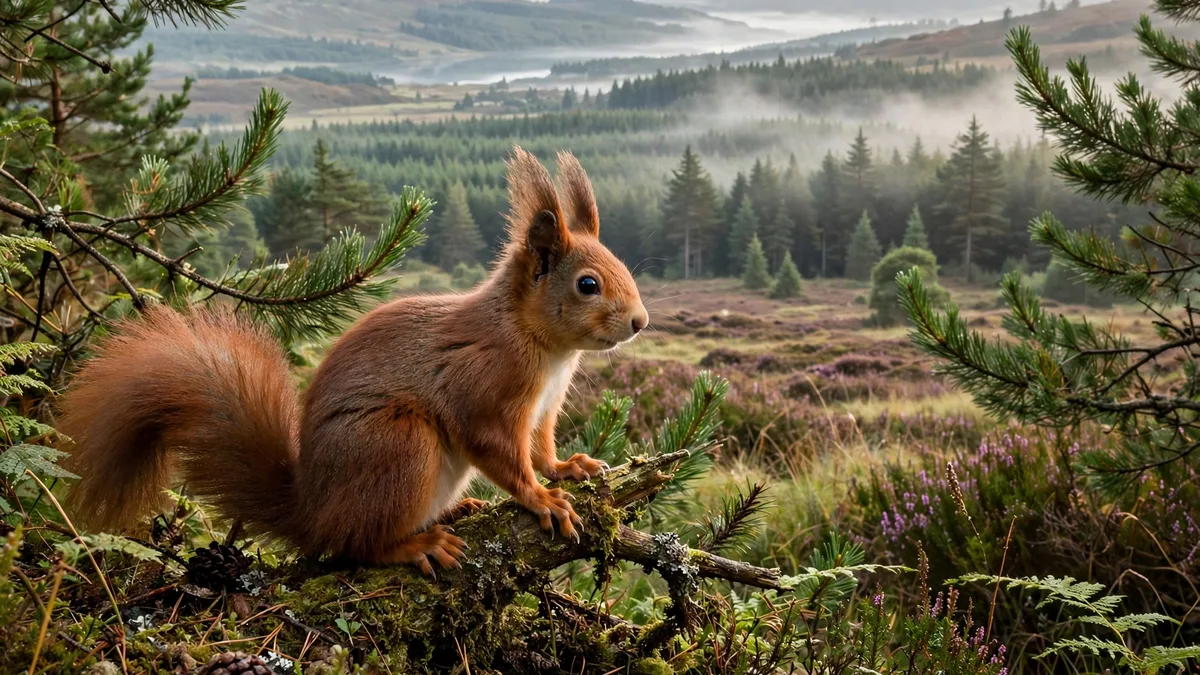
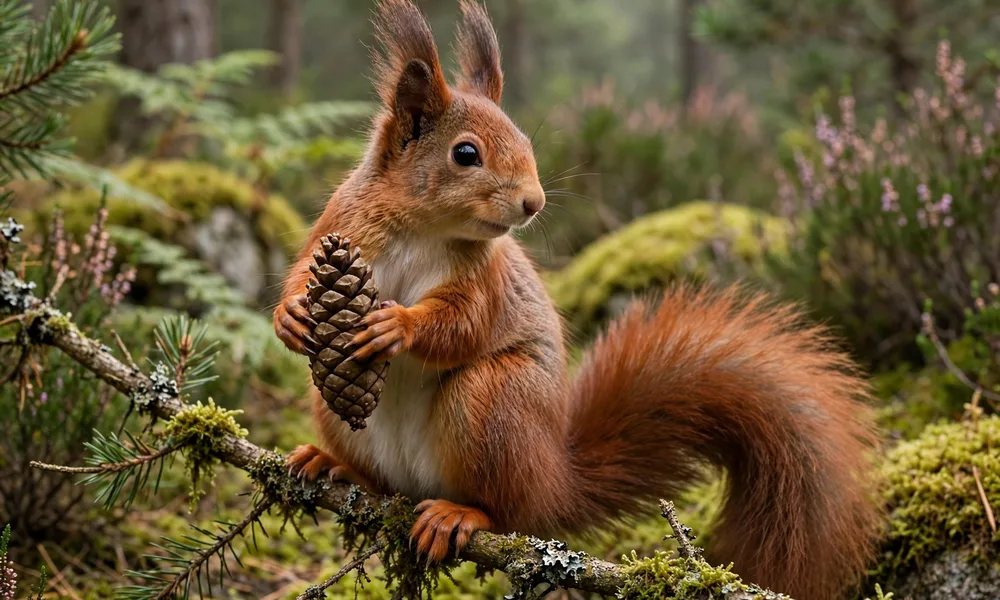
A red squirrel is a small, slender animal with a russet red coat, a pale belly, large tufted ears in winter, and a long bushy tail that is almost as long as its body. Its body measures roughly 19 to 23 centimetres, with a tail about 15 to 20 centimetres long again, and it usually weighs between 250 and 350 grammes.
The tail defines the red squirrel: a long, bushy tail that works as a balance when the animal leaps between branches, as a blanket when it sleeps curled up in its nest, and as a signal to other squirrels. Red squirrels are active by day, and they spend most of their time in the trees, coming to the ground only to search for food and to bury nuts.
The red squirrel species and its relatives
Sciurus vulgaris is the only red squirrel species, and it is not split into formally recognised subspecies in most modern accounts, although squirrels in different parts of its wide range vary a little in size and in the colour of their coats, from bright russet in the west to darker brown in the east. These differences are not enough to split it into separate species, and all red squirrels are the same species.
The grey squirrel is the red squirrel’s closest relative in Britain and Ireland, being a larger squirrel introduced from North America in the nineteenth century, but it is heavier, it outcompetes the red squirrel for food, and it carries squirrelpox, a disease that kills red squirrels but rarely harms grey squirrels. The fox squirrel of North America is larger still, while the Japanese squirrel and the Caucasian squirrel are close cousins in Asia and the Caucasus.
| Type | Animal | Where it lives | Best-known food | Weight |
|---|---|---|---|---|
| Species | Red squirrel (Sciurus vulgaris) | Forests of Eurasia, from Britain to Siberia | Seeds, nuts and fungi | 250 to 350 g |
| Close relative | Grey squirrel | North America, Britain and Ireland, Italy | Nuts, acorns and seeds | 400 to 650 g |
| Close relative | Fox squirrel | Forests of North America | Nuts, acorns and seeds | 500 to 1,000 g |
| Close relative | Douglas squirrel | Forests of western North America | Pine seeds and fungi | 150 to 300 g |
| Close relative | Japanese squirrel | Forests of Japan | Seeds, nuts and fungi | 250 to 310 g |
| Close relative | Caucasian squirrel | Forests of the Caucasus and Turkey | Seeds, nuts and buds | 200 to 400 g |
| Close relative | Siberian flying squirrel | Forests of northern Eurasia | Leaves, buds and catkins | 100 to 170 g |
How red squirrels live
Red squirrels are creatures of the trees. A red squirrel lives alone, holding a home range in the forest that it shares only loosely with other squirrels, and it sleeps in a nest called a drey, built of twigs and leaves high in a tree, or in a hole in a tree trunk. Like other forest animals, the red squirrel spends most of its life above the ground, leaping from branch to branch with its tail held high for balance.
Seeds and nuts make up most of the diet, and the squirrel eats pine seeds, hazelnuts, acorns, fungi and buds, choosing the food that is ripest at each season. It also eats bark, shoots and birds’ eggs from time to time, and it buries nuts in the autumn to eat in winter, when food is scarce.
Breeding happens in spring and again in summer, and after a gestation of about 38 to 39 days the female gives birth to three to four young in the drey. The young are born blind and helpless, and they stay in the drey for about seven weeks, learning to climb and to find food before they leave their mother. Red squirrels live for around three to five years in the wild, and more than 10 years in captivity.
Where red squirrels live
The red squirrel’s range covers the forests of Eurasia, from Britain and Ireland in the west to Siberia and the far east of Asia, and from Scandinavia in the north to the Mediterranean in the south. It lives in coniferous and mixed woodland, where there are pine, spruce, larch and hazel trees to feed on, and it needs large areas of unbroken forest to find enough food through the year. It is one of the characteristic Asian animals of the Siberian taiga, most common where the conifer forests are largest.
Conifer forest is the key requirement. A red squirrel needs trees that produce seeds in every season, so it moves through the forest as different trees come into seed, and it avoids farmland and busy roads.
The species is listed as Least Concern, but its numbers have fallen sharply in Britain and Ireland. The main pressure is the grey squirrel, introduced from North America in the nineteenth century, which is larger, outcompetes the red squirrel for food, and carries squirrelpox, a disease that kills red squirrels. Red squirrels are now rare in much of England and Wales, surviving mainly in Scotland, in parts of northern England, and on islands where grey squirrels have not arrived, while they remain common across continental Europe.
Best seasons for red squirrel watching
There is no closed season, because red squirrels are active all year in the forests of Eurasia, but autumn is usually the best time to look for them. The squirrels are busy gathering and burying nuts, the trees are losing their leaves, and the animals are easier to see against the branches. In Britain the best months are often September to November.
The spring has its own rewards: the young squirrels are leaving the drey, the forest is coming into leaf, and the squirrels are at their most active. Whichever season you choose, the best hours are the early morning and the late afternoon, when the squirrels feed most actively.
Good places to try include the pine forests of Scotland, where the red squirrels are well protected, and the woodlands of Northumberland, Cumbria and the Isle of Wight, where grey squirrels are scarce or absent. Conifer forests across continental Europe also give a good chance of a sighting, especially at dawn.
Staying safe around red squirrels
A red squirrel is a wild animal with sharp teeth and sharp claws, and it can bite if handled, though red squirrels almost never attack people. Keep your distance, never try to touch or pick up a squirrel, and never feed one by hand. If you meet a red squirrel in the woods, stand still, stay quiet and watch from a distance, and never chase it, because a frightened squirrel may fall from a tree and hurt itself.
Like other wild mammals, red squirrels can carry diseases, and any bite or scratch should be washed at once and checked by a doctor without delay. Admire from a distance. Avoid flash photography too, because a bright flash can startle a squirrel and disturb its feeding.
Red squirrel watching checklist
A little preparation turns a woodland walk into a real chance of seeing a red squirrel, so pack for cool forest weather and early mornings.
- Binoculars with good low-light performance, for picking a squirrel out of the branches.
- A camera with a long lens, because squirrels should always be watched from a distance.
- Warm layers and waterproof clothing, because the forest is cool and damp all year.
- Sturdy boots for muddy paths, because the best squirrel woods are found off the main tracks.
- A booked local guide who knows the dreys, the feeding trees and the squirrel trails.
- A plan to be out in the early morning, when squirrels are most active and the light is at its best.
- Patience and silence, because squirrels are shy animals and a noisy group will send them away.
Frequently asked questions
How many red squirrel species are there?
There is one red squirrel species, Sciurus vulgaris. It lives across Eurasia, from Britain to Siberia, and squirrels in different countries vary a little in size and colour, but they are all the same species. No second red squirrel species is recognised.
Why are red squirrels declining in Britain?
Red squirrels are declining in Britain because of the grey squirrel, introduced from North America in the nineteenth century. Grey squirrels are larger, they outcompete red squirrels for food, and they carry squirrelpox, a disease that kills red squirrels but rarely harms grey squirrels.
What is a drey?
A drey is the nest of a squirrel, built of twigs and leaves high in a tree, or in a hole in a tree trunk. The squirrel sleeps in its drey by night, raises its young there, and uses it as a safe place to rest between feeding trips, often building several dreys in its home range.
Can you keep a red squirrel as a pet?
No. A red squirrel is a wild animal that needs a large area of forest, climbs and leaps all day, and can bite hard if handled. Keeping one is illegal in many places, and many pet squirrels end up in rescue centres when they grow too strong and too restless to handle.
How is this guide different from the European otter species guide?
This guide covers the single red squirrel species, a small tree-dwelling animal of Eurasian forests, while our European otter species guide covers the single European otter species, a fish-eating swimmer of European rivers and coasts. The red squirrel lives in the trees and eats seeds and nuts, and the European otter lives in the water and hunts fish.
Are red squirrels endangered?
Red squirrels are listed as Least Concern, so they are not classed as endangered, because their range across Eurasia is so wide and they are still common on the continent. In Britain and Ireland, however, they are rare and declining, and protecting conifer forests and controlling grey squirrels are the most important steps for keeping them healthy there.
Conclusion
The red squirrel species shows how much specialisation one animal can hold: Sciurus vulgaris, with tufted ears, a long bushy tail for balance, sharp claws for climbing, and a life spent gathering seeds and nuts in the conifer forests of Eurasia.
If you go looking for one, go in autumn, go with a guide, and go quietly. Watch a red squirrel perched on a pine branch, stripping a cone with its small paws, and you will understand why it has earned its place as a symbol of British woodland, and why keeping its conifer forest whole matters most.