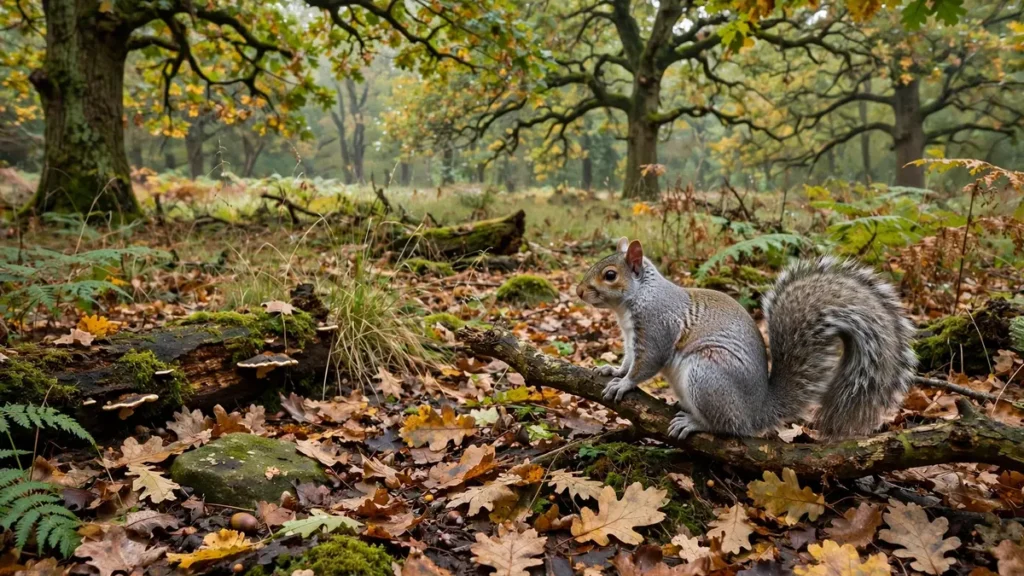
The grey squirrel species is a single species, Sciurus carolinensis, a bold tree squirrel of North America that is now one of the most familiar wild animals in the parks and gardens of Britain and Ireland. If you are asking how many grey squirrel species there are, the answer is one: there is only one grey squirrel species in the world, and every grey squirrel alive today belongs to it.
The grey squirrel belongs to the genus Sciurus, the same genus as the red squirrel and the fox squirrel, yet it lives very differently from its smaller red cousin. It is larger, bolder and far more at home around people, and it carries squirrelpox harmlessly to itself while the same virus is deadly to red squirrels, which is the main reason red squirrels have declined where greys have spread.
Key takeaways
- There is only one grey squirrel species, Sciurus carolinensis, with several recognised subspecies across North America.
- Grey squirrels are native to North America and were introduced to Britain, Ireland and Italy in the late nineteenth and early twentieth centuries.
- A grey squirrel weighs about 400 to 650 grammes, with a bushy tail that it uses for balance, warmth and signalling.
- Grey squirrels eat nuts, seeds, fungi, buds and bark, and they bury acorns and hazelnuts that they later dig up again.
- In its native range the grey squirrel is an ordinary, non-threatened species, but in Britain it has displaced the native red squirrel.
What makes a grey squirrel a grey squirrel
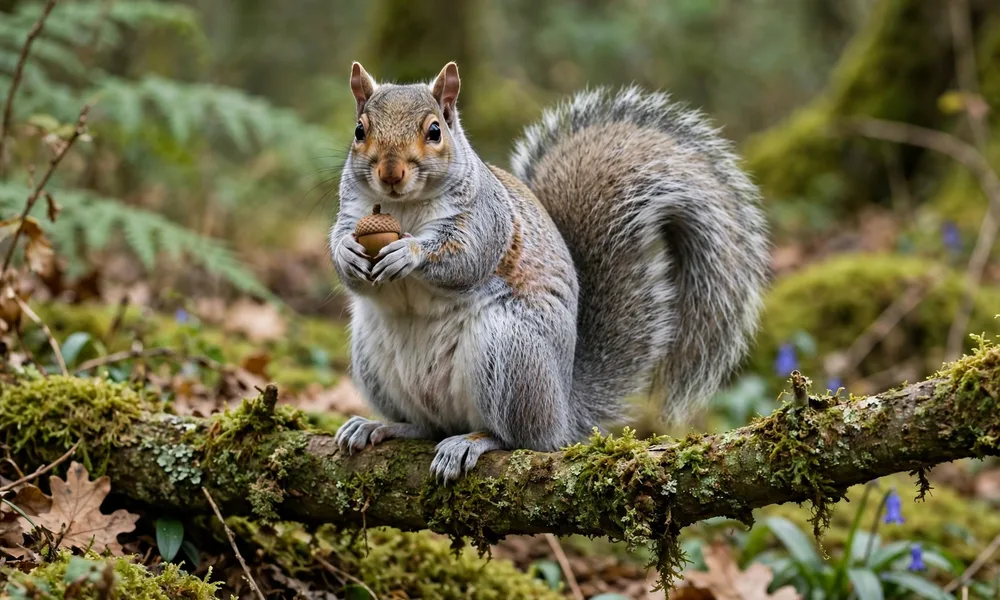
A grey squirrel is a medium-sized tree squirrel with a grey coat flecked with white and brown, a pale cream belly, large dark eyes and a very bushy tail that is almost as long as its body. Its body measures roughly 23 to 30 centimetres, with a tail about 20 to 25 centimetres long again, and it usually weighs between 400 and 650 grammes, with males slightly heavier than females in autumn.
The tail defines the grey squirrel: it flicks and waves it to warn other squirrels, wraps it around its body like a blanket in cold weather, and holds it over its back like a parasol in summer rain.
The grey squirrel species and its relatives
Sciurus carolinensis is the only grey squirrel species, and it is split into several recognised subspecies across its native range. Sciurus carolinensis carolinensis lives in the south-eastern United States, Sciurus carolinensis leucotis lives in the north-east, and other subspecies live further west and south, differing mainly in the shade of their coats and their size. All of them are the same species, and they interbreed freely where their ranges meet.
The red squirrel is the grey squirrel’s closest relative in Europe, being a smaller tree squirrel with ear tufts in winter and a chestnut coat, but it is shy and scarce where greys are common. The American red squirrel is a small, noisy squirrel of the northern conifer forests that chatters loudly at intruders.
| Type | Animal | Where it lives | Best-known food | Weight |
|---|---|---|---|---|
| Species | Grey squirrel (Sciurus carolinensis) | North America, Britain, Ireland and Italy | Acorns, hazelnuts and seeds | 400 to 650 g |
| Subspecies | Southern grey squirrel | South-eastern United States | Acorns and hickory nuts | 400 to 600 g |
| Subspecies | Northern grey squirrel | North-eastern United States and Canada | Acorns, maple seeds and buds | 450 to 650 g |
| Close relative | Red squirrel | Europe and northern Asia | Hazelnuts, pine seeds and fungi | 250 to 340 g |
| Close relative | Fox squirrel | Central and eastern North America | Acorns, walnuts and corn | 700 to 1,000 g |
| Close relative | American red squirrel | Canada and Alaska | Conifer seeds and fungi | 140 to 250 g |
| Close relative | Douglas squirrel | Western North America | Conifer seeds and fungi | 140 to 300 g |
How grey squirrels live
Grey squirrels are creatures of the treetops. A grey squirrel lives alone or in a loose group, holding a home range that it shares with other squirrels, and it builds a nest, called a drey, of twigs and leaves high in a fork of a tree. The drey is lined with moss and grass, and it shelters the squirrel from rain and cold. Grey squirrels are most active in the early morning and the late afternoon, resting at midday in hot weather.
Acorns, hazelnuts, beech mast, seeds, buds, bark and fungi make up most of the diet, and the grey squirrel buries hundreds of nuts in autumn, hiding each one in a separate hole and finding most of them again by smell in winter. Its predators include hawks, owls and foxes, and in North America the cougar will take a squirrel when it can catch one on the ground.
Breeding can happen twice a year, in late winter and in summer, and after a gestation of about 44 days the female gives birth to two to four young, called kits, in a drey or a tree hole. The kits are born blind and naked, and they stay in the nest for about ten weeks, then follow their mother to learn where the best nut trees grow. Grey squirrels live for around six years in the wild, and more than ten years in captivity.
Where grey squirrels live
The grey squirrel’s native range covers the broadleaf woodlands of eastern North America, from Canada south to the Gulf of Mexico, and it lives wherever there are oaks, hickories and other nut-bearing trees. It is one of the characteristic forest animals of the region, most common in mature deciduous woodland, in parkland and in leafy suburbs, where the nut trees are largest and the gardens offer easy food.
Outside its native range the grey squirrel is an introduced animal, and its story is a warning about moving wildlife. It was brought to Britain, Ireland and Italy in the late nineteenth and early twentieth centuries, and it spread quickly through the broadleaf woods, outcompeting the native red squirrel for food and carrying squirrelpox, a virus that is harmless to greys but kills reds. It is now the common squirrel across most of England and Wales, and it remains widespread across North American animals in its home range.
The species is listed as Least Concern, because its native population is large and stable, but its spread is a conservation problem in Britain and Ireland. The main pressure on red squirrels is the grey squirrel itself, which eats the same nuts and seeds, grows larger on the same food, and passes on squirrelpox where the two meet.
Best seasons for grey squirrel watching
There is no closed season, because grey squirrels are active all year, but autumn is usually the best time to look for them. The squirrels are busy burying nuts, the leaves are falling so they are easier to see, and the animals are at their fattest and boldest. In Britain the best weeks run from September to November, when the acorns and hazelnuts are ripe.
Spring has its own rewards: the kits are born, the squirrels are busy feeding and the woods are at their greenest. Whichever season you choose, the best hours are the first few after dawn and the hour before dusk.
Good places to try include the broadleaf woodlands of southern England and the oak woods of eastern North America.
Staying safe around grey squirrels
A grey squirrel is a wild animal with sharp teeth and strong claws, and it can bite if it is cornered or handled. Keep your distance, never try to pick one up, and never feed one by hand, because a squirrel that expects food can nip a finger. If you meet a grey squirrel on a path, stand still and let it pass, and never chase it, because a frightened squirrel may bite.
Like other wild mammals, grey squirrels can carry diseases, and any bite or scratch should be washed at once and checked by a doctor without delay. Admire from a distance.
Grey squirrel watching checklist
A little preparation turns a woodland walk into a real chance of seeing a grey squirrel, so pack for the trees, the mud and the early mornings.
- Binoculars with good low-light performance, for picking a squirrel out of the canopy.
- A camera with a long lens, because squirrels should always be watched from a distance.
- Light layers and waterproofs, because the woodland is cool at dawn and damp after rain.
- Water and snacks for long walks, because the best sightings come after hours of searching.
- A field guide to trees, so you can find the oaks and hazels where squirrels feed.
- A plan to be out at dawn, when squirrels are most active and the light is at its best.
- Patience and silence, because squirrels are shy animals and a noisy walker will send them away.
Frequently asked questions
How many grey squirrel species are there?
There is one grey squirrel species, Sciurus carolinensis. It is split into several recognised subspecies across North America, but they are all the same species. No second grey squirrel species is recognised.
Why are grey squirrels a problem in Britain?
Grey squirrels are a problem in Britain because they outcompete the native red squirrel for food and carry squirrelpox, a virus that is harmless to greys but kills reds. Grey squirrels are larger, bolder and better at digesting acorns, so where greys spread, reds usually disappear within a few years.
Do grey squirrels hibernate?
No. Grey squirrels do not hibernate, and they stay active through the winter, living on the nuts they buried in autumn.
Can you keep a grey squirrel as a pet?
No. A grey squirrel is a wild animal that needs a huge territory, stays awake by day, and can bite a person with one nip. Keeping one is illegal in many places, and many pet squirrels end up in rescue centres when they grow too wild to handle.
Are grey squirrels endangered?
No. Grey squirrels are listed as Least Concern, so they are not classed as endangered, and their native population in North America is large and stable. The conservation concern runs the other way: the grey squirrel is a threat to the native red squirrel in Britain and Ireland, where red squirrels are now scarce.
How is this guide different from the red squirrel species guide?
This guide covers the single grey squirrel species, a bold North American tree squirrel that was introduced to Britain and Ireland, while our red squirrel species guide covers the single red squirrel species, a smaller native squirrel of Europe and northern Asia. The grey squirrel is larger, bolder and common in parks and gardens, and the red squirrel is smaller, shyer and now scarce where greys have spread.
Conclusion
The grey squirrel species shows how much change one animal can bring: Sciurus carolinensis, with a bushy tail that works as a blanket and a parasol, a memory for thousands of buried nuts, and a life spent in the treetops of North America. It is an ordinary, non-threatened squirrel at home, and a newcomer that reshaped the woods of Britain and Ireland.
If you go looking for one, go at dawn, go quietly, and look up into the oaks.