The red panda species is a single species, Ailurus fulgens, the only living species in its family, a bamboo-eating climber of the Himalayas with a rust-red coat and a ringed tail. If you are asking how many red panda species there are, the answer is one in most authorities: there is only one red panda species recognised by most experts, and every red panda alive today belongs to it.
The red panda belongs to the family Ailuridae, a family with only one living species, and it is not a close relative of the giant panda at all. It is a small, tree-dwelling carnivore that eats almost only bamboo, and it climbs with a false thumb, an enlarged wrist bone that helps it grip the stems.
Key takeaways
- There is one red panda species, Ailurus fulgens, in most authorities, and it is the only living species in its family.
- Red pandas eat almost only bamboo, though they are classed as carnivores, and they use a false thumb to grip the stems.
- Red pandas live in the temperate forests of the Himalayas, in Nepal, India, Bhutan, Myanmar and China.
- Red pandas usually weigh between 3 and 6 kilogrammes and live alone in the trees.
- Red pandas are listed as Endangered, with about 10,000 left in the wild.
What makes a red panda a red panda
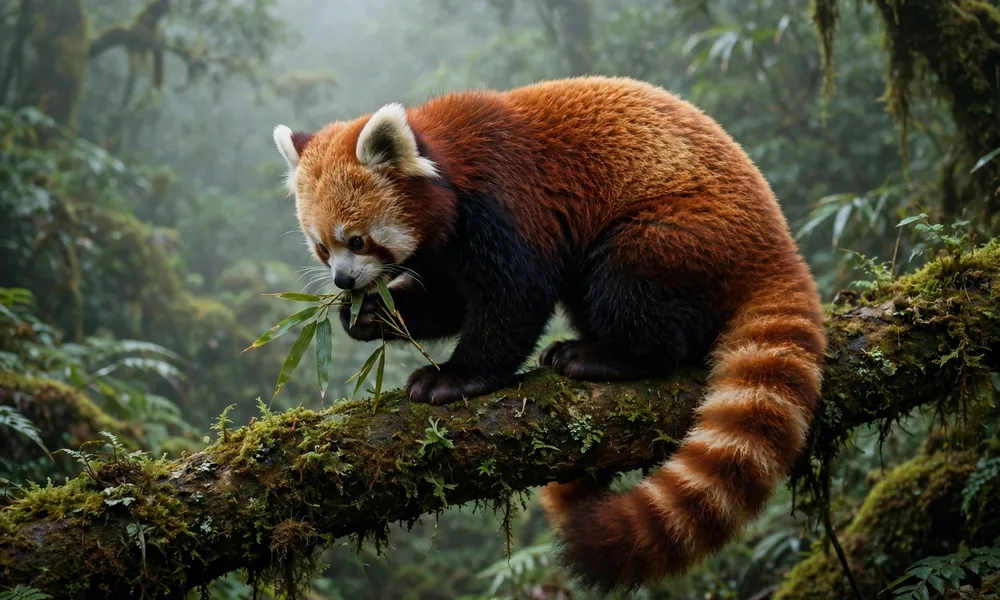
A red panda is a small, cat-sized animal with a rust-red coat, a pale face, dark ears, a white muzzle and a long, bushy tail ringed in red and white. Its body measures roughly 50 to 64 centimetres, with a tail about 28 to 59 centimetres long again, and it usually weighs between 3 and 6 kilogrammes.
The false thumb defines the red panda: an enlarged wrist bone that works like a thumb, letting it grip bamboo stems and climb trees with ease. Its thick coat keeps it warm in the cold mountain forests, and its bushy tail works as a blanket in winter and as a balance in the trees. Red pandas eat mainly bamboo, and they also eat fruit, roots, eggs and small animals, taking whatever the forest offers.
The red panda species and their relatives
Ailurus fulgens is the only red panda species in most authorities, and it is the only living species in the family Ailuridae. A 2020 genetic study proposed two species, the Himalayan red panda, Ailurus fulgens, and the Chinese red panda, Ailurus styani, and some authorities now recognise two, but most still treat the red panda as one species, and this guide follows that view.
The giant panda is the red panda’s best-known namesake, being a large bamboo eater of China, but it is a bear, not a close relative, and the two evolved their bamboo diet quite separately.
| Type | Animal | Where it lives | Best-known food | Length |
|---|---|---|---|---|
| Species | Red panda (Ailurus fulgens) | Himalayan forests of Nepal, India, Bhutan, Myanmar and China | Bamboo leaves and shoots | 50 to 64 cm body, tail 28 to 59 cm |
| Close relative | Himalayan red panda | Western Himalayas of Nepal, India and Bhutan | Bamboo leaves and shoots | 50 to 64 cm body |
| Close relative | Chinese red panda | Mountains of China and Myanmar | Bamboo leaves and shoots | 50 to 64 cm body |
| Close relative | Giant panda | Mountains of central China | Bamboo | 120 to 190 cm body |
| Close relative | Raccoon | Forests of North America | Fruit, nuts and small animals | 40 to 70 cm body |
| Close relative | Ringtail | Dry lands of North America | Rodents and fruit | 30 to 42 cm body |
| Close relative | Kinkajou | Forests of Central and South America | Fruit and nectar | 40 to 60 cm body |
How red pandas live
Red pandas are creatures of the trees. A red panda lives alone, holding a home range in the forest that it marks with scent, and it spends most of its life in the branches, sleeping curled up with its tail wrapped around its face. It is most active at dawn and dusk, feeding in the cool of the day and resting through the heat of the afternoon. Like other nocturnal animals, red pandas are not truly nocturnal, though they are most active in the low light of dawn and dusk.
Bamboo leaves and shoots make up most of the diet, about 98 per cent of what a red panda eats, and the animal spends many hours a day feeding, because bamboo is low in energy.
Breeding happens once a year, in the late winter, and after a gestation of about 90 to 145 days the female gives birth to one to four cubs in a hollow tree or a rock crevice. The cubs are born blind and helpless, and they stay in the nest for about three months, drinking milk that is very rich in fat. Red pandas live for around 8 to 10 years in the wild, and more than 15 years in captivity.
Where red pandas live
The red panda lives in the temperate forests of the Himalayas, in Nepal, India, Bhutan, northern Myanmar and south-western China. It lives in mountain forests with dense bamboo, at heights of 2,200 to 4,800 metres, wherever there is bamboo to eat and trees to climb. It is one of the characteristic forest animals of the Himalayas, most common in the cloud forests, where the bamboo is thickest.
Dense bamboo is the key requirement. A red panda needs bamboo to eat and trees to shelter in, so it avoids open ground and lowland forest, and it follows the bamboo as it grows through the seasons. It depends on the forest staying cool and damp, like many other Asian animals of the Himalayas.
The species is listed as Endangered, with about 10,000 left in the wild, and its numbers are falling. The main pressure is the loss of forest to farming and logging, which removes bamboo and breaks the forest into small pieces, while hunting and the pet trade add to the decline in some countries.
Best seasons for red panda watching
There is no closed season, because red pandas are active all year in the Himalayas, but the spring and autumn are usually the best times to look for them. The weather is clear, the forests are at their brightest, and the red pandas are easiest to find. In Nepal the best months run from March to May and from September to November.
The winter has its own rewards: the leaves are gone, the red pandas stand out against the bare branches, and the forests are quiet. Whichever season you choose, the best hours are the first few after dawn and the hour before dusk, when the red pandas feed in the trees.
Good places to try include the Singalila National Park in India and the forests of Ilam in Nepal, where local guides know the bamboo groves, and the cloud forests of Bhutan, where the red pandas are easiest to see against the misty trees.
Staying safe around red pandas
A red panda is a wild animal with sharp teeth and strong claws, and it can bite a person if it feels cornered, though it is far more likely to climb away. Keep your distance, never try to handle a wild red panda, and never feed one, because feeding can make it bold around people. If you meet a red panda in a tree, stand still, keep quiet and watch from a distance, and never chase it.
Like other wild mammals, red pandas can carry diseases, and any bite or scratch should be washed at once and checked by a doctor without delay. Admire from a distance. Avoid flash photography too, because a bright flash can startle a red panda and disturb its feeding.
Red panda watching checklist
A little preparation turns a forest walk into a real chance of seeing a red panda, so pack for the cold mornings, the mist and the steep paths.
- Binoculars with good low-light performance, for picking a red panda out of the bamboo.
- A camera with a long lens, because red pandas should always be watched from a distance.
- Warm layers and rain protection, because the mountains are cold by day and colder at dawn.
- Water and snacks for long walks, because the best sightings come after hours of searching.
- A booked local guide who knows the bamboo groves, the nests and the feeding trees.
- A plan to be out at dawn, when red pandas are most active and the light is at its best.
- Patience and silence, because red pandas are quiet animals and a noisy group will send them away.
Frequently asked questions
How many red panda species are there?
There is one red panda species, Ailurus fulgens, in most authorities. A 2020 genetic study proposed two species, the Himalayan red panda and the Chinese red panda, and some authorities now recognise two, but most still treat the red panda as one species. No population is classed as a separate species by most experts.
Is a red panda related to a giant panda?
No, not closely. The red panda and the giant panda share a name and a bamboo diet, but the giant panda is a bear, and the red panda is the only living species in its own family, Ailuridae. The two evolved their bamboo diet quite separately, and their false thumbs evolved separately too.
Why do red pandas eat bamboo?
Red pandas eat bamboo because it is plentiful in their mountain forests, even though they are classed as carnivores and their guts are not well suited to it. Bamboo is low in energy, so a red panda must eat a great deal of it, spending many hours a day feeding, and it also eats fruit, roots and eggs when it can find them.
Can you keep a red panda as a pet?
No. A red panda is a wild animal that needs a cool mountain forest, stays awake at dawn and dusk, and can bite a person with one bite. Keeping one is illegal in many places, and many pet red pandas end up in rescue centres when they grow too wild to handle. The pet trade is one of the threats to the species.
Are red pandas endangered?
Red pandas are listed as Endangered, with about 10,000 left in the wild, and their numbers are falling. The main threats are loss of forest, hunting and the pet trade, and protecting large areas of Himalayan forest is the most important step for keeping them healthy.
How is this guide different from the spotted hyena species guide?
This guide covers the single red panda species, a bamboo-eating climber of the Himalayas, while our spotted hyena species guide covers the spotted hyena, a matriarchal clan hunter of the African savanna. The red panda lives alone in the cool mountain forests and eats bamboo, and the spotted hyena lives in large clans and hunts in groups at night.
Conclusion
The red panda species shows how much specialisation one small animal can hold: Ailurus fulgens, with a rust-red coat, a ringed tail, a false thumb for gripping bamboo, and a life spent climbing in the misty forests of the Himalayas.
If you go looking for one, go at dawn, go with a guide, and go quietly. Watch a red panda feeding on bamboo in the trees and you will understand why it has earned its place as the firefox of the Himalayas, and why keeping its mountain forests standing matters most.