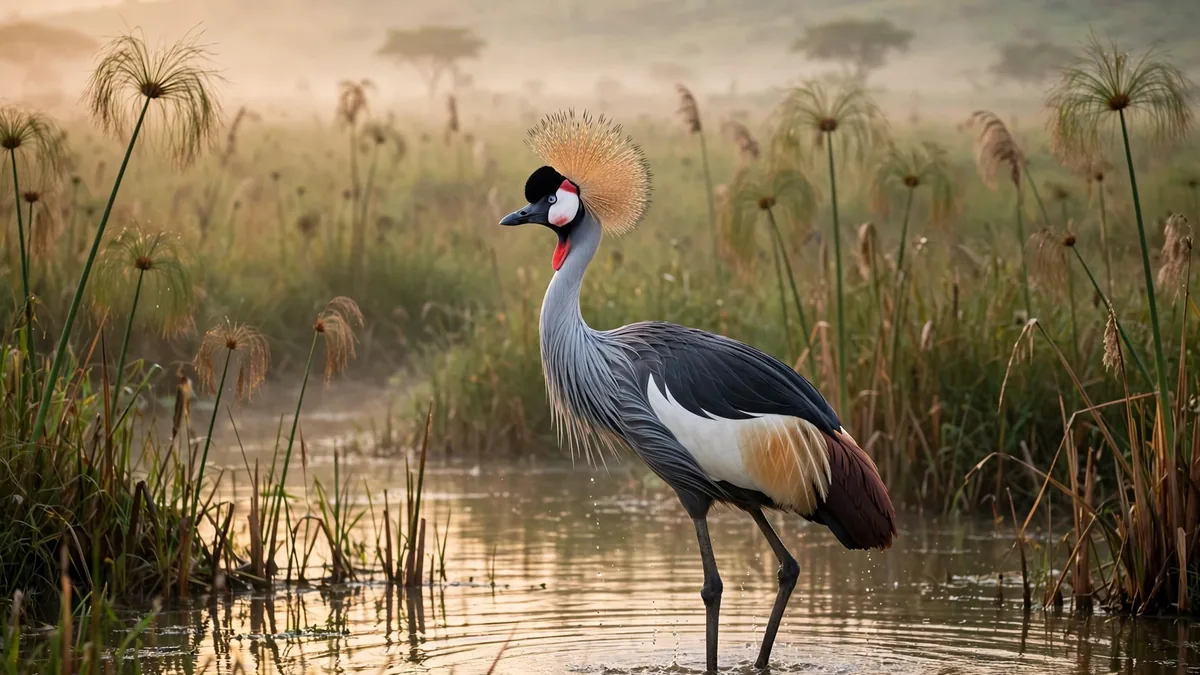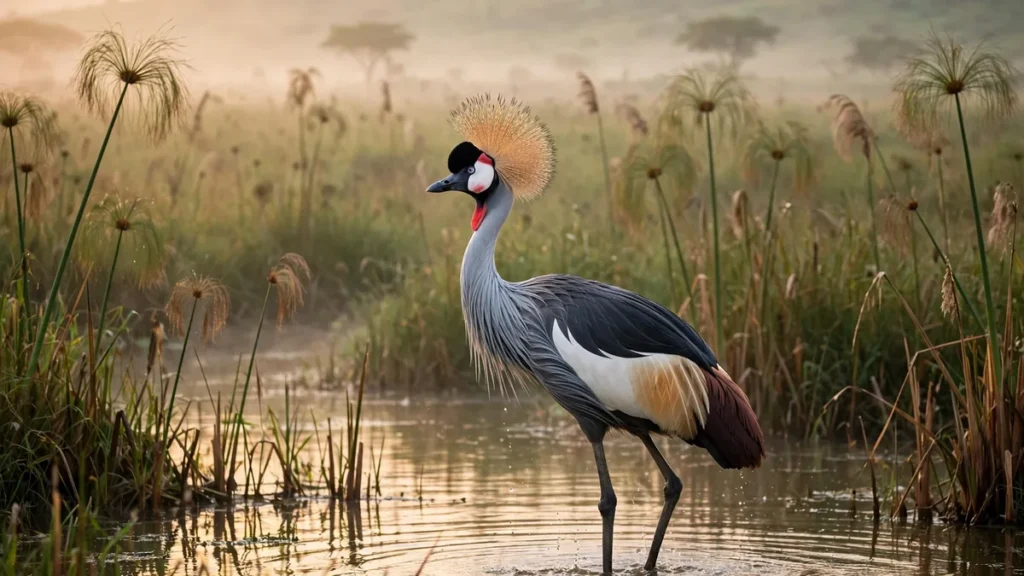
The grey crowned crane species is a single species, Balearica regulorum, a tall grey wetland bird of eastern and southern Africa famous for the stiff golden crown that fans out behind its head. If you are asking how many grey crowned crane species there are, the answer is one, and it is the national bird of Uganda, shown on the country’s flag and coat of arms.
The grey crowned crane stands about a metre tall on long dark legs, with a pale grey body, white wings touched with gold and brown, white cheeks and a red pouch under the chin. It is one of the most recognisable birds in Africa, and one of the most threatened: its numbers have fallen sharply as its breeding wetlands are drained, and it is now listed as Endangered.
Key takeaways
- There is one grey crowned crane species, Balearica regulorum, with two subspecies, East African and South African.
- An adult stands about 1 metre tall, weighs roughly 3 to 4 kilograms and has a wingspan of about 1.8 to 2 metres.
- Grey crowned cranes are omnivores, eating seeds, grain, insects, frogs, small fish and other small animals.
- The species is listed as Endangered, with about 26,500 to 33,500 birds left in the wild.
- It is the national bird of Uganda and, with the black crowned crane, one of only two cranes that can roost in trees.
What makes a grey crowned crane a grey crowned crane
A grey crowned crane is a large, long-legged bird with a body of soft grey plumage and wings that are mostly white, with dark grey and dark red feathers and a patch of gold. Its head is black and white, with a white cheek patch topped with red, a short grey bill and a small red pouch under the chin that it inflates when it calls. Behind the head rises the crown itself: a spray of stiff, bristle-like golden feathers that gives the bird its name.
The crane’s long legs end in a long hind toe, and that toe is the key to one of its most unusual habits. Grey crowned cranes can grip a branch and perch, and they regularly roost in trees overnight, something almost no other crane can do. Only its close relative, the black crowned crane, shares the trick.
The grey crowned crane species and their relatives
The grey crowned crane belongs to Balearica, a small genus of crowned cranes within the crane family Gruidae. There are two subspecies. The East African grey crowned crane, Balearica regulorum gibbericeps, ranges from the eastern Democratic Republic of the Congo, Uganda and Kenya south through Tanzania, Zambia, Malawi and Mozambique into eastern South Africa. The South African grey crowned crane, Balearica regulorum regulorum, lives from Angola and Namibia south to South Africa.
Its closest relative is the black crowned crane, Balearica pavonina, which lives further west and north across sub-Saharan Africa and has darker grey plumage and a paler crown. The two crowned cranes are the oldest branch of the crane family tree, and they differ from other cranes in their tree-roosting habit and in their shorter, more rounded wings. Like the secretary bird, another tall bird of the African savanna, the grey crowned crane walks open ground on long legs, but it always returns to water to roost and nest.
| Type | Animal | Where it lives | Best-known food | Length or Weight |
|---|---|---|---|---|
| Genus | Crowned cranes (genus Balearica) | Wetlands and savannas of sub-Saharan Africa | Seeds, insects and frogs | About 1 m tall |
| Species | Grey crowned crane (Balearica regulorum) | Eastern and southern Africa | Seeds, grain, insects and frogs | About 3 to 4 kg |
| Species | Black crowned crane (Balearica pavonina) | Western and central Africa | Insects, frogs and seeds | About 3 to 4 kg |
| Species | Blue crane (Anthropoides paradiseus) | Grasslands of South Africa | Seeds, insects and small animals | About 1 to 1.2 m tall |
| Species | Common crane (Grus grus) | Wetlands of Europe and Asia | Plants, grain and insects | Wingspan about 1.8 to 2.4 m |
| Species | Sarus crane (Antigone antigone) | Wetlands of India and South-East Asia | Plants, grain and small animals | Up to about 1.8 m tall |
How grey crowned cranes live
Grey crowned cranes are omnivores with a broad diet that changes with the season and the ground under their feet. In wetlands and shallow water they pick up insects, frogs, worms, small fish and the eggs of water animals, and on dry ground they eat grass seeds, grain, roots and other plant matter, often following the plough on farmland to gather seeds left behind after harvest.
Pairs are monogamous and appear to mate for life, holding a breeding territory that they defend together. Breeding is tied to the rains, and the pair builds a bulky platform nest of sedges and grasses in or beside a marsh, usually in water about half a metre to a metre deep and hidden in tall reeds. The female lays a clutch of two to five glossy, dirty-white eggs, and both parents take turns incubating them for about 28 to 31 days.
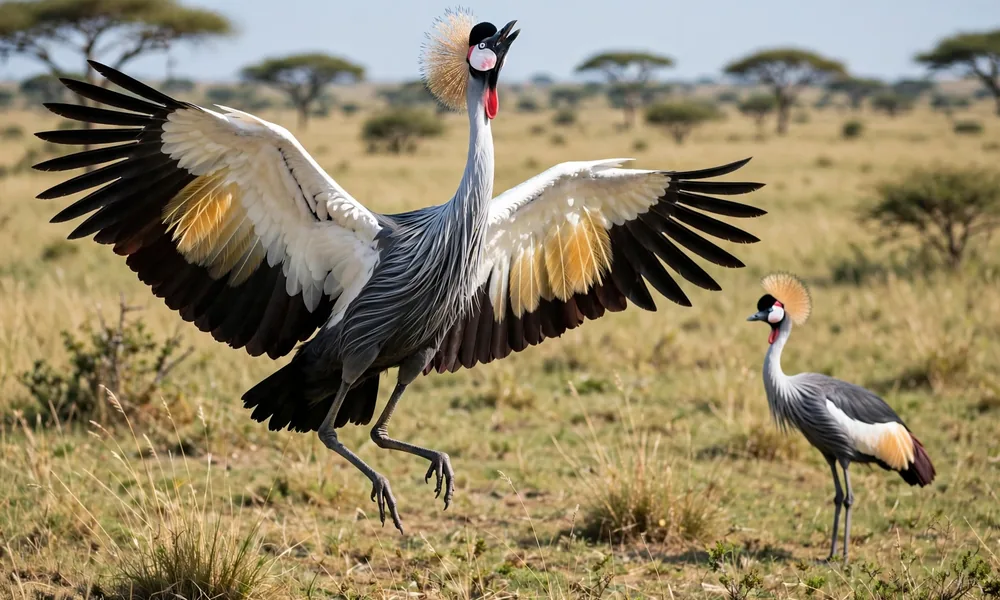
The dancing of the grey crowned crane is one of the great sights of the African savanna. Pairs dance together at any time of year, bowing, jumping into the air with wings spread, tossing grass and running in short bursts, and the display strengthens the bond between the two birds. Outside the breeding season, cranes gather in flocks that can number in the dozens, feeding together in open grassland and returning to the same roosting trees or shallow water each evening. Grey crowned cranes can live for about 22 years in the wild and up to about 25 years in captivity.
Where grey crowned cranes live
Grey crowned cranes live across eastern and southern Africa, from the eastern Democratic Republic of the Congo, Uganda and Kenya south through Tanzania, Rwanda, Zambia and Malawi to Zimbabwe, Mozambique and South Africa. They need two kinds of ground close together: wetlands for nesting and roosting, and open grassland or farmland for feeding. Marshes, lake shores and river floodplains give them tall sedges to hide the nest, while the grassland and fields beside them provide seeds and insects.
The birds range from sea level up to about 3,000 metres, and they are most numerous in the great wetland systems of East Africa, above all in Uganda, Kenya and Tanzania, with further strongholds in Zambia and the high grasslands of KwaZulu-Natal in South Africa. They are not strongly migratory, but flocks move locally with the rains, following water as wetlands flood and dry.
The grey crowned crane is listed as Endangered on the IUCN Red List, after being moved up from Vulnerable in 2012. The IUCN assessment published in 2024 puts the global population at about 26,500 to 33,500 birds, of which roughly 17,700 to 22,300 are mature adults, and the numbers are still falling. The population stood at more than 100,000 birds in 1985, so the decline has been steep. The main threat is the loss of breeding wetlands, drained for farming, overgrazed, dammed or polluted, and the birds are also taken for the pet trade, killed by power lines and poisoned by pesticides.
Best seasons for grey crowned crane watching
The best time to watch grey crowned cranes is the dry season, when the birds gather in open grassland and on the edges of shrinking wetlands and are easier to find and see well. In East Africa that usually means June to September, and again December to February, when flocks feed in the open and the dancing displays are frequent. In the breeding season pairs are spread out on their territories, so keep your distance and watch from the edge of the wetland.
Staying safe around grey crowned cranes
A grey crowned crane is a wild bird and should be watched from a distance, never approached or fed. The birds are shy at the nest, and a pair that is disturbed may leave its eggs or chicks exposed to the sun and to predators. Keep well back from nesting marshes, stay on paths and tracks, and never walk into the reeds to get a closer view.
If a crane raises its crown, calls loudly or runs towards you with its wings half open, you are too close: step back calmly and give the birds room. Watch from a vehicle or a hide where you can, use binoculars rather than walking in, and follow the guidance of local guides and wardens, who know where the birds are nesting and which areas are closed.
Grey crowned crane watching checklist
A little preparation turns a morning on the wetland edge into a real chance of seeing Africa’s golden-crowned crane.
- A visit to the wetlands of Uganda, Kenya or Tanzania, ideally with a local bird guide who knows the roosting trees.
- A dry-season trip, from about June to September or December to February, when flocks feed in open grassland.
- Binoculars, because cranes are often first spotted as small grey shapes on the far side of a marsh.
- An early start, since cranes leave the roost at dawn and feed most actively in the cool morning hours.
- Neutral-coloured clothing, so you blend in and do not disturb the birds.
- A camera with a zoom lens, for close views from a respectful distance.
- Patience and a quiet approach, because a flock that feels watched will walk away rather than dance.
Frequently asked questions
How many grey crowned crane species are there?
There is one grey crowned crane species, Balearica regulorum, with two subspecies: the East African grey crowned crane and the South African grey crowned crane. It lives across eastern and southern Africa, from Uganda and Kenya south to South Africa.
Why is the grey crowned crane the national bird of Uganda?
The grey crowned crane is the national bird of Uganda and appears on the country’s flag and coat of arms. It was chosen for its grace and its striking golden crown, and it is one of the most familiar birds of Uganda’s wetlands.
What does a grey crowned crane eat?
Grey crowned cranes are omnivores. They eat grass seeds, grain and roots on dry ground, and insects, frogs, worms, small fish and the eggs of water animals in wetlands and shallow water.
Can grey crowned cranes really sleep in trees?
Yes. The grey crowned crane and its close relative, the black crowned crane, are the only cranes that can roost in trees. A long hind toe lets them grip a branch, and flocks regularly spend the night perched in trees beside a wetland, dropping down to feed at dawn.
How is this guide different from the vervet monkey guide?
This guide covers the grey crowned crane, one tall wetland bird of eastern and southern Africa that feeds on seeds, insects and frogs, dances with its mate and roosts in trees, while our vervet monkey species guide covers the vervet monkey, a small social African monkey that lives in troops, eats fruit and leaves and spends much of its life in trees.
Are grey crowned cranes endangered?
Yes. The grey crowned crane is listed as Endangered on the IUCN Red List, with about 26,500 to 33,500 birds left in the wild and numbers still falling. The main causes are the drainage and damage of breeding wetlands, capture for the pet trade, power-line collisions and pesticides.
Conclusion
The grey crowned crane species is one of Africa’s most beautiful birds: a single species, Balearica regulorum, with a golden crown and a dancer’s display.
If you go looking for one, go in the dry season, go with a guide, and keep your distance from the nest. Watch a flock feed in the morning light, and you will see why Uganda put this bird on its flag.