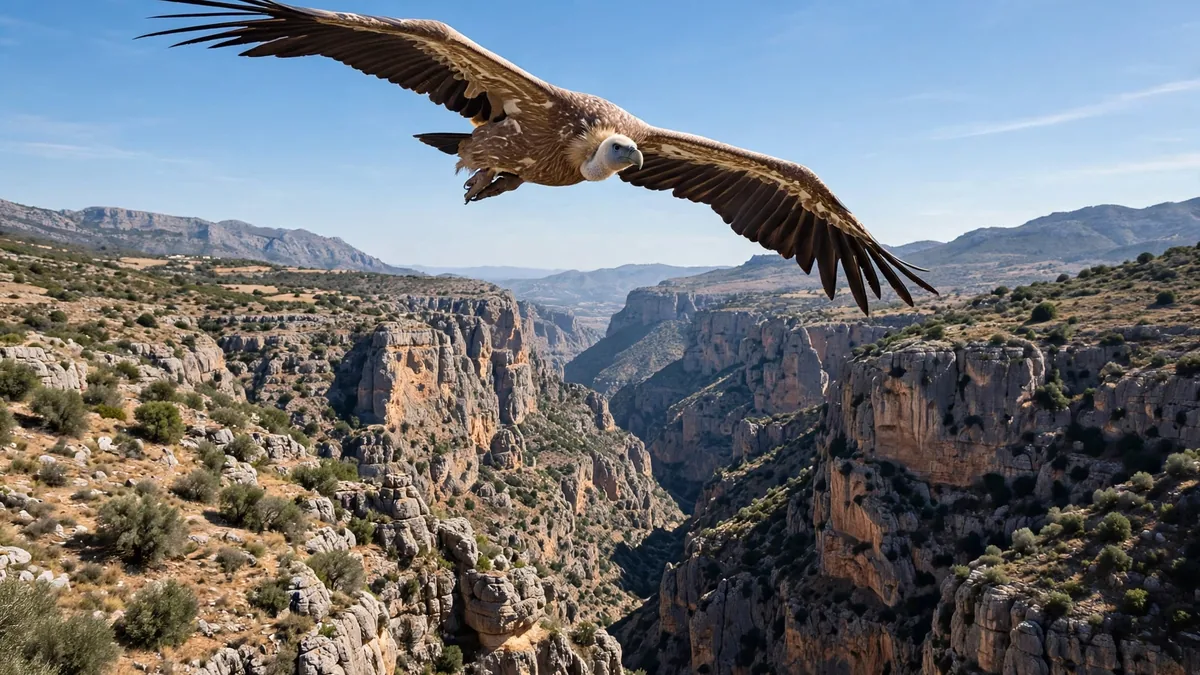
The griffon vulture species is a single species, Gyps fulvus, a huge Old World vulture with a wingspan of about 2.3 to 2.8 metres that soars for hours over the mountains of southern Europe, North Africa and Asia. If you are asking how many griffon vulture species there are, the answer is one, and it is one of the largest birds of prey in the Old World, a scavenger that finds its food by sight while riding columns of warm air.
The griffon vulture is a pale sandy-brown bird with a small white head, a long bare neck and a fluffy white ruff at the base of the neck, and in flight its broad wings show dark flight feathers against pale underwing coverts. It eats nothing it has killed itself: it lives almost entirely on the carcasses of large mammals, and its work as a cleaner makes it one of the most useful birds of the mountains.
Key takeaways
- There is one griffon vulture species, Gyps fulvus, also called the Eurasian griffon.
- An adult is about 93 to 122 centimetres long, weighs roughly 6 to 11 kilograms and has a wingspan of about 2.3 to 2.8 metres.
- Griffon vultures are obligate scavengers, feeding almost entirely on the carcasses of large mammals.
- The species is listed as Least Concern, with about 648,000 to 688,000 mature birds in the wild.
- They nest in colonies on cliff ledges, lay a single egg and can live for more than 40 years.
What makes a griffon vulture a griffon vulture
A griffon vulture is a massive, bulky bird with a heavy hooked bill, a short square-ended tail and very long, broad wings with deeply fingered tips. Its plumage is pale sandy brown above and paler below, with dark brown flight feathers, and its wings are often held in a shallow V as it soars. The head and neck are covered only in short white down, with a fluffy white ruff at the base of the neck, and the bare skin stays clean when the bird feeds inside a carcass.
There is almost no difference in size or plumage between males and females, and age shows above all in the neck and head: young birds are darker, with a brownish ruff and a dark bill, and they grow paler over about five years. The griffon is often confused with other large vultures, but it is paler than the cinereous vulture, which is uniformly dark brown to blackish, and much larger and plainer than the bearded vulture, which has a black beard and rusty underparts and eats bones rather than soft flesh.
The griffon vulture species and their relatives
The griffon vulture belongs to Gyps, a genus of large Old World vultures within the hawk and eagle family Accipitridae. Its closest relatives are the other Gyps vultures of Africa and Asia, including the white-backed vulture of Africa, the Himalayan vulture of the high mountains of Asia and Rüppell’s vulture, which is smaller and slimmer with scaly dark feathers. The griffon is the most widespread vulture in southern Europe.
Unlike the bearded vulture, which eats bones and drops them onto rocks to shatter them, the griffon feeds on the soft tissue and organs of dead animals, reaching deep inside a carcass with its long neck. Like the golden eagle, another huge raptor of the same mountains, the griffon rides the thermals to great heights, but where the eagle hunts live prey, the vulture only ever feeds on the dead.

| Type | Animal | Where it lives | Best-known food | Length or Weight |
|---|---|---|---|---|
| Genus | Griffon vultures (genus Gyps) | Mountains and open country of Europe, Africa and Asia | Carrion of large mammals | Wingspan about 2.3 to 2.8 m |
| Species | Griffon vulture (Gyps fulvus) | Southern Europe, North Africa and Asia | Soft tissue of dead ungulates | About 6 to 11 kg |
| Species | Himalayan vulture (Gyps himalayensis) | High mountains of central Asia | Carrion of wild and domestic animals | Wingspan about 2.6 to 3.1 m |
| Species | White-backed vulture (Gyps africanus) | Savannas of sub-Saharan Africa | Carrion of large mammals | About 4 to 7 kg |
| Species | Bearded vulture (Gypaetus barbatus) | Mountains of Europe, Africa and Asia | Bones of dead animals | About 4.5 to 7 kg |
| Species | Cinereous vulture (Aegypius monachus) | Mountains and forests of Europe and Asia | Carrion of large mammals | About 7 to 12.5 kg |
How griffon vultures live
Griffon vultures are scavengers in the strictest sense: they feed almost entirely on the carcasses of medium and large mammals, above all dead sheep, goats and cattle, and wild hoofed animals such as red deer, ibex and wild boar. They find food by sight rather than smell, scanning the ground from great heights, and they watch other vultures too, so that when one bird drops towards a carcass, dozens may follow within minutes. They eat mainly muscle and internal organs, and their stomach acid is strong enough to destroy many of the bacteria in rotting meat.
Griffon vultures are among the most social of vultures. They breed, roost and feed in groups, and they soar in loose parties, keeping each other in sight across the sky. Adults are mostly sedentary, staying close to their breeding colonies, while young birds wander widely and many spend the winter in the Sahel of Africa, returning in spring. A griffon can stay aloft for hours with hardly a wingbeat, climbing in a thermal and then gliding for kilometres to the next one.
Breeding takes place in colonies on steep cliff faces, on ledges and in caves, and colonies usually hold twenty pairs or fewer, though the largest in Spain held 730 pairs. Pairs court from mid-September to mid-December, flying in tandem near the cliffs, and both birds build the nest. The female usually lays a single egg between November and April, and both parents incubate it in turns for about 48 to 54 days. The chick first flies at about 110 to 120 days old, and the parents may feed it for weeks after it leaves the nest. Birds first breed at about four to six years old.
Where griffon vultures live
Griffon vultures live across the south of Europe and Asia, from Iberia and north-west Africa east through the Balkans, Turkey and the Middle East to Central Asia and northern India. They need open country with cliffs, gorges or mountains: cliffs for nest sites and roosts, and rising air for the soaring flight they depend on. They forage over Mediterranean scrub, steppe, pasture and farmland where wild or domestic hoofed animals are plentiful, and a colony needs cliffs and plenty of livestock, above all sheep and goats, within about ten kilometres.
The stronghold of the species is Spain, which holds by far the largest population in Europe, with further large numbers in France, Italy, Greece, Turkey and the Balkans. In Europe the population is estimated at about 32,400 to 34,400 breeding pairs, and the species has recovered strongly in western Europe, helped by feeding stations, protection and reintroductions in France and Italy, where the birds had died out.
The griffon vulture is listed as Least Concern on the IUCN Red List, and it has held that status since 2004. The IUCN assessment puts the global population at about 648,000 to 688,000 mature birds, and numbers are increasing overall. The picture is not without risk: poison, power lines, wind turbines and the removal of livestock carcasses from the countryside still kill birds.
Best seasons for griffon vulture watching
The best time to watch griffon vultures is late morning to mid-afternoon on a warm, sunny day, when the sun has heated the ground and the thermals lift the birds high over the cliffs. In southern Europe that means the months from about April to September, when the vultures are most active and the young birds are learning to soar.
Staying safe around griffon vultures
A griffon vulture is a wild bird and should be watched from a distance, never approached or fed. The birds are shy at the nest, and a colony that is disturbed may leave its eggs or chicks exposed to the sun and to predators, so keep well back from breeding cliffs, stay on paths and viewpoints, and never climb towards a nest ledge.
If you find a dead animal with vultures feeding, keep your distance: a feeding party can be nervous, and the birds may abandon a carcass if people walk in. Follow the guidance of local wardens and reserve staff, who know which cliffs are in use and which viewpoints are open, and never use a drone near a colony.
Griffon vulture watching checklist
A little preparation turns a morning at a mountain viewpoint into a real chance of seeing the great soaring vulture of the cliffs.
- A visit to a known vulture viewpoint in Spain, France or the Balkans, ideally with a local guide who knows the colonies.
- A warm, sunny day between April and September, when the thermals are strong and the birds soar high.
- Binoculars, because griffon vultures are often first spotted as small dark shapes circling far above the cliffs.
- A late-morning start, since the birds leave their roosts once the sun has warmed the ground.
- Sun protection and water, because the best viewpoints are open, sunny and exposed.
- A camera with a zoom lens, for close views from a respectful distance.
- Patience and a quiet approach, because a colony that feels watched will stay on its ledges.
Frequently asked questions
How many griffon vulture species are there?
There is one griffon vulture species, Gyps fulvus, also called the Eurasian griffon. It lives across southern Europe, North Africa and Asia, from Iberia to northern India.
What does a griffon vulture eat?
Griffon vultures eat almost entirely carrion, the flesh of animals that are already dead. They feed on the soft tissue and organs of large mammals such as sheep, goats, cattle, deer and wild boar, finding carcasses by sight while soaring on thermals.
How is a griffon vulture different from a bearded vulture?
The griffon vulture is a pale sandy-brown social scavenger that feeds on soft flesh and nests in colonies, while the bearded vulture is a rarer, darker bird with a wedge-shaped tail and a black beard that specialises in eating bones, dropping them onto rocks to shatter them.
How is a griffon vulture different from a cinereous vulture?
The cinereous vulture is larger and uniformly dark brown to blackish, with broader, more rectangular wings and a wedge-shaped tail, while the griffon is pale sandy brown with dark flight feathers and a short square-ended tail.
How is this guide different from the grey crowned crane guide?
This guide covers the griffon vulture, one huge soaring scavenger of the mountains of southern Europe, North Africa and Asia that feeds only on carrion and nests in colonies on cliff ledges, while our grey crowned crane species guide covers the grey crowned crane, a tall wetland bird of Africa that eats seeds, insects and frogs, dances with its mate and roosts in trees.
Are griffon vultures endangered?
No. The griffon vulture is listed as Least Concern on the IUCN Red List, with about 648,000 to 688,000 mature birds in the wild and numbers increasing overall. It has recovered strongly in western Europe, though poison, power lines and wind turbines still kill birds.
Conclusion
The griffon vulture species is one of the great sights of the mountain sky: a single species, Gyps fulvus, with a wingspan wider than a tall man, that can stay aloft for hours without a wingbeat.
If you go looking for one, go on a warm sunny day, go to a cliff viewpoint, and look up. Watch a party of griffons circle high on a thermal, and you will see a bird that keeps the mountains clean.