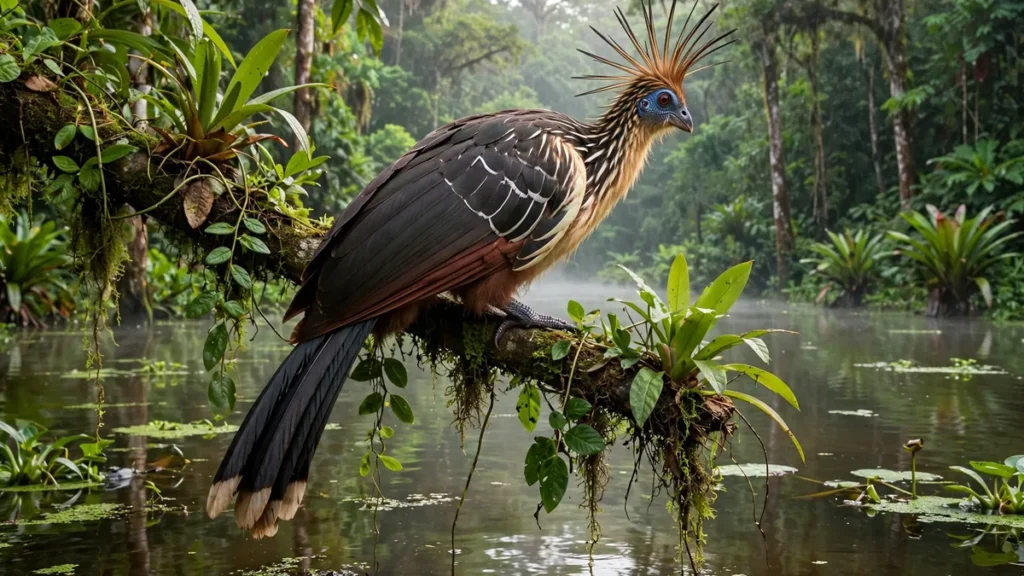
The hoatzin species is a single species, Opisthocomus hoazin, the only living member of the family Opisthocomidae, a leaf-eating bird of the Amazon and Orinoco river basins that ferments its food in its crop much as a cow ferments grass in its stomach. If you are asking how many hoatzin species there are, the answer is one, and it is one of the strangest birds alive: its chicks have claws on their wings, it smells of manure, and it can barely fly.
The hoatzin lives in swamps, flooded forest and river-edge trees across northern South America, from Brazil and Peru to Guyana, Venezuela, Colombia, Ecuador, Bolivia and Suriname. It spends most of its life perched in waterside trees, digesting leaves, and it is so unusual that scientists have argued for centuries about where it belongs in the bird family tree. It is now placed in an order of its own, Opisthocomiformes.
Key takeaways
- There is one hoatzin species, Opisthocomus hoazin, the only living member of its family and its order.
- Hoatzins eat mostly leaves, which they ferment in a greatly enlarged crop with the help of bacteria, much like a cow’s rumen.
- The fermentation gives the bird a manure-like smell, which is why it is also known as the stinkbird.
- Chicks have two claws on each wing, which they use to climb back to the nest after dropping into the water to escape predators.
- The species is listed as Least Concern, and it is the national bird of Guyana, where it is called the Canje pheasant.
What makes a hoatzin a hoatzin
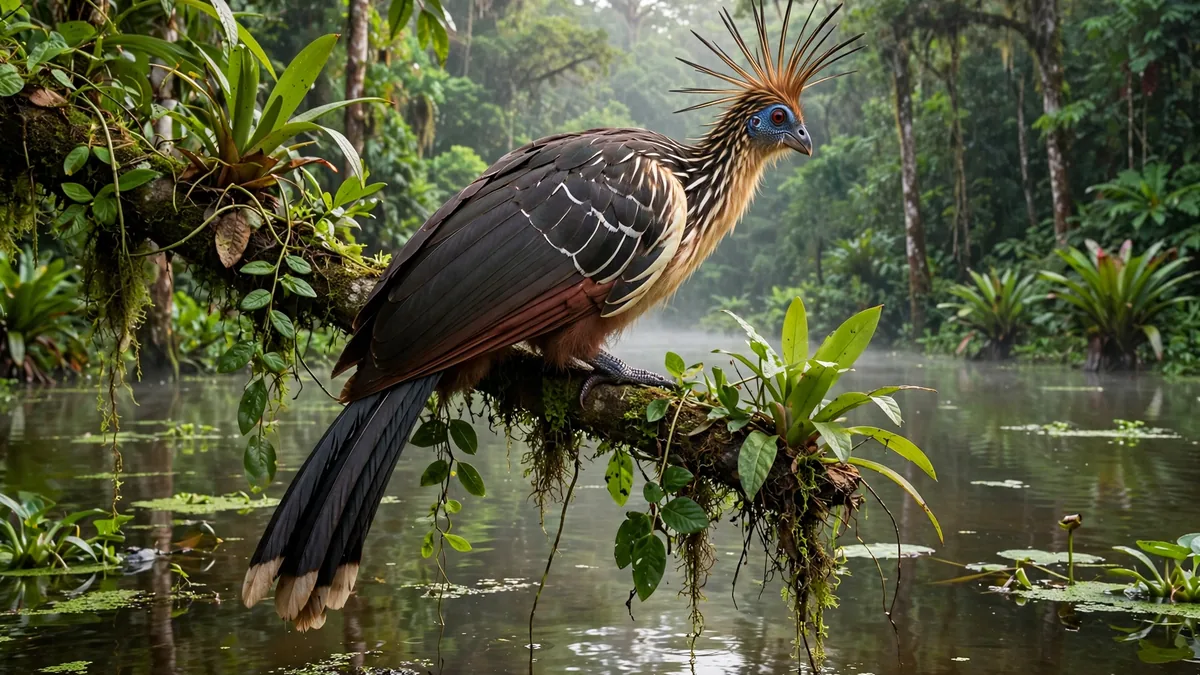
A hoatzin is a pheasant-sized bird, about 65 centimetres long, with a long neck, a small head and a long tail. It weighs less than a kilogram. Its most striking features are a spiky, rufous crest, an unfeathered blue face and maroon eyes. The upper parts are dark, sooty brown streaked with buff, the underparts are yellowish-buff, and the long tail is bronze-green tipped with a broad whitish band.
The hoatzin’s body is shaped by its diet. Its crop, the pouch in the lower throat where birds usually store food, is greatly enlarged and muscular, forming a fermentation chamber that holds leaves for many hours. The crop is about fifty times heavier than the bird’s tiny stomach. To make room for it, the breast muscles are reduced and shifted backwards, and a large rubbery callus on the breastbone acts as a tripod, propping the bird up as it perches and digests. The result is a bird that flies clumsily and only for short distances.
The hoatzin is a noisy bird. It makes a variety of hoarse calls, including groans, croaks, hisses and grunts, often while spreading its wings. An adult spends most of its time perched in a horizontal, hunched posture, digesting its leafy meals in the shade of the riverside trees.
The hoatzin species and their relatives
The hoatzin belongs to Opisthocomus, a genus with a single living species, and to the family Opisthocomidae, which also has no other living members. It was first described scientifically in 1776, and since then it has been grouped at different times with the cuckoos, the turacos, the game birds and the pigeons. Modern research places it in its own order, Opisthocomiformes.
The hoatzin has no close living relatives, but it shares odd traits with a few distant cousins. Like the turacos of Africa, its nestlings use claws on their wings to climb in trees. The wing claws once led scientists to compare the hoatzin with Archaeopteryx, the fossil bird of the dinosaur era, but modern research suggests the claws are a more recent adaptation to life in dense waterside trees.

| Type | Animal | Where it lives | Best-known food | Length or Weight |
|---|---|---|---|---|
| Genus | Hoatzins (genus Opisthocomus) | Amazon and Orinoco basins | Leaves, flowers and fruit | About 65 cm long |
| Species | Hoatzin (Opisthocomus hoazin) | Swamps and rivers of South America | Leaves, fermented in the crop | About 65 cm, under 1 kg |
| Species | Toco toucan (Ramphastos toco) | Forests of central South America | Fruit, eggs and insects | About 55 to 65 cm long |
| Species | Oilbird (Steatornis caripensis) | Caves and forests of South America | Fruit of palms and laurels | About 40 to 49 cm long |
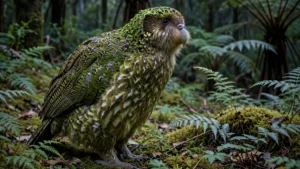
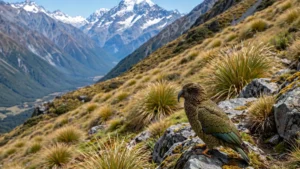
| Species | Kakapo (Strigops habroptilus) | Forests of New Zealand | Leaves, fruit and seeds | About 59 to 64 cm long |
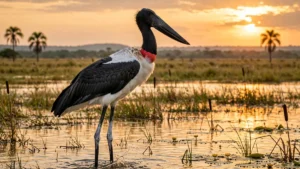
| Species | Shoebill (Balaeniceps rex) | Swamps of central Africa | Fish, frogs and small animals | About 110 to 140 cm tall |
How hoatzins live
Hoatzins are leaf-eaters, or folivores, and leaves make up more than four-fifths of their diet, with flowers, buds and fruit making up the rest. Leaves are a difficult food: they are fibrous, low in quickly available energy and often full of chemicals that deter animals from eating them. The hoatzin solves this by fermenting its food. Leaves are swallowed and held for many hours in the enlarged crop, where bacteria break down the cellulose and detoxify harmful compounds, much like the fermentation in a cow’s rumen.
The fermentation gives the hoatzin its famous smell. The bird reeks of manure, which is why it is widely known as the stinkbird, and the smell may put off hunters and some predators, though that has never been proven. The fermentation also takes so long that a hoatzin spends much of its day sitting still, digesting, and it eats in the cooler hours of the morning and evening.
Hoatzins nest in small colonies in trees over slow-moving water, usually during the rainy season. The nest is a loose platform of sticks. The female usually lays two or three pale eggs, and both parents incubate them for about four weeks. Hoatzins are cooperative breeders: older siblings from earlier years often stay and help feed the new chicks, bringing them a paste of regurgitated leaves.
The chicks are the most remarkable part of the story. Each young hoatzin has two large claws on the first two digits of each wing, and it uses them, with its oversized feet, to scramble through branches. When a predator such as a great black hawk attacks the colony, the adults fly about noisily to distract it, while the chicks drop from the nest into the water below. They swim to escape, then climb back up to the nest with their clawed wings. The claws are lost shortly after the young bird learns to fly.
Where hoatzins live
Hoatzins live in the lowland rainforests of the Amazon and Orinoco basins, in swamps, flooded forest, oxbow lakes and river-edge trees. They are found in Brazil, Peru, Colombia, Venezuela, Ecuador, Bolivia, Guyana and Suriname, and they are common in suitable habitat, often gathering in noisy groups. They live only in the lowlands. The same riverside trees are shared with toucans, and the forest canopy above holds harpy eagles.
The hoatzin depends on unbroken waterside forest. It needs trees overhanging slow water for its nests, and a year-round supply of young leaves. Where riverside forest is cut or the water is drained, hoatzins disappear. The bird is sedentary and does not migrate.
The hoatzin is listed as Least Concern on the IUCN Red List. It is widespread and often common, but its dependence on river-edge forest makes it vulnerable to deforestation and river engineering. In Guyana, where it is the national bird, it is protected.
Best seasons for hoatzin watching
The best time to watch hoatzins is the rainy season, from about December to May in most of the Amazon, when the birds are nesting in colonies over the high water and the chicks are in the nest.
Hoatzins are active in the cooler hours, so the best viewing is early in the morning and late in the afternoon, when they feed and call noisily from the branches. In the heat of the day they sit hunched and still, digesting, and they can be hard to spot among the leaves.
Staying safe around hoatzins
A hoatzin is a wild bird and should be watched from a distance, never approached or fed. Nesting colonies are easily disturbed, and a colony that is flushed may lose eggs or chicks to predators, so keep your distance. Use binoculars rather than creeping closer.
Hoatzins are harmless, but the rivers they live on are not. Watch for caimans and strong currents, wear a life jacket on small boats, and never swim in rivers where hoatzins nest. The smell is strong at close range, so enjoy the bird from a respectful distance.
Hoatzin watching checklist
A little preparation turns a slow boat ride along an Amazon backwater into a real chance of seeing the strangest bird in South America.
- A boat trip on a quiet Amazon or Orinoco backwater, ideally with a local guide.
- A visit in the rainy season, from about December to May, when hoatzins are nesting over the high water.
- Binoculars, because hoatzins sit still among the leaves and are often spotted by their blue faces first.
- An early morning or late afternoon trip, when the birds are feeding and calling noisily.
- Light, long-sleeved clothing and insect repellent, for the biting insects of the riverside forest.
- A camera with a zoom lens, for close views from the boat without disturbing the colony.
- Patience and a quiet boat, because a noisy approach will send the adults flying and the chicks dropping into the water.
Frequently asked questions
How many hoatzin species are there?
There is one hoatzin species, Opisthocomus hoazin, the only living member of the genus Opisthocomus, the family Opisthocomidae and the order Opisthocomiformes. It lives in the swamps and riverside forests of the Amazon and Orinoco basins.
Why is the hoatzin called the stinkbird?
The hoatzin is called the stinkbird because it smells of manure. The smell comes from the fermentation of leaves in its enlarged crop, where bacteria break down the food over many hours. The process is much like the fermentation in a cow’s stomach, and the smell is strong from several metres away.
Do hoatzin chicks really have claws on their wings?
Yes. Hoatzin chicks have two large claws on the first two digits of each wing, and they use them to climb through branches. When danger threatens, the chicks drop into the water below the nest, swim to safety, and then use the claws to climb back up. The claws are lost shortly after the young birds learn to fly.
What does a hoatzin eat?
Hoatzins eat mostly leaves, which make up more than four-fifths of their diet, along with flowers, buds and fruit. They ferment the leaves in a greatly enlarged crop, where bacteria break down the cellulose and detoxify harmful plant chemicals. Adults feed their chicks a paste of regurgitated leaves.
How is this guide different from the gyrfalcon guide?
This guide covers the hoatzin, a clumsy, leaf-eating bird of the Amazon that ferments its food in its crop and barely flies, while our gyrfalcon species guide covers the gyrfalcon, a powerful Arctic falcon that hunts live ptarmigan and seabirds in fast, low flight. The hoatzin sits in riverside trees digesting leaves, and the gyrfalcon chases prey across the tundra.
Are hoatzins endangered?
No. The hoatzin is listed as Least Concern on the IUCN Red List, and it is widespread and often common in suitable habitat. It depends on unbroken riverside forest, so deforestation and river engineering are the main threats.
Conclusion
The hoatzin species is one of the strangest birds on Earth: one species, Opisthocomus hoazin, that eats leaves like a cow, smells like a farmyard, and gives its chicks claws to climb with.
If you go looking for one, go by boat, go early, and listen for the groans and hisses in the riverside trees. A blue face and a spiky crest among the leaves is a sight like no other.