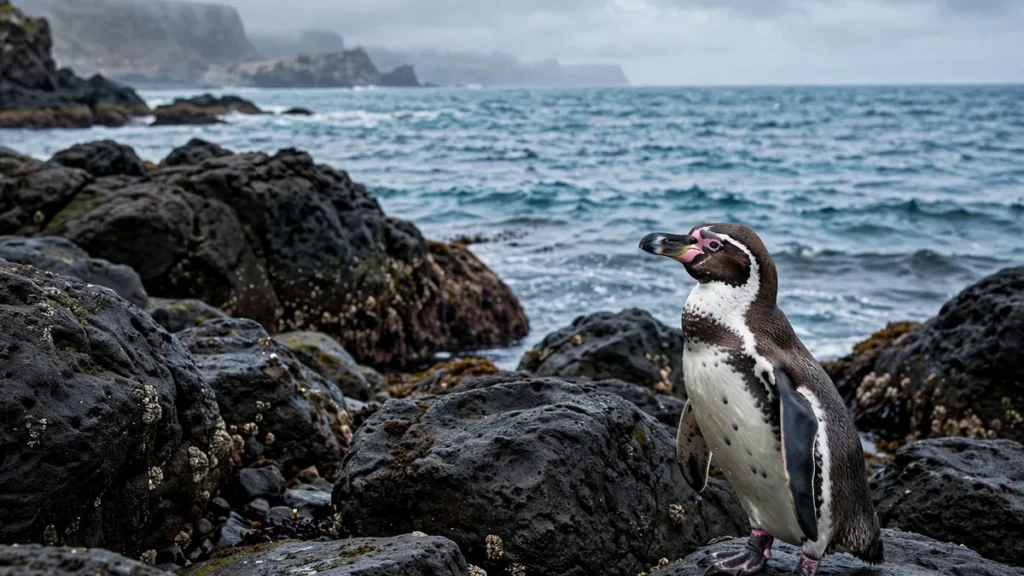
The humboldt penguin species is a single species, Spheniscus humboldti, a medium-sized banded penguin that lives along the cold Pacific coast of Peru and Chile and is named after the explorer Alexander von Humboldt and the ocean current that bears his name. If you are asking how many humboldt penguin species there are, the answer is one, and it is listed as Vulnerable on the IUCN Red List.
The Humboldt penguin is easy to recognise once you know what to look for: a white head marked with a broad black band that curves down from the crown, a black band across the white belly, and a large patch of bare pink skin on the face that flushes deeper red when the bird is hot. On land it is clumsy and upright; under water it is swift, chasing the anchovy shoals the current brings within reach.
Key takeaways
- There is one humboldt penguin species, Spheniscus humboldti, a banded penguin of the Pacific coast of Peru and Chile.
- Adults stand about 66 to 70 centimetres tall and weigh roughly 4 to 5 kilograms, with bare pink skin on the face and a black band across the belly.
- Humboldt penguins nest in burrows dug into guano, in rock crevices and in sea caves, usually laying two eggs.
- Their diet is mostly anchovies, sardines and herring, with some squid and crustaceans, caught on dives shallower than 60 metres.
- The species is listed as Vulnerable, its numbers falling with El Niño years, overfishing and bycatch in fishing nets.
What makes a Humboldt penguin a Humboldt penguin
A Humboldt penguin is a medium-sized penguin with a black back, a white belly crossed by a single broad black band, and a black head with a white band sweeping from above the eye down the side of the neck. A wide patch of bare pink skin on the face works like a radiator: blood flowing close to the surface lets the bird shed heat on a hot day.
Adults stand about 66 to 70 centimetres tall and weigh roughly 4 to 5 kilograms, males a little heavier than females on average. The species belongs to the banded penguins, genus Spheniscus, and our penguin species guide covers the whole family.
The humboldt penguin species and their relatives
The Humboldt penguin belongs to Spheniscus, a genus of four banded penguins that all live in warm and temperate seas rather than in the Antarctic. Its nearest relatives are the African penguin of southern Africa, the Magellanic penguin of Argentina and southern Chile, and the Galápagos penguin, the only penguin that lives on the equator. All four share the black band across the belly and the bare pink skin on the face, and all four nest in burrows or sheltered scrapes rather than on open ice.
The Humboldt penguin’s range overlaps that of the Magellanic penguin on the central Chilean coast, and the two have been known to nest in mixed colonies in the far south. The Humboldt penguin is the only one of the four that lives entirely on the Pacific coast, bound to the cold Humboldt Current and its anchovy shoals.
| Type | Animal | Where it lives | Best-known food | Length or Weight |
|---|---|---|---|---|
| Genus | Banded penguins (genus Spheniscus) | Warm and temperate southern seas | Schooling fish | About 60 to 70 cm tall |
| Species | Humboldt penguin (Spheniscus humboldti) | Pacific coast of Peru and Chile | Anchovies, sardines, herring | About 66 to 70 cm, 4 to 5 kg |
| Species | Magellanic penguin (Spheniscus magellanicus) | Argentina and southern Chile | Anchovies, squid, small fish | About 61 to 76 cm, 3 to 6 kg |
| Species | African penguin (Spheniscus demersus) | Namibia and South Africa | Anchovies, sardines, squid | About 60 to 70 cm, 2 to 4 kg |
| Species | Galápagos penguin (Spheniscus mendiculus) | Galápagos Islands, on the equator | Small schooling fish | About 49 to 53 cm, 2 to 3 kg |
How Humboldt penguins live
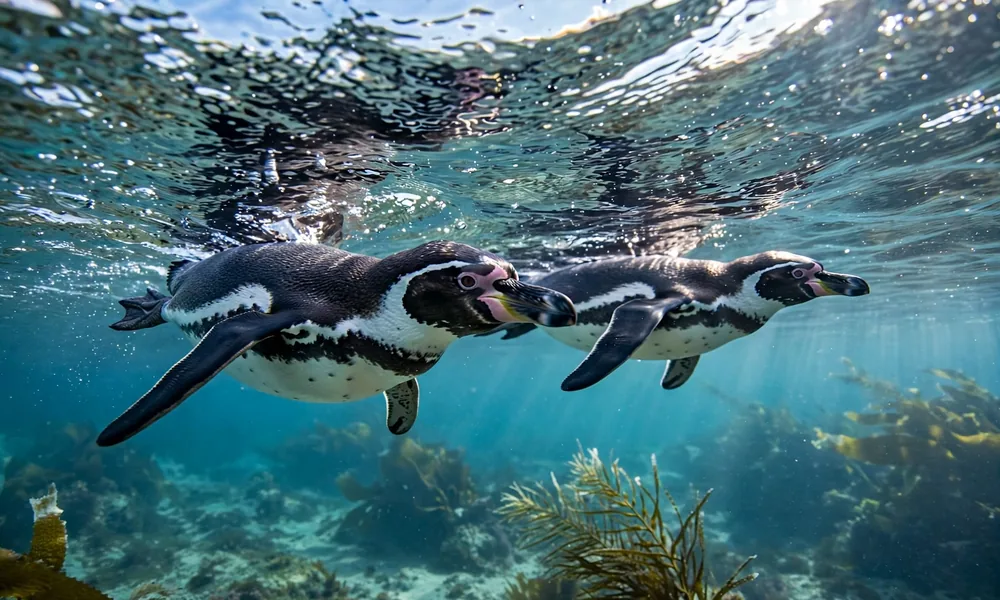
Humboldt penguins feed almost entirely on pelagic schooling fish, above all anchovies, sardines and herring, with squid and small crustaceans taken as well. They are visual hunters, leaving their islands after sunrise and swimming out to the shoals, where they dart through the school, snatching fish and swallowing them whole under water. Most dives are shallower than 60 metres, though birds have been recorded down to 150 metres.
Breeding takes place in loose colonies on islands and rocky stretches of coast, and pairs can nest at any time of year, though laying peaks with the seasons of greatest food. The nest is a burrow dug into guano or soft soil, a scrape, a rock crevice or a sea cave, and the pair usually lays two eggs of equal size a few days apart. Both parents take turns incubating for about 40 to 42 days, and both feed the chicks, which stay at the nest until they fledge at 10 to 12 weeks old. Many pairs raise two clutches in a good year.
Once a year, usually between mid-January and mid-February, Humboldt penguins moult, shedding all their feathers at once and growing a fresh waterproof coat. For the two or three weeks of the moult they cannot go to sea at all, so they fast on land, living off the fat they stored beforehand. After moulting, some birds wander hundreds of kilometres north, and a few have turned up as vagrants in Ecuador, Colombia and even Alaska. Humboldt penguins can live for 15 to 20 years.
Where Humboldt penguins live
Humboldt penguins live only on the Pacific coast of South America, from Isla Foca in northern Peru, at about 5 degrees south, down to Isla Guafo in southern Chile, at about 43 degrees south. At least 49 breeding sites are known, and the largest colonies are at Punta San Juan in Peru and Isla Chañaral in Chile. Every part of this range is washed by the Humboldt Current, whose cold, nutrient-rich water feeds the anchovy shoals that the penguins live on.
The species is listed as Vulnerable, and its numbers have fallen sharply since the middle of the nineteenth century, when the great guano harvest stripped the deep guano beds in which the penguins dug their burrows. In the early 1980s the global population was estimated at 16,000 to 20,000 birds, and the El Niño event of 1982 to 1983 cut it to perhaps 5,000 to 6,000. Recent censuses put the global population in the region of 24,000 to 32,000 mature birds, but the figure is uncertain, and the trend is believed to be downward.
In El Niño years, warm water drives the anchovy shoals deep or far offshore and breeding fails. Added to that are the overfishing of anchovy, drowning in fishing nets, oil spills, and introduced rats, cats and dogs that eat eggs and chicks on the breeding islands. The birds are protected by law in Peru and Chile, and several of the largest colonies lie inside reserves, where wardens guard the nests.
Best seasons for Humboldt penguin watching
Humboldt penguins can be seen all year round, because they stay close to their colonies even outside the breeding season, but the best watching comes in the austral spring and summer, roughly September to March, when the colonies are at their busiest and the birds are coming and going all day. Boat trips run from Paracas to the Ballestas Islands in Peru, and from Caldera to Isla Chañaral and the Choros Islands in Chile.
Staying safe around Humboldt penguins
A Humboldt penguin is a wild seabird with a sharp bill and strong flippers, so it should always be watched from a distance and never approached, touched or fed. Keep well away from burrows on land, because a frightened bird may abandon its eggs, and a burrow roof can collapse under a careless foot. Follow the rules of the reserve, and never chase a bird in the water.
If you meet a penguin on a beach or a rock, stop and give it room, speaking quietly and moving slowly so it can slip into the sea. Never try to pick up a chick or a bird that looks stranded: a moulting penguin on land is fasting, not sick, so leave it alone and tell the wardens.
Humboldt penguin watching checklist
A little preparation turns a boat trip along the Pacific coast into a real chance of seeing South America’s cold-current penguin at close quarters.
- A boat trip to the Ballestas Islands in Peru or the Choros Islands in Chile, where the boats run daily.
- A trip in the austral spring or summer, roughly September to March, when the colonies are at their busiest.
- Binoculars, because the birds are often spotted porpoising beside the boat or standing on rocks some way off.
- Warm, windproof clothing and a waterproof jacket, for a cold, wet ride.
- A camera with a zoom lens, for close views of the pink face and black belly band.
- Sun protection and seasickness tablets, because the Pacific sun is strong and the swell can be rough.
- Respect for the colonies and their wardens, because a burrow disturbed is a nest lost.
Frequently asked questions
How many humboldt penguin species are there?
There is one humboldt penguin species, Spheniscus humboldti, a banded penguin that lives only on the Pacific coast of Peru and Chile. It is one of four species in the genus Spheniscus, alongside the Magellanic, African and Galápagos penguins.
Why is it called a Humboldt penguin?
The penguin is named after the German explorer Alexander von Humboldt, who studied the cold ocean current that runs along the coasts of Peru and Chile. The current is also named after him, and the penguin’s whole life is bound to it, because its cold water supports the anchovy shoals the penguins eat.
What does a Humboldt penguin eat?
A Humboldt penguin eats mostly schooling fish, above all anchovies, sardines and herring, with squid and small crustaceans as well. It hunts by sight under water, diving usually to less than 60 metres, though birds have been recorded down to 150 metres.
Why does a Humboldt penguin have pink skin on its face?
The bare pink skin on the face helps the penguin lose heat: blood flowing close to the surface there cools the bird on a hot day on the rocks. The skin flushes deeper red when the bird is hot, and pales again when it cools down in the sea.
How is this guide different from the house sparrow guide?
This guide covers the Humboldt penguin, a flightless seabird of the cold Pacific coast that swims after anchovies and nests in guano burrows, while our house sparrow species guide covers the house sparrow, a small brown songbird that lives around houses and farms and eats seeds and insects. One is a seabird that cannot fly; the other is a garden bird you can see from your window.
Are Humboldt penguins endangered?
Not in the strict sense. The Humboldt penguin is listed as Vulnerable on the IUCN Red List, one step below Endangered, with its numbers falling in El Niño years and under pressure from overfishing and bycatch. Recent censuses put the global population in the region of 24,000 to 32,000 mature birds, though the figure is uncertain.
Conclusion
The humboldt penguin species is a bird shaped by one cold current: one species, Spheniscus humboldti, living only where the Humboldt Current runs, nesting in burrows on rocky islands and hunting anchovy shoals in cold, green water.
If you go looking for one, take a boat in the austral spring and watch the water beside the hull for a penguin porpoising through the swell, pink face flashing in the sun.