The vampire bat species are three small bats of the Americas that live entirely on blood, the only mammals in the world to do so. If you are asking how many vampire bat species there are, the answer is three, and they belong to the subfamily Desmodontinae: the common vampire bat, the hairy-legged vampire bat and the white-winged vampire bat.
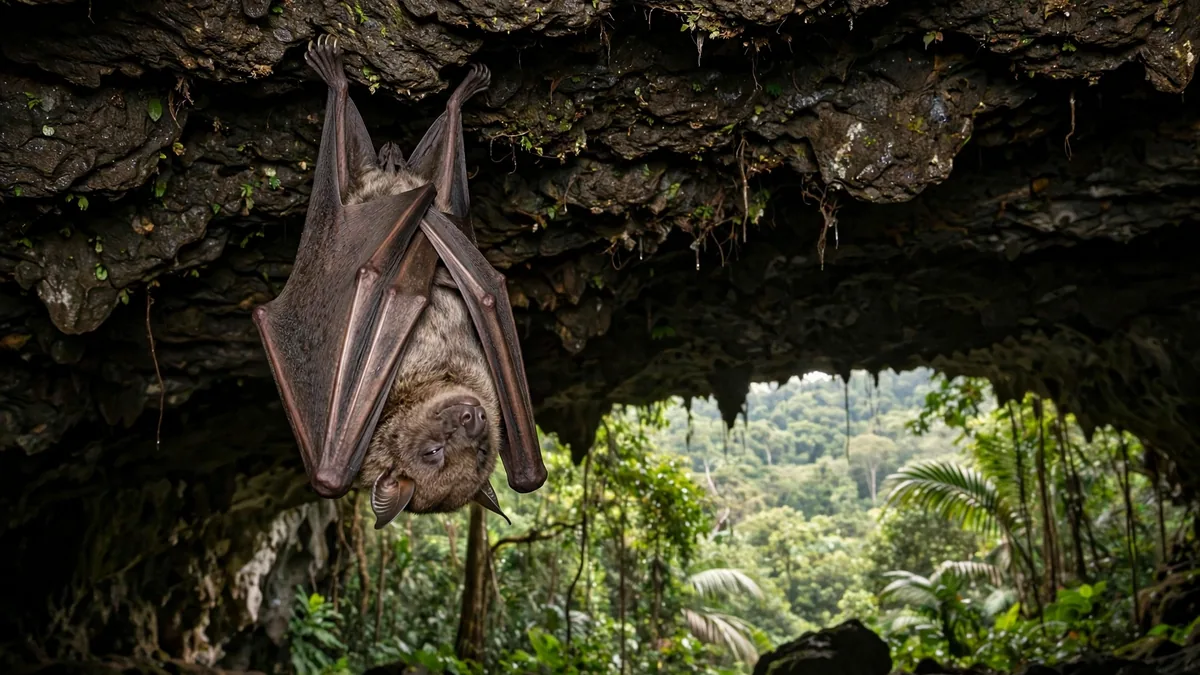
Despite their fearsome name, vampire bats are small, shy, nocturnal animals that spend their days hanging upside down in dark caves. They do not suck blood like the vampires of legend. Instead, they make a tiny cut with razor-sharp teeth and lap up the blood that flows, usually without waking the sleeping animal they feed on.
Key takeaways
- There are three vampire bat species in the subfamily Desmodontinae, and they are the only mammals that feed entirely on blood.
- The common vampire bat, Desmodus rotundus, is the best known and most widespread, feeding mainly on the blood of mammals such as cattle and horses.
- A common vampire bat is about 7 to 9 centimetres long, with a wingspan of about 18 centimetres and a weight of roughly 25 to 40 grams.
- Vampire bats roost in caves, hollow trees, mines and abandoned buildings, in colonies that usually number about 100 animals.
- Well-fed bats share regurgitated blood with hungry roost-mates and groom each other, in one of the clearest examples of reciprocal help among wild mammals.
What makes a vampire bat a vampire bat
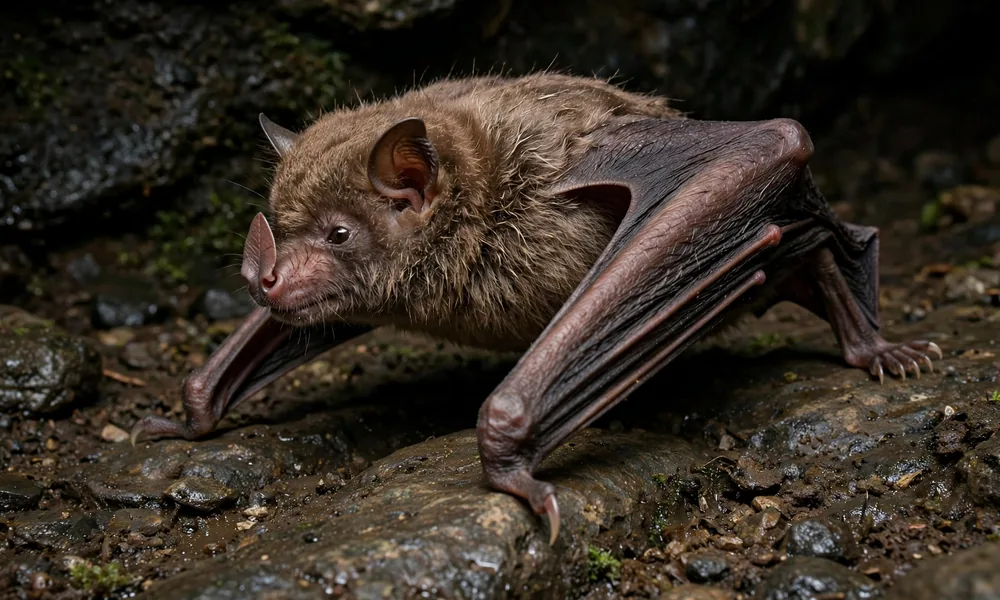
A vampire bat is a small, compact bat with short brown or grey-brown fur, a pale underside, a flat leaf-shaped nose and a deeply grooved lower lip. It has no tail, and its wings are long and pointed. Its teeth are its most striking feature: it has fewer teeth than any other bat, but its upper incisors are large, razor-sharp and lack enamel on one side, which keeps their edges keen.
The common vampire bat has a heat sensor on its nose that points it towards a spot where warm blood flows just beneath its victim’s skin. Like the slow loris, another nocturnal mammal, it is active only after dark, but the slow loris moves slowly through trees while the vampire bat flies, walks and hops with surprising agility. Its long thumbs are clawed and exceptionally strong, and it uses them to climb onto prey and to leap into the air when taking off from the ground.
The vampire bat species and their relatives
The three vampire bat species belong to the subfamily Desmodontinae, part of the leaf-nosed bat family Phyllostomidae of the New World tropics. The common vampire bat, Desmodus rotundus, is the only living member of its genus. The hairy-legged vampire bat, Diphylla ecaudata, and the white-winged vampire bat, Diaemus youngi, are its two close cousins.
The three species look alike at a glance, but they differ in what they eat. The common vampire bat feeds mainly on the blood of mammals, above all livestock such as cattle, horses and pigs, while the other two species feed mainly on the blood of birds. The common vampire bat has a longer thumb, and it is the only one of the three that thrives in farmland as well as in forest.
| Type | Animal | Where it lives | Best-known food | Length or Weight |
|---|---|---|---|---|
| Species | Common vampire bat (Desmodus rotundus) | Mexico to Chile and Argentina | Blood of cattle, horses and pigs | About 7 to 9 cm long, 25 to 40 g |
| Species | Hairy-legged vampire bat (Diphylla ecaudata) | Mexico to Brazil and Peru | Blood of birds | About 7 to 9 cm long, 24 to 43 g |
| Species | White-winged vampire bat (Diaemus youngi) | Mexico to northern Argentina | Blood of birds | About 8 cm long, 30 to 48 g |
| Subfamily | Vampire bats (Desmodontinae) | Tropical Americas | Blood of warm-blooded animals | Three species in total |
| Relative | Leaf-nosed bats (Phyllostomidae) | Central and South America | Fruit, nectar, insects and blood | A large bat family |
| Relative | Fruit bats (Pteropodidae) | Africa, Asia and Australia | Fruit and nectar | Some weigh over 1 kg |
How vampire bats live
Vampire bats sleep during the day in total darkness, suspended upside down from the roofs of caves. They typically gather in colonies of about 100 animals, sometimes 1,000 or more. In one year, a colony of 100 bats can drink the blood of 25 cows, yet each bat takes so little that the host is rarely harmed by the loss itself.
During the darkest part of the night, vampire bats emerge to hunt. They use echolocation to find their way, and they can recognise the breathing pattern of a familiar animal and return to it night after night. Sleeping cattle and horses are their usual victims, though they have rarely been known to feed on people. The bats drink their victim’s blood for about 30 minutes, and their saliva contains a strong anticoagulant that keeps the blood from clotting while they lap it up with their tongues.
Unlike other bats, vampire bats strike their victims from the ground. They land near their prey and approach it on all fours, walking, running and hopping with a bounding gait powered by their wings. They are the only bats able to take off from the ground, leaping a metre or more into the air on their long thumbs. A bat can drink up to half its body weight in a single feeding, and may struggle to fly until it has passed some of the water in the blood as urine.
The social life of vampire bats is unusually generous. A bat that fails to feed for two nights in a row can starve, so well-fed bats regurgitate blood for hungry roost-mates, and the favour is remembered and returned. Grooming is a large part of roost life, strengthening the bonds that make food sharing work. Young vampire bats feed not on blood but on milk, clinging to their mothers for about three months before they learn to feed on their own.
Where vampire bats live
Vampire bats are found in the tropics of Mexico, Central America and South America, from Mexico south to Chile and Argentina. They need warm climates and do not live where winters are cold. They roost in caves, hollow trees, wells, mine shafts and abandoned buildings, anywhere dark, humid and sheltered.
The common vampire bat is the most widespread of the three and thrives in farmland where cattle are kept, while the other two are more restricted to intact forest, where they feed on birds. All three species are listed as Least Concern on the IUCN Red List, and the common vampire bat has a stable population trend. No reliable total population figure exists for any of the three, so none is given here.
Vampire bats can carry rabies, and this is the main risk they pose, above all to livestock. Human cases are rare, and the bats themselves are not aggressive: they are small, shy animals that avoid people when they can. A bite is usually painless and the blood loss is tiny, but any bat bite should be cleaned and checked by a doctor, and livestock where vampire bats live are routinely vaccinated against rabies.
Best seasons for vampire bat watching
Vampire bats are active all year round in the tropics, so there is no single best season. The dry season, roughly December to April in much of Central America, is often the easiest time to visit cave roosts, when tracks are passable. Watching means a night visit with a local guide and a red-filtered torch, which disturbs them far less than white light.
Staying safe around vampire bats
A vampire bat is a wild animal and should never be handled, approached closely or fed. Never enter a bat cave without a local guide, and never touch a bat, alive or dead. Wear sturdy shoes near a roost, and keep your distance from the animals.
If a bat bites you, wash the wound at once with soap and water and seek medical advice the same day, because rabies, though rare, is serious once symptoms appear. Do not try to catch or kill bats: killing them does not reduce rabies risk, while vaccinated livestock and sealed farm buildings do far more good.
Vampire bat watching checklist
A night visit to a tropical cave roost is unforgettable with the right guide and the right care.
- A local guide who knows the roost and the bats, and permission to visit the site.
- A night visit in the dry season, when cave tracks are passable and the bats are active.
- A red-filtered torch or headlamp, which disturbs roosting bats far less than white light.
- Sturdy closed shoes and long sleeves, for walking on wet rock near a cave mouth.
- Binoculars for watching bats as they leave the roost at dusk.
- A camera that can cope with low light, used without flash inside the cave.
- Patience and a respectful distance, because a disturbed colony may abandon its roost.
Frequently asked questions
How many vampire bat species are there?
There are three vampire bat species in the subfamily Desmodontinae: the common vampire bat, Desmodus rotundus, the hairy-legged vampire bat, Diphylla ecaudata, and the white-winged vampire bat, Diaemus youngi. They are the only mammals that feed entirely on blood.
Do vampire bats suck blood?
No, they do not suck blood. A vampire bat makes a small, shallow cut with its razor-sharp incisors and laps up the blood that flows, using its tongue. Its saliva contains an anticoagulant that keeps the blood flowing, and a feed usually lasts about 30 minutes.
What do vampire bats eat besides blood?
Nothing, as adults. Vampire bats feed entirely on blood: the common vampire bat mainly on mammals such as cattle, horses and pigs, and the other two mainly on birds. Young bats drink only their mother’s milk for about three months.
Are vampire bats dangerous to people?
Rarely. Vampire bats are small and shy, and they feed on people only occasionally. The main risk is rabies, which they can carry, though human cases are rare and the risk to livestock is far greater. Any bat bite should be washed at once and checked by a doctor, but the blood loss from a bite is tiny and not dangerous in itself.
How is this guide different from the tarsier guide?
This guide covers the vampire bat, a nocturnal flying mammal of the American tropics that feeds entirely on blood, roosts in cave colonies of about 100 and walks on all fours to reach its prey, while our tarsier species guide covers the tarsier, a tiny insect-eating primate of Southeast Asia with enormous eyes that hunts in trees. One is a blood-feeding bat, and the other is a small, wide-eyed primate that eats insects.
Are vampire bats endangered?
No. All three vampire bat species are listed as Least Concern on the IUCN Red List, and the common vampire bat has a stable population trend. They are sometimes killed as pests because they spread rabies to livestock, but their numbers remain healthy across their range.
Conclusion
The vampire bat species are small, social and far gentler than their name suggests: three bats that share blood meals, groom their roost-mates and raise a single pup on milk.
If you go looking for one, go at night, go with a guide, and keep your distance. Watch a colony slip out of a cave at dusk, and you will see an animal that has turned one of the strangest diets in the mammal world into a way of life.