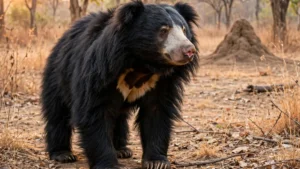
The spectacled bear species is a single species, Tremarctos ornatus, a shy, tree-climbing bear that lives in the cloud forests of the Andes and is the only bear native to South America. If you are asking how many spectacled bear species there are, the answer is one, and it is the only living member of its genus, listed as Vulnerable on the IUCN Red List.
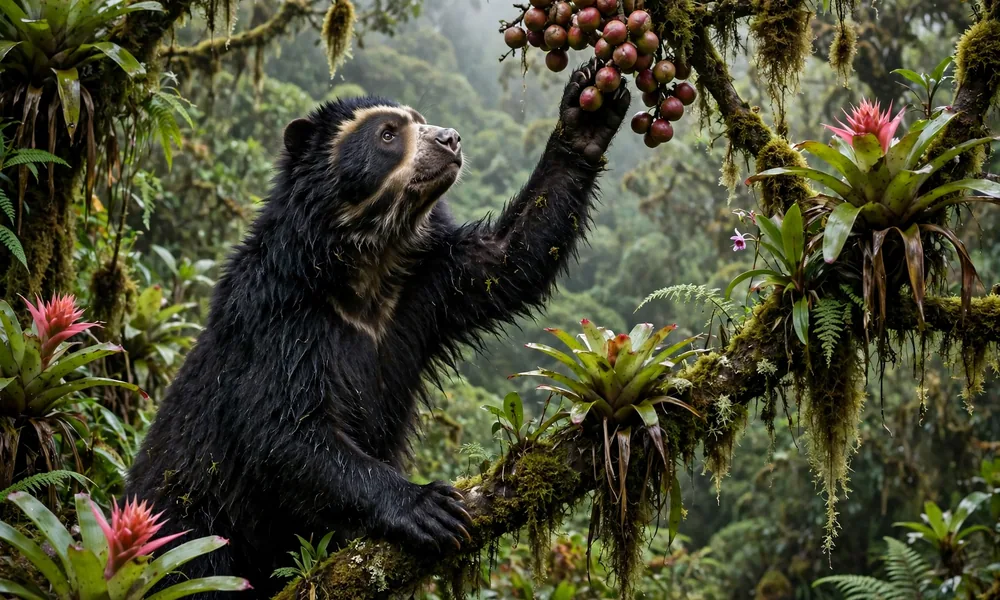
The spectacled bear gets its name from the pale, cream-coloured rings and patches around its eyes, which look like a pair of spectacles, though no two bears wear quite the same pattern. Also called the Andean bear, and ukumari in the Quechua language of the high Andes, it is one of the smallest bears in the world, yet it is the largest land carnivore in South America, and one of the most tree-loving of all bears, feeding and resting high in the canopy.
Key takeaways
- There is one spectacled bear species, Tremarctos ornatus, the only living member of its genus and the only bear native to South America.
- Adult males weigh roughly 100 to 200 kilograms, females about 35 to 82 kilograms, and the pale eye markings differ on every bear.
- Spectacled bears live alone in Andean cloud forests from Venezuela to Bolivia and north-western Argentina, from about 200 to 4,700 metres.
- About 95 per cent of their diet is plant food, above all bromeliads and fruit, with only the occasional insect, bird or small mammal.
- The species is listed as Vulnerable, its numbers falling as cloud forest is cleared and broken into fragments.
What makes a spectacled bear a spectacled bear
A spectacled bear is a mid-sized, powerfully built animal with a short, broad muzzle, strong jaws and flat, wide molars for grinding tough plants. Its shaggy fur is mostly black or dark brown, sometimes reddish, and pale markings sweep from the eyes across the muzzle and down the chest. Its head and body measure about 120 to 200 centimetres, its shoulder stands 60 to 90 centimetres high, and its tail is a stub of 7 centimetres. Males are much larger than females, sometimes twice as heavy.
Its sense of smell is extremely keen, and it can tell from the ground when a tree above is loaded with ripe fruit, while its hearing is only moderate and its eyesight is short. Its short, strong legs end in powerful curved claws that grip bark and tear open bromeliads. It belongs to the bear family, Ursidae, which holds eight living species, and our bear species guide covers the whole family.
The spectacled bear species and their relatives
The spectacled bear belongs to Tremarctos, a genus with a single living species. It is the last living member of the short-faced bears, the subfamily Tremarctinae, which once included the enormous giant short-faced bear of North America. Its short, deep muzzle and powerful jaw muscles are the surviving signature of that ancient lineage, now put to work on tough, fibrous plants rather than on meat.
The species has no recognised subspecies, and its long, narrow range runs for more than 4,600 kilometres along the Andes, from western Venezuela through Colombia, Ecuador and Peru to western Bolivia and north-western Argentina. Readers in Britain may already know this bear: Paddington Bear, from darkest Peru in the stories by Michael Bond, is a spectacled bear, and the pale markings around his eyes are the giveaway.
| Type | Animal | Where it lives | Best-known food | Length or Weight |
|---|---|---|---|---|
| Genus | Spectacled bears (genus Tremarctos) | Cloud forests of the Andes | Bromeliads and fruit | About 1.2 to 2.0 m long |
| Species | Spectacled bear (Tremarctos ornatus) | Andes, Venezuela to Argentina | Bromeliads, fruit, palm hearts | About 100 to 200 kg for males |
| Species | American black bear (Ursus americanus) | Forests of North America | Berries, nuts, insects | About 60 to 300 kg |
| Species | Brown bear (Ursus arctos) | North America, Europe and Asia | Berries, roots, fish, small mammals | About 100 to 600 kg |
| Species | Sloth bear (Melursus ursinus) | Forests of India and Sri Lanka | Termites, ants, fruit | About 55 to 140 kg |
| Species | Giant panda (Ailuropoda melanoleuca) | Mountain forests of central China | Almost entirely bamboo | About 70 to 120 kg |
How spectacled bears live
Spectacled bears are herbivores for almost all practical purposes, with around 95 per cent of their diet made up of plant matter. Bromeliads are the backbone of the diet through much of the range: a bear tears open the rosette of a terrestrial bromeliad to eat the soft heart, or climbs into the canopy for epiphytic bromeliads, fruit, palm hearts, orchid bulbs, berries and cactus. They also eat honey, corn and sugarcane where farms meet the forest, and the occasional insect or small rodent.
They are famously at home in trees. A spectacled bear climbs high into the canopy and bends or breaks branches into a platform, then sits on it for days while the fruit around it ripens, feeding in comfort above the forest floor. They are generally solitary, meeting other bears only to mate or where a rich food source, such as a fruiting tree or a cornfield, draws several together. They are usually active by day, with peaks in the early morning and late afternoon.
Breeding is spread across much of the year, and after a gestation of about five and a half to eight and a half months, including a period of delayed implantation, a mother gives birth to one or two cubs, most commonly two. The cubs are born blind, weigh only about 300 to 330 grams, and stay with their mother for a year or more, learning which plants are safe and how to climb. Spectacled bears live for up to 25 years in captivity.
Where spectacled bears live
Spectacled bears live almost entirely in the Andes, in a long, narrow band of mountains from western Venezuela through Colombia, Ecuador and Peru to western Bolivia and north-western Argentina. Their best habitat is humid to very humid montane cloud forest, but they also use drier forests, high-altitude grasslands known as paramo, and scrubby slopes, ranging from about 200 metres to more than 4,700 metres.
Like the sloth bear, another bear that feeds mostly on plants, the spectacled bear depends on forest that is still whole. Its greatest threat is the loss and fragmentation of cloud forest, cleared for farming, grazing and roads, which cuts populations off from one another and pushes bears into cornfields, where they are sometimes shot as pests. Poaching adds further pressure, and the species is listed on CITES Appendix I, which bans international commercial trade.
The spectacled bear is listed as Vulnerable on the IUCN Red List, and its population is believed to be falling. No reliable total exists, because the bears are shy, solitary and spread thinly across steep, forested mountains, so conservationists work on protecting large blocks of cloud forest, linking them with corridors, and paying farmers for losses so that bears raiding crops are not killed. Manu National Park in Peru and Chingaza National Park in Colombia hold important populations.
Best seasons for spectacled bear watching
The best time to look for spectacled bears is the dry season, roughly June to September, when the mountain trails are passable and the skies are clearer, though bears can be seen in any month where fruit is ripening. Your best chance comes at a fruiting tree, where a bear may sit on its branch platform for days, so local guides track the fruiting season closely. Reserves such as Maquipucuna in Ecuador and Chaparri in Peru are known for sightings.
Staying safe around spectacled bears
A spectacled bear is a shy animal that would rather climb a tree or slip away than meet a person, and attacks are very rare. Watch from a distance with binoculars, never approach a bear, and never feed one, because a fed bear loses its fear of people. Keep dogs on a lead, since a dog can provoke a charge, and do not walk between a mother and her cubs.
If you meet a bear on a trail, stop, stay calm and give it room to leave, speaking in a steady voice so it knows you are there. Back away slowly rather than running, and if the bear stands up, it is usually trying to see and smell you better, not threatening you. Follow your guide, stay on marked paths, and never enter a cornfield at night, when bears may be feeding.
Spectacled bear watching checklist
A little preparation turns a walk through the cloud forest into a real chance of seeing South America’s only bear.
- A guided visit to a cloud forest reserve in Ecuador, Peru or Colombia, where guides know the fruiting trees.
- A dry-season trip, roughly June to September, when the trails are passable and the skies are clearer.
- Binoculars, because bears feed high in the canopy and are often spotted in a tree first.
- Warm, waterproof clothing and sturdy boots, for wet and muddy mountain forest.
- A camera with a zoom lens, for close views from a distance.
- Patience at a fruiting tree, where a bear may sit on its branch platform for days.
- Respect for the forest and its farmers, because a bear that raids crops is a bear at risk.
Frequently asked questions
How many spectacled bear species are there?
There is one spectacled bear species, Tremarctos ornatus, the only living member of the genus Tremarctos. It lives in the Andes, from Venezuela to Bolivia and north-western Argentina, and it is the only bear native to South America.
Why is it called a spectacled bear?
The name comes from the pale, cream-coloured markings around its eyes, which look like a pair of spectacles. The markings vary from bear to bear, and the pattern is so individual that researchers use it to tell bears apart.
What does a spectacled bear eat?
A spectacled bear eats mostly plants, with about 95 per cent of its diet made up of bromeliads, fruit, palm hearts, orchid bulbs, berries and cactus. It also eats honey and farm crops such as corn, and the occasional insect, snail, bird or small mammal, which makes it the most herbivorous of all bears apart from the giant panda.
Are spectacled bears dangerous?
Spectacled bears are shy and very rarely dangerous to people, and they would rather climb a tree or slip away than confront anyone. They are large, strong animals with powerful jaws and claws, so they should always be watched from a distance and never approached, fed or cornered.
How is this guide different from the slow loris guide?
This guide covers the spectacled bear, a large, tree-climbing bear of the Andean cloud forests that eats mostly bromeliads and fruit and lives alone, while our slow loris species guide covers the slow loris, a small, nocturnal primate of Asia that moves slowly through the trees and eats insects, fruit and tree gum. One is a South American bear the size of a person; the other is a primate small enough to hold in two hands.
Are spectacled bears endangered?
No, not in the strict sense. The spectacled bear is listed as Vulnerable on the IUCN Red List, one step below Endangered, with its numbers falling as cloud forest is cleared and broken into fragments. It is protected by law everywhere it lives, and on CITES Appendix I, which bans international commercial trade.
Conclusion
The spectacled bear species is a survivor from another age: one species, Tremarctos ornatus, the last of the short-faced bears, still climbing the cloud forests of the Andes.
If you go looking for one, go in the dry season, go with a local guide, and watch the fruiting trees. Find a bear on its platform in the canopy, and you will see the only bear South America has ever had.