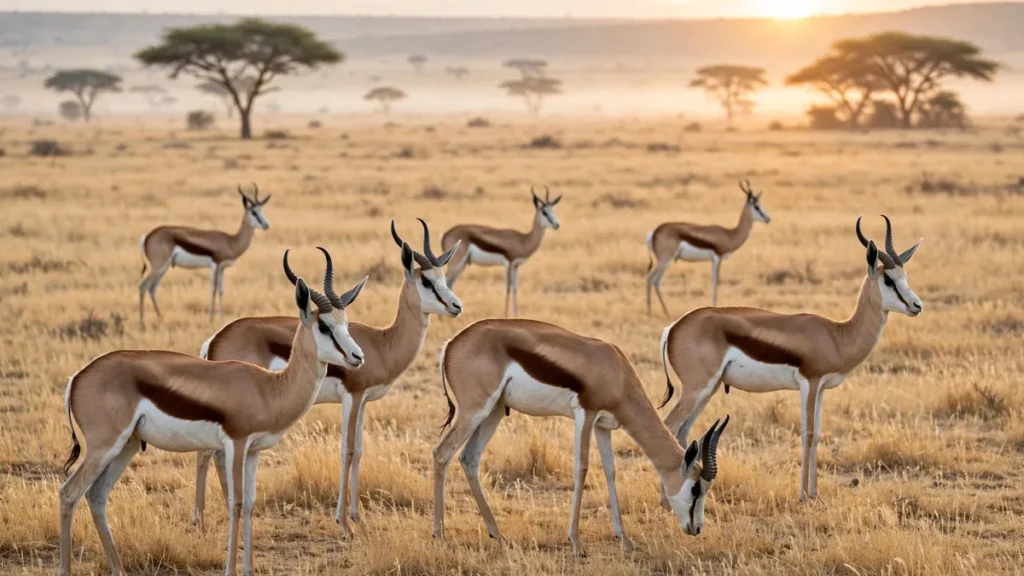
The springbok species is a single species, Antidorcas marsupialis, a slender antelope of the dry grasslands and semi-deserts of southern Africa, famous for pronking, the stiff-legged leaps that can carry it two metres into the air. If you are asking how many springbok species there are, the answer is one, and it is the only living member of its genus, the national animal of South Africa and the namesake of the country’s rugby team.
The springbok gets its name from the Afrikaans words spring, meaning jump, and bok, meaning antelope or goat, and the name fits: few animals advertise themselves as boldly as a springbok in mid-pronk, back arched and white dorsal crest flared. It is lightly built, quick enough to outrun most predators over a short sprint, and tough enough to live for years without drinking water, drawing the moisture it needs from the plants it eats.
Key takeaways
- There is one springbok species, Antidorcas marsupialis, the only living member of the genus Antidorcas.
- A springbok stands about 71 to 86 centimetres at the shoulder and weighs roughly 27 to 42 kilograms, with both sexes carrying black horns 35 to 50 centimetres long.
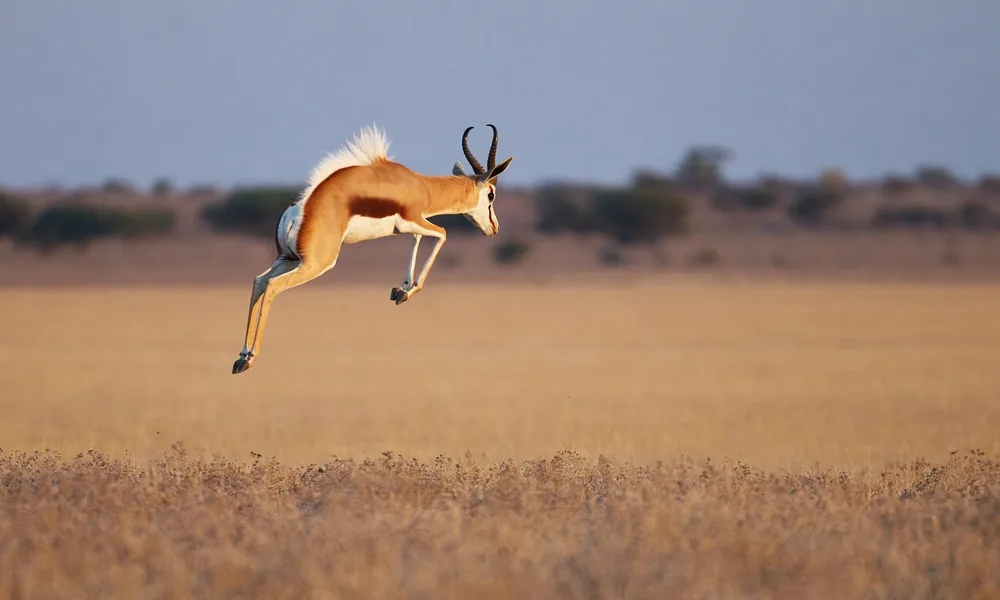
- Pronking, the stiff-legged leap up to 2 metres high with the white dorsal crest raised, is the springbok’s signature behaviour.
- The species is listed as Least Concern, with roughly two to two and a half million animals and numbers still rising.
- Springbok live in the dry grasslands and semi-deserts of southern Africa, from South Africa through the Kalahari into Namibia and Botswana.
What makes a springbok a springbok
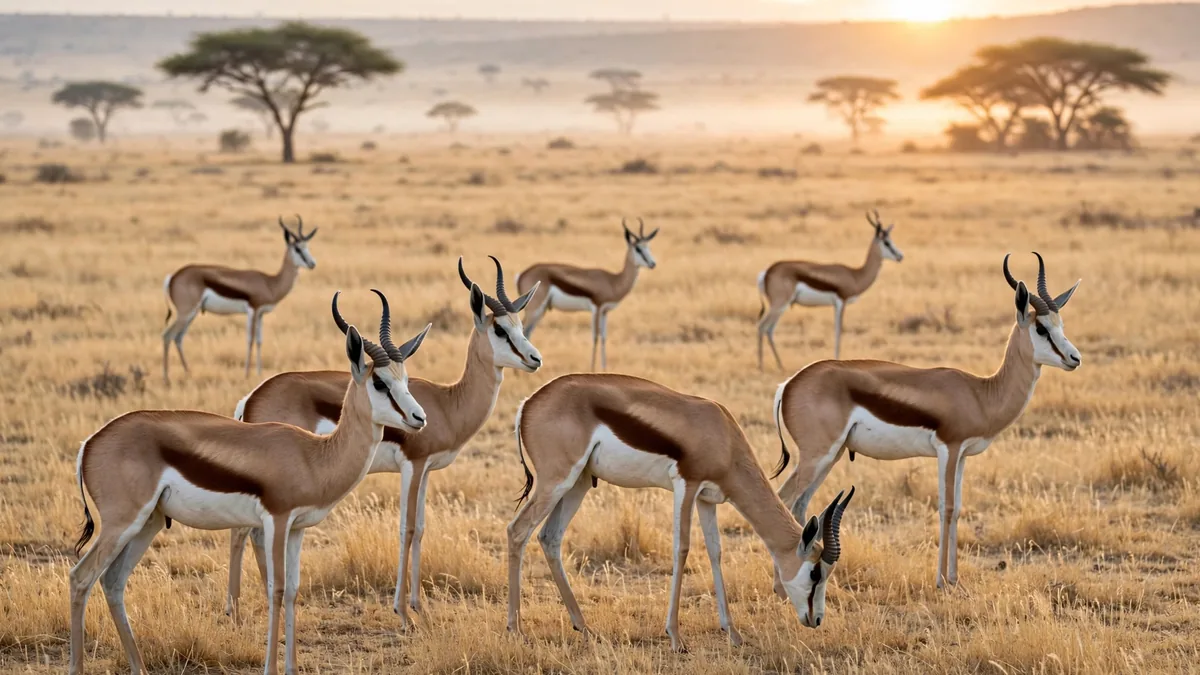
A springbok is a slender, long-legged antelope with a light brown coat, a white face and a dark stripe running from each eye to the mouth. A reddish brown stripe runs from the upper foreleg to the buttocks along each flank, and a fold of skin along the back hides a crest of long white hair that flares upwards when the animal pronks. The head and body measure about 120 to 150 centimetres.
Both rams and ewes carry a pair of black horns, 35 to 50 centimetres long, that rise from the head and curve backwards, with a slight inward turn at the tips. The ram’s horns are thicker and more strongly ringed at the base, while the ewe’s are slimmer, but the sexes are otherwise so similar in size that they are hard to tell apart. Like the gazelle, a close relative among the smaller antelopes, the springbok is built for speed rather than strength, with long, thin legs and a light frame.
The springbok species and their relatives
The springbok belongs to Antidorcas, a genus with a single living species. It is a member of the family Bovidae and the subfamily Antilopinae, the true antelopes, and it was first described by the German zoologist Eberhard August Wilhelm von Zimmermann in 1780. In 1845 the Swedish zoologist Carl Jakob Sundevall moved it into its own genus, Antidorcas, where it has stayed ever since.
Three subspecies are recognised: Antidorcas marsupialis marsupialis, south of the Orange River and the smallest; Antidorcas marsupialis hofmeyri, the largest, across Namibia and the Kalahari; and Antidorcas marsupialis angolensis, in southern Angola and northern Namibia. The springbok’s closest relatives are the gazelles, and its likeness to Thomson’s gazelle of East Africa is so close that early naturalists grouped them together.
| Type | Animal | Where it lives | Best-known food | Length or Weight |
|---|---|---|---|---|
| Genus | Springbok (genus Antidorcas) | Dry grasslands of southern Africa | Grasses, shrubs and succulents | About 71 to 86 cm at the shoulder |
| Species | Springbok (Antidorcas marsupialis) | South Africa, Namibia and Botswana | Grasses, shrubs and succulents | About 27 to 42 kg |
| Species | Thomson’s gazelle (Eudorcas thomsonii) | Savannas of Kenya and Tanzania | Grasses and shrubs | About 15 to 35 kg |
| Species | Impala (Aepyceros melampus) | Savannas of eastern and southern Africa | Grasses, leaves and shoots | About 40 to 75 kg |
| Species | Greater kudu (Tragelaphus strepsiceros) | Woodlands of eastern and southern Africa | Leaves, shoots and fruit | About 120 to 315 kg |
| Species | Gemsbok (Oryx gazella) | Deserts of Namibia, Botswana and South Africa | Grasses and succulents | About 180 to 240 kg |
How springbok live
Springbok are mixed feeders, grazing on green grass when it is fresh and turning to shrubs, herbs and succulents when the grass dries out. They eat moisture-rich plants such as the tsamma melon of the Kalahari, and they can live without drinking water for years, meeting their needs from what they eat. They feed mostly in the cool of the morning and late afternoon, resting in the shade during the heat of the day.
Springbok are social animals that gather in herds, which range from a handful of animals to hundreds when food is plentiful and herds merge on the open plains. In the dry season the herds break into smaller groups, and during the rut a ram holds a territory and keeps a group of ewes within it, driving off rivals with horn clashes and displays.
Breeding takes place all year round, with a peak in the rainy season when forage is most abundant. After a pregnancy of five to six months, a ewe gives birth to a single lamb, usually hidden in long grass for its first few days. The lamb is weaned at about six months. Springbok live for about ten years in the wild, and their speed is their main defence: they can reach about 88 kilometres per hour in a short sprint, and their zigzag flight and high leaps make them hard for a predator to catch.
Where springbok live
Springbok live in the dry areas of south and southwestern Africa, in open grassland, semi-desert and savanna, where the short grass lets them spot danger early. Their range runs from northwestern South Africa through the Kalahari Desert into Namibia and Botswana, with a separate population in southern Angola. Like the impala, another antelope of open country, they avoid thick bush, where predators can approach unseen.
Springbok are nomadic rather than settled, moving with the rains in search of fresh grazing. In the Kalahari they follow the scattered thunderstorms, gathering in herds of many hundreds on the green flush that follows the rain. In the dry season they spread out again, and they are often seen in the early morning at waterholes, though they can manage without drinking when the plants they eat hold enough moisture.
The springbok is listed as Least Concern on the IUCN Red List, and it is one of the few African antelopes whose numbers are still rising. The total population across southern Africa is estimated at roughly two to two and a half million animals, well represented in protected areas such as Etosha National Park in Namibia and the Kgalagadi Transfrontier Park shared by South Africa and Botswana. Large numbers also live on private game farms and ranches, which has helped the population grow.
Best seasons for springbok watching
The best time to watch springbok is the dry season, from about May to October, when the grass is short and the herds gather near waterholes in the early morning. Etosha National Park in Namibia is one of the finest places to see them, with great herds around the salt pan, and the Kgalagadi Transfrontier Park offers the classic Kalahari view of springbok on the red dunes. In the rainy season the herds are larger but more spread out, and the green grass makes the animals harder to spot.
Staying safe around springbok
A springbok is a wild animal and should be watched from a distance, never approached or fed. Springbok are not usually dangerous, but they are nervous animals, and a herd that feels crowded will scatter in a sudden rush. Keep well back, move slowly and quietly, and never walk between a ewe and her lamb.
On a self-drive safari, stay in your vehicle near herds and keep your speed down on gravel roads, watching for springbok crossing at dawn and dusk. In the rut, a territorial ram can be bold and may stand his ground, so give him room. Follow the guide’s instructions and the park rules; feeding wild animals is against the rules in every reserve.
Springbok watching checklist
A little preparation turns a drive across the Kalahari into a real chance of seeing a herd pronking at dawn.
- A visit to Etosha National Park in Namibia or the Kgalagadi Transfrontier Park, with a local guide.
- A dry-season trip, from about May to October, when herds gather at waterholes.
- Binoculars, because springbok are small and blend into dry grass at a distance.
- An early start, because springbok feed most actively in the cool of the morning.
- A camera with a zoom lens, for close views of a pronking animal without approaching it.
- Sun protection and plenty of water, because the Kalahari sun is fierce even in winter.
- Patience and a respectful distance, because a herd that feels crowded will scatter before it pronks.
Frequently asked questions
How many springbok species are there?
There is one springbok species, Antidorcas marsupialis, the only living member of the genus Antidorcas. Three subspecies are recognised, but they are all the same species, found across the dry grasslands and semi-deserts of southern Africa.
Why do springbok pronk?
Springbok pronk, leaping up to 2 metres into the air on stiff legs with the back arched and the white dorsal crest raised, most often when they are alarmed, excited or playing. The exact purpose is still debated, but the display probably signals to predators that the springbok is fit and hard to catch, and warns the rest of the herd.
How can a springbok live without drinking water?
A springbok gets most of the water it needs from the plants it eats, especially moisture-rich succulents and wild melons such as the tsamma of the Kalahari. It also produces water as a by-product of digesting its food, and it rests in the shade during the heat of the day. Springbok will drink when water is available, but they can survive for years without it.
What eats a springbok?
Its main predators are the cheetah, the leopard, the lion and the spotted hyena, with jackals and large eagles taking lambs. Its defence is speed and alertness: it can sprint at about 88 kilometres per hour, zigzag as it runs, and pronk high into the air, which makes it hard for a predator to catch one. Like the kudu, a larger antelope of the same region, it relies on open ground and early warning rather than on hiding.
How is this guide different from the spider monkey guide?
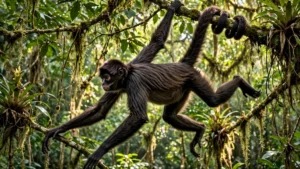
This guide covers the springbok, a single species of leaping antelope that lives on the dry grasslands of southern Africa and escapes predators by pronking and sprinting across open ground, while our spider monkey species guide covers the spider monkey, a tree-dwelling monkey of Central and South America that swings through the rainforest canopy on long limbs. One is a ground-running grazer of the African savanna, the other a canopy-dwelling primate of the American tropics.
Are springbok endangered?
No. The springbok is listed as Least Concern on the IUCN Red List, with an estimated population of roughly two to two and a half million animals and numbers still rising. It is one of the few African antelopes whose long-term population is expanding, helped by protection in national parks and by large numbers on private game farms and ranches.
Conclusion
The springbok species is one of southern Africa’s great sights: a single species, Antidorcas marsupialis, that has turned leaping into a way of life.
If you go looking for one, go in the dry season, go early in the morning, and keep your distance. Watch a herd feed across the Kalahari plain, and sooner or later one of them will pronk.