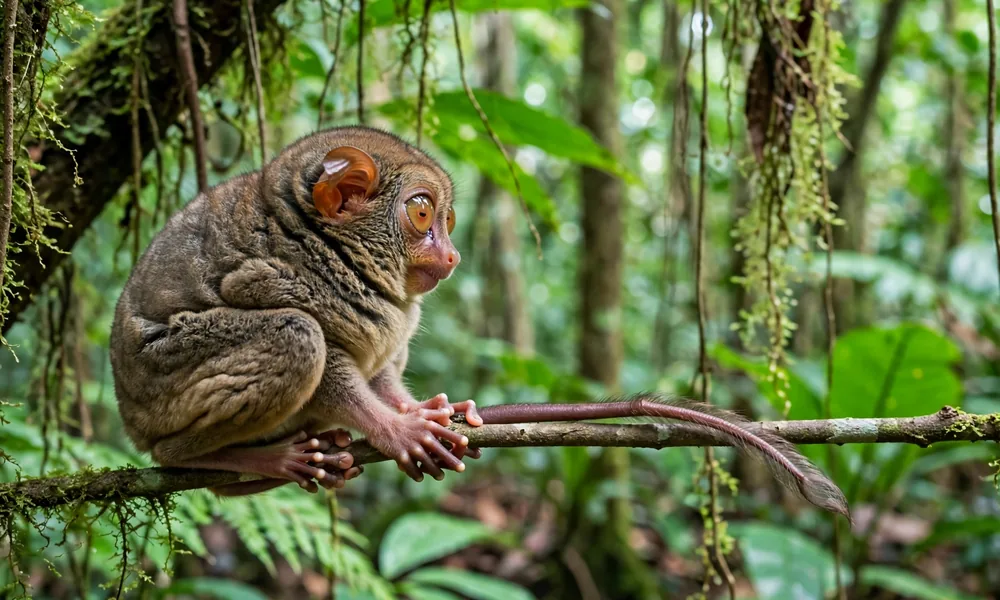
The tarsier species belong to the family Tarsiidae, about 13 to 14 recognised species of tiny nocturnal primates found only on the islands of Southeast Asia. If you are asking how many tarsier species there are, the answer depends on the authority, but every one shares the same striking design: enormous eyes, a head that turns almost all the way round, and long hind legs built for leaping.
The tarsier is one of the strangest primates alive. It is small enough to sit in the palm of your hand, yet each of its eyes is about as big as its whole brain, the largest eyes of any mammal relative to body size. It is also the only primate that eats nothing but live animal prey, hunting insects, lizards and small birds in the dark, guided by eyes and ears.
Key takeaways
- Tarsiers belong to the family Tarsiidae, with about 13 to 14 recognised species split across three genera: Tarsius, Cephalopachus and Carlito.
- A tarsier’s head and body measure only about 9 to 16 centimetres, with a tail roughly twice that long, and adults weigh just 80 to 165 grams.
- Each eye is about 16 millimetres across, roughly the size of the brain, and the head can rotate about 180 degrees because the eyes cannot move.
- Tarsiers are the only entirely carnivorous primates, eating insects, lizards and small birds, and never fruit or leaves.
- Conservation status varies by species: the Philippine tarsier is Near Threatened, the western tarsier is Vulnerable, and the Siau Island tarsier is Critically Endangered.
What makes a tarsier a tarsier
A tarsier is a study in exaggeration. Its round head is dominated by two huge, forward-facing eyes, each about 16 millimetres across, held rigid in bony sockets, so the animal turns its whole head to look around, rotating it about 180 degrees. Behind the eyes sits a small brain with a greatly enlarged visual cortex. Unlike most nocturnal mammals, tarsiers have no reflective layer behind the retina, and they compensate with a retina packed with light-gathering rod cells.
The tarsier’s body is built for clinging and leaping. Its hind legs are greatly elongated, above all the ankle bones, the tarsals, that give the animal its name, and they act like springs when it leaps from trunk to trunk. Its fingers and toes end in broad pads that grip bark, and its long, thin, nearly naked tail acts as a prop while it sits upright. The fur is thick and silky, grey to dark brown, and the large ears are almost constantly in motion, listening for prey. Like the slow loris, another small nocturnal primate of Asia, the tarsier hunts after dark, but it is a leaper where the loris is a slow climber.
The tarsier species and their relatives
Tarsiers sit in their own corner of the primate family tree. They are haplorhine primates, closer relatives of monkeys, apes and humans than of lemurs, in their own infraorder, Tarsiiformes, whose only surviving family is Tarsiidae. Their fossil relatives once ranged across northern Africa and Europe, and tarsiers are often called living fossils because they resemble primates from about 45 million years ago.
Most biologists now divide the family into three genera, formalised by Groves and Shekelle in 2010: Tarsius holds the eastern tarsiers of Sulawesi, Cephalopachus the western tarsier of Borneo and Sumatra, and Carlito the Philippine tarsier. Older books placed them all in a single genus and recognised only seven species, so the count has grown as researchers have studied their calls, genes and island distributions. Like the loris, tarsiers are nocturnal and keenly scent-driven, but their dry nose, eye structure and placenta align them with monkeys and apes.
| Type | Animal | Where it lives | Best-known food | Length or Weight |
|---|---|---|---|---|
| Family | Tarsiers (family Tarsiidae) | Islands of Southeast Asia | Insects, lizards and snakes | About 9 to 16 cm head and body |
| Species | Philippine tarsier (Carlito syrichta) | Bohol, Samar, Leyte and Mindanao | Insects and small lizards | About 80 to 165 g |
| Species | Western tarsier (Cephalopachus bancanus) | Borneo and Sumatra | Insects, lizards and small birds | About 100 to 150 g |
| Species | Spectral tarsier (Tarsius tarsier) | Sulawesi | Insects and small vertebrates | About 100 to 160 g |
| Species | Pygmy tarsier (Tarsius pumilus) | Central Sulawesi highlands | Insects | About 50 to 60 g |
| Species | Siau Island tarsier (Tarsius tumpara) | Siau Island, Indonesia | Insects | About 100 to 130 g |
How tarsiers live
Tarsiers are the only primates that eat nothing but live animal prey. Insects make up most of the diet, above all crickets, beetles and grasshoppers, but they also catch lizards, frogs, snakes and small birds, snatching prey with both hands and biting the back of the neck. They never eat fruit, leaves or seeds, and they hunt alone, clinging upright to a trunk before leaping several metres onto their prey.
Tarsiers are nocturnal, spending the day asleep in dense vegetation or a tree hollow, often in small groups, and waking at dusk to hunt alone. They are strongly territorial, and pairs or family groups defend a home range with scent marking and calls, some pitched in pure ultrasound. The Philippine tarsier’s call, at around 70 kilohertz, is one of the highest-pitched of any land mammal.
Breeding is slow. After a gestation of about six months, a female gives birth to a single young, born furred and with its eyes open, able to climb within a day. The mother parks the infant on a branch while she hunts, and it leaves to find its own territory within a year. Tarsiers live for about 12 to 16 years in the wild, and their leaping is their main defence: they can jump many times their own body length, and they are gone before a predator can follow.
Where tarsiers live
Tarsiers live only on the islands of Southeast Asia, in rainforest, mangrove and scrub with enough vertical trunks and branches for clinging and leaping. The Philippine tarsier lives on Bohol, Samar, Leyte and Mindanao, the western tarsier on Borneo and Sumatra, and the eastern tarsiers on Sulawesi and its surrounding islands. Each island often has its own species, which is why the family has split into so many forms.
Tarsiers rarely come down to the ground. They move through the understorey, from trunk to trunk, pressing the tail against the bark and gripping with their padded fingers and toes. They need dense, low vegetation to sleep in during the day, and they can live in disturbed forest and gardens with enough vertical surfaces and insects. But they are easily stressed and do not survive well in captivity, so almost all tarsiers seen by visitors are wild animals in sanctuaries.
Conservation status varies sharply from species to species, so there is no single verdict for the family. The Philippine tarsier is listed as Near Threatened, the western tarsier as Vulnerable, and the Siau Island tarsier, found only on one small volcanic island, as Critically Endangered. The main threats are the same across the family: forest cleared for farming, and the pet trade, in which tarsiers are taken from the wild and sold to tourists. Protecting forest and stopping the pet trade are the two measures that matter most.
Best seasons for tarsier watching
The best time to watch tarsiers is at dusk and after dark, all year round. The dry season, roughly March to May in the Philippines, is the most comfortable time to visit. The Philippine Tarsier Sanctuary at Corella on Bohol is one of the best-known places to see them, and Tangkoko on Sulawesi and Danum Valley in Borneo are the classic places for the eastern and western species.
Staying safe around tarsiers
A tarsier is a wild animal and should be watched quietly and from a distance, never touched, held or fed. Tarsiers are famously sensitive to stress: a frightened tarsier may injure itself, and animals kept for tourists often die within days, so the kindest viewing is a short, quiet look at a wild animal in its own tree. Keep your voice low, move slowly, and never use a camera flash.
On a night walk, follow your guide and stay on the path, using a red-filtered torch rather than a white light. Do not reach for a tarsier or wake one that is sleeping in the daytime, and never buy a tarsier or pay to hold one for a photograph, because that trade is the reason so many of them die. A good sanctuary will not allow handling at all.
Tarsier watching checklist
A little preparation turns a night walk in the rainforest into a real chance of seeing this wide-eyed hunter.
- A visit to the Philippine Tarsier Sanctuary on Bohol or Tangkoko Nature Reserve on Sulawesi, with a local guide.
- A night walk, starting at dusk, when tarsiers wake to hunt.
- A red-filtered torch, because white light disturbs them.
- Quiet clothes and soft shoes, because tarsiers hear very well.
- A camera with a fast lens and no flash, because flash can blind a tarsier.
- Insect repellent and long sleeves, for the mosquitoes after dark.
- Patience and a respectful distance, because a tarsier that feels watched will slip away into the dark.
Frequently asked questions
How many tarsier species are there?
About 13 to 14 tarsier species are recognised, split across three genera: Tarsius in Sulawesi, Cephalopachus in Borneo and Sumatra, and Carlito in the Philippines. Older books recognised only seven species, but studies of their calls, genes and island distributions have split several of them.
Why are a tarsier’s eyes so big?
Each eye is about 16 millimetres across, roughly the size of the tarsier’s whole brain, and relative to body size they are the largest eyes of any mammal. The huge eyes gather as much light as possible for hunting in the dark, because tarsiers have no reflective tapetum. The eyes cannot move in their sockets, which is why the tarsier turns its head about 180 degrees to look around.
What do tarsiers eat?
Tarsiers eat only live animal prey, and they are the only entirely carnivorous primates. Insects make up most of the diet, above all crickets, beetles and grasshoppers, but they also catch lizards, frogs and small birds. They never eat fruit, leaves or seeds, which sets them apart from every other living primate.
Can tarsiers be kept as pets?
No. Tarsiers are easily stressed, need large territories and live prey, and die quickly in captivity, often within days. They are protected by law across their range, and the pet trade is one of the main threats to the family. See them only in the wild, at a sanctuary.
How is this guide different from the springbok guide?
This guide covers the tarsier, a family of tiny nocturnal primates of Southeast Asia that cling to trees and hunt insects in the dark with enormous eyes, while our springbok species guide covers the springbok, a single species of leaping antelope of southern Africa that runs across open grassland and escapes predators by pronking. One is a palm-sized hunter of the Asian rainforest, the other a swift grazer of the African savanna.
Are tarsiers endangered?
It depends on the species. The Philippine tarsier is Near Threatened, the western tarsier is Vulnerable, and the Siau Island tarsier is Critically Endangered. The main threats are forest clearance and the pet trade. Protecting their forest and refusing to pay to hold a tarsier help them most.
Conclusion
The tarsier species are some of the most remarkable primates on Earth: a family of tiny, wide-eyed hunters that have kept their ancient design for about 45 million years.
If you go looking for one, go at dusk, go quietly, and keep your distance. Watch a tarsier cling to its branch in the dark, and you will see an animal that looks like nothing else alive.