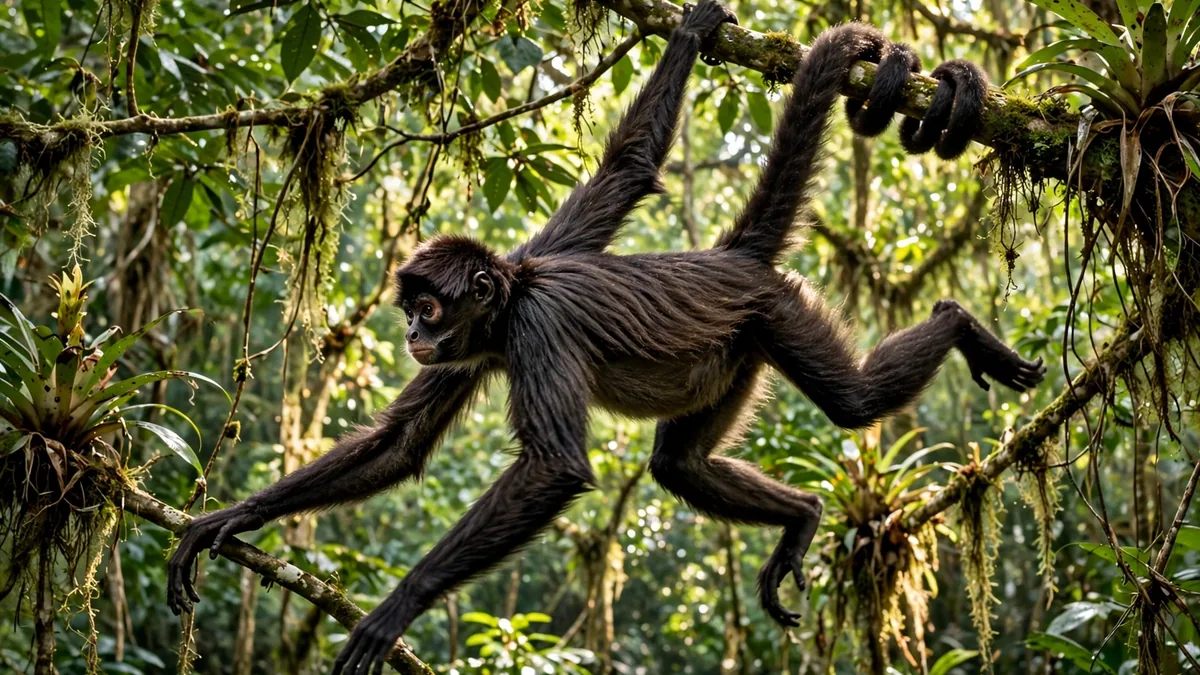
The spider monkey species are seven recognised species in the genus Ateles, long-limbed, fruit-eating monkeys that live in the high canopy of the rainforests of Central and South America. If you are asking how many spider monkey species there are, the answer is seven, and every one of them is threatened, with two listed as Critically Endangered.
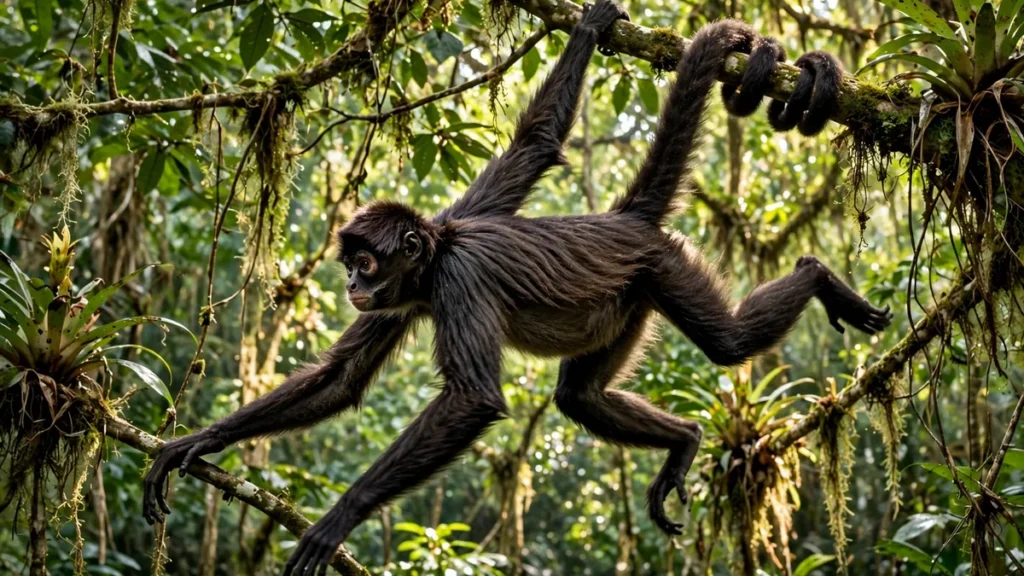
Spider monkeys get their name from the way they look when they hang in the trees: four long, spindly limbs and a very long tail splayed out like the legs of a spider. Their tail is prehensile, which means it can grip, and it works as a fifth limb, strong enough to hold the monkey’s whole weight while its hands are free to pick fruit. They are among the largest of the New World monkeys, and among the most important seed dispersers in the rainforest.
Key takeaways
- Spider monkeys are seven recognised species in the genus Ateles, and all seven are threatened.
- Their tails are fully prehensile and usually longer than their bodies, acting as a fifth limb that can support their whole weight.
- They live in the high canopy of tropical rainforests from southern Mexico to Brazil and Bolivia, and rarely come down to the ground.
- Ripe fruit makes up about 71 to 83 per cent of their feeding time, and they are important seed dispersers for the rainforest.
- The brown and black-headed spider monkeys are Critically Endangered, and all seven are losing forest to farming, ranching and roads.
What makes a spider monkey a spider monkey
A spider monkey is built for swinging. Its arms and legs are disproportionately long and thin, its body is slim, and its head is small with a short, dark face. Its body measures about 40 to 60 centimetres, its tail is usually longer than its body, reaching 60 to 90 centimetres, and it weighs about 6 to 11 kilograms depending on the species. Its coat varies from black to brown, grey or golden, with pale patches on the belly, forehead or cheeks in some species.
Its hands are the giveaway. They are long, narrow and hook-like, with four curved fingers and a thumb reduced to a tiny stub or missing altogether, which is why the genus is called Ateles, from the Greek word for incompleteness. The hook hand is poor at fine gripping but perfect for swinging, and the monkey moves by brachiation, swinging hand over hand beneath the branches. It is a New World monkey, a group that also includes howler, woolly and capuchin monkeys; our monkey species guide covers the wider family.
The spider monkey species and their relatives
Spider monkeys belong to the genus Ateles, part of the subfamily Atelinae in the family Atelidae. Their closest relatives are the woolly monkeys, the muriquis and the howler monkeys, all tree-dwelling monkeys of the American tropics. Like the other atelines, spider monkeys have prehensile tails, but theirs is the most developed of all, with a bare, ridged gripping pad at the tip that works much like a fingerprint and can pick up a piece of fruit on its own.
The seven species are the red-faced spider monkey, Ateles paniscus, also called the black spider monkey; the white-bellied, Ateles belzebuth; the Peruvian, Ateles chamek; the brown, Ateles hybridus; the white-cheeked, Ateles marginatus; the black-headed, Ateles fusciceps; and Geoffroy’s, Ateles geoffroyi, the most widespread of the seven in Central America. Each differs in range and appearance, and each carries its own conservation status, from Vulnerable to Critically Endangered.
| Type | Animal | Where it lives | Best-known food | Length or Weight |
|---|---|---|---|---|
| Genus | Spider monkeys (genus Ateles) | Rainforests from Mexico to Brazil | Ripe fruit | 40 to 60 cm, tail 60 to 90 cm |
| Species | Red-faced spider monkey (Ateles paniscus) | Guianas and the Amazon basin | Ripe fruit, leaves | About 7 to 10 kg |
| Species | White-bellied spider monkey (Ateles belzebuth) | Colombia to Peru | Ripe fruit, leaves | About 7 to 9 kg |
| Species | Peruvian spider monkey (Ateles chamek) | Peru, Bolivia and Brazil | Ripe fruit, flowers | About 7 to 10 kg |
| Species | Brown spider monkey (Ateles hybridus) | Colombia and Venezuela | Ripe fruit, leaves | About 7 to 9 kg |
| Species | White-cheeked spider monkey (Ateles marginatus) | Amazon basin of Brazil | Ripe fruit, seeds | About 7 to 9 kg |
| Species | Black-headed spider monkey (Ateles fusciceps) | Panama, Colombia and Ecuador | Ripe fruit, leaves | About 9 to 11 kg |
| Species | Geoffroy’s spider monkey (Ateles geoffroyi) | Mexico to Panama | Ripe fruit, flowers | About 6 to 9 kg |
How spider monkeys live
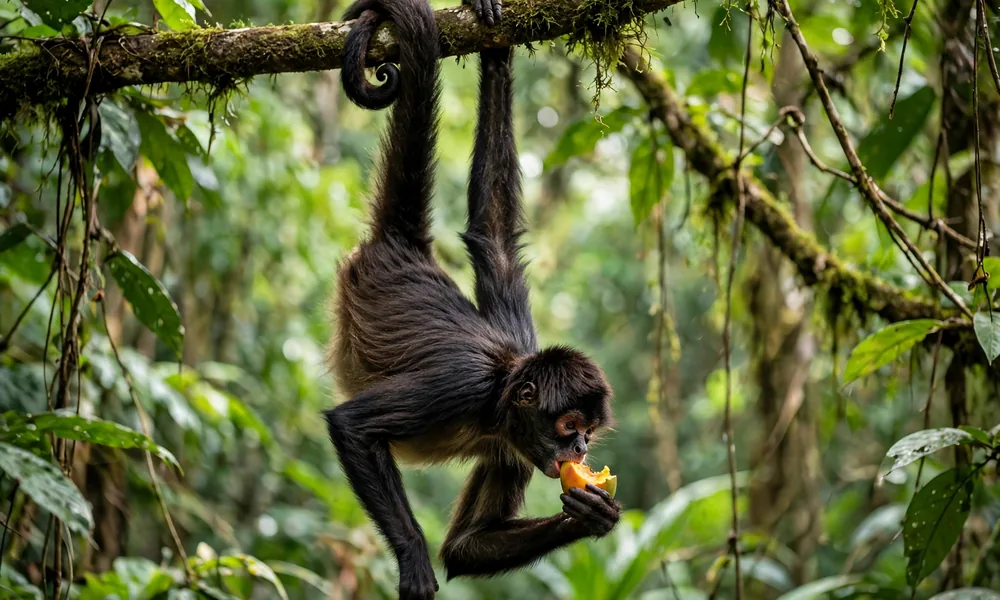
Spider monkeys are fruit specialists. Ripe, fleshy fruit makes up about 71 to 83 per cent of their feeding time, and they can live for long periods on only one or two kinds of fruit. They swallow many fruits whole, and the seeds pass through unharmed and are dropped far from the parent tree, fertilised by the droppings, which makes the monkeys gardeners of the forest. When fruit is scarce they turn to young leaves, flowers, nuts and seeds.
They are social animals that live in troops of up to 40, but the troop rarely stays together. Instead it splits into small subgroups that forage apart by day and reunite at night to sleep huddled in the trees, a fluid arrangement known as fission-fusion society. They are noisy, expressive animals, with a wide range of barks, whinnies and screams.
Spider monkeys breed slowly, which is one reason they are so vulnerable. Gestation lasts about seven to seven and a half months, a mother usually bears a single infant, and she may not breed again for two to four years. The infant rides on its mother for months and is not fully independent for years, and the monkeys live about 22 years in the wild.
Where spider monkeys live
Spider monkeys live in tropical forests from southern Mexico through Central America to Bolivia and Brazil, spending almost their whole lives in the upper rainforest, about 25 to 30 metres above the ground. They need large tracts of moist, evergreen forest, and prefer undisturbed primary rainforest with tall trees and an unbroken canopy, because they travel through the treetops and cannot easily cross open ground. They rarely come to the forest floor, usually only to drink or eat soil.
Like the slow loris, another tree-dwelling primate, the spider monkey depends on forest that is still standing and still connected. Farming, ranching and road building are cutting its habitat into fragments, and because spider monkeys are large, they are widely hunted for meat. The brown spider monkey of Colombia and Venezuela and the black-headed spider monkey of Panama, Colombia and Ecuador are both Critically Endangered, and according to the IUCN, all spider monkey populations are decreasing.
No single conservation status covers the whole genus, because each of the seven species is assessed separately. The most stable wild population, that of the red-faced spider monkey in Guyana, French Guiana, Suriname and Brazil, is still listed as Vulnerable, and the white-bellied, Peruvian, white-cheeked and Geoffroy’s spider monkeys are all Endangered. Protection of large, unbroken tracts of rainforest, and an end to hunting, are the measures that matter most.
Best seasons for spider monkey watching
The best time to watch spider monkeys is the dry season, when the trails are passable and the monkeys are easier to follow, and the early morning, when troops are most active and vocal after a night roosting together. In Costa Rica, Manuel Antonio and Corcovado National Parks are famous for Geoffroy’s spider monkeys, and guided dawn walks in Panama and the Amazon lodges of Peru and Ecuador offer the best chance of seeing a troop feeding in a fruiting tree.
Staying safe around spider monkeys
Spider monkeys are wild animals and should be watched from the ground with binoculars, never approached or fed. A fed monkey loses its fear of people and may snatch food, hats or sunglasses, and a threatened troop may shake branches, bark loudly or drop things from above. Keep your distance, keep food out of sight, and never try to touch one, however tame it seems.
Troops are usually peaceful, but adult males can be bold in defence of their group, and a monkey that bares its teeth or shakes a branch at you is telling you to move away. If that happens, back off calmly and give the animals room. Follow your guide and stay on the trails.
Spider monkey watching checklist
A little preparation turns a walk through the rainforest into a real chance of seeing these canopy acrobats at work.
- A guided dawn walk in a rainforest reserve in Costa Rica, Panama, Peru or Ecuador, where troops are tracked daily.
- A dry-season trip, when the trails are passable and the monkeys are easier to follow through the canopy.
- Binoculars, because spider monkeys live 25 to 30 metres up and are often heard before they are seen.
- Light, long-sleeved clothing and insect repellent, for the heat, humidity and biting insects.
- Sturdy, waterproof walking shoes, for muddy trails.
- A camera with a zoom lens, for close views high in the canopy.
- Patience and quiet, because a troop that feels watched will melt away through the treetops.
Frequently asked questions
How many spider monkey species are there?
There are seven recognised spider monkey species in the genus Ateles: the red-faced, white-bellied, Peruvian, brown, white-cheeked, black-headed and Geoffroy’s. They live in the tropical rainforests of Central and South America, from southern Mexico to Brazil.
Why are they called spider monkeys?
They are named for the way they look when they hang in the trees, with four long, spindly limbs and a very long tail splayed out like the legs of a spider. Their long arms, legs and tail give them a spidery silhouette as they swing through the canopy.
What do spider monkeys eat?
Spider monkeys eat mostly ripe fruit, which makes up about 71 to 83 per cent of their feeding time, along with young leaves, flowers, nuts and seeds. They swallow many fruits whole, and the seeds pass through unharmed, which makes them important seed dispersers for the rainforest.
Can a spider monkey hang by its tail?
Yes. A spider monkey’s tail is fully prehensile and can support its whole body weight, letting the monkey hang from a branch with its hands free to pick and eat fruit. The tip of the tail is bare and ridged, much like a fingerprint, and it grips so well that the monkey can pick up a piece of fruit with its tail alone.
How is this guide different from the spectacled bear guide?
This guide covers the spider monkey genus, seven fruit-eating monkeys that live in troops in the high canopy of the Central and South American rainforest and travel by swinging from branch to branch, while our spectacled bear species guide covers the spectacled bear, a single, solitary bear of the Andean cloud forests that eats mostly bromeliads and fruit. One is a canopy primate that lives in a group; the other is a lone mountain bear.
Are spider monkeys endangered?
Yes. All seven spider monkey species are threatened, and their populations are all decreasing. The brown and black-headed spider monkeys are Critically Endangered, the white-bellied, Peruvian, white-cheeked and Geoffroy’s are Endangered, and the red-faced spider monkey is Vulnerable.
Conclusion
The spider monkey species are the acrobats of the American rainforest: seven species in the genus Ateles, built for swinging through the high canopy on long limbs and a tail that works as a fifth hand.
If you go looking for one, go at dawn, go with a guide, and listen for the troop before you look for it. Find a fruiting tree full of feeding monkeys, and you will see why the forest needs them as much as they need it.