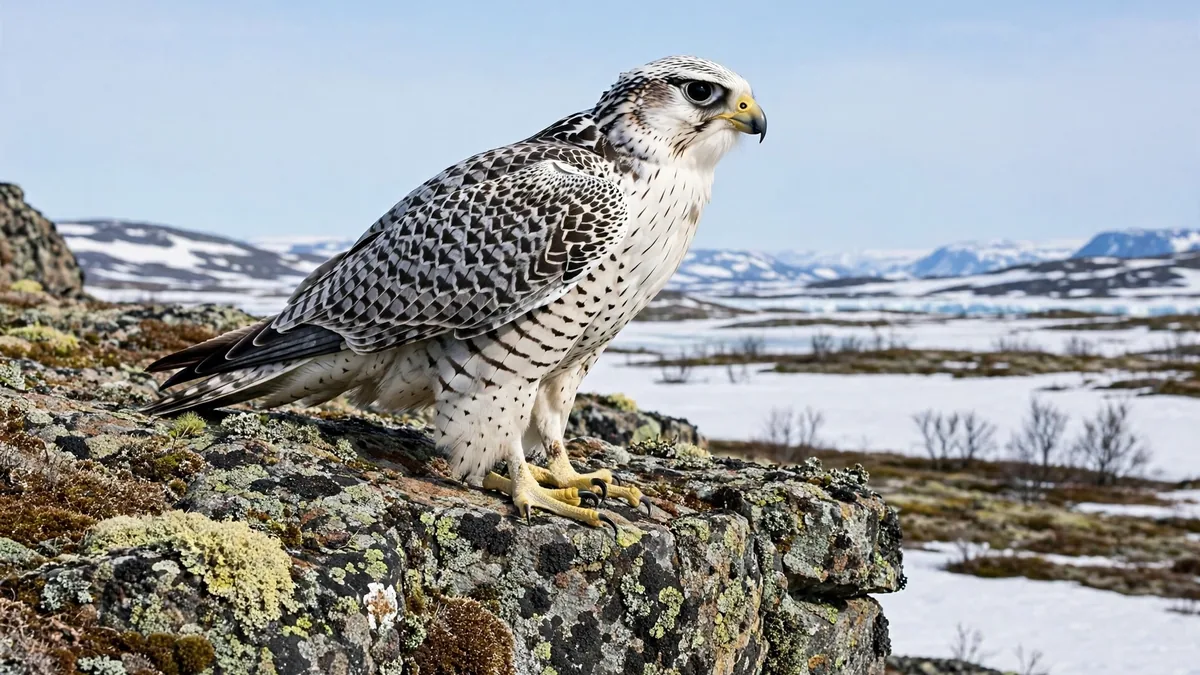
The gyrfalcon species is a single species, Falco rusticolus, the largest falcon in the world, a powerful Arctic hunter that takes ptarmigan and seabirds in low, fast pursuit over the tundra. If you are asking how many gyrfalcon species there are, the answer is one, and it is a bird of extremes: it lives further north than any other falcon, comes in white, grey and dark forms, and white birds were once gifts fit for kings.
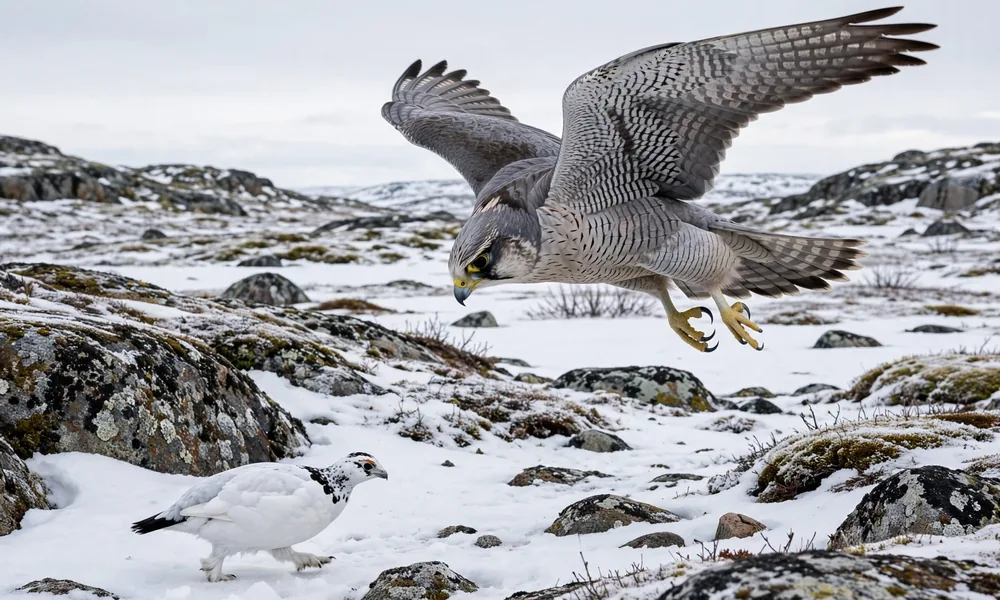
The gyrfalcon breeds on cliffs in Alaska, Canada, Greenland, Iceland, Scandinavia and Siberia, and spends the winter in the same far northern lands. Unlike many birds of prey, it does not stoop from the sky like a peregrine. Instead, it flies low and hard over the tundra, using ridges and hollows for cover, and overtakes its prey in a burst of powered flight before striking it down to the ground.
Key takeaways
- There is one gyrfalcon species, Falco rusticolus, the largest falcon in the world.
- Females are much larger than males, reaching 51 to 65 centimetres long with a wingspan of 124 to 160 centimetres and a weight of 1,180 to 2,100 grams.
- Gyrfalcons come in white, grey and dark morphs, with the whitest birds in Greenland and the darkest in Iceland.
- Ptarmigan are the main prey on the inland tundra, while coastal birds take more seabirds, ducks and gulls.
- The species is listed as Least Concern, though its small global population follows ptarmigan numbers.
What makes a gyrfalcon a gyrfalcon
A gyrfalcon is a big, heavily built falcon with broad pointed wings, a long tail and a powerful hooked beak with a small notch, called a tomial tooth, on the upper mandible. Females are much larger than males. Males measure 48 to 61 centimetres long, with a wingspan of 110 to 130 centimetres and a weight of 805 to 1,350 grams.
The plumage is famously variable. Gyrfalcons occur in three main forms, or morphs: white, grey and dark. White birds, almost pure white with dark speckling, are most common in Greenland, grey birds are the most widespread form across the Arctic, and dark, sooty-brown birds are most frequent in Iceland and Labrador. Two birds from the same nest can look quite different, and the morphs are not separate species, simply colour forms of one species.
In flight, a gyrfalcon looks bigger and broader-winged than a peregrine, with slower, deeper wingbeats and a long tail that it fans to steer through turns. Like the peregrine falcon, it has a dark moustache mark below the eye and yellow legs and cere, the bare skin at the base of the beak, but it is heavier, longer-tailed and less inclined to hunt from great height.
The gyrfalcon species and their relatives
The gyrfalcon belongs to Falco, a genus of about forty falcon species found on every continent except Antarctica. It was formally described by the Swedish naturalist Carl Linnaeus in 1758. Its closest relatives are the other large northern falcons, above all the peregrine, the saker and the lanner, which share the same hooked beak, tomial tooth and long pointed wings.
Among its relatives, the gyrfalcon stands apart by size and by range. It is the largest of all falcons, about the size of a red-tailed hawk, and the only falcon that breeds entirely within the Arctic. The peregrine breeds almost worldwide and is the faster diver, but the gyrfalcon is the stronger low-level hunter, built to chase ptarmigan across open tundra in freezing wind.
| Type | Animal | Where it lives | Best-known food | Length or Weight |
|---|---|---|---|---|
| Genus | Falcons (genus Falco) | Worldwide, except Antarctica | Birds and small mammals | About 24 to 65 cm long |
| Species | Gyrfalcon (Falco rusticolus) | Arctic tundra of the far north | Ptarmigan and seabirds | About 48 to 65 cm long |
| Species | Peregrine falcon (Falco peregrinus) | Almost worldwide | Birds caught in flight | About 34 to 58 cm long |
| Species | Saker falcon (Falco cherrug) | Central Asia and eastern Europe | Small mammals and birds | About 47 to 55 cm long |
| Species | Lanner falcon (Falco biarmicus) | Africa and southern Europe | Birds and small mammals | About 43 to 50 cm long |
| Species | Merlin (Falco columbarius) | Northern North America and Eurasia | Small birds | About 24 to 32 cm long |
How gyrfalcons live
Gyrfalcons are hunters of birds above all else. On the inland tundra, ptarmigan are the mainstay of the diet, and in some places they make up as much as nine-tenths of what a breeding pair catches. Coastal gyrfalcons take more seabirds, including gulls, ducks, murres and guillemots. They also catch mammals, above all lemmings, ground squirrels and young Arctic hares.
The hunt is usually a low, fast tail-chase. A gyrfalcon watches from a cliff or a raised perch, then launches itself low across the tundra, using dips and ridges for cover, and overtakes its prey in powered flight. It strikes the bird in the air or drives it to the ground, where it kills with a bite to the neck. A breeding pair raising young can catch 150 to 200 ptarmigan in a single season.
Gyrfalcons do not build their own nests. Instead, a pair takes over a bare cliff ledge or the abandoned nest of another bird, most often a raven or a golden eagle, and uses the same eyrie for many years. Some eyries have been used for centuries. The female lays three or four eggs in April or May, and incubates them for about five weeks while the male brings her food. The young fledge at about seven weeks old. Pairs usually stay together for life, and a gyrfalcon can live for about fifteen years or more in the wild.
Most gyrfalcons stay in the far north all year, even through the polar night, but some wander south in winter, especially young birds and those in years when ptarmigan are scarce. Its only regular predator is the golden eagle, and even eagles rarely challenge a full-grown gyrfalcon.
Where gyrfalcons live
Gyrfalcons breed right around the top of the world, in the high Arctic and the mountain tundra of Alaska, Canada, Greenland, Iceland, Norway, Sweden, Finland and Russia. They need two things: open tundra full of ptarmigan or seabird colonies, and cliffs or steep slopes for nesting. In Greenland, the great ice-free coasts hold some of the finest gyrfalcon country on Earth, and Iceland is famous for its dark-morph birds.
In winter, gyrfalcons stay close to their breeding grounds when they can, hunting along coasts, river valleys and open moorland where birds gather. Some birds drift south into northern Europe, the northern United States and southern Canada, but they never travel far from the cold.
The gyrfalcon is listed as Least Concern on the IUCN Red List, and its numbers are thought to be broadly stable. The global population is small and hard to count across such a vast and empty range, with estimates in the low tens of thousands, and it rises and falls with ptarmigan numbers. Climate change is the main long-term worry.
Best seasons for gyrfalcon watching
The best time to watch gyrfalcons is late spring and summer, from about May to August, when the birds are at their breeding cliffs, the days are long and the tundra is alive with ptarmigan. In Iceland, the cliffs of the north and east are among the most reliable places in the world to see a dark-morph gyrfalcon.
Winter brings a second chance. From about November to March, wandering gyrfalcons appear on northern coasts and open moorlands, including the north of Scotland, where they hunt ptarmigan, waders and ducks. Winter birds are often young grey or white birds, and they can stay in one area for weeks if the hunting is good.
Staying safe around gyrfalcons
A gyrfalcon is a wild bird of prey and should be watched from a distance, never approached or fed. Nesting birds are easily disturbed, and a pair that is flushed from its cliff may abandon its eggs in cold weather, so keep well back from known eyries and follow local guidance on closed areas. Use binoculars or a telescope rather than creeping closer.
Never use a drone near a nesting cliff, and never play recordings of gyrfalcon calls to lure a bird in. In winter, give a hunting bird space: a gyrfalcon that is watching a ptarmigan flock has little energy to spare, and a close approach can cost it a meal.
Gyrfalcon watching checklist
A little preparation turns a cold walk across the tundra into a real chance of seeing the largest falcon in the world.
- A trip to Iceland, northern Norway or Greenland in late spring or summer, when gyrfalcons are at their breeding cliffs.
- Binoculars or a telescope, because a gyrfalcon is often spotted as a distant speck over the tundra.
- Warm, windproof clothing and sturdy boots, because the Arctic wind is cold even in summer.
- A local guide who knows the nesting cliffs, since eyries are far apart and often hidden.
- Patience at a viewpoint above the tundra, watching for ptarmigan flocks, which a hunting gyrfalcon will follow.
- A camera with a zoom lens, for close views from a respectful distance.
- A winter visit to a northern coast or moorland, where a wandering young bird may hunt for weeks.
Frequently asked questions
How many gyrfalcon species are there?
There is one gyrfalcon species, Falco rusticolus, the largest falcon in the world. It breeds right around the Arctic, in Alaska, Canada, Greenland, Iceland, Scandinavia and Russia, in white, grey and dark morphs.
What does a gyrfalcon eat?
Gyrfalcons eat mostly birds. Ptarmigan are the main prey on the inland tundra, and in some places they make up as much as nine-tenths of the diet during the breeding season. Coastal birds take more seabirds, ducks and gulls, and all gyrfalcons also catch small mammals such as lemmings and ground squirrels.
Why are some gyrfalcons white and others dark?
Gyrfalcons are polymorphic, which means the species comes in several colour forms, or morphs: white, grey and dark. The whitest birds live in Greenland, the darkest in Iceland and Labrador, and grey birds are the most widespread. The morphs are not separate species.
Where do gyrfalcons nest?
Gyrfalcons nest on cliff ledges in the Arctic, and they do not build their own nests. A pair usually takes over the abandoned nest of a raven or a golden eagle, or simply lays its eggs on a bare ledge, and it may use the same eyrie for many years. The female lays three or four eggs in April or May.
How is this guide different from the griffon vulture guide?
This guide covers the gyrfalcon, a single Arctic hunting falcon that chases live ptarmigan and seabirds in fast, low flight over the tundra, while our griffon vulture species guide covers the griffon vulture, a large soaring scavenger that feeds on carrion. The gyrfalcon is a powerful predator of the far north, while the griffon vulture rides thermals over southern Europe, Africa and Asia.
Are gyrfalcons endangered?
No. The gyrfalcon is listed as Least Concern on the IUCN Red List, with a broadly stable population. It is naturally rare, with a global population in the low tens of thousands, though a warming Arctic and falling ptarmigan numbers in some areas are watched closely.
Conclusion
The gyrfalcon species is the Arctic in bird form: one species, Falco rusticolus, the largest falcon in the world, hunting ptarmigan across the tundra in white, grey and dark.
If you go looking for one, go north in summer and watch the cliffs at dawn. A white bird crossing a snowfield, low and fast, is a sight that stays with you for the rest of your life.