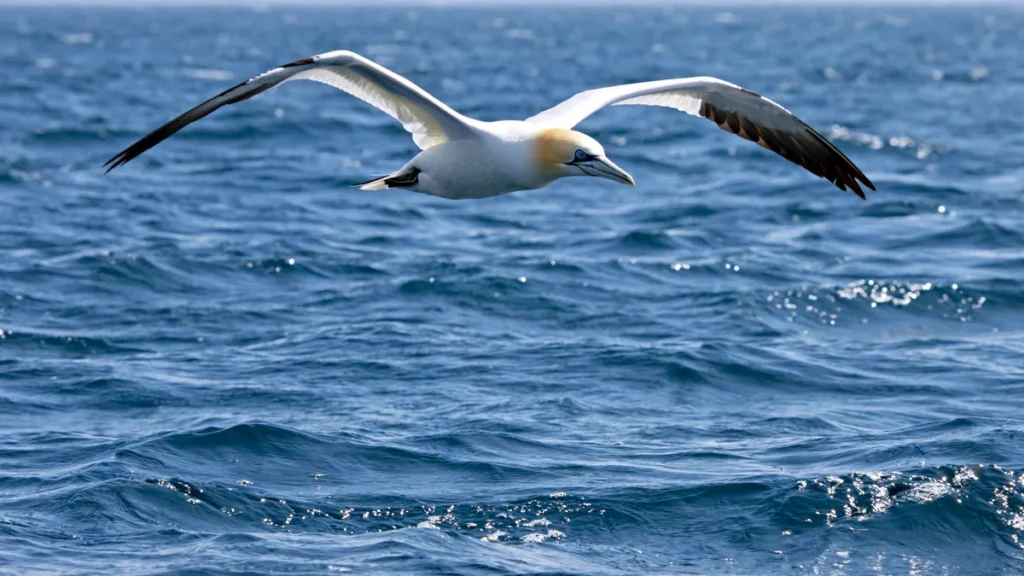
The northern gannet species is a single species, Morus bassanus, the largest seabird of the North Atlantic, a white seabird that hunts by folding its wings and plunging into the sea at great speed. If you are asking how many northern gannet species there are, the answer is one, and it is one of the most spectacular seabirds to watch anywhere in the world.
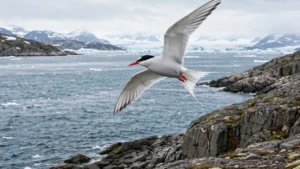
The gannet is unmistakable: a white body, black wingtips, a pale yellow head and a long, dagger-like bill, with a wingspan of up to 180 centimetres. In summer, tens of thousands crowd onto a few rocky islands and cliffs, filling the air with harsh calls and the sea below with diving birds.
Key takeaways
- The northern gannet species is Morus bassanus, the largest seabird of the North Atlantic.
- Adults are 87 to 100 centimetres long, with a wingspan of 170 to 180 centimetres and a weight of 2.3 to 3.6 kilograms.
- Gannets hunt by plunge-diving from up to 30 metres, hitting the water at speeds of around 100 kilometres per hour.
- They breed in huge colonies on offshore islands and cliffs, laying a single egg each year.
- The species is listed as Least Concern, with a population estimated at 1.5 to 1.8 million mature birds.
What makes a northern gannet a northern gannet
An adult northern gannet is a large, streamlined seabird, 87 to 100 centimetres long, with a mainly white body, a long neck, and long, narrow wings tipped with black. The head and neck are washed with a pale, buff yellow, and the bill is long, pointed and blue-grey, with blue skin around the eye. In flight the wings are held stiff and straight, and the bird glides for long stretches.
Young gannets look very different: dark brown, speckled all over with white spots, whitening gradually over four to five years until they reach full adult plumage. The gannet is built for its dive: it has no external nostrils, so water cannot rush in on impact, air sacs under the skin of the face and chest act like cushions, and a clear membrane drops over the eye as it enters the water. Its call in the colony is a harsh, rasping arrah-arrah, repeated again and again.
The northern gannet species and their relatives
The northern gannet belongs to Morus, a small genus in the family Sulidae, and Morus bassanus is its only member in the North Atlantic. It is a monotypic species, which means no subspecies are recognised. Its name comes from Bass Rock, the island in the Firth of Forth that holds one of its greatest colonies.
Its closest relatives are the other two gannets: the Cape gannet of the coasts of southern Africa and the Australasian gannet of Australia and New Zealand, both slightly smaller and with darker heads. The wider family Sulidae also includes the boobies of tropical seas, such as the masked booby and the blue-footed booby, which share the gannets’ pointed wings, dagger bills and habit of diving for fish.
| Type | Animal | Where it lives | Best-known food | Length or Weight |
|---|---|---|---|---|
| Genus | Gannets (genus Morus) | North Atlantic and southern oceans | Fish caught by diving | Wingspan up to about 180 cm |
| Species | Northern gannet (Morus bassanus) | Coasts of the North Atlantic | Mackerel, herring and sandeels | About 87 to 100 cm long |
| Species | Cape gannet (Morus capensis) | Coasts of southern Africa | Sardines and anchovies | About 84 to 94 cm long |
| Species | Australasian gannet (Morus serrator) | Coasts of Australia and New Zealand | Pilchards and squid | About 84 to 91 cm long |
| Species | Masked booby (Sula dactylatra) | Tropical oceans worldwide | Fish and squid | About 81 to 92 cm long |
| Species | Blue-footed booby (Sula nebouxii) | Eastern Pacific Ocean | Fish, above all sardines | About 76 to 84 cm long |
How northern gannets live
Northern gannets are fish specialists, and their diet is made up almost entirely of shoaling fish such as mackerel, herring, sandeels, sardines and anchovies. A hunting gannet circles high over the sea, then folds its wings back and drops like an arrow, entering the water from a height of up to 30 metres at speeds of around 100 kilometres per hour. Underwater it uses its wings and feet to chase fish down, sometimes to depths of 10 to 20 metres, and it swallows its catch before surfacing.
Gannets often hunt in groups, and a feeding flock can draw in other seabirds, dolphins and whales. They also follow fishing boats, picking up fish thrown overboard, which brings them into danger from nets and hooks. A cormorant is another diving fish hunter of the same coasts, but the cormorant swims down from the surface, while the gannet arrives from the sky.
Gannets are monogamous and form pair bonds that can last for life, renewed each year with displays of head shaking and bill fencing at the nest. The pair lays a single pale blue egg, which both parents incubate for 42 to 46 days, warming it under their webbed feet. The chick is fed regurgitated fish for about 13 weeks and fledges at 84 to 97 days old. Gannets first breed at four to five years old, and a bird that reaches breeding age lives for about 17 years, with the oldest ringed bird reaching more than 37 years.
Where northern gannets live
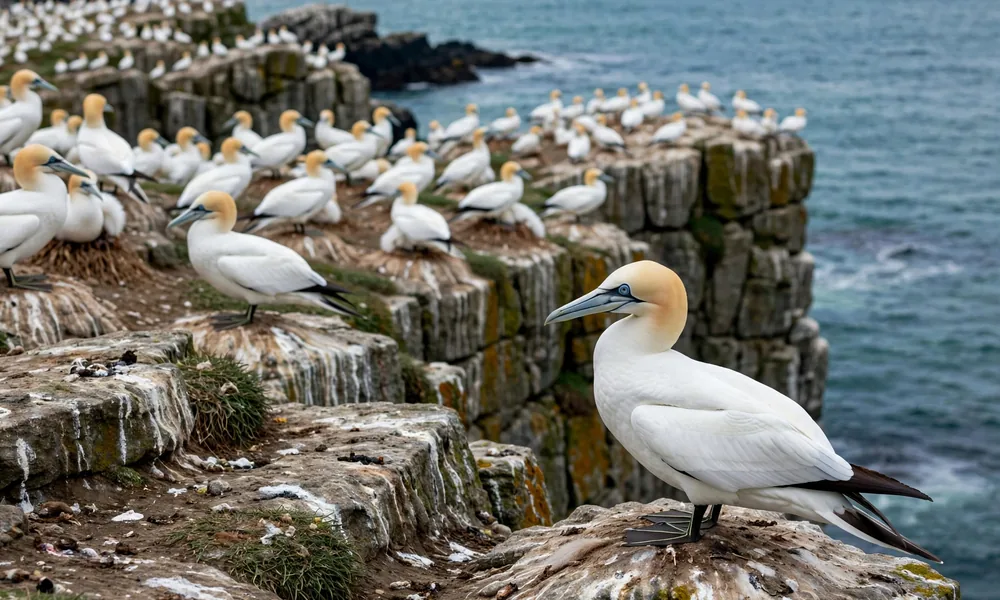
Northern gannets live only in the North Atlantic, breeding on both sides of the ocean. More than 70 per cent of the world population breeds around the coasts of the British Isles, above all in Scotland, with other colonies in Ireland, Wales, Iceland, Norway, France, the Faroe Islands and eastern Canada. The largest colonies are at Bass Rock, with about 75,000 pairs, St Kilda, with about 60,000 pairs, and Bonaventure Island off Quebec, with about 60,000 pairs.
Gannets need offshore islands and steep cliffs for breeding, because a crowded colony gives them room to land and take off, and the height helps them launch into the air. Outside the breeding season they live entirely at sea over the continental shelf, and they rarely come ashore except to breed. North American birds winter along the eastern seaboard of the United States from New Jersey to Florida, while European birds cross the Strait of Gibraltar into the Mediterranean or follow the African coast to the Gulf of Guinea. On the same cliffs you may see an Atlantic puffin nesting in a burrow below the gannets.
The northern gannet is listed as Least Concern on the IUCN Red List, with a population estimated at 1.5 to 1.8 million mature birds, and numbers had been rising for decades as hunting for food and feathers came to an end. Recent outbreaks of highly pathogenic avian influenza have hit colonies hard, however, and the full effects are not yet certain, so the species is watched closely every summer.
Best seasons for northern gannet watching
The best time to watch northern gannets is the breeding season, from April to September, when the colonies are full and the air is thick with birds coming and going. May and June are best for the colony itself, with pairs displaying and the first chicks hatching, while August and September bring the fledging of the young. In winter the colonies are empty and the birds are far out at sea, so a boat trip is the only way to see them. A great egret may be fishing in the shallows below the cliffs while gannets dive offshore.
Staying safe around northern gannets
A northern gannet is a large, strong bird with a dagger bill, and a colony bird will defend its nest with a sharp jab, so never approach a nest or reach towards a bird on the ground. Watch colonies from the marked viewpoints, using binoculars or a telescope, and never climb cliffs or enter a colony, because the ledges are slippery with droppings and a fall can be fatal. Keep dogs on a lead near cliff tops, since a dog can flush birds from their nests.
If you take a boat trip to a gannery, follow the crew’s instructions, stay seated when told, and keep hands and cameras inside the boat, because gannets may fly close and the sea can be rough. Stay on marked paths, ask before crossing private land, and never handle a gannet, which is protected by law in Britain, Ireland and Canada. If you find a dead or sick seabird on a beach, do not touch it, and report it to the local wildlife authorities.
Northern gannet watching checklist
A little preparation turns a visit to a seabird colony into a real chance of seeing northern gannets diving.
- A breeding-season visit, from April to September, to a known colony such as Bass Rock or Bempton Cliffs.
- An early morning or late afternoon start, when the colony is at its busiest.
- Binoculars or a telescope, because a gannet colony is best watched from a safe distance.
- An ear tuned for the harsh arrah-arrah call, which carries across the colony.
- Patience on the cliff-top viewpoints, where the birds stream past on their way to the fishing grounds.
- A camera with a zoom lens, for close views of diving birds without approaching a nest.
- Respect for cliff edges, colony boundaries and private land, because a disturbed nest may be abandoned.
Frequently asked questions
How many northern gannet species are there?
There is one northern gannet species in this guide, Morus bassanus, and it has no recognised subspecies. Its closest relatives are the Cape gannet of southern Africa and the Australasian gannet of Australia and New Zealand, separate species in the same genus.
How fast do northern gannets dive?
Northern gannets dive from heights of up to 30 metres and hit the water at speeds of around 100 kilometres per hour, about 60 miles per hour. Air sacs under the skin of the face and chest cushion the impact, and a clear membrane covers the eye as the bird enters the water.
What do northern gannets eat?
Northern gannets eat almost entirely fish, above all shoaling species such as mackerel, herring, sandeels, sardines and anchovies. They catch their prey by plunge-diving from the air and chasing it underwater, and they also take fish thrown overboard by fishing boats.
Where do northern gannets breed?
Northern gannets breed in large colonies on offshore islands and steep cliffs around the North Atlantic, with more than 70 per cent of the world population around the British Isles. The largest colonies are Bass Rock and St Kilda in Scotland and Bonaventure Island off Quebec.
How is this guide different from the northern flicker guide?
This guide covers the northern gannet, a large white seabird of the North Atlantic that plunge-dives for fish and breeds in huge cliff colonies, while our northern flicker species guide covers the northern flicker, a brown woodpecker of North America that feeds on ants on the ground. One dives into the sea from the sky; the other digs in the soil for ants.
Are northern gannets endangered?
No. The northern gannet is listed as Least Concern on the IUCN Red List, with a population estimated at 1.5 to 1.8 million mature birds. Numbers had been rising for decades, but recent outbreaks of avian influenza have hit colonies hard, so the population is watched closely every summer.
Conclusion
The northern gannet species is built for the plunge: one species, Morus bassanus, a white seabird with black wingtips and a yellow head that drops from the sky into the sea and breeds in colonies of tens of thousands.
If you go looking for one, go in summer to a cliff colony, and watch the birds stream out to sea. Find a gannet folding its wings and dropping like an arrow, and you will see why it is the North Atlantic’s most spectacular seabird.