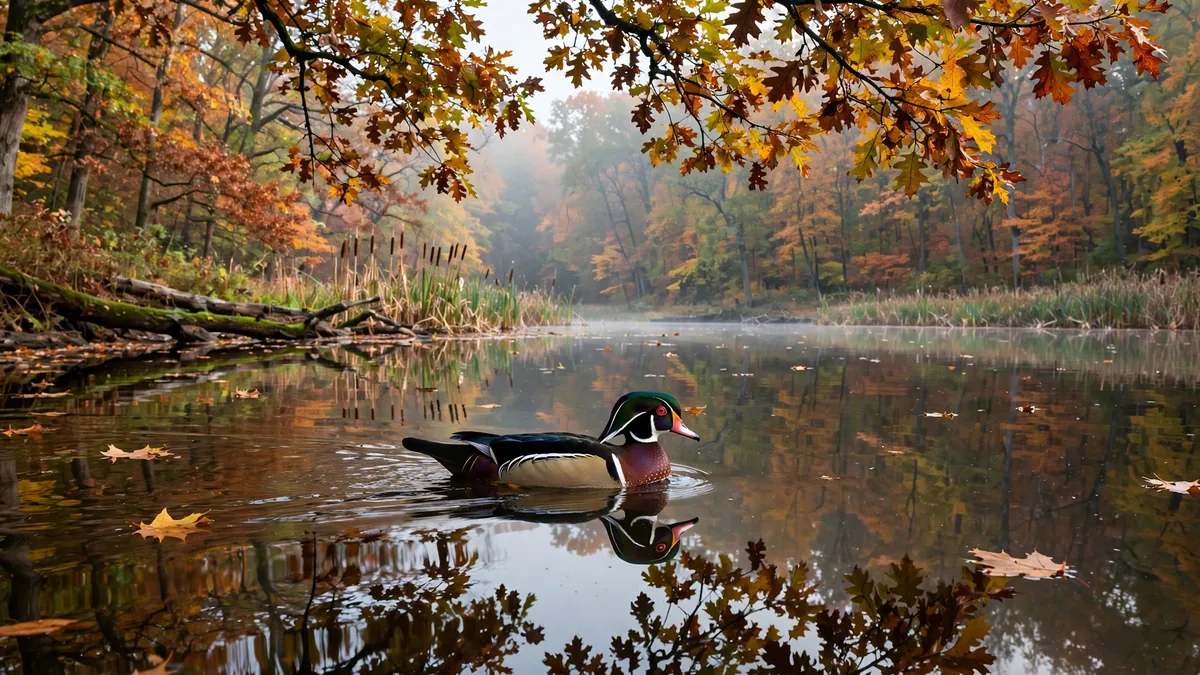
The wood duck species is Aix sponsa, a small, crested perching duck of North America, and the male is one of the most colourful ducks in the world. If you are asking how many wood duck species there are, the answer is one, with no recognised subspecies.
Wood ducks were nearly wiped out by hunting and habitat loss in the early twentieth century, yet they recovered so well that they are now common across much of North America. Their secret is the nest box: thousands of wooden boxes in wetlands gave them the tree holes they need to breed.
Key takeaways
- The wood duck species is Aix sponsa, one species with no recognised subspecies in the duck family Anatidae.
- Males are 41 to 49 centimetres long, with a wingspan of 66 to 75 centimetres and weighing 500 to 700 grammes.
- Wood ducks nest in tree holes and nest boxes, and the ducklings leap to the ground within a day of hatching.
- They eat acorns, seeds, fruit, insects and small aquatic animals in wooded wetlands.
- Listed as Least Concern, with a large and increasing population after near-extinction in the early 1900s.
What makes a wood duck a wood duck
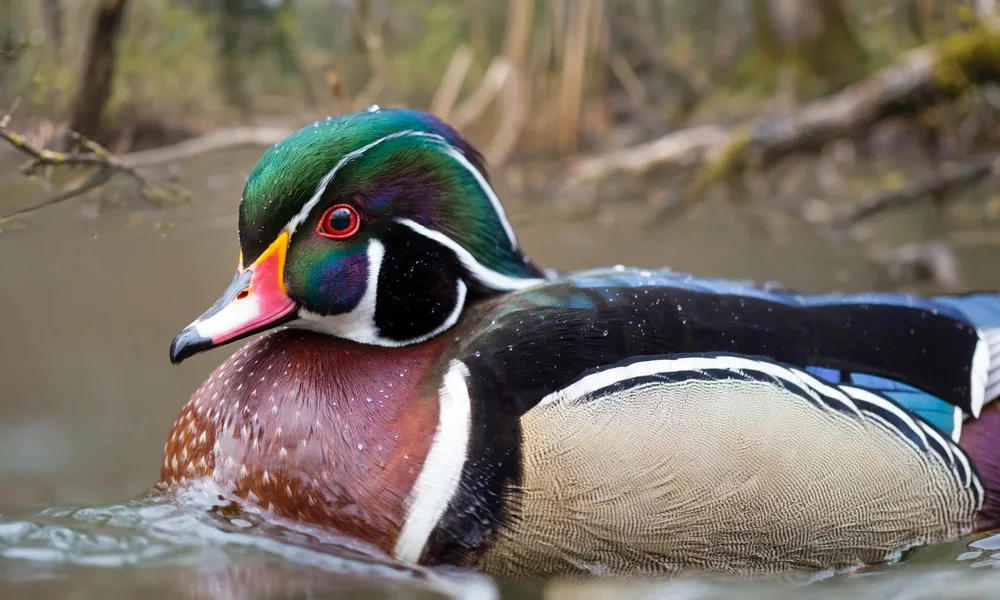
A wood duck is a small, compact duck, 41 to 49 centimetres long, with a wingspan of 66 to 75 centimetres and a weight of 500 to 700 grammes. The male is unmistakable: an iridescent green crested head with white stripes, a red eye, a red, white and yellow bill, a chestnut breast spotted with white, and buff flanks patterned with black and white. The female is far plainer, grey-brown with a white ring around the eye and a crested head, which hides her well on the nest. Both sexes have long, square tails and strong claws for perching.
Wood ducks are perching ducks, a small group that spends much of its time in trees. They perch on branches, roost in trees at night, and nest in holes high above the ground. They fly fast through woodland, twisting between branches with surprising agility, and they are strong swimmers, though they rarely dive. The male has a soft, rising whistle, while the female gives a loud, squealing call, and in summer the male moults into a dull eclipse plumage much like the female.
The wood duck species and their relatives
The wood duck belongs to Aix, a small genus of perching ducks in the family Anatidae, and it is a monotypic species, meaning no subspecies are recognised. Eastern and western populations look the same, and no regional forms are generally accepted, though western birds tend to be slightly smaller. The species was first described by Carl Linnaeus in 1758, and its name, Aix sponsa, means roughly a bridal duck, a nod to the male’s splendid plumage.
Its only close relative is the mandarin duck, Aix galericulata, of East Asia, the other living species in the genus Aix. The mandarin male is even more flamboyant, with orange sails on its back, while the female looks much like a female wood duck. Like the mute swan, the wood duck belongs to the waterfowl family Anatidae, but the swan is a huge, long-necked grazer of open water, while the wood duck is a small, crested bird of wooded ponds and streams.
| Type | Animal | Where it lives | Best-known food | Length or Weight |
|---|---|---|---|---|
| Genus | Perching ducks of genus Aix | North America and East Asia | Seeds and insects | About 41 to 49 cm long |
| Species | Wood duck (Aix sponsa) | North America | Acorns and insects | 41 to 49 cm, 500 to 700 g |
| Species | Mandarin duck (Aix galericulata) | East Asia, introduced in Europe | Seeds and insects | 41 to 49 cm, 400 to 700 g |
| Species | Mallard (Anas platyrhynchos) | Northern hemisphere | Seeds and plants | About 50 to 65 cm, 0.7 to 1.6 kg |
| Species | American black duck (Anas rubripes) | Eastern North America | Seeds and plants | About 48 to 63 cm, 0.7 to 1.6 kg |
| Species | Northern pintail (Anas acuta) | Northern hemisphere | Seeds and plants | About 51 to 66 cm, 0.5 to 1.1 kg |
How wood ducks live
Wood ducks feed in shallow water and on land, dabbling at the surface and tipping up in the shallows. Acorns are their most important food in autumn and winter, along with beech and hickory seeds, berries, grain and the buds of water plants. In spring and summer they eat far more animal food: insects, caterpillars, small crustaceans, tadpoles and small fish, which give the ducklings the protein they need to grow.
Breeding starts in late winter and spring, with pairs forming in February to April depending on latitude. Wood ducks are monogamous for the season, and the female chooses a nest hole in a tree, often an old woodpecker hole or a natural hollow, usually near water but sometimes hundreds of metres away and up to 18 metres high. She lays six to fifteen creamy white eggs, one a day, and incubates them alone for about 28 to 37 days, while the male stays nearby at first and then leaves to moult.
The ducklings hatch covered in down, and within a day they must leave the nest. At the female’s call they climb to the entrance and leap, tumbling to the ground or water below, a fall that can be 15 metres or more, and they bounce unharmed thanks to their light weight. The female leads them to water at once, where they feed themselves, and they fledge after about 56 to 70 days. Wild wood ducks usually live for three to four years, though some reach 15 years or more.
Where wood ducks live
Wood ducks live across North America, breeding from southern Canada through the eastern and central United States to the Gulf of Mexico, and along the Pacific coast to California. They favour wooded wetlands: slow streams, ponds, marshes, swamps and flooded forest, where overhanging trees give them cover, perches and nest holes, and where acorns and seeds are plentiful. They avoid open, treeless water.
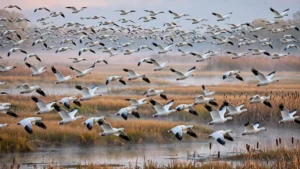
Northern birds are migratory, moving south in autumn to winter in the southern United States and northern Mexico, while southern birds stay put all year. In winter they gather in flooded woodland and marshes, sometimes in large flocks, and often feed in fields at dawn and dusk. Like the snow goose, the wood duck is a North American waterbird that migrates south in winter, but the goose gathers in huge flocks on open tundra, while the wood duck hides in wooded swamps.
The wood duck is listed as Least Concern on the IUCN Red List, with an increasing population estimated at several million birds. That was not always so: by the early 1900s, hunting for food and feathers and the loss of bottomland forest had brought the species to the edge of extinction. The Migratory Bird Treaty Act of 1918 banned market hunting, and from the 1930s onwards thousands of nest boxes were put up in wetlands across North America, giving the birds the nest holes they had lost. The recovery was rapid, and the wood duck is now one of the most common ducks in eastern North America. Habitat loss, predation by raccoons and collisions with vehicles remain threats, and the birds are still hunted under strict limits.
Best seasons for wood duck watching
Wood ducks are easiest to watch from spring to autumn, when the breeding birds are on wooded ponds and streams. From March to June, look for pairs on quiet, tree-lined water at dawn and dusk. In autumn, watch flooded woodland and marshes, where the birds gather to feed on acorns, and listen for the female’s squealing call.
Staying safe around wood ducks
A wood duck is a shy, wild bird, best watched from a distance with binoculars. Never approach a nest box or tree hole closely in the breeding season, since a disturbed female may abandon her eggs. Keep dogs on a lead near nesting sites, and do not flush birds from the water for a photograph. Like the bald eagle, the wood duck is protected in the United States under the Migratory Bird Treaty Act, and its nests and eggs are protected by law.
Wood ducks are harmless to people, but they are vulnerable to disturbance, especially in winter, when they need to feed undisturbed to survive the cold. If you find an injured duck, do not handle it yourself: call a local wildlife rescue group instead. If you put up a nest box, place it over water or near a wetland, with a predator guard.
Wood duck watching checklist
A little preparation turns a quiet morning on a wooded pond into a real chance of watching wood ducks.
- A visit from March to June, when pairs are on quiet, tree-lined ponds and streams.
- A dawn or dusk start, when the birds feed in low light and the male’s colours show best.
- Binoculars, since a wood duck on a distant pond is hard to see clearly.
- A scan of overhanging branches and fallen trees, where the birds perch and roost.
- A look for nest boxes on posts over the water, which the birds use in place of tree holes.
- An ear for the female’s loud, squealing call and the male’s soft, rising whistle.
- Respect for nest sites and winter flocks, keeping your distance and never flushing birds.
Frequently asked questions
How many wood duck species are there?
There is one wood duck species, Aix sponsa, with no recognised subspecies. The species is monotypic, meaning eastern and western populations are treated as the same bird, though western birds tend to be slightly smaller. Its only close relative is the mandarin duck of East Asia.
What does a wood duck eat?
A wood duck eats acorns, seeds, fruit, grain and the buds of water plants, along with insects, caterpillars, small crustaceans, tadpoles and small fish. Acorns matter most in autumn and winter, while animal food matters most in spring and summer.
Where do wood ducks nest?
Wood ducks nest in holes in trees, usually old woodpecker holes or natural hollows, often near water but sometimes hundreds of metres away and up to 18 metres high. They also use nest boxes put up in wetlands, which were vital to the species’ recovery.
How do wood duck ducklings leave the nest?
Within a day of hatching, the ducklings climb to the entrance of the nest hole and leap, tumbling to the ground or water below, a fall that can be 15 metres or more. They bounce unharmed thanks to their light weight and fluffy down, and the female leads them to water at once.
Are wood ducks endangered?
Not officially. The wood duck is listed as Least Concern on the IUCN Red List, with a large and increasing population of several million birds. By the early 1900s it was near extinction from hunting and habitat loss, but the Migratory Bird Treaty Act of 1918 and thousands of nest boxes brought it back to abundance.
How is this guide different from the white stork guide?
This guide covers the wood duck, a small, colourful, crested duck of North American wooded ponds that nests in tree holes, while our white stork species guide covers the white stork, a tall, black-and-white, long-legged wader of Europe and Africa that nests on rooftops and migrates thousands of kilometres. One is a tree-hole duck of one continent; the other is a rooftop giant of two.
Conclusion
The wood duck species needs little introduction once you have seen a male in spring light: one species, Aix sponsa, a small, crested duck with an iridescent green head and a chestnut breast, nesting in tree holes.
If you go looking for one, go at dawn, to a quiet, tree-lined pond, and listen for the squeal. Find a pair slipping through the reeds in low light, and you will see a conservation success story at work.