The sword-billed hummingbird species is a single species, Ensifera ensifera, the only member of its genus and the only bird in the world whose bill is longer than its body. If you are asking how many sword-billed hummingbird species there are, the answer is one, and its bill, at 8 to 12 centimetres long, is longer than the rest of its body without the tail.
The swordbill lives high in the Andes, in the cool, misty cloud forests of South America, where it hovers at long, hanging flowers that no other bird can reach. Its bill is so long that it cannot preen its own feathers with it, so it scratches itself with its feet, and it perches upright, the great black bill pointing skywards like a sword at rest. It is one of the strangest birds on Earth, and it owes its whole way of life to a single partnership with a flower.
Key takeaways
- The sword-billed hummingbird species is Ensifera ensifera, a single species and the only member of the genus Ensifera.
- Its bill measures 8 to 12 centimetres, longer than its body without the tail, the most extreme bill-to-body ratio of any bird.
- Adults are 13 to 14 centimetres long excluding the bill and weigh 10 to 15 grams, making the swordbill one of the largest hummingbirds.
- It lives in humid Andean cloud forest from Venezuela to Bolivia, mostly at 1,700 to 3,500 metres, and feeds on nectar from long tubular flowers, above all the passionflower Passiflora mixta.
- The species is listed as Least Concern, but deforestation and climate change threaten the cloud forest and the flowers it depends on.
What makes a sword-billed hummingbird a sword-billed hummingbird
A sword-billed hummingbird is a large hummingbird with glittering bronze-green upperparts and a bill that dominates everything else about it. The body alone is 13 to 14 centimetres long, and the bird weighs 10 to 15 grams, yet the bill adds another 8 to 12 centimetres, so the total length reaches 17 to 23 centimetres including the bill. Published accounts give slightly different bill figures, with most putting the usual range at 9 to 11 centimetres.
The sexes differ in plumage. The male has a coppery bronze head with a small white spot behind the eye, dark bronze-green upperparts, a blackish throat, glittering green breast and belly, and a forked blackish bronze-green tail. The female has similar upperparts, but her underparts are white and speckled with green, her throat is greyish and spotted with olive, and her tail is less deeply forked and edged with greyish white. Because the bill is too long to reach its own feathers, the swordbill preens and scratches with its feet, and it perches upright, clinging to a stem at a steep angle.
The sword-billed hummingbird species and their relatives
The sword-billed hummingbird belongs to Ensifera, a genus with a single member, in the hummingbird family Trochilidae. Its scientific name tells the story: both the genus and the species name come from the Latin for sword bearer. It is monotypic, meaning no subspecies are recognised, and it sits within the brilliants, a group of Andean hummingbirds.
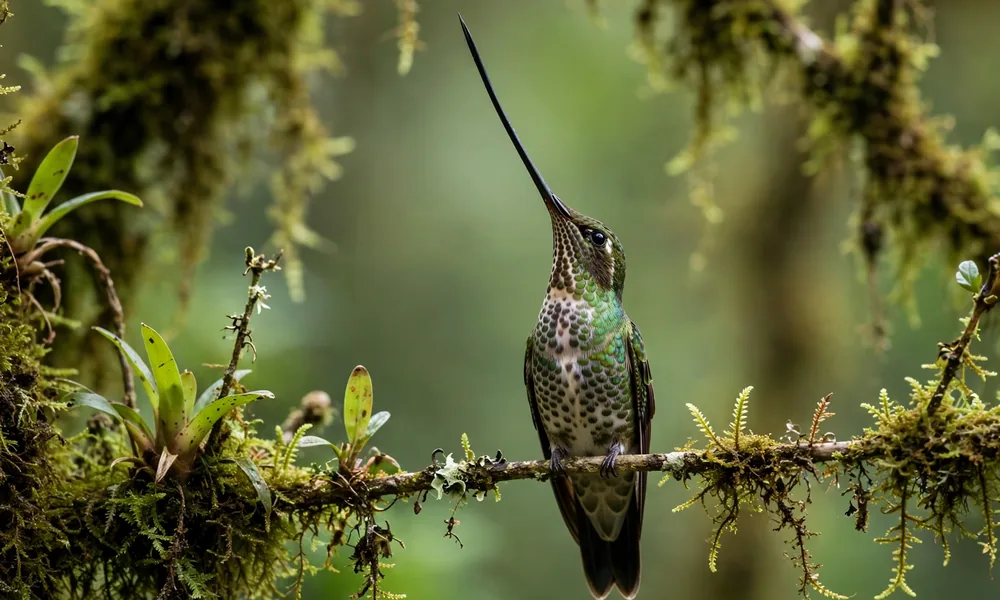
Its closest relatives are other hummingbirds of the high Andes, but none of them carries anything like its bill. The giant hummingbird is larger in body and the buff-tailed coronet shares its mountain forests, yet both have ordinary bills. The swordbill alone has traded a normal bill for a tool that opens a private food supply, and that single specialisation sets it apart from every other member of its family.
| Type | Animal | Where it lives | Best-known food | Length or Weight |
|---|---|---|---|---|
| Genus | Sword-billed hummingbird of genus Ensifera | High Andes of South America | Nectar of long tubular flowers | 13 to 14 cm plus an 8 to 12 cm bill |
| Species | Sword-billed hummingbird (Ensifera ensifera) | Andes from Venezuela to Bolivia | Passionflower nectar and insects | 17 to 23 cm including the bill, 10 to 15 g |
| Species | Giant hummingbird (Patagona gigas) | Andes from Ecuador to Chile and Argentina | Nectar and insects | About 20 to 24 cm, about 18 to 20 g |
How sword-billed hummingbirds live
Sword-billed hummingbirds feed on nectar, and their whole feeding life revolves around flowers with very long corollas. The most important is the passionflower Passiflora mixta, known as tacso, whose tube measures 8 to 12 centimetres, a near-perfect match for the bird’s bill, and the two species have coevolved: the flower can only be pollinated by a visitor with a bill this long, and the bird can reach nectar no competitor can touch. The swordbill also visits red angel’s trumpet, fuchsias and moonflowers, and it hawks for insects in mid-air, since insects supply the protein that nectar lacks.
The swordbill is a trap-line feeder, flying a regular route between productive flowers and pollinating them as it goes, and males defend rich feeding territories, chasing away other males, other birds and even large insects. Like other hummingbirds it can hover and fly backwards, though its flight is heavier and less nimble than that of smaller hummingbirds. At the cold heights where it lives, night temperatures regularly approach freezing, and like other high-Andean hummingbirds it saves energy overnight by entering torpor, letting its body temperature fall until morning.
Breeding runs from February to March. The male performs a U-shaped aerial display to attract females to his territory, and after mating he takes no further part in nesting. The female alone chooses the nest site and builds the nest, a small cup of woven plant fibres strengthened with spider webs and camouflaged with green moss, usually set on a thin, horizontal branch high above the ground. She lays two white eggs and incubates them alone for about sixteen to nineteen days, and she alone feeds the chicks, pushing regurgitated insects and nectar down their throats with her long bill. The chicks stay in the nest for roughly three weeks, though accounts differ on the exact fledging time, and the species is thought to raise one brood a year.
Where sword-billed hummingbirds live
Sword-billed hummingbirds live only in the Andes, from western Venezuela through Colombia, Ecuador and Peru to Bolivia, and they are year-round residents rather than migrants. They inhabit humid montane forest, forest edges, shrubland and gardens, with patches of high páramo grassland at the upper edge of their range, at elevations of 1,700 to 3,500 metres, though they are most common between about 2,400 and 3,100 metres. Their distribution follows that of the long-tubed passionflowers they depend on, so where the flowers thin out, the birds thin out too.
Unlike the osprey, a long-distance migrant that crosses whole continents, the swordbill stays within its mountain home all year, moving only short distances up and down the slopes as flowers come into bloom. It is never common, even in good habitat, and it is usually seen singly, either hovering at a flower or perched upright on an exposed twig.
The sword-billed hummingbird is listed as Least Concern on the IUCN Red List, in an assessment from 2024, on account of its large range and the absence of a significant population decline. No global population figure is published, and the species is described as uncommon throughout its range. The main threats are deforestation and climate change, which can shift flowering times and push the cool, humid forest the birds need further up the mountains.
Best seasons for sword-billed hummingbird watching
The best time to look for sword-billed hummingbirds is the dry season in the Andes, roughly from June to September, when the mountain roads are passable and the birds are regular at flowering shrubs and lodge feeders. Go in the morning, when the birds run their trap-lines between flowers. The Papallacta to Baeza road east of Quito in Ecuador is one of the most reliable places, and the bird is a regular visitor at the Guango lodge gardens along that road.
Staying safe around sword-billed hummingbirds
A sword-billed hummingbird is a harmless bird with no defence beyond its speed and its habit of vanishing into the cloud forest, so the main risk is to the bird rather than to you. Keep your distance from a feeding bird and never crowd a nest, and at altitudes of 2,500 metres and more, look after yourself first: move slowly and drink water.
Do not try to handle a hummingbird, and never use a net or a trap, since their bones are delicate and their energy budget is finely balanced at high altitude. Like the eastern bluebird, the sword-billed hummingbird rewards a quiet watcher far more than a chasing one.
Sword-billed hummingbird watching checklist
A little preparation turns a morning in the cloud forest into a real chance of seeing the only bird whose bill is longer than its body.
- A dry-season visit, from June to September, when Andean roads are at their best.
- An early morning start, when the birds run their trap-lines between flowers.
- Binoculars, since a swordbill often perches well above the track.
- A flowering shrub to watch, above all passionflowers and red angel’s trumpets.
- Warm, waterproof clothing for cold, misty mornings at 2,500 metres and more.
- Time to acclimatise to the altitude, moving slowly and drinking water.
- Respect for nests and feeding birds, keeping your distance and never crowding a flower.
Frequently asked questions
How many sword-billed hummingbird species are there?
There is one sword-billed hummingbird species, Ensifera ensifera. It is the only member of the genus Ensifera, and no subspecies are recognised.
Why is the sword-billed hummingbird’s bill so long?
The bill is an adaptation for feeding on flowers with very long corollas, above all the passionflower Passiflora mixta, whose tube measures 8 to 12 centimetres. Only a bird with a bill this long can reach the nectar, and in return it pollinates the flower, so the two species have coevolved.
How does a sword-billed hummingbird preen itself?
It cannot use its bill, which is too long to reach its own feathers, so it preens and scratches with its feet instead. It also perches upright, clinging to a stem at a steep angle with its bill pointing skywards.
What does a sword-billed hummingbird eat?
A sword-billed hummingbird eats nectar from long tubular flowers, above all passionflowers, along with red angel’s trumpet, fuchsias and moonflowers, and it hawks for insects in mid-air. Nectar supplies its energy, while insects supply the protein that chicks need.
Are sword-billed hummingbirds endangered?
Not officially. The sword-billed hummingbird is listed as Least Concern on the IUCN Red List, because of its large range and the absence of a significant population decline. No global population figure is published, it is uncommon throughout its range, and deforestation and climate change threaten the cloud forest and its flowers.
How is this guide different from the superb lyrebird guide?
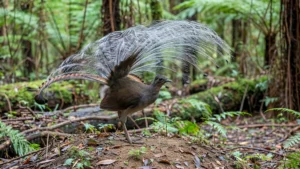
This guide covers the sword-billed hummingbird, a tiny Andean nectar feeder weighing 10 to 15 grams whose bill is longer than its body, while our superb lyrebird species guide covers the superb lyrebird, a large ground-dwelling songbird of Australian rainforest that weighs about a kilogram and is famous for mimicry. One is a jewel of the cloud forest; the other is a singer of the forest floor.
Conclusion
The sword-billed hummingbird species needs no introduction once you have seen it: one species, Ensifera ensifera, the only member of its genus, and the only bird in the world whose bill is longer than its body.
If you go looking for one, go in the dry season, go early, and watch the long tubular flowers, since the bird goes where its flowers bloom. Find a swordbill hovering beneath a pink passionflower in the morning mist, and you will see why a single partnership with a flower can shape a whole bird.