The red-winged blackbird species is a single species, Agelaius phoeniceus, one of the most abundant birds in North America. If you are asking how many red-winged blackbird species there are, the answer is one, a marsh songbird whose glossy black males flash scarlet shoulder patches and sing a harsh konk-la-ree from the top of a cattail.
The red-winged blackbird takes its name from the male’s red shoulder patches, called epaulets, which he flashes when he sings and hides when he slips through the reeds. It is the bird that announces spring across the marshes of North America, arriving alongside the American robin, and filling the wetlands with song.
Key takeaways
- The red-winged blackbird species is Agelaius phoeniceus, a single species with twenty to twenty-four recognised subspecies.
- Males are glossy black with red shoulder patches edged in yellow, while females are streaked brown and look like large sparrows.
- Red-winged blackbirds live in marshes, wet meadows and fields, eating seeds and grain with insects in the breeding season.
- Males are polygynous, holding a territory that may contain several nesting females, and they defend it fiercely.
- The species is listed as Least Concern, with about 210 million mature birds, though numbers have fallen by more than a quarter since 1966.
What makes a red-winged blackbird a red-winged blackbird
A male red-winged blackbird is unmistakable: glossy black all over, with a bright red shoulder patch, or epaulet, edged in yellow on each wing. He can hide the patches or flare them wide while he sings, and the display signals his confidence to rival males. In a few western forms the yellow border is missing, and those birds are sometimes called bicolored blackbirds, but they are the same species.
The female looks like a different bird altogether. She is dark brown and heavily streaked, paler below, with a whitish stripe over the eye and a peachy wash on the throat, so she is often mistaken for a large sparrow. Both sexes have a slender, pointed bill, a medium-length rounded tail and black legs. The male is larger, at 22 to 24 centimetres long against her 17 to 18, with a wingspan of 31 to 40 centimetres and a weight of 32 to 77 grams.
The red-winged blackbird species and their relatives
The red-winged blackbird belongs to Agelaius, a small genus of blackbirds in the family Icteridae, the New World blackbird family, and it is one of five species in the genus. Between twenty and twenty-four subspecies are recognised, depending on the authority, and most are very similar, differing mainly in size and in small details of the female’s plumage. The best-known exceptions are the bicolored forms of California and the Mexican plateau, whose males lack the yellow border.
The Icteridae also include the orioles, grackles, cowbirds and meadowlarks, and the red-winged blackbird’s closest relative is the red-shouldered blackbird of Cuba, once treated as one of its subspecies. The tricolored blackbird of California is a near lookalike, with a deeper red patch edged in white rather than yellow, and the yellow-headed blackbird shares the marshes but wears a bright yellow head. No single global total is agreed, but the IUCN puts the species at about 210 million mature birds, while other estimates run nearer 180 million.

| Type | Animal | Where it lives | Best-known food | Length or Weight |
|---|---|---|---|---|
| Genus | Blackbirds of genus Agelaius | Wetlands of the Americas | Seeds and insects | Up to about 24 cm long |
| Species | Red-winged blackbird (Agelaius phoeniceus) | North and Central America | Seeds, grain and insects | 17 to 24 cm, 32 to 77 g |
| Species | Red-shouldered blackbird (Agelaius assimilis) | Wetlands of Cuba | Seeds and insects | About 22 cm long |
| Species | Tricolored blackbird (Agelaius tricolor) | Marshes of California and Oregon | Seeds and insects | About 22 cm long |
| Species | Yellow-headed blackbird (Xanthocephalus xanthocephalus) | Marshes of western North America | Seeds and insects | 21 to 26 cm long |
| Species | Common grackle (Quiscalus quiscula) | Open country of North America | Seeds, insects and grain | 28 to 34 cm long |
How red-winged blackbirds live
Red-winged blackbirds eat mainly seeds and grain, including weed seeds, waste corn and rice, and fruit such as blackberries in season. In the breeding season insects make up a much larger share, above all dragonflies, damselflies, butterflies, moths and flies, with snails, spiders, worms, frogs, eggs and carrion as well. They pick insects from plants, catch them in the air, and forage on the ground in fields and along the edges of marshes.
Breeding is a loud and busy affair, and males are polygynous, holding a small territory in the marsh that may contain several nesting females. The male arrives first in spring, claims a patch of cattails and defends it with song, perching high and singing his nasal konk-la-ree while flashing his red epaulets. In some populations nine in ten territorial males have more than one mate, and the record is fifteen females in a single territory, though a quarter to a half of the nestlings are fathered by other males.
The female builds the nest alone, weaving a cup of wet leaves, reeds and grasses between cattail stems or in a shrub, and lays two to five eggs, usually three or four, which she incubates for 10 to 12 days. The chicks fledge in 11 to 14 days and are independent in two to three weeks, and a female may raise two or even three broods in a season. Males help feed the young but the female does most of the work, and both parents dive at intruders, including blue jays and people who wander too close.
Where red-winged blackbirds live
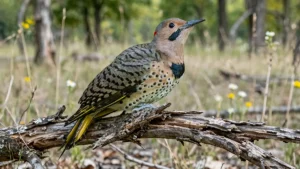
Red-winged blackbirds live across most of North America, breeding from Alaska and Newfoundland south to Florida, Mexico and Guatemala, with isolated populations reaching Costa Rica. They are birds of wet, open country, needing marsh vegetation to nest in and open ground to feed on. Those needs are met in freshwater and saltwater marshes, above all where cattails grow, and in wet meadows, shrubby swamps, roadside ditches, hayfields and the edges of farm ponds, where the northern flicker also hunts ants on the ground.
Northern birds migrate, leaving Canada and the northern United States in autumn for the southern states and Mexico, while birds of the southern United States stay put all year. In winter the migrants gather in enormous roosts with other blackbirds, and a single roost can hold hundreds of thousands of birds, sometimes more than a million, swirling over the fields at dusk. In spring the males return first, weeks ahead of the females, to claim the best patches of marsh.
The red-winged blackbird is listed as Least Concern on the IUCN Red List, with a population trend described as decreasing, and it remains one of the most abundant birds on the continent. Even so, numbers have fallen by about 28 per cent between 1966 and 2019, and the decline is thought to come from the drainage of wetlands, the loss of hayfields and the use of pesticides. It is protected by law in the United States and Canada, and its main dangers now are the loss of marshland and the control programmes that target its winter roosts.
Best seasons for red-winged blackbird watching
The best time is spring, when the males return to the marshes, claim their territories and sing from the cattail tops from dawn until dusk. Early morning is best, when the males are at their loudest and the females are building nests low in the reeds, and winter is good too, when huge roosts gather at dusk.
Staying safe around red-winged blackbirds
A red-winged blackbird is a small bird, but a territorial male will dive at anything that comes near his nest, including people, dogs and much larger birds. Watch from the edge of the marsh rather than wading into the reeds, and if a male starts swooping at your head, walk calmly away rather than running or waving your arms.
Keep dogs on a lead near marshes in spring and early summer, and never disturb a nest, since a female that is flushed may abandon her eggs. Do not feed red-winged blackbirds at garden feeders in the breeding season, though in winter they are welcome visitors, and never handle a blackbird, which is protected by law.
Red-winged blackbird watching checklist
A little preparation turns a walk beside a marsh into a real chance of seeing North America’s most familiar songbird.
- A spring visit to a cattail marsh or wet meadow, where males sing from the reed tops at dawn.
- Binoculars, because a female building her nest low among the reeds is easy to miss.
- An ear for the nasal konk-la-ree song, which carries far across the marsh.
- An eye for the male’s red epaulets, flashed while he sings and hidden when he slips through the reeds.
- A camera with a zoom lens, for close views of a singing male without wading into the marsh.
- A winter dusk visit to a known roost, where thousands of blackbirds swirl over the fields at sunset.
- Respect for nests, territories and the law, since red-winged blackbirds and their nests are protected.
Frequently asked questions
How many red-winged blackbird species are there?
There is one red-winged blackbird species, Agelaius phoeniceus, with twenty to twenty-four recognised subspecies. Authorities differ on the exact number, but all of the forms, including the bicolored blackbirds of California and Mexico, belong to the same species.
Why do male red-winged blackbirds have red shoulders?
The red shoulder patches, or epaulets, are a signal between males. A male flashes them while he sings to hold his territory and hides them when he trespasses on another male’s ground. Males with larger patches are attacked more fiercely by rivals, though studies disagree on how much the colour itself matters to females.
What does a red-winged blackbird eat?
A red-winged blackbird eats mainly seeds and grain, including weed seeds, waste corn and rice, with blackberries in season. In the breeding season insects make up a much larger share of the diet, above all dragonflies, damselflies, butterflies, moths and flies, with snails, spiders, worms, frogs and eggs as well.
Do red-winged blackbirds attack people?
Yes, territorial males dive at people who come close to their nests in the breeding season, sometimes striking the head with their feet. The attacks are noisy and startling but rarely harmful, and the best response is to walk calmly away from the area rather than running or waving your arms.
Are red-winged blackbirds endangered?
No. The species is listed as Least Concern on the IUCN Red List, with about 210 million mature birds, though numbers have fallen by about 28 per cent since 1966. The decline is a warning, but the species remains one of the most abundant birds in North America.
How is this guide different from the red-tailed hawk guide?
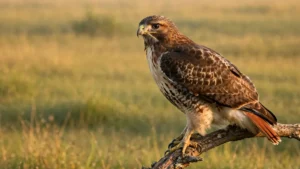
This guide covers the red-winged blackbird, a small marsh songbird that eats seeds and insects, nests in cattails and sings konk-la-ree from the reed tops, while our red-tailed hawk species guide covers the red-tailed hawk, a large bird of prey that soars over open country, hunts rodents with its talons and shows a brick-red tail. One is a songbird of the marsh; the other is a hunter of the open sky.
Conclusion
The red-winged blackbird species needs no introduction once you have heard it: one species, Agelaius phoeniceus, a marsh songbird whose males flash scarlet epaulets and sing konk-la-ree from the cattails.
If you go looking for one, go in spring and stand at the edge of a cattail marsh. Find a male singing from a reed top with his red shoulders flared, and you will see why this is the songbird North America knows best.