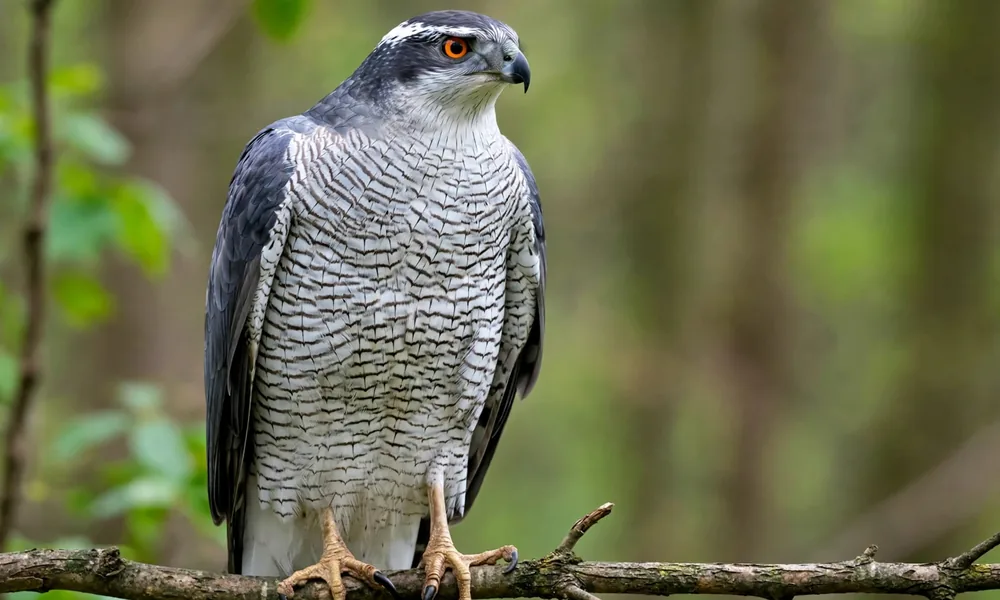
The northern goshawk species is a single species in the sense this guide uses the name, Accipiter gentilis, the Eurasian goshawk, a slate-grey forest hunter with a bold white eyebrow and fierce orange eyes that ambushes pigeons, grouse and squirrels among the trees. If you are asking how many northern goshawk species there are, the answer is one, and it is the largest of the true hawks of the northern forests.
The goshawk is a bird of old forests and sudden violence, a hunter that slips silently between the trunks and strikes before its prey has time to react. Falconers have prized it for centuries, and birdwatchers call it the grey ghost, because it is far more often heard, in a ringing kik-kik-kik from deep in the trees, than seen.
Key takeaways
- The northern goshawk species is Accipiter gentilis, the Eurasian goshawk, a slate-grey forest raptor with barred underparts and a bold white eyebrow.
- Adults are 46 to 64 centimetres long, with a wingspan of 89 to 127 centimetres and a weight of about 515 grams to 2.2 kilograms, females being much larger.
- Goshawks live in mature coniferous, deciduous and mixed forest across Europe and northern Asia, hunting by ambush among the trees.
- They eat mostly birds such as pigeons and grouse, and mammals such as squirrels, rabbits and hares.
- The species is listed as Least Concern, with 1 to 2.5 million mature individuals, though European numbers are suspected to be falling.
What makes a goshawk a goshawk
An adult goshawk is unmistakable: slate-grey upperparts, pale underparts finely barred with dark grey, a dark cap, and a bold white eyebrow that gives it a fierce, frowning look. Its eyes are orange-red in adults and yellow in young birds, its bill is short, hooked and dark, and its long yellow legs are built for seizing prey in a burst of speed.
Its wings are short, broad and rounded, and its tail is long, both shaped for steering at speed through branches rather than soaring in the open. In flight it flaps powerfully a few times and then glides, low and fast, between the trunks. Young birds look quite different, with brown upperparts and pale underparts heavily streaked, not barred, with dark brown. The call is a loud, ringing kik-kik-kik, often the first sign that a goshawk is nearby.
The northern goshawk species and their relatives
The goshawk belongs to Accipiter, a large genus of forest hawks in the family Accipitridae, and Accipiter gentilis is its largest member. This guide covers the Eurasian northern goshawk, Accipiter gentilis in the strict sense, because in 2023 the American Ornithological Society split the old, wider northern goshawk into two: the Eurasian goshawk of Europe and Asia, and the American goshawk, Accipiter atricapillus, of North America. Some authorities now place both birds in the genus Astur, though the IUCN Red List still uses Accipiter gentilis.
Its closest relatives are the other Accipiter hawks, above all the Eurasian sparrowhawk, a much smaller bird of the same woodlands, and the American goshawk across the Atlantic. More distant relatives include the Cooper’s hawk of North America and the grey goshawk of Australia. Like the peregrine falcon and the golden eagle, the goshawk is a bird of prey, but it hunts inside the forest rather than in the open sky.
| Type | Animal | Where it lives | Best-known food | Length or Weight |
|---|---|---|---|---|
| Genus | Goshawks (genus Accipiter) | Forests of the Northern Hemisphere | Birds and mammals | About 46 to 64 cm long |
| Species | Eurasian goshawk (Accipiter gentilis) | Forests of Europe and northern Asia | Pigeons, grouse and squirrels | About 46 to 64 cm long |
| Species | American goshawk (Accipiter atricapillus) | Forests of North America | Grouse, squirrels and hares | About 46 to 61 cm long |
| Species | Cooper’s hawk (Accipiter cooperii) | Woodland and suburbs of North America | Medium-sized birds | About 35 to 51 cm long |
| Species | Eurasian sparrowhawk (Accipiter nisus) | Woodland and gardens of Europe and Asia | Small birds | About 28 to 41 cm long |
| Species | Grey goshawk (Accipiter novaehollandiae) | Forests of Australia and New Guinea | Birds and small mammals | About 40 to 55 cm long |
How northern goshawks live
Goshawks are ambush hunters, hunting by stealth and surprise rather than by long chases. A goshawk waits on a hidden perch, watches the forest floor and the clearings, and then launches in a low, fast flight between the trees, twisting through gaps that look too small for a bird of its size. Pigeons, grouse, corvids and thrushes are the usual prey, along with squirrels, rabbits and hares, and a large female can take prey as heavy as a duck. The kill is made with the feet, and the bird carries its prey to a favourite plucking post, where the ground is often littered with feathers.
Goshawks are birds of the forest interior, mostly sedentary and holding the same territory for years. Pairs often stay together for several seasons, and in late winter and early spring the male performs a slow, looping display flight above the trees, calling as he rises and falls. Outside the breeding season they are solitary and silent, most often seen as a grey shape flashing across a forest ride and vanishing into the trees.
Goshawks nest in a large stick nest high in a tall tree, usually a conifer, and the same nest is often used and added to for several years. The female lays two to four eggs and incubates them for 35 to 38 days while the male brings her food. The young leave the nest after 35 to 46 days but are fed by their parents for several weeks more, and the female defends the nest fiercely, diving at anything that comes too close.
Where northern goshawks live
Northern goshawks breed across a huge band of northern Eurasia, from the British Isles and Scandinavia east through Russia and Siberia to Japan, and south into the mountains of central Asia and the Mediterranean. They are birds of mature forest, coniferous, deciduous or mixed, most at home in old woodland with tall trees for nesting and open rides and clearings in which to hunt. In the south of their range they live mainly in mountain forest.
A goshawk needs two things above all: tall trees in which to build a nest safe from disturbance, and prey-rich ground nearby, including woodland edges, clearings and farmland. They have also learned to live in large parks, commercial forests and wooded suburbs, and in Britain, where they were once almost lost, there are now around 1,100 breeding pairs. Most adults stay in the same forest all year, while young birds wander widely in search of a territory of their own, and far northern birds move south in hard winters.
The northern goshawk is listed as Least Concern on the IUCN Red List, with a very large range and about 1 to 2.5 million mature individuals. The European population is estimated at 117,000 to 190,000 breeding pairs, but it is suspected to be falling, and the global trend is unknown. The birds were heavily persecuted in the past and still suffer from habitat loss, disturbance at the nest and illegal killing, and they are protected by law in most of Europe.
Best seasons for northern goshawk watching
The best time to look for goshawks is late winter and early spring, roughly February to April, when the males display above the forest and call loudly, and bare branches make a perched bird easier to spot. Winter is also good, because the birds hunt along forest edges and rides in the low light, and fresh snow can show their tracks and a kill. Autumn brings dispersing young birds, which are bolder and more likely to appear at migration watchpoints.
Staying safe around northern goshawks
A goshawk is not dangerous to people in the ordinary sense, but a female with a nest is famously fearless, and she will dive at anyone who comes too close, striking with her talons and drawing blood. Never approach a nest or linger near one, because a disturbed pair may abandon the eggs or the young. Watch from a forest path with binoculars, and if a bird starts calling loudly above you, move quietly away.
Keep dogs on a lead where goshawks are known to nest, since a dog can flush a bird from its nest or be attacked itself. Stay on marked paths, ask before crossing private woodland, and never handle a goshawk, which is protected by law in most of Europe. If you find a nest, enjoy the knowledge from well away and do not return every day, because repeated visits can draw predators.
Northern goshawk watching checklist
A little preparation turns a walk through mature forest into a real chance of seeing a goshawk.
- A late winter or early spring visit to mature forest, when males display and call above the trees.
- Binoculars, because a goshawk perched in the trees is easy to miss.
- An ear tuned for the loud kik-kik-kik call, which carries further than the bird is visible.
- Patience on forest rides and clearings, where goshawks cross low and fast.
- A look out for plucking posts, where pigeon and grouse feathers litter the ground below.
- A camera with a zoom lens, for close views from a distance without approaching a nest.
- Respect for nest sites and private woodland, because a disturbed nest may be abandoned.
Frequently asked questions
How many northern goshawk species are there?
There is one northern goshawk species in this guide, Accipiter gentilis, the Eurasian goshawk. The American goshawk was once counted as the same species, but the American Ornithological Society split it off in 2023, so the Eurasian bird now stands alone here.
What does a northern goshawk eat?
A northern goshawk eats mostly birds, above all pigeons, grouse, corvids, thrushes and ducks, and mammals such as squirrels, rabbits and hares. It hunts by ambush, waiting on a hidden perch and then flying low and fast between the trees to snatch its prey, which it kills with its feet.
How can you tell a goshawk from a sparrowhawk?
A goshawk is much larger and bulkier than a sparrowhawk, with broader wings, a longer tail and a bold white eyebrow. A sparrowhawk is slimmer and smaller, with a weaker eyebrow, and it hunts small garden birds, while a goshawk takes pigeons, grouse and rabbits.
Are northern goshawks dangerous?
Not to people in the ordinary sense, but a female defending her nest is famously fearless and will dive at intruders, striking with her talons and drawing blood. Keep well away from nests, watch from a forest path, and move quietly away if a bird starts calling loudly above you.
How is this guide different from the northern gannet guide?
This guide covers the northern goshawk, a slate-grey forest hunter that ambushes pigeons and squirrels among the trees of Europe and northern Asia, while our northern gannet species guide covers the northern gannet, a white seabird with black wingtips that plunge-dives for fish in the open ocean. One hunts in the forest; the other hunts at sea.
Are northern goshawks endangered?
No, not in the strict sense. The northern goshawk is listed as Least Concern on the IUCN Red List, with a very large range and about 1 to 2.5 million mature individuals. Numbers are suspected to be falling in parts of Europe, but the species as a whole is not threatened.
Conclusion
The northern goshawk species needs no introduction once you have seen it: one species, Accipiter gentilis, a slate-grey hunter with a white eyebrow, barred underparts and fierce orange eyes.
If you go looking for one, go in late winter, go early, and listen for the kik-kik-kik above the forest. Find a goshawk flashing across a ride in the morning light, and you will see why falconers prized it.