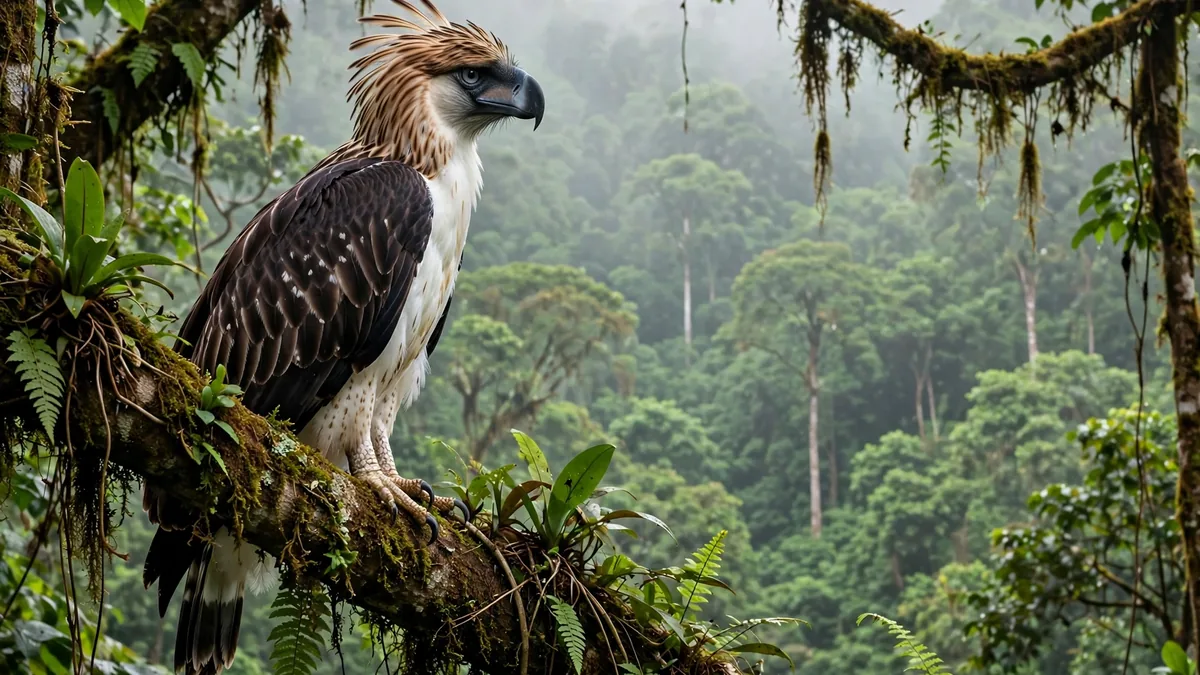
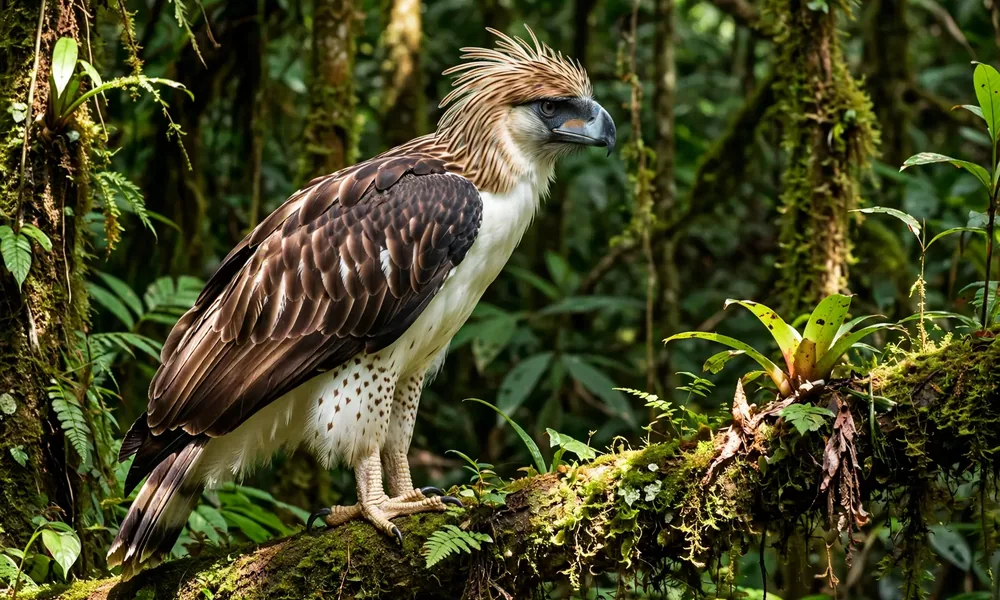
The Philippine eagle species is a single species, Pithecophaga jefferyi, a giant forest eagle found nowhere on earth but the Philippines. If you are asking how many Philippine eagle species there are, the answer is one, and it is one of the largest eagles in the world, about a metre tall, with a wingspan of around two metres and a shaggy crest.
Known locally as the Haring Ibon, the king bird, it is the national bird of the Philippines and the apex predator of its rainforests. It is also one of the rarest eagles alive, listed as Critically Endangered since 1994, with only a few hundred breeding pairs left in the wild. A pair needs a huge stretch of old forest, raises a single chick only once every two years, and hunts mainly on flying lemurs and palm civets, not monkeys.
Key takeaways
- The Philippine eagle species is Pithecophaga jefferyi, a single species and the only member of its genus, endemic to the Philippines.
- Adults are 86 to 102 centimetres long, with a wingspan of 184 to 220 centimetres and a weight of 4.7 to 8.0 kilograms.
- They live in mountain rainforest on Luzon, Samar, Leyte and Mindanao, with most of the population on Mindanao.
- They hunt flying lemurs, palm civets and monkeys, and a pair raises a single chick once every two years.
- The species is listed as Critically Endangered, with estimates from 180 to 500 mature birds to about 392 breeding pairs.
What makes a Philippine eagle a Philippine eagle
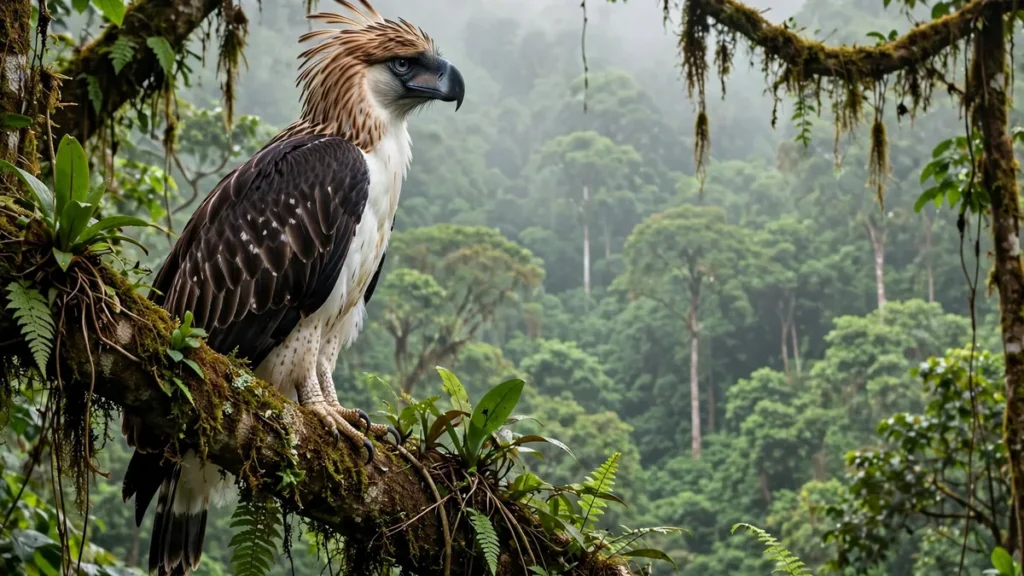
A Philippine eagle is a huge, powerful raptor built for hunting in dense forest. Its most striking feature is the shaggy crest of long, brown feathers on the back of its head, which it can raise like a mane, giving the bird a fierce, crowned appearance. The bill is enormous, deep and laterally compressed, and the eyes are a pale grey-blue set in a dark face. The upperparts are dark brown, the underparts are white, and the thick legs carry powerful yellow feet with claws up to 7.6 centimetres long.
Females are noticeably larger than males, averaging about 105 centimetres from bill to tail against about 95 for males, and weighing up to 8 kilograms while males average about 4.5. The wings are broad and relatively short for so large an eagle, which lets the bird steer through the trees. Young birds are paler and buff-washed, and take five to seven years to reach adult plumage.
The Philippine eagle species and their relatives
The Philippine eagle belongs to Pithecophaga, a genus with only this one species, in the family Accipitridae, the broad family that holds the hawks, kites and most eagles. Its scientific name means monkey-eating eagle, a name given after an early report that it lived on monkeys alone. That report was wrong. It has no close relative in its own genus, and its nearest kin are the other great forest eagles of the tropics.
Among those relatives, the harpy eagle of Central and South America is the closest in build and way of life, a forest hunter with huge feet and a similar crest. The Philippine eagle is the longest eagle in the world by length and wing surface area, though the harpy and Steller’s sea eagles outweigh it. No reliable global population total exists, and the estimates that do exist disagree, which is why the figures in this guide are given as a range.
| Type | Animal | Where it lives | Best-known food | Length or Weight |
|---|---|---|---|---|
| Genus | Eagles of genus Pithecophaga | Rainforest of the Philippines | Forest mammals and birds | About 86 to 102 cm long |
| Species | Philippine eagle (Pithecophaga jefferyi) | Luzon, Samar, Leyte, Mindanao | Flying lemurs and palm civets | 86 to 102 cm, 4.7 to 8.0 kg |
| Species | Harpy eagle (Harpia harpyja) | Rainforest of Central and South America | Sloths and monkeys | 86 to 107 cm, 4 to 9 kg |
| Species | Steller’s sea eagle (Haliaeetus pelagicus) | Coasts of north-east Asia | Fish and seabirds | 85 to 105 cm, 5 to 9 kg |
| Species | Golden eagle (Aquila chrysaetos) | Mountains of the northern hemisphere | Rabbits and marmots | 66 to 100 cm, 3 to 7 kg |
| Species | Wedge-tailed eagle (Aquila audax) | Open country of Australia | Rabbits and reptiles | 81 to 106 cm, 3 to 5 kg |
How Philippine eagles live
Philippine eagles hunt mostly from a perch high in the forest canopy, sitting still for long stretches and watching the branches below before launching in a fast, agile stoop through the trees. Despite its size it is quick and manoeuvrable in the forest. Pairs have been seen hunting monkeys together, one bird distracting the troop while the other comes in from behind. The diet changes from island to island: on Mindanao the main prey is the Philippine flying lemur, which does not live on Luzon.
Breeding is slow and careful, which is why the species recovers so slowly from losses. A pair holds a territory of up to 133 square kilometres of forest and builds a huge stick nest more than 30 metres up in an enormous dipterocarp tree, and the nest may be used for many seasons. The female lays a single large white egg, and both parents incubate it for 58 to 64 days, the female doing most of the sitting. The chick fledges at about four to five months, but it stays dependent on its parents for up to 17 months, so a successful pair breeds only once every two years.
Philippine eagles are monogamous, with pairs holding long-term bonds, and they are solitary and territorial outside the breeding season, patrolling their forest alone or as a pair. Courtship involves soaring, circling and dive chases. Wild birds may live 30 to 40 years, though reliable figures are scarce, and every adult lost is a serious blow.
Where Philippine eagles live
Philippine eagles live only in the Philippines, in the mountain rainforests of Luzon, Samar, Leyte and Mindanao, and Mindanao holds most of the population. They need large tracts of old-growth dipterocarp forest, the tall trees of the lowland and mountain forests, and they are absent from logged forest, farmland and towns. A pair needs an enormous territory, and that need for unbroken forest is the heart of the eagle’s trouble.
The eagle is the apex predator of its forest, and its presence is a sign that the forest is still whole, with flying lemurs, civets, hornbills and monkeys all present in the canopy. Where the forest has been cleared the eagles vanish. The birds stay in the same forest all year, and young birds wander in search of a territory of their own, a journey across cleared land where they are at risk.
The Philippine eagle has been listed as Critically Endangered on the IUCN Red List since 1994, and it is on Appendix I of CITES, which bans international trade. How many are left is not known for certain. The 2018 assessment put the adult population at 180 to 500 birds, while a more recent modelling study estimated about 392 breeding pairs, or around 784 mature birds, and other published estimates range from 128 to 924 mature individuals. All the estimates agree that it is very small and falling. Deforestation is the main threat, with hunting, trapping and electrocution on power lines adding to the losses, and the Philippine Eagle Foundation works to protect nests and breed birds in captivity.
Best seasons for Philippine eagle watching
There is no easy season for Philippine eagle watching, since the birds are rare, shy and spread thinly through remote forest. The dry months, roughly from December to May, are the best time to trek in the mountains of Mindanao and Luzon, when the trails are passable.
Staying safe around Philippine eagles
A Philippine eagle is a wild predator with a huge bill and claws, and it is not a bird to approach. Watch only from a distance, with a guide and binoculars, and never walk up to a nest tree, since a disturbed pair may abandon its egg or chick. Keep to the trails and follow the rules of the protected area.
Never hunt, trap or trade a Philippine eagle, which is protected by law in the Philippines, and report any bird in trouble to the Philippine Eagle Foundation or the local wildlife office. If you want to see one closely, visit the Philippine Eagle Center near Davao, where captive-bred birds are kept for breeding and education, rather than disturbing a wild pair. Like the bald eagle, it is a bird to admire from far away.
Philippine eagle watching checklist
Seeing a wild Philippine eagle is one of the great prizes of birdwatching, and it takes planning, patience and a good guide.
- A guided trek in a protected forest on Mindanao or Luzon, in the dry months from December to May, when trails are passable.
- A local guide who knows the forest and the territories.
- An early morning start, when the eagles are most active.
- Binoculars or a spotting scope, because the birds perch high in the canopy.
- A camera with a long lens, for close views from a distance without approaching a nest tree.
- Sturdy boots, rain gear and patience, since the forest is steep and wet and the wait can be long.
- Respect for the forest and the rules of the protected area, because a disturbed pair may lose a breeding season.
Frequently asked questions
How many Philippine eagle species are there?
There is one Philippine eagle species, Pithecophaga jefferyi, and it is the only member of its genus. It lives only in the Philippines, in the rainforests of Luzon, Samar, Leyte and Mindanao.
Why is it called the monkey-eating eagle?
The name comes from an early report that it lived on monkeys alone, and the scientific name means monkey-eating eagle. The report was wrong: on Mindanao its main prey is the flying lemur, and it also takes palm civets, snakes and birds.
How big is a Philippine eagle?
A Philippine eagle is 86 to 102 centimetres long, with a wingspan of 184 to 220 centimetres and a weight of 4.7 to 8.0 kilograms. Females are larger than males, averaging about 105 centimetres against about 95. It is the longest eagle in the world by length and wing surface area, though the harpy and Steller’s sea eagles are heavier.
What does a Philippine eagle eat?
A Philippine eagle eats mainly forest mammals, above all flying lemurs and palm civets, with monkeys, flying squirrels, rats, snakes, monitor lizards and birds such as hornbills and owls. It hunts from a perch in the canopy, and pairs sometimes hunt together.
Why is the Philippine eagle endangered?
The Philippine eagle is listed as Critically Endangered, mainly because its old-growth rainforest is being cut and fragmented, leaving pairs without the huge territories they need. Hunting, trapping and electrocution add to the losses, and the slow breeding cycle, one chick every two years, makes recovery very slow.
How is this guide different from the painted bunting guide?
This guide covers the Philippine eagle, a giant forest raptor of the Philippines that weighs up to 8 kilograms and hunts flying lemurs in the canopy, while our painted bunting species guide covers the painted bunting, a tiny songbird of North American scrub that weighs less than 20 grams and lives on seeds. One is the king bird of the rainforest; the other is a jewel of the thickets.
Conclusion
The Philippine eagle species needs no introduction once you have seen it: one species, Pithecophaga jefferyi, the giant, crested eagle of the Philippine rainforest.
If you go looking for one, go with a guide, go in the dry season, and go early, and be ready for a long wait in the forest. Find a Philippine eagle perched high in the canopy in the morning light, and you will see why it is called the Haring Ibon, the king bird.