The Stellers sea eagle species is a single species, Haliaeetus pelagicus, a massive sea eagle of the cold coasts of north-east Asia and one of the largest raptors on Earth. If you are asking how many Steller’s sea eagle species there are, the answer is one, a monotypic species with no recognised subspecies, and it is also one of the rarest of the great eagles.
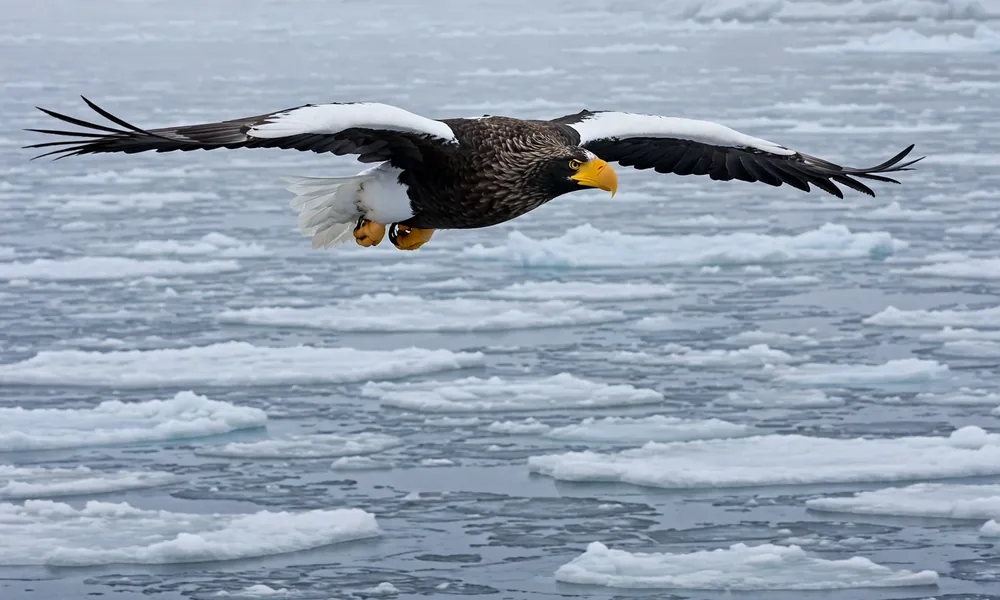
An adult Steller’s sea eagle is unmistakable: a dark brown-black body set against white shoulders, white thighs and a white wedge-shaped tail, and a huge, deep yellow bill that is the largest bill of any eagle. It breeds only in the Russian Far East, and many birds winter on the drift ice of Hokkaido in northern Japan.
Key takeaways
- The Steller’s sea eagle species is Haliaeetus pelagicus, a single monotypic species in the sea eagle genus, with no recognised subspecies.
- Adults are dark brown-black with white shoulders, white thighs and a white wedge-shaped tail, and carry a huge deep yellow bill.
- Steller’s sea eagles are 85 to 105 centimetres long, with a wingspan of 195 to 250 centimetres, and females weigh 6.8 to 9.0 kilograms, the heaviest of any eagle.
- They breed only in the Russian Far East, around the Sea of Okhotsk and Kamchatka, and many winter in Hokkaido, Japan, with smaller numbers in Korea and north-east China.
- The species is listed as Vulnerable on the IUCN Red List, with 3,600 to 4,670 mature individuals in the 2021 assessment, and its numbers are still decreasing.
What makes a Steller’s sea eagle a Steller’s sea eagle
A Steller’s sea eagle is a huge, heavy-bodied raptor with broad wings and a short, wedge-shaped tail. The adult is dark brown-black over most of its body, with a white forehead, white shoulders, white thighs and a white tail, a pattern no other eagle shares. Its bill is enormous, deep and hooked, bright yellow in the adult. Females are substantially larger than males, as in most birds of prey, with males weighing 4.9 to 6.0 kilograms and females 6.8 to 9.0 kilograms.
Young birds look very different. Juveniles are dark brown all over with a pale, mottled tail and a dark bill, and they take four to five years to gain the full adult plumage. In flight the adult shows broad, fingered wings and a short white wedge of a tail, and it flies with slow, powerful wingbeats.
The Steller’s sea eagle species and their relatives
The Steller’s sea eagle belongs to Haliaeetus, the genus of sea eagles and fish eagles in the hawk family, Accipitridae, and it is the largest bird in the genus. It was first observed by the German naturalist Georg Wilhelm Steller during the Great Northern Expedition of the 1730s and 1740s, and formally described by Peter Simon Pallas in 1811 as Aquila pelagica, before George Robert Gray moved it into Haliaeetus in 1849. It is monotypic, with no recognised subspecies.
Genetic work on mitochondrial DNA shows that the Steller’s sea eagle diverged about three to four million years ago from the lineage that gave rise to the bald eagle of North America and the white-tailed eagle of Europe and Asia, its two closest relatives. The Steller’s is the heaviest of the three, and the most restricted in range, breeding only around the Sea of Okhotsk while its cousins range across whole continents.
| Type | Animal | Where it lives | Best-known food | Length or Weight |
|---|---|---|---|---|
| Genus | Sea eagles of genus Haliaeetus | Northern coasts and rivers | Fish and water birds | About 70 to 105 cm |
| Species | Steller’s sea eagle (Haliaeetus pelagicus) | Russian Far East | Salmon, cod, carrion | 85 to 105 cm, 4.9 to 9.0 kg |
| Species | Bald eagle (Haliaeetus leucocephalus) | North America | Fish and water birds | About 70 to 102 cm, 3 to 6.3 kg |
| Species | White-tailed eagle (Haliaeetus albicilla) | Europe and northern Asia | Fish and water birds | About 76 to 92 cm, 3.5 to 6.9 kg |
| Species | African fish eagle (Haliaeetus vocifer) | Sub-Saharan Africa | Fish | About 63 to 75 cm, 2 to 3.6 kg |
| Species | Pallas’s fish eagle (Haliaeetus leucoryphus) | Central Asia | Fish and water birds | About 72 to 84 cm, 2 to 3.7 kg |
How Steller’s sea eagles live
Steller’s sea eagles live mainly on fish, above all Pacific salmon, taken live from shallow water with their huge talons or scavenged as carrion after the fish die in great numbers at the end of spawning. They also take cod and other marine fish, seabirds, seals, hares and carrion, and they steal prey from other birds. On Hokkaido in winter they feed heavily on Pacific cod and Alaska pollock discarded by trawlers, and on the carcasses of sika deer left by hunters.
Breeding is slow, as it is in all the great eagles. Pairs are monogamous and territorial, defending long stretches of river or coastline, and they build enormous nests of sticks, up to two metres across, in the crown of a large tree or on a sea cliff, usually within sight of water. The female lays one to three eggs, usually two, and incubates them for 38 to 45 days. Usually only a single chick is raised. Outside the breeding season the eagles gather in groups of up to several hundred at rich food sources such as salmon rivers and ice floes with stranded fish.
Steller’s sea eagles are diurnal, hunting by day and roosting at night in tall trees near the coast. They hunt mostly in shallow water, snatching fish at the surface rather than diving deep.
Where Steller’s sea eagles live
Steller’s sea eagles have one of the most restricted ranges of any large raptor. They breed only in the Russian Far East, along the coasts of the Sea of Okhotsk, on the Kamchatka Peninsula, along the lower Amur River, on northern Sakhalin and the Shantar Islands, and along the western Bering Sea coast.
When winter comes, many birds move south to the Kuril Islands and Japan, above all to eastern Hokkaido, where about 1,400 to 1,700 birds winter, most of them around Furen-ko near Nemuro and Rausu on the Shiretoko Peninsula. Rare vagrants have wandered far further, including to Alaska and the Atlantic coast of North America.
The Steller’s sea eagle is listed as Vulnerable on the IUCN Red List, in an assessment by BirdLife International published in 2021, and its population trend is decreasing. The IUCN assessment puts the number of mature individuals at 3,600 to 4,670, while other published estimates give roughly 4,600 to 5,100 birds in total, including about 1,830 to 1,900 breeding pairs. The main threats are the loss of riverside nesting forest to logging, dams and development, overfishing, and lead poisoning: on Hokkaido the eagles swallow fragments of lead ammunition from deer carcasses left by hunters. Hokkaido has banned lead ammunition for deer hunting in response.
Best seasons for Steller’s sea eagle watching
The best time and place to see a Steller’s sea eagle is winter in eastern Hokkaido, from December to February, when the birds gather on the drift ice off the Shiretoko Peninsula and around the lakes and fishing ports near Nemuro. Rausu, on the Shiretoko coast, is the most famous site, and boat trips from the port run out to the ice in winter.
Staying safe around Steller’s sea eagles
A Steller’s sea eagle is a powerful wild raptor with a bill and talons built to tear fish and carry prey weighing two to three kilograms, so it must be treated with respect. Never approach a perched eagle closely, never walk up to a nest, and never try to feed one by hand. The birds are most at ease when watched from a boat, a hide or a vehicle at a distance.
On the Hokkaido drift-ice trips, follow the boat crew’s instructions and stay seated when the eagles come in close. Dress for extreme cold, with windproof layers and insulated boots, because the best viewing happens on the ice in midwinter. Like the Philippine eagle, the Steller’s sea eagle is a rare and slow-breeding giant, and the watcher who keeps a respectful distance is the one who sees it at its best.
Steller’s sea eagle watching checklist
A little preparation turns a winter trip to Hokkaido into a meeting with the heaviest eagle in the world.
- A winter trip, from December to February, to eastern Hokkaido, above all Rausu on the Shiretoko Peninsula or Furen-ko near Nemuro.
- A drift-ice boat trip from Rausu, booked in advance, which brings you close to eagles perched on the floes.
- Binoculars and a long camera lens, since the birds often sit on ice well away from the shore.
- Extreme cold-weather clothing, with windproof layers, insulated boots and gloves, for hours on the ice.
- An early start, when the eagles gather at the fishing ports and on the ice at first light.
- Knowledge of the white shoulders, white wedge tail and huge yellow bill.
- Patience and a respectful distance, never approaching a nest or a feeding bird closely.
Frequently asked questions
How many Steller’s sea eagle species are there?
There is one Steller’s sea eagle species, Haliaeetus pelagicus, and it is monotypic, meaning it has no recognised subspecies.
Is the Steller’s sea eagle the largest eagle in the world?
On average weight, yes. Females weigh 6.8 to 9.0 kilograms, which makes the Steller’s sea eagle the heaviest eagle in the world. Its wingspan is 195 to 250 centimetres, with published sources disagreeing on the exact range.
What does a Steller’s sea eagle eat?
A Steller’s sea eagle eats mostly fish, above all Pacific salmon, taken live from shallow water or scavenged after spawning. It also eats cod, pollock, seabirds, small mammals and carrion.
Where do Steller’s sea eagles live?
Steller’s sea eagles breed only in the Russian Far East, around the Sea of Okhotsk, on Kamchatka, along the lower Amur River and on northern Sakhalin. Many winter in Hokkaido, Japan, with smaller numbers in Korea and north-east China.
Are Steller’s sea eagles endangered?
They are listed as Vulnerable on the IUCN Red List, with 3,600 to 4,670 mature individuals in the 2021 assessment and a decreasing trend. The main threats are loss of nesting forest, overfishing and lead poisoning from deer carcasses on Hokkaido.
How is this guide different from the snow goose guide?
This guide covers the Steller’s sea eagle, a solitary, Vulnerable raptor of the North Pacific that hunts salmon with a bill the size of a fist, while our snow goose species guide covers the snow goose, a sociable Arctic goose that migrates in flocks of tens of thousands and eats only plants. One is a hunter of the cold sea; the other is a traveller of the open sky.
Conclusion
The Steller’s sea eagle species needs no introduction once you have seen it: one species, Haliaeetus pelagicus, the heaviest eagle in the world, dark against the white ice.
If you go looking for one, go in winter, go to eastern Hokkaido, and go out onto the drift ice at first light. Find a Steller’s sea eagle sitting on a floe, and you will see why a bird that lives on the edge of the map has watchers crossing the world to find it.