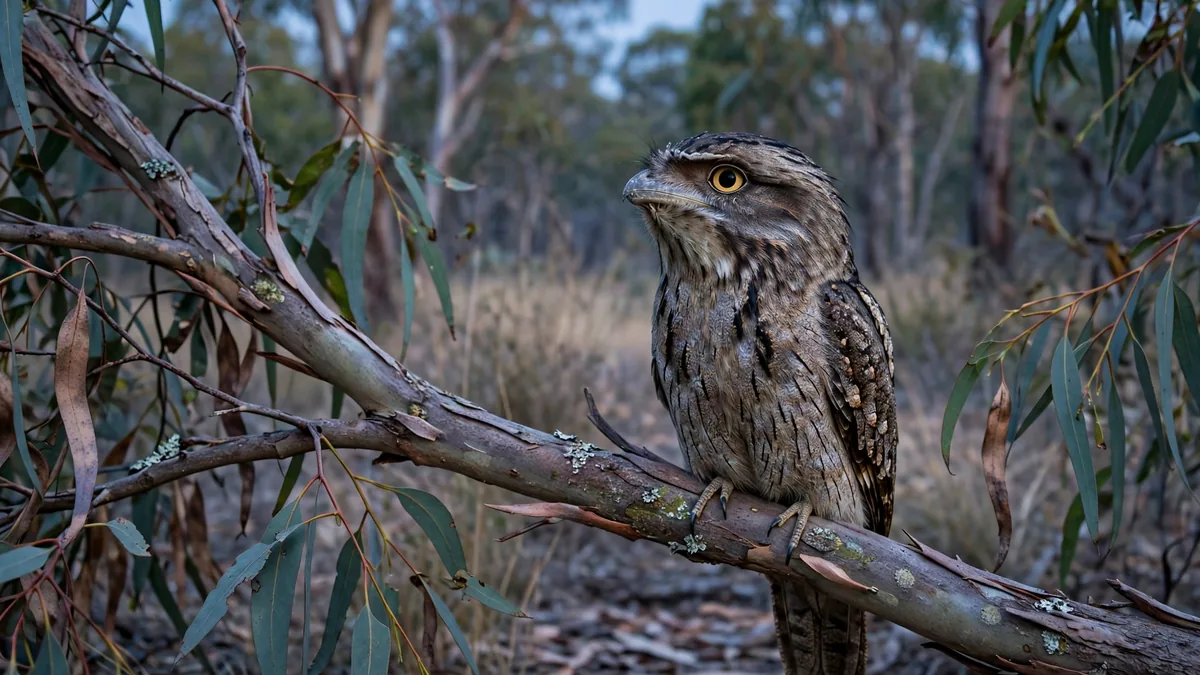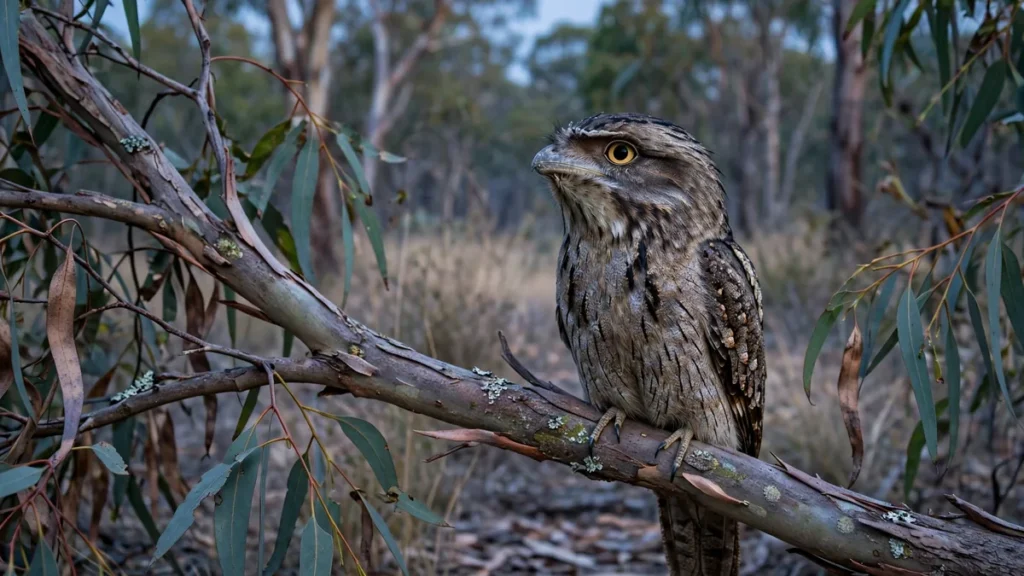
The tawny frogmouth species is a single species, Podargus strigoides, a big-headed night bird of Australia that is so often mistaken for an owl that most people never question it. If you are asking how many tawny frogmouth species there are, the answer is one, and it is not an owl at all, but a frogmouth, a close relative of the nightjars.
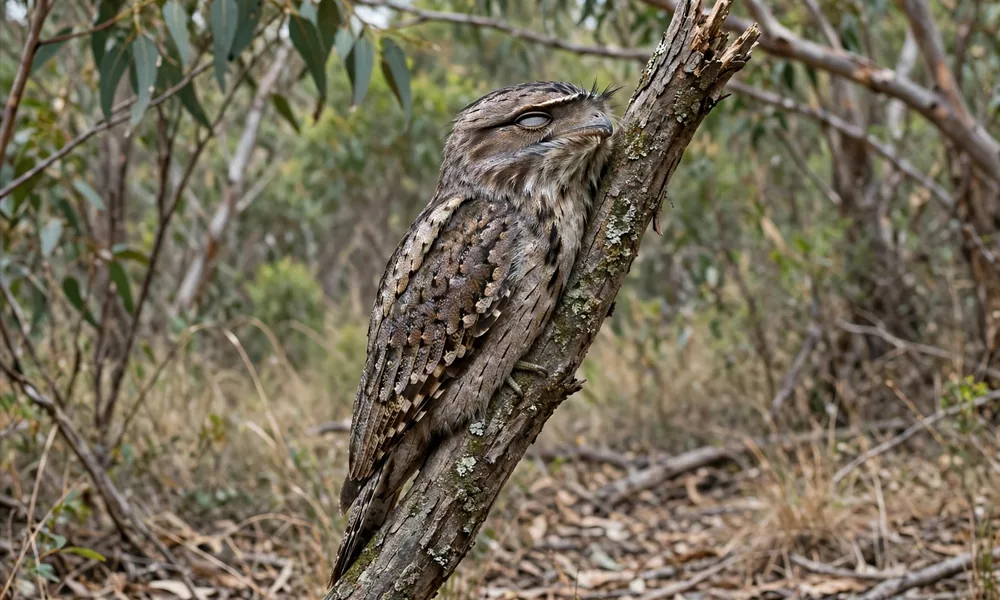
By day the tawny frogmouth sits motionless on a branch, stretched upright with its eyes nearly shut, looking so exactly like a broken limb that you can walk straight past it. At dusk it wakes and hunts the insects of the Australian night.
Key takeaways
- The tawny frogmouth species is Podargus strigoides, a single species with three recognised subspecies in the frogmouth genus Podargus.
- Often mistaken for an owl, it is closer to the nightjars and roosts in the open, relying on camouflage.
- Tawny frogmouths are 34 to 53 centimetres long, with a wingspan of 65 to 98 centimetres and a weight of roughly 150 to 680 grams.
- They eat mostly large nocturnal insects, spiders, worms, slugs and snails, and only occasionally take small mammals, frogs, reptiles or birds.
- Listed as Least Concern, it is widespread and common, and pairs stay together for life.
What makes a tawny frogmouth a tawny frogmouth
A tawny frogmouth is a stocky, big-headed bird with rounded wings, short legs and a broad, flattened bill that opens into a wide, frog-like gape, edged with stiff bristles. Its plumage is mottled silver-grey, brown and white, streaked and barred with black and rufous, and females are often darker and more rufous than males. The eyes are large and yellow, set forward in the face.
The bird’s real trick is its daytime pose. A roosting frogmouth stretches its head and body into a straight line, tightens its feathers flat, closes its eyes to narrow slits and freezes, so that it looks like a broken branch. Its call is a low, soft, repeated oom-oom-oom, and a threatened bird may snap its bill or give a loud hiss.
The tawny frogmouth species and their relatives
The tawny frogmouth belongs to Podargus, a small genus of frogmouths in the family Podargidae, and it is a single species with three recognised subspecies. The northern race, P. s. phalaenoides, lives across northern Australia and is the smallest and palest; the western race, P. s. brachypterus, lives across western and central Australia; and the nominate eastern race, P. s. strigoides, lives in eastern and south-eastern Australia and Tasmania and is the largest of the three. Some authors have recognised anything from five subspecies to none.
The genus Podargus holds three species in total: the tawny frogmouth, the marbled frogmouth of the rainforests of eastern Australia and New Guinea, and the Papuan frogmouth of New Guinea and far northern Queensland. The frogmouths sit within the nightjar order, Caprimulgiformes, and their closest relatives are the oilbirds, potoos, owlet-nightjars and true nightjars.
| Type | Animal | Where it lives | Best-known food | Length or Weight |
|---|---|---|---|---|
| Genus | Frogmouths of genus Podargus | Australia and New Guinea | Large insects and spiders | About 34 to 53 cm long |
| Species | Tawny frogmouth (Podargus strigoides) | Mainland Australia and Tasmania | Moths, beetles, spiders, worms | 34 to 53 cm, 150 to 680 g |
| Species | Marbled frogmouth (Podargus ocellatus) | Rainforests of eastern Australia and New Guinea | Insects and small vertebrates | About 45 cm, 300 to 500 g |
| Species | Papuan frogmouth (Podargus papuensis) | New Guinea and far northern Queensland | Insects, frogs and small mammals | About 50 to 60 cm, up to 1 kg |
| Family | Owlet-nightjars (Aegothelidae) | Australia and New Guinea | Insects caught in flight | About 18 to 30 cm long |
| Order | Nightjars (Caprimulgiformes) | Warm regions worldwide | Flying insects | About 20 to 40 cm long |
How tawny frogmouths live
Tawny frogmouths are nocturnal, spending the daylight hours roosting and becoming active from dusk until dawn. They are sit-and-wait hunters: a bird watches from a branch or fence post above open ground, and when it spots moving prey it glides silently down and takes it from the ground, or sometimes snatches a moth from the air. The bulk of the diet is large nocturnal insects, above all moths, beetles and cockroaches, along with spiders, centipedes, scorpions, worms, slugs and snails.
Pairs form strong bonds that are thought to last for life, and once established a pair will usually hold the same small territory for a decade or more. The breeding season runs from August to December in temperate southern Australia, peaking from September to October. Both partners build the nest together, a loose, flimsy, almost flat platform of thin sticks and leaves laid across a horizontal fork, usually 3 to 10 metres above the ground. The nest is so lightly built that eggs and chicks sometimes fall out of it.
The clutch is one to three eggs, and both parents share the incubation, which lasts about a month, with the male sitting during the day and the female thought to take the night shift. Once the chicks hatch, both parents bring food, and the young fledge after 25 to 35 days, having reached about half their adult weight. Pairs usually raise only one brood a year. Wild birds may live up to 14 years, and birds in captivity have lived for more than 30 years.
Where tawny frogmouths live
Tawny frogmouths live throughout most of mainland Australia and Tasmania, and they are absent only from far western Queensland, the central Northern Territory and most of the Nullarbor Plain. They use almost any habitat with trees or scrub to roost and nest in and open ground nearby to hunt over, including eucalyptus forest and woodland, mallee and acacia shrubland, heath, savanna. They are rarely seen in dense rainforest, alpine moorland or treeless desert, but they are common in parks, gardens and suburban streets, and they often nest in trees beside houses.
In cold weather tawny frogmouths have a remarkable trick for saving energy. On cold nights when food is scarce they can enter torpor, dropping their body temperature and metabolism for a few hours before dawn, and at around 500 grams they are one of the largest birds known to use it. Their camouflage is their main defence: a roosting bird that is spotted may freeze even harder rather than fly, trusting that a predator will pass it by as part of the tree.
The tawny frogmouth is listed as Least Concern on the IUCN Red List, in an assessment from 2024. No published global population figure exists for the species, so its numbers are best described as widespread and common rather than counted. The main dangers are road traffic, since the birds hunt low over roadsides at night, domestic cats and dogs, and the loss of old trees with the forks they need for nesting. Pesticides that kill insects also reduce its food.
Best seasons for tawny frogmouth watching
Tawny frogmouths are present all year, so there is no migration season to wait for, but the breeding season from August to December is the best time to look, when pairs roost close together and call more often, with the low oom-oom-oom carrying through the night. In the southern states, September and October are the peak months, when nests are active and the birds are easiest to find. At dusk, watch a branch beside open ground for a frogmouth gliding down to take a moth.
Staying safe around tawny frogmouths
A tawny frogmouth is a gentle, harmless bird whose only defence is to freeze and hide, so the risk is to the bird rather than to you. Never approach a roosting bird closely or touch it, since a bird that is flushed in daylight may fly into a window or a fence, and a disturbed nest may be abandoned. Watch from a distance with binoculars. Like the great horned owl and the barn owl, the frogmouth rewards a quiet watcher far more than a chasing one.
Slow down when driving at night on roads through woodland and suburbs, because frogmouths hunt low over the verge and are often killed by cars. Keep cats indoors at night and avoid garden insecticides, which kill the frogmouth’s food. Like the snowy owl, it is a bird that asks only to be left in peace.
Tawny frogmouth watching checklist
A little preparation turns an evening walk in Australia into a real chance of seeing a frogmouth wake up and hunt.
- A visit between August and December, when pairs call most and nests are active, with September and October the peak months.
- A dusk start, watching a branch or fence post beside open ground as the birds begin to hunt.
- Binoculars, since a roosting frogmouth is a grey shape on a branch that is easy to walk past.
- An ear tuned to the low oom-oom-oom call, which often gives a pair away after dark.
- A slow scan of low branches, looking for a shape too straight to be a branch.
- Patience and a quiet approach, because a flushed bird may not return to the same roost.
- Respect for nests and roosts, keeping cats indoors at night and never touching a roosting bird.
Frequently asked questions
How many tawny frogmouth species are there?
There is one tawny frogmouth species, Podargus strigoides, with three recognised subspecies: the northern P. s. phalaenoides, the western P. s. brachypterus and the eastern P. s. strigoides of eastern Australia and Tasmania.
Is a tawny frogmouth an owl?
No. A tawny frogmouth looks and sounds like an owl, with large forward-facing eyes and night habits, but it is a frogmouth, more closely related to the nightjars. Owls roost hidden in thick foliage and nest in tree hollows, while frogmouths roost in the open and nest in tree forks.
What does a tawny frogmouth eat?
A tawny frogmouth eats mostly large nocturnal insects, above all moths, beetles and cockroaches, along with spiders, centipedes, scorpions, worms, slugs and snails. It hunts from a perch, gliding down to take prey from the ground, and only occasionally eats small mammals, frogs, reptiles or birds.
Why does a tawny frogmouth look like a branch?
Its mottled grey, brown and white plumage matches bark, and by day it stretches its body into a straight line, flattens its feathers and closes its eyes to slits, so it looks like a broken limb.
Are tawny frogmouths endangered?
Not officially. The tawny frogmouth is listed as Least Concern on the IUCN Red List, and it is widespread and common across Australia and Tasmania. Road traffic, cats and dogs, and the loss of old nesting trees are the main threats, along with pesticides that reduce its insect food.
How is this guide different from the sword-billed hummingbird guide?
This guide covers the tawny frogmouth, a large, mottled, nocturnal Australian bird that hunts insects on the ground and hides by pretending to be a branch, while our sword-billed hummingbird species guide covers the sword-billed hummingbird, a tiny South American bird with a bill longer than its body that hovers to drink nectar. One is a master of stillness; the other is a master of flight.
Conclusion
The tawny frogmouth species needs no introduction once you have seen it: one species, Podargus strigoides, a night bird of Australia that is not an owl, that eats the insects of the dark and spends the day disguised as part of a tree.
If you go looking for one, go at dusk, go quietly, and look for the branch that is not quite a branch. Find one frozen on its limb, and you will see why it survives so well: it does not hide from the world, it becomes part of it.