The great horned owl species is a single species, Bubo virginianus, a horned hunter of the night forests, and one of the most powerful owls in the Americas. If you are asking how many great horned owl species there are, the answer is one: there is only one great horned owl species in the world, though it is split into more than a dozen subspecies, and every great horned owl alive today belongs to it.
The great horned owl belongs to the family Strigidae, the true owls, and it lives across the Americas, from Alaska and Canada to Argentina, in forests, deserts, swamps and suburbs. Its ear tufts, its yellow eyes, its deep hooting call and its fearsome hunting make it one of the most famous owls on Earth.
Key takeaways
- There is only one great horned owl species, Bubo virginianus, and it is split into more than a dozen subspecies across the Americas.
- Great horned owls have wingspans of up to 1.5 metres, and they can kill prey much larger than themselves, including skunks and herons.
- Great horned owls fly in silence, thanks to the soft fringed edges of their wing feathers.
- Great horned owls do not build nests, and they use the old nests of hawks, crows and herons instead.
- Great horned owls are listed as Least Concern, and they are one of the most widespread owls in the world.
What makes a great horned owl a great horned owl
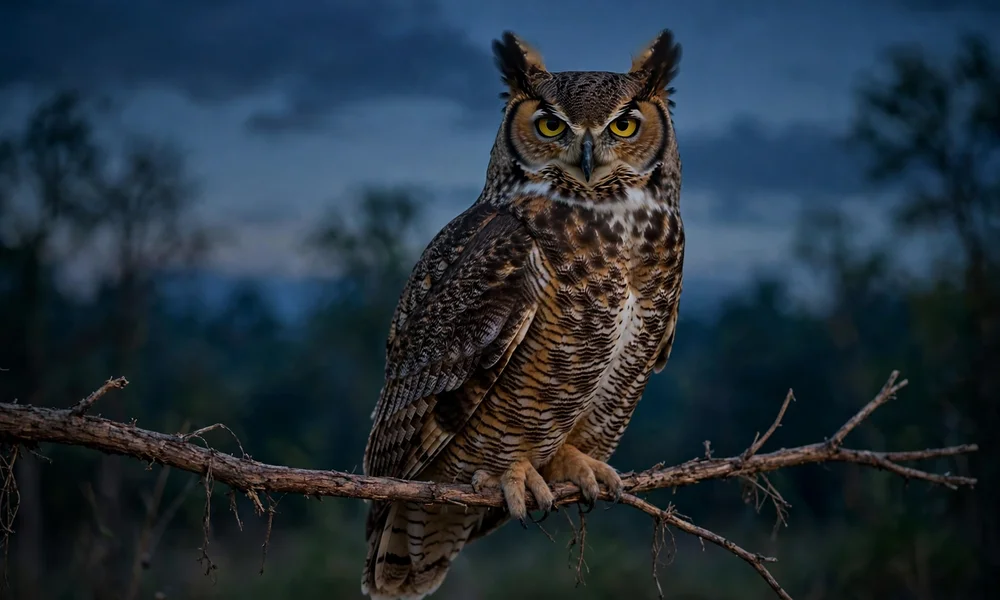
A great horned owl is a large owl with mottled brown and grey plumage, two tall ear tufts, piercing yellow eyes, a white throat patch and huge talons, and it measures roughly 46 to 64 centimetres long with a wingspan of 91 to 153 centimetres, and usually weighs between 0.9 and 2.7 kilogrammes, with females larger than males. The ear tufts are not ears at all, but tufts of feathers that the owl raises when it is alert or angry.
The silence defines the great horned owl: soft fringed feathers on the wings that muffle the sound of flight, letting the owl swoop onto its prey without a whisper. The owl cannot move its eyes in their sockets, so it turns its head up to 270 degrees to look around, and its hearing is so sharp that it can find a mouse under the snow in the dark. Like other snowy owls, the great horned owl is a powerful hunter, but it hunts in forests at night, while the snowy owl hunts in the open tundra by day and night.
The great horned owl species and their relatives
There is one great horned owl species, Bubo virginianus, and it is split into more than a dozen subspecies. The northern subspecies live in Alaska and Canada, and they are the palest of all, while the desert subspecies of the southwestern United States are the smallest and palest of all. The South American subspecies live from Colombia to Argentina, and they are darker and more richly coloured.
The snowy owl is the great horned owl’s most famous relative, a white owl of the Arctic tundra, while the barn owl is a pale owl with a heart-shaped face that hunts in barns and fields. The Eurasian eagle-owl is the largest owl in the world, living in the mountains of Europe and Asia, and the barred owl is an owl of the eastern forests with dark eyes. The great grey owl is the tallest owl in North America, and the tawny owl is a small owl of the woodlands of Europe.
| Type | Animal | Where it lives | Best-known food | Length or Weight |
|---|---|---|---|---|
| Species | Great horned owl (Bubo virginianus) | Forests of North and South America | Rabbits, rodents and skunks | Wingspan 91 to 153 cm, 0.9 to 2.7 kg |
| Close relative | Snowy owl | Arctic tundra | Lemmings and voles | Wingspan 125 to 150 cm, 1.6 to 3 kg |
| Close relative | Barn owl | Barns and fields worldwide | Mice, voles and shrews | Wingspan 80 to 95 cm, 0.25 to 0.7 kg |
| Close relative | Eurasian eagle-owl | Mountains of Europe and Asia | Rabbits, hares and hedgehogs | Wingspan 1.6 to 1.9 m, 1.5 to 4.2 kg |
| Close relative | Barred owl | Forests of eastern North America | Mice, voles and frogs | Wingspan 96 to 125 cm, 0.5 to 1.1 kg |
| Close relative | Great grey owl | Boreal forests of the north | Voles and mice | Wingspan 1.3 to 1.5 m, 0.8 to 1.7 kg |
| Close relative | Tawny owl | Woodlands of Europe | Mice, voles and small birds | Wingspan 81 to 101 cm, 0.35 to 0.65 kg |
How great horned owls live
Great horned owls are creatures of the night forest. A great horned owl lives in a pair, holding a territory that it defends with deep hooting calls, and it hunts by night, perching silently on a branch and listening for the rustle of prey below. Like other barn owls, the great horned owl is a night hunter, but it is far larger and stronger, and it can kill skunks, opossums and herons that a barn owl could never touch.
Rabbits, rodents and skunks make up most of the diet, along with opossums, hares and other owls, and a great horned owl eats by swooping silently onto its prey and killing it with its talons, then carrying it to a perch to tear it apart. It hunts mostly at dusk and dawn, when rabbits are out feeding, and it has almost no sense of smell, which is why it can eat skunks without minding the spray.
Breeding happens in late winter, one of the earliest of any bird, and the pair takes over an old nest of a hawk, crow or heron, where the female lays one to five eggs, usually two or three. She sits on them for about a month while the male brings her food, and the chicks leave the nest after about six weeks, though they stay with their parents for months afterwards. Great horned owls live for around 13 years in the wild, and up to 38 years in captivity.
Where great horned owls live
The great horned owl lives across the Americas, from Alaska and Canada to Argentina, and it is most common in the forests of North America, where rabbits and rodents are plentiful. It is seen regularly in the forests of the eastern United States, the deserts of the southwest and the woodlands of Central America, where it hunts from the trees.
Forest and open ground are the key requirements. A great horned owl needs trees to nest and perch in, and open ground to hunt over, so it follows the seasons as they change, and when winter comes the northern owls stay put, hunting through the snow. It depends on the rabbits staying plentiful, and it hunts the same territory year after year, returning to the same nest.
The species is listed as Least Concern, and its numbers are stable across most of its range. Roughly 5 million great horned owls live in the world, and the species is one of the most widespread owls on Earth. The main pressures are the loss of forest to farming, poisoning from rat poison in prey, and collisions with cars, though the owl’s size and wariness keep most dangers at bay.
Best seasons for great horned owl watching
There is no closed season, because great horned owls are active all year, but the best time to look for them depends on where you go. In North America the best months are often January to March, when the owls are calling and nesting and their deep hoots carry through the cold air. In Central America the best months are often December to February, when the owls are most vocal.
Staying safe around great horned owls
A great horned owl is a wild animal with huge talons and a powerful beak, and it can injure a person with a strike of its talons, though great horned owls almost never attack people. Keep your distance, never approach a nest, and never try to touch or feed an owl, because an owl that is disturbed may abandon its nest and its chicks may die. If you see great horned owls while walking, stay on the path, and watch with binoculars, because owls that are disturbed may leave their territory for good.
Great horned owl watching checklist
A little preparation turns a forest visit into a real chance of seeing a great horned owl, so pack for cold, dark and long quiet hours.
- Binoculars with good low-light performance, for picking a perched owl out of the trees at dusk.
- A torch with a red filter, because owls should always be watched without a bright white light.
- Warm clothes and a waterproof jacket, because the best watching is on cold winter evenings.
- A booked night walk with a guide who knows the owl territories and the safe routes.
- A plan to be out at dusk, when the owls are most active and calling.
- Patience and silence, because owls are shy birds and a noisy group will send them away.
- A field guide to owls, for telling a great horned owl from a barred owl at a glance.
Frequently asked questions
How many great horned owl species are there?
There is one great horned owl species, Bubo virginianus. It is split into more than a dozen subspecies, from Alaska to Argentina, but they are all the same species, and the great horned owl is not closely related to the barn owl, despite the shared name.
Why are they called horned owls?
Great horned owls are called horned because of the two tall tufts of feathers on their heads, which look like horns or ears. The tufts are not ears at all, and the owl raises them when it is alert or angry, and lowers them when it is relaxed.
Do great horned owls really eat skunks?
Yes. Great horned owls are one of the few animals that regularly eat skunks, and they can do it because they have almost no sense of smell. Skunks are a common prey in North America, and the owl’s nest often smells of skunk for weeks afterwards.
Can you keep a great horned owl as a pet?
No. A great horned owl is a wild animal that needs the forest, hunts live prey, and is fully protected by law in most of the countries where it lives. Owls in falconry are kept by licensed falconers only, and they are not pets.
How is this guide different from the golden eagle species guide?
This guide covers the single great horned owl species, a night hunter that flies in silence through the forests of the Americas, while our golden eagle species guide covers the single golden eagle species, a day hunter that dives at 320 kilometres per hour over the mountains of the Northern Hemisphere. The great horned owl is up to 1.5 metres across the wings and hunts by night, and the golden eagle is up to 2.3 metres across the wings and hunts by day.
Are great horned owls endangered?
Great horned owls are listed as Least Concern, so they are not classed as endangered. Roughly 5 million birds live across the Americas, though the loss of forest and poisoning from rat poison are the main threats.
Conclusion
The great horned owl species shows how much power one bird can hold: a single species of night hunter, with horns of feathers, silent wings, and a life spent hunting the forests of the Americas from Alaska to Argentina.
If you go looking for one, go in the winter to the forests of North America, go quietly, and go with patience. Listen for the deep hoot in the dark and you will understand why it has earned its place as the tiger of the night, and why keeping its forests matters most.