The ruby-throated hummingbird species is a single species, Archilochus colubris, a jewel of the eastern gardens, and the only hummingbird that breeds in eastern North America. If you are asking how many ruby-throated hummingbird species there are, the answer is one: there is only one ruby-throated hummingbird species in the world, and every ruby-throated hummingbird alive today belongs to it.
The ruby-throated hummingbird belongs to the family Trochilidae, the hummingbirds, and it lives in the gardens, forests and meadows of eastern North America in summer, and in Mexico and Central America in winter. Its tiny size, its ruby-red throat, its hovering flight and its epic sea crossing make it one of the most loved birds in the world.
Key takeaways
- There is only one ruby-throated hummingbird species, Archilochus colubris, and it is the only hummingbird that breeds in eastern North America.
- Ruby-throated hummingbirds weigh only 2 to 6 grammes, and their wings beat about 53 times a second.
- Ruby-throated hummingbirds cross the Gulf of Mexico non-stop, flying 800 kilometres in about 20 hours.
- Males have an iridescent ruby-red throat, and they perform U-shaped courtship dives in front of females.
- Ruby-throated hummingbirds are listed as Least Concern, and they are common across eastern North America.
What makes a ruby-throated hummingbird a ruby-throated hummingbird
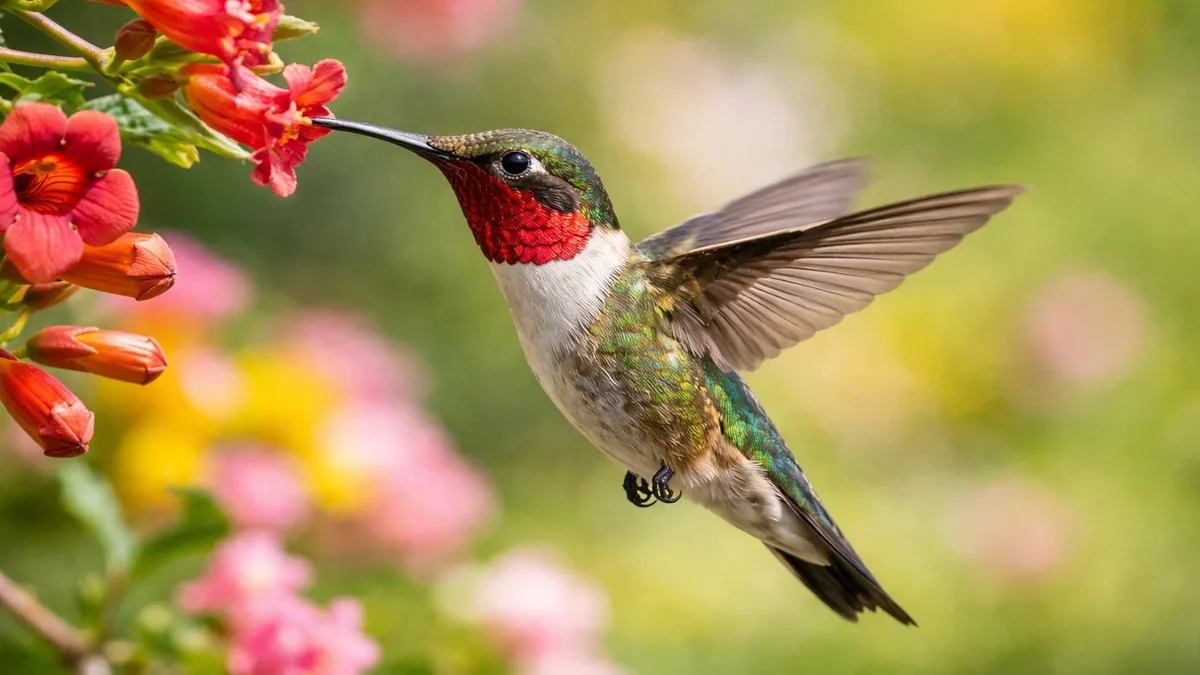
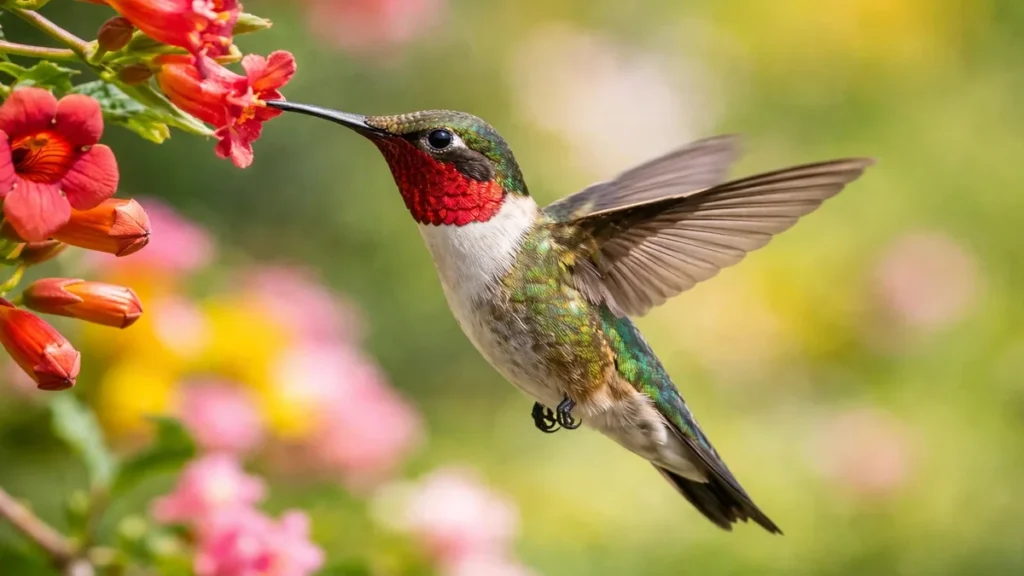
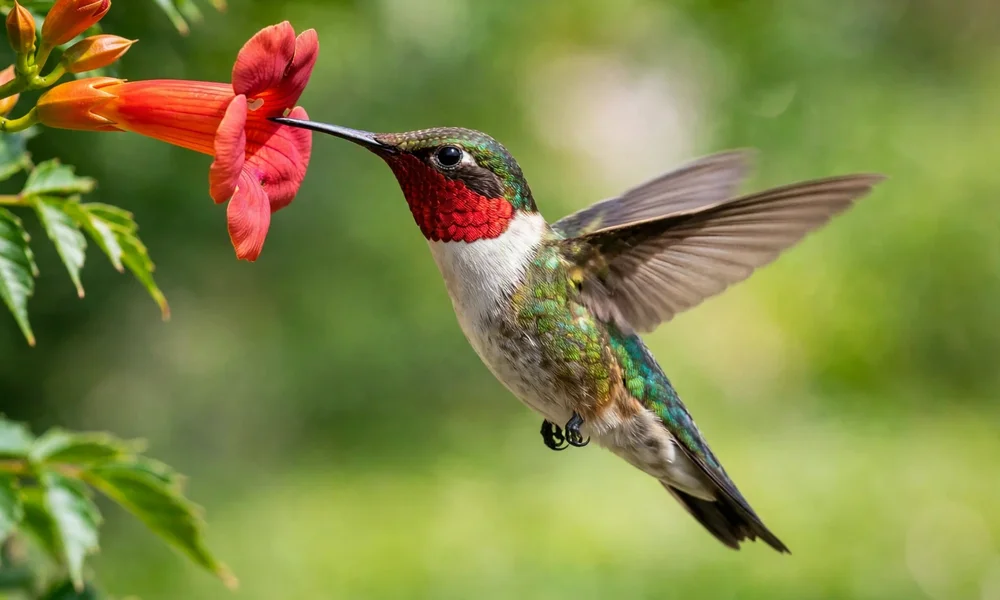
A ruby-throated hummingbird is a tiny bird with metallic green upperparts, white underparts, a long straight bill and a forked tail, and it measures roughly 7 to 9 centimetres long with a wingspan of 8 to 11 centimetres, and usually weighs between 2 and 6 grammes. The male has a brilliant ruby-red throat that flashes in the sun, while the female has a white throat and a slightly longer bill.
The hover defines the ruby-throated hummingbird: wings beating about 53 times a second in a figure-of-eight pattern, letting the bird hang in the air and sip nectar from a flower, and it can fly backwards and upside down, the only bird that can do both. The heart beats up to 1,200 times a minute in flight, and at night the bird enters torpor, slowing its heart to save energy. Like other hummingbirds, the ruby-throated hummingbird is a nectar feeder, but it is the only one that breeds in the east, while the others live in the west.
The ruby-throated hummingbird species and their relatives
There is one ruby-throated hummingbird species, Archilochus colubris, and it has no subspecies. It breeds in the forests and gardens of eastern North America, from Canada to Florida, and it winters in Mexico and Central America, as far south as Panama, and it is the most common hummingbird in the east.
The Anna’s hummingbird is the ruby-throated hummingbird’s most famous relative, a hummingbird of the western coast with a red crown, while the rufous hummingbird is a fiery orange hummingbird that migrates further than any other. The calliope hummingbird is the smallest bird in North America, the black-chinned hummingbird is a hummingbird of the western deserts, and the broad-tailed hummingbird is a hummingbird of the Rocky Mountains. The bee hummingbird is the smallest bird in the world, living only in Cuba.
| Type | Animal | Where it lives | Best-known food | Length or Weight |
|---|---|---|---|---|
| Species | Ruby-throated hummingbird (Archilochus colubris) | Eastern North America in summer | Flower nectar and insects | 7 to 9 cm, 2 to 6 g |
| Close relative | Anna’s hummingbird | Western coast of North America | Flower nectar and insects | 10 cm, 4 to 4.5 g |
| Close relative | Rufous hummingbird | Western North America | Flower nectar and insects | 8 to 9 cm, 2.5 to 4 g |
| Close relative | Calliope hummingbird | Mountains of western North America | Flower nectar and insects | 7 to 8 cm, about 2.5 g |
| Close relative | Black-chinned hummingbird | Deserts of western North America | Flower nectar and insects | 8 to 9 cm, 2.5 to 4 g |
| Close relative | Broad-tailed hummingbird | Rocky Mountains | Flower nectar and insects | 9 to 10 cm, 3 to 4 g |
| Close relative | Bee hummingbird | Cuba only | Flower nectar and insects | 5 to 6 cm, 1.6 to 2 g |
How ruby-throated hummingbirds live
Ruby-throated hummingbirds are creatures of the summer garden. A ruby-throated hummingbird lives alone, defending a patch of flowers from other hummingbirds, and it visits hundreds of flowers each day, drinking nectar and catching insects in the air. Like other scarlet macaws, the ruby-throated hummingbird is a bright tropical bird, but it is tiny and migratory, and it flies thousands of kilometres each year instead of staying in one forest.
Flower nectar makes up most of the diet, along with insects and spiders, and a ruby-throated hummingbird eats by hovering at a flower and licking nectar with its long tongue, which flicks in and out up to 13 times a second. It feeds mostly in the morning and evening, when flowers are full of nectar, and it needs to eat every ten minutes or so, visiting more than a thousand flowers a day to fuel its tiny body.
Breeding happens in summer, and the female builds a tiny cup nest the size of a walnut shell, made of plant down and spider silk and covered in lichen, where she lays two eggs the size of peas. She sits on them for about two weeks, and the chicks leave the nest after about three weeks, though they stay with their mother for a while afterwards. Ruby-throated hummingbirds live for around 3 to 5 years in the wild, and up to 9 years in the oldest banded birds.
Where ruby-throated hummingbirds live
The ruby-throated hummingbird lives in eastern North America in summer, from Canada to Florida, and in Mexico and Central America in winter, as far south as Panama, and it is most common in the gardens and forests of the eastern United States, where flowers are plentiful. It is seen regularly in back gardens, parks and meadows, where it visits feeders and flowers.
Flowers and feeders are the key requirements. A ruby-throated hummingbird needs flowers full of nectar, and insects to feed its chicks, so it follows the flowers as they bloom through the summer, and when autumn comes it flies south, doubling its weight first to fuel the journey. It depends on the flowers staying plentiful, and it returns to the same gardens year after year, generation after generation.
The species is listed as Least Concern, and its numbers are stable across most of its range. Roughly 20 million ruby-throated hummingbirds live in the world, and the species is one of the most common hummingbirds in North America. The main pressures are the loss of flowers to building, window strikes, and cats, though the bird’s small size and speed keep most dangers at bay.
Best seasons for ruby-throated hummingbird watching
There is no closed season, because ruby-throated hummingbirds are active all year, but the best time to look for them depends on where you go. In the eastern United States the best months are often May to September, when the birds are breeding and visiting gardens. In Mexico the best months are often November to March, when the birds are wintering in the south.
Staying safe around ruby-throated hummingbirds
A ruby-throated hummingbird is a wild animal with a sharp bill and great speed, and it can injure a person with a peck, though ruby-throated hummingbirds almost never attack people. Keep your distance, never try to touch or catch a hummingbird, and never use red dye in a feeder, because the dye can harm the bird. If you see hummingbirds in your garden, put out a feeder with plain sugar water, and watch with binoculars, because hummingbirds that are disturbed may leave their flowers for good.
Ruby-throated hummingbird watching checklist
A little preparation turns a garden visit into a real chance of seeing a ruby-throated hummingbird, so pack for sun, flowers and long quiet hours.
- Binoculars with good close focus, for picking a tiny hummingbird out of the flowers.
- A camera with a fast shutter, because hummingbirds should always be watched from a distance.
- Sun cream and a hat, because the best watching is in the bright midday sun.
- A booked visit to a garden with feeders and red trumpet flowers.
- A plan to be out in the morning, when the hummingbirds are most active and feeding.
- Patience and silence, because hummingbirds are shy birds and a noisy group will send them away.
- A field guide to hummingbirds, for telling a ruby-throated hummingbird from a black-chinned hummingbird at a glance.
Frequently asked questions
How many ruby-throated hummingbird species are there?
There is one ruby-throated hummingbird species, Archilochus colubris. It has no subspecies, and it is the only hummingbird that breeds in eastern North America, though more than 300 hummingbird species live in the Americas as a whole.
How do ruby-throated hummingbirds cross the Gulf of Mexico?
Ruby-throated hummingbirds cross the Gulf of Mexico non-stop, flying about 800 kilometres in around 20 hours. They double their weight before the crossing, storing fat as fuel, and they fly through the night without stopping to eat or rest.
Why is the male’s throat red?
The male’s throat is red because of tiny feather structures that bend the light, and the colour flashes ruby-red in the sun and looks black in the shade. The male shows off his throat in U-shaped courtship dives, flashing it at the female below.
Can you keep a ruby-throated hummingbird as a pet?
No. A ruby-throated hummingbird is a wild animal that needs flowers and insects, migrates thousands of kilometres, and is fully protected by law in the United States and Canada. Hummingbirds in captivity are kept by licensed carers only, and they are not pets.
How is this guide different from the great horned owl species guide?
This guide covers the single ruby-throated hummingbird species, a tiny jewel that weighs 2 to 6 grammes and crosses the Gulf of Mexico non-stop, while our great horned owl species guide covers the single great horned owl species, a night hunter that weighs up to 2.7 kilogrammes and flies in silence through the forests of the Americas. The hummingbird is 7 to 9 centimetres long and eats nectar, and the owl is 46 to 64 centimetres long and hunts rabbits.
Are ruby-throated hummingbirds endangered?
Ruby-throated hummingbirds are listed as Least Concern, so they are not classed as endangered. Roughly 20 million birds live across North America, though the loss of flowers and window strikes are the main threats.
Conclusion
The ruby-throated hummingbird species shows how much journey one tiny bird can hold: a single species of jewel, with wings that beat 53 times a second, a sea crossing of 800 kilometres, and a life spent between the gardens of the east and the forests of the south.
If you go looking for one, go in the summer to a garden in the eastern United States, go quietly, and go with patience. Watch a ruby-throated hummingbird hover at a flower and you will understand why it has earned its place as the most loved tiny bird in North America, and why keeping its flowers matters most.