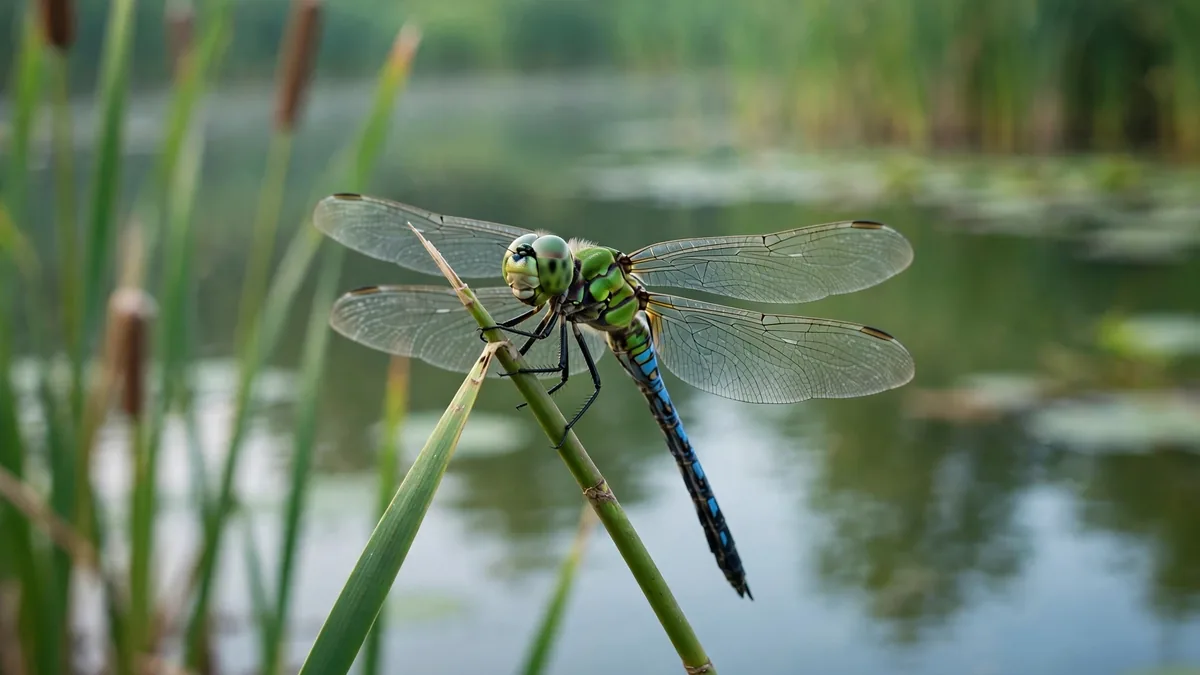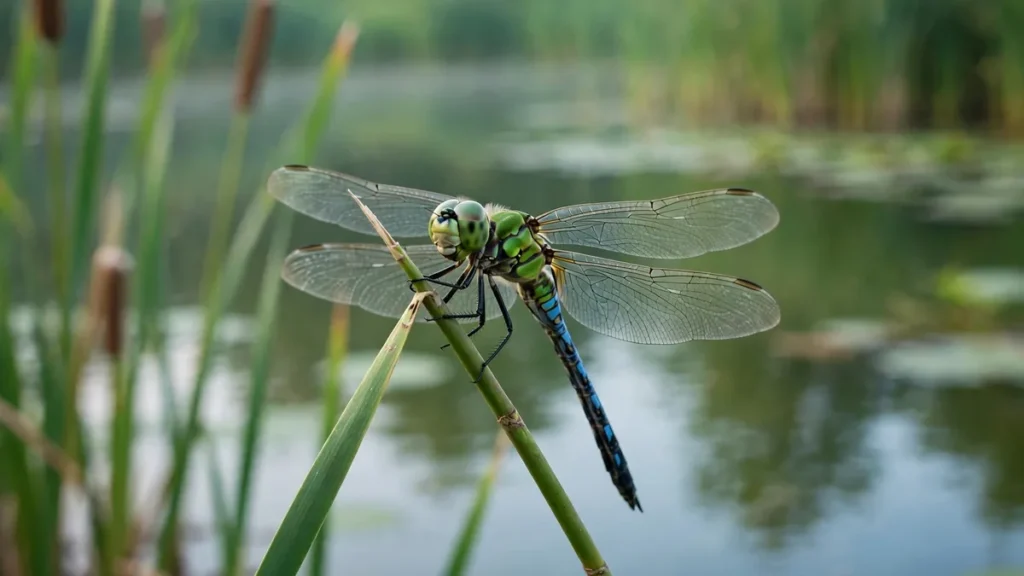
The dragonfly species are the fighter pilots of the insect world, ancient aerial hunters that have been patrolling ponds and rivers for some 300 million years. If you are asking what a dragonfly is, the short answer is an insect of the order Odonata, in the suborder Anisoptera, the true dragonflies, best known in the common green darner, Anax junius, a large North American darner about 7 to 8 centimetres long with a wingspan of up to about 11 centimetres. It has two huge compound eyes, four transparent wings that move independently, and a hunting success rate of about 95 percent, and it spends most of its life underwater as a nymph, emerging for only a few weeks of fast, bright adult life in the air.
What makes a dragonfly so gripping to watch is the combination of age and agility. These insects were flying long before the first dinosaurs, and their fossil relatives had wingspans of more than 60 centimetres, yet the modern dragonfly is a creature of the summer pond, darting, hovering and flying backwards with a control that no other insect can match. It can spot a mosquito from metres away, intercept it in mid-air, and eat it without landing, and it can do all of that while seeing almost all the way around its own head. This guide follows the whole animal: how it looks, where it lives, what it eats, how it behaves, how it breeds, and how to watch one without disturbing it.
Key takeaways
- The dragonfly species belong to the order Odonata, which holds more than 6,400 described species of dragonflies and damselflies, and the true dragonflies sit in the suborder Anisoptera.
- The common green darner, Anax junius, is about 7 to 8 centimetres long with a wingspan of up to about 11 centimetres, while the giant petaltail reaches a wingspan of about 16 centimetres.
- A dragonfly has two huge compound eyes with up to about 30,000 lenses each, four wings that move independently, and a top speed of about 35 miles per hour.
- Dragonflies eat mosquitoes, midges, flies and other insects, catching about 95 percent of the prey they chase, and a single dragonfly can eat 30 to 100 mosquitoes in a day.
- Most dragonflies spend months or years underwater as nymphs and live only four to seven weeks as adults, and about 16 percent of dragonfly and damselfly species are threatened with extinction.
The dragonfly species and their relatives
Dragonflies belong to the order Odonata, a small and ancient order of insects whose name comes from the Greek word for tooth, a nod to the serrated jaws they use to catch and eat prey, and the order sits in the class Insecta and the phylum Arthropoda, which makes dragonflies relatives of beetles, bees and butterflies as well as of their closest kin, the damselflies. More than 6,400 species of dragonflies and damselflies have been described, and the order splits into two main groups: the true dragonflies, the suborder Anisoptera, which are stout-bodied and hold their wings out flat at rest, and the damselflies, the suborder Zygoptera, which are slender and fold their wings together over their backs. The best-known true dragonfly in North America is the common green darner, Anax junius, a member of the darner family Aeshnidae, and it is one of the largest, most abundant and most widespread dragonflies on the continent. Like the ant, the dragonfly is an insect with six legs and a body in three parts, but the ant is a ground-dwelling social insect that lives in a colony, while the dragonfly is a solitary hunter that lives most of its life alone, first in the water and then in the air.
| Type | Animal | Where it lives | Best-known food | Length or Weight |
|---|---|---|---|---|
| Family | Skimmers (Libellulidae) | Ponds and lakes worldwide | Mosquitoes, midges and flies | Most 3 to 5 cm long |
| Genus | Darners (Anax) | North America and beyond | Mosquitoes, flies and moths | About 7 to 8 cm long |
| Species | Common green darner (Anax junius) | North and South America | Mosquitoes and flies | Up to 8 cm, wingspan up to 11 cm |
| Species | Giant petaltail (Petalura ingentissima) | North-eastern Queensland, Australia | Large insects | Wingspan about 16 cm |
| Species | Globe skimmer (Pantala flavescens) | Worldwide, except Antarctica | Small flying insects | Up to 4.5 cm, wingspan 7.2 to 8.4 cm |
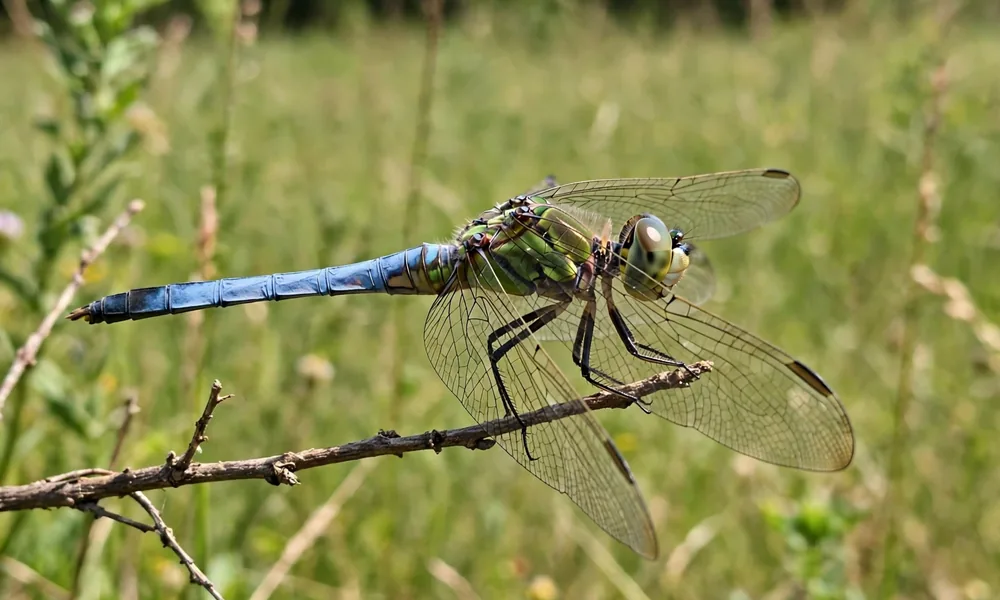
The closest relatives of the green darner are the other darners of the family Aeshnidae, a family of large, strong-flying dragonflies found on every continent except Antarctica, and the differences between them are often a matter of colour, size and the shape of the markings on the thorax. The common green darner is the largest and most widespread darner in North America, with a green head and thorax, a long blue-and-black abdomen in the male and a red-brown abdomen in the female, and a body about 7 to 8 centimetres long with a wingspan of up to about 11 centimetres. The giant petaltail of north-eastern Queensland, Petalura ingentissima, is often called the world’s largest dragonfly, with a wingspan of about 16 centimetres and a body length of up to about 12.5 centimetres, and the giant hawker of South-East Asia, Tetracanthagyna plagiata, rivals it with reported wingspans of about 163 to 165 millimetres. At the other end of the scale sits the scarlet dwarf, Nannophya pygmaea, the smallest known dragonfly, only about 15 millimetres long with a wingspan of about 20 millimetres, and between those extremes sit the skimmers, the clubtails, the cruisers and the emeralds, each family with its own shape, its own flight and its own patch of water.
What dragonflies look like
A dragonfly looks like a needle with wings. The body is long and slender, in three parts like every insect: a head dominated by the eyes, a thorax that carries the legs and the wings, and a long, segmented abdomen that trails behind in flight like the tail of a kite. The thorax carries three pairs of legs and two pairs of large, transparent wings, veined like fine glass, which beat independently and let the insect hover, fly backwards and turn on the spot.
The size of a dragonfly depends on the species, and the range is enormous. Most dragonflies are 3 to 5 centimetres long, about the length of a thumb, and the common green darner is one of the big ones, at about 7 to 8 centimetres long with a wingspan of up to about 11 centimetres. The giant petaltail dwarfs it, with a wingspan of about 16 centimetres and a body of up to about 12.5 centimetres, and the giant hawker is close behind, with a wingspan of about 163 to 165 millimetres. The largest wingspan of any living member of the order Odonata belongs not to a true dragonfly but to a damselfly, the helicopter damselfly Megaloprepus caerulatus of Central and South America, with a wingspan of up to 19 centimetres, and the smallest dragonfly, the scarlet dwarf, is only about 15 millimetres long, with a wingspan of about 20 millimetres, which is smaller than a postage stamp.
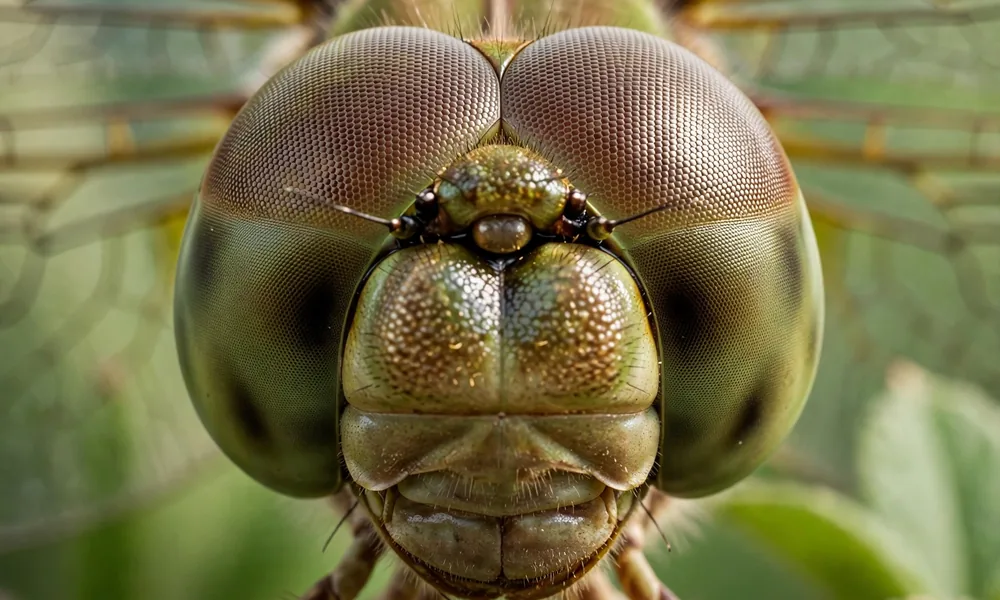
The eyes are the most remarkable part of a dragonfly, and they are what set it apart from every other insect. Each compound eye can hold up to about 30,000 individual lenses, called ommatidia, and each lens gathers light and sends its own picture to the brain, which processes the flood of images at a rate of about 200 images per second. The dragonfly can spot a moving insect from more than 40 feet away, track it through a swarm, and intercept it in mid-air.
Where dragonflies live
Dragonflies live almost everywhere there is fresh water, and they are found on every continent except Antarctica, from lowland ponds and slow rivers to mountain lakes, marshes, bogs and even temporary pools that fill after rain. The common green darner is at home across North America, from Canada to Mexico, and through Central America, the Caribbean and parts of South America and Asia, and it is the dragonfly most people meet first, patrolling the edge of a pond on a summer afternoon. Other dragonflies are far more local: the giant petaltail lives only in a small area of north-eastern Queensland, the Hine’s emerald lives only in a handful of wetlands in the American Midwest, and many tropical species live only on a single island or a single stretch of river.
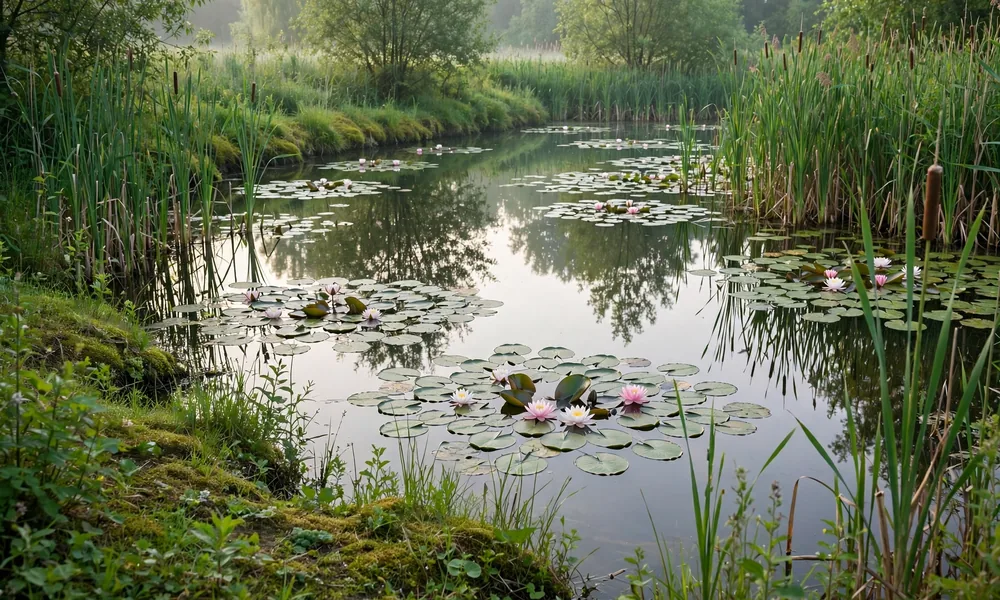
The habitat a dragonfly needs is water for its young and open air for its adults, and the two halves of its life need different things. The nymph lives underwater, in ponds, lakes, marshes and slow streams, where it hides among weed, mud and fallen leaves and hunts the small animals of the pond bottom, and it needs clean water with plenty of prey and places to hide from fish. The adult needs warm air, sunshine and open space to hunt in, and it needs reeds, rushes and twigs to perch on, to rest, to warm up and to lay its eggs on, and it needs the water close by, because it never strays far from the place it emerged.

The water a dragonfly needs must be fresh, and it must be clean enough for the nymph to breathe and hunt, which is why dragonflies are used as a sign of a healthy wetland. They are sensitive to pollution, to the draining of ponds and to the loss of the reeds and rushes they perch on, and a pond that loses its dragonflies has usually lost something else first. Some dragonflies are travellers too: the globe skimmer makes an annual multi-generational journey of some 18,000 kilometres across the Indian Ocean, with individual dragonflies flying more than 6,000 kilometres, and the common green darner migrates in three generations between Canada and the southern United States and Mexico.
What dragonflies eat
Dragonflies are hunters in every stage of their lives, and their diet is written in the air above the pond. The everyday food of the adult is mosquitoes, midges, gnats, flies, moths and other small flying insects, and a big darner will take larger prey too, including butterflies, bees and even other dragonflies. A single dragonfly can eat 30 to 100 mosquitoes and biting flies in a day, which is why they are called mosquito hawks in parts of North America.

What a dragonfly eats changes as it grows, and the change follows the size of its jaws. The nymph is a fierce underwater hunter, eating mosquito larvae, bloodworms, small crustaceans, tadpoles and even small fish, and it catches them with a hinged lower jaw that shoots out in a flash, grabs the prey with pincers, and pulls it back to the mouth. The adult eats only what it can catch in the air, and it takes bigger prey as it grows stronger, moving from midges and gnats to flies and moths, and a large darner can take prey almost as big as itself. The dragonfly is one of the most successful hunters in the animal kingdom, catching about 95 percent of the prey it aims for, which is a far better record than a lion, at about 25 percent, or a shark, and it does it with eyes, wings and timing rather than with size or strength.
The hunting style of a dragonfly is the reason it is so different from other insects, and it is also the reason it is so successful. A butterfly drifts and a bee commutes, but a dragonfly intercepts, watching its prey, predicting where it will be, and flying to that point rather than chasing behind it. It can hover like a helicopter, fly backwards, fly sideways, and spin 360 degrees on its own axis, and its two pairs of wings move independently, so it can change direction in mid-air by tweaking the angle and the speed of each wingbeat. Some species can reach speeds of up to about 35 miles per hour, or 56 kilometres per hour, and the southern giant darner of Australia, Austrophlebia costalis, has been clocked at 58 kilometres per hour, or 36 miles per hour, in short bursts. The wings do the flying, the eyes do the aiming, and the legs do the catching, and together they make a hunter that is hard to escape and harder still to outfly.
How dragonflies behave
Dragonflies are solitary animals, and their day is spent alone, hunting, perching and patrolling. They do not form groups or colonies, and they do not share food, though several may hunt over the same pond when the insects are plentiful, each one keeping its own patch of air. They are most active on warm, sunny days, when their flight muscles work best, and on cool or cloudy days they sit still, warming themselves in the sun with their wings spread flat, waiting for the air to warm up. Males are the more visible sex, patrolling a stretch of pond edge and chasing away rivals, while females spend more time away from the water, hunting in meadows and gardens and coming to the pond only to mate and lay eggs.
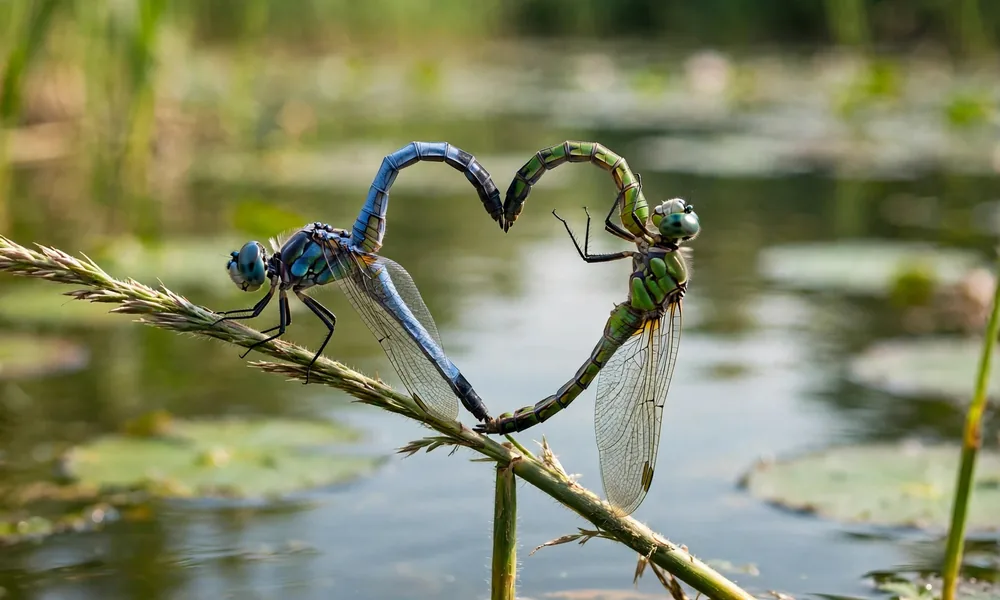
The most famous behaviour in the dragonfly is its flight, and it is a trick that no other insect can match. The four wings beat at less than 30 beats per second, which is slow for an insect, yet the dragonfly is one of the fastest fliers in the insect world, because each wing is large, stiff and independently controlled, and the flight muscles are among the most powerful, relative to body size, of any animal. The dragonfly can loop the loop, hover in one spot, fly straight up and straight down, and change direction without slowing, and it uses that agility to hunt, to escape birds and frogs, and to defend its patch of pond. A male that owns a stretch of water will chase any rival that enters it, and the chases are fast, noisy and acrobatic, ending when one of them gives up and leaves.

Dragonflies are also migrants, and some of them travel further than any other insect. The globe skimmer rides the monsoon winds across the Indian Ocean, from India to East Africa and back, in a journey that takes several generations to complete, and the common green darner does the same across North America, with spring migrants flying north to breed in Canada, their summer offspring staying north, and a third generation flying south in autumn to overwinter in the southern United States and Mexico. A dragonfly is not just a pond insect: it is a traveller, a hunter and a creature of the open sky, and that is why a dragonfly that appears over a garden in spring may have flown hundreds of kilometres to get there.
Breeding and life cycle
Dragonflies breed in the warm months, and their life cycle is a strange two-act story, with a long underwater childhood giving way to a short, bright adult life in the air. The adult female lays her eggs on the surface of the water, or in aquatic vegetation, or directly into the stems of reeds and rushes, depending on the species, and she lays them in batches of hundreds, often with the male still holding her in the mating wheel, guarding her from rivals while she works. The eggs hatch within one to three weeks, and the tiny larvae that emerge are called nymphs, or naiads, and they drop into the water and begin the longest part of their lives.
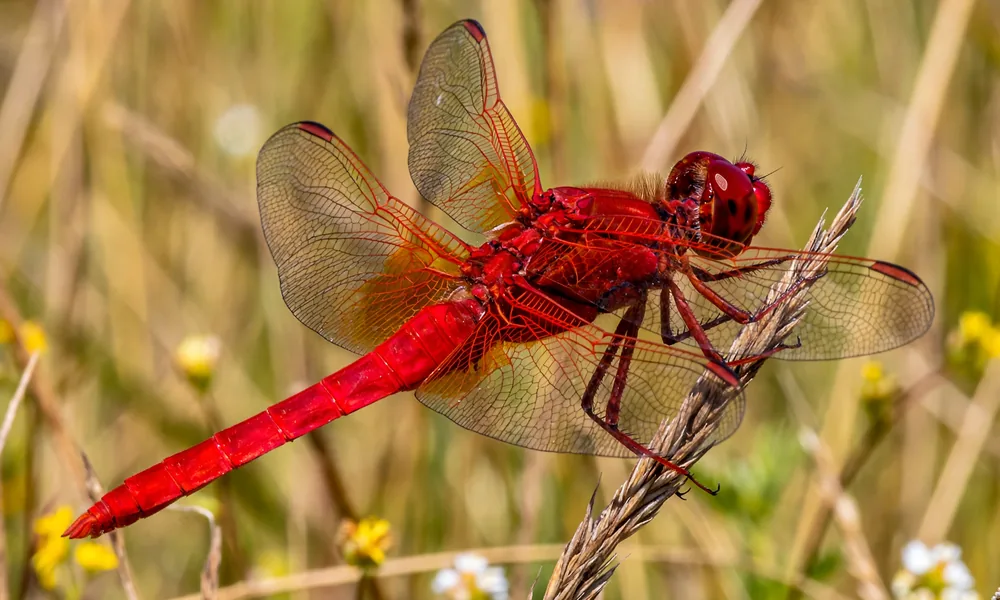
The nymph is a very different animal from the adult, and it lives a very different life. It has no wings, a stout brown body, six legs and a hinged lower jaw that shoots out to grab prey, and it breathes through gills in its rectum, which also lets it jet away from danger by forcing out a stream of water. It grows by moulting, shedding its skin between 6 and 15 times as it gets bigger, and it stays underwater for months or years, depending on the species and the climate: a green darner nymph may take three to twelve months, while a golden-ringed dragonfly can spend more than five years as a nymph before it emerges. The nymph is a top predator of the pond bottom, eating mosquito larvae, bloodworms, tadpoles and small fish, and it is itself eaten by fish, frogs and birds, which is why it hides in the weed and the mud.
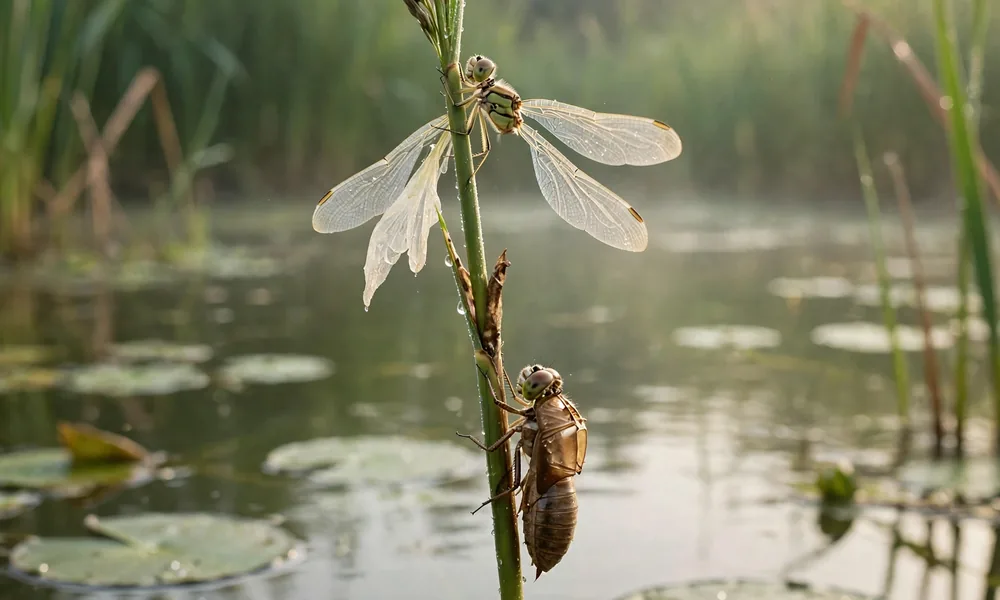
When the nymph is ready, it climbs out of the water on a reed, a rush or a twig, and the skin on the back of its neck splits, and the adult dragonfly crawls out, leaving behind its empty skin, called the exuviae, still clinging to the stem. It takes several hours for the new adult to pump up its wings, harden its body and gain its full colour, and it is at its most vulnerable in those hours, easy prey for anything that spots it. The adult that flies away will live only a few weeks, usually four to seven weeks, and in that time it must hunt, mature, mate and lay eggs, and then it dies, having spent most of its life underwater and only a short summer in the air.
Conservation status
The conservation status of the dragonfly is, for the group as a whole, a warning, though many familiar species are doing well. The first global assessment of the order Odonata, completed by the International Union for Conservation of Nature and covering 6,016 species, found that about 16 percent of the world’s dragonfly and damselfly species are threatened with extinction, and only one species, the St Helena darter, Sympetrum dilatatum, is listed as extinct. The common green darner is listed as Least Concern, with a steady population, and most of the dragonflies of a garden pond are common and widespread, yet the picture changes for the species that need a particular kind of water, a particular plant, or a particular climate, and those are the ones in trouble.

The main pressure on dragonflies is the loss of wetlands, and it is a heavy one. Ponds are drained for building and farming, rivers are straightened and polluted, and the reeds and rushes that dragonflies need to perch on and lay eggs in are cleared away, and the global assessment found that the decline of dragonflies is directly linked to the widespread loss of wetlands caused by urbanisation and unsustainable agriculture. More than a quarter of dragonfly species in South and South-East Asia are threatened, largely because of rapid habitat destruction, and in Europe about 15 percent of the 138 dragonfly and damselfly species are threatened. Climate change is the second pressure, and pollution is the third, because dragonfly nymphs are sensitive to chemicals in the water and die where fish can still survive. There are conservation efforts aimed at dragonflies in many countries, from pond creation and wetland restoration to the protection of the Hine’s emerald in the United States, and a garden pond with clean water and native plants is a small conservation project of its own, and a pond that holds dragonflies is a pond that is working as it should.
Best seasons for dragonfly watching
The best time to look for dragonflies is the summer, when the adults are out in force and the ponds are at their busiest. In Britain and northern Europe the season runs from late spring to early autumn, with May and June the best months for the early species and July and August the best for the late ones, and the dragonflies are most common in the warmest weeks, when the sun is strong and the insects are plentiful. In North America the season is longer, from spring to autumn, and the green darners are on the wing from spring through the summer, with a second wave in the autumn as the migrants pass through. In the cooler months the adults are gone, and only the nymphs remain, hidden underwater, waiting for the spring.

The best hours are the late morning and the early afternoon, when the sun has warmed the air and the dragonflies are out hunting over the water, and a visit to a pond with reeds and open water, with a pair of binoculars and a field guide, is the best way to meet them. The dragonfly is so well known that National Geographic keeps a live profile of the dragonfly, and a guided pond dip or a visit to a wetland reserve, in the summer, is the best way to see one without ever having to chase it through the reeds yourself.
Staying safe around dragonflies
A dragonfly is not dangerous to people who meet it by a pond, and there is no safety warning that matters more than the obvious one: do not grab one, do not pull one out of the air, and do not try to keep one in a jar. A dragonfly has strong jaws and a large one that feels trapped can give a nip, though it cannot break the skin of a person, and it does not sting, does not bite people in the normal course of things, and does not carry disease. The safest way to meet a dragonfly is to stand still by the water, keep your hands to yourself, and let the animal come to you, and if one lands on you, stay still and enjoy it, because it will fly away in a moment, and you will have been perched on by one of the finest hunters in the air.
Dragonfly watching checklist
A little preparation turns a trip to a summer pond into a good chance of meeting dragonflies at their best, in the warm air they hunt.
- A visit in the summer, from late spring to early autumn, when the adults are on the wing and the ponds are at their busiest.
- Binoculars, so you can watch dragonflies hunting over the water without getting close enough to disturb them.
- A field guide to the dragonflies of the region, so you can tell a green darner from a blue dasher or a scarlet darter.
- A camera with a fast shutter, so you can catch a dragonfly in flight or perched on a reed in the sun.
- Light clothes, sun cream and insect repellent, so you can stay by the pond through the warm middle of the day.
- A notebook, so you can record the species you see, the time of day, and the weather, and compare one visit with the next.
- Respect for the pond and the animals in it, keeping to the paths, keeping your hands off any dragonfly, and leaving the pond as you found it.
Frequently asked questions
How big do dragonflies get?
Dragonflies vary a great deal in size, and the species matters more than the group. Most dragonflies are 3 to 5 centimetres long, and the common green darner is one of the big ones, at about 7 to 8 centimetres long with a wingspan of up to about 11 centimetres. The giant petaltail is the largest true dragonfly, with a wingspan of about 16 centimetres and a body of up to about 12.5 centimetres, and the giant hawker is close behind, with a wingspan of about 163 to 165 millimetres. The smallest dragonfly, the scarlet dwarf, is only about 15 millimetres long, with a wingspan of about 20 millimetres, and the largest wingspan of any living member of the order Odonata, 19 centimetres, belongs to a damselfly, the helicopter damselfly Megaloprepus caerulatus.
What do dragonflies eat?
A dragonfly eats mosquitoes, midges, gnats, flies, moths and other small flying insects, which it catches in the air with its legs and eats without landing. The everyday food of the green darner is mosquitoes and flies, and a single dragonfly can eat 30 to 100 mosquitoes and biting flies in a day. The nymph eats mosquito larvae, bloodworms, small crustaceans, tadpoles and even small fish underwater, catching them with a hinged lower jaw that shoots out in a flash, and the adult takes bigger prey as it grows stronger, moving from midges and gnats to flies, moths and even other dragonflies.
Are dragonflies dangerous to people?
No, dragonflies are not dangerous to people, and they do not sting, do not bite people in the normal course of things, and do not carry disease. A large dragonfly that feels trapped can give a nip with its strong jaws, though it cannot break the skin of a person, and it would rather fly away than fight. They are harmless to people and helpful to them, because they eat mosquitoes and other biting insects, and a pond with dragonflies is a pleasanter place to sit on a summer evening.
Where do dragonflies live?
Dragonflies live almost everywhere there is fresh water, on every continent except Antarctica, from lowland ponds and slow rivers to mountain lakes, marshes and bogs. The common green darner is at home across North America, from Canada to Mexico, and through Central America, the Caribbean and parts of South America and Asia, and it prefers ponds, lakes and slow streams with reeds and rushes to perch on. Other dragonflies are far more local, and the giant petaltail lives only in a small area of north-eastern Queensland, while many tropical species live only on a single island or a single stretch of river.
Can you keep a dragonfly as a pet?
No, you should not try to keep a dragonfly as a pet, and in most places you would not be allowed to. A dragonfly needs a pond to live in as a nymph, open air and sunshine to hunt in as an adult, and a steady supply of live flying insects, and even in a perfect setting it will live only four to seven weeks as an adult. It is also an animal that needs space to fly and hunt, and it will die quickly in a jar or a tank, so it belongs by the pond or in a wetland reserve, not in a home, and anyone who wants to see one should visit a pond or a wetland reserve instead.
How is this guide different from the cuttlefish guide?
This guide covers the dragonfly, a group of ancient insects of the order Odonata, led by the common green darner, Anax junius, a fast-flying hunter of ponds and meadows that catches mosquitoes in mid-air with about 95 percent success and lives only four to seven weeks as an adult, while our cuttlefish guide covers a group of colour-changing cephalopods of the sea that hover over sandy seabeds, strike with two shooting tentacles, and live only one or two years. One is an insect of fresh water and summer air you meet over a pond; the other is a mollusc of salt water you meet hovering over the sand.
Conclusion
The dragonfly species are a reminder that the finest hunter in the air does not need size, or strength, or numbers to be remarkable. Two huge compound eyes with up to about 30,000 lenses each, four wings that move independently, a top speed of about 35 miles per hour, and a hunting success rate of about 95 percent have made the common green darner one of the most successful predators on the planet, at home by the ponds and slow rivers of North America and beyond.
If you go looking for one, go in the summer, go to a pond with reeds and open water, and watch the air above the water with your eyes open. Find the warm hours of the late morning, look for the flash of green and blue over the reeds, and give it all the room in the world, and you will have met the dragonfly that turns a quiet stretch of pond into a place of sudden, brilliant flight.