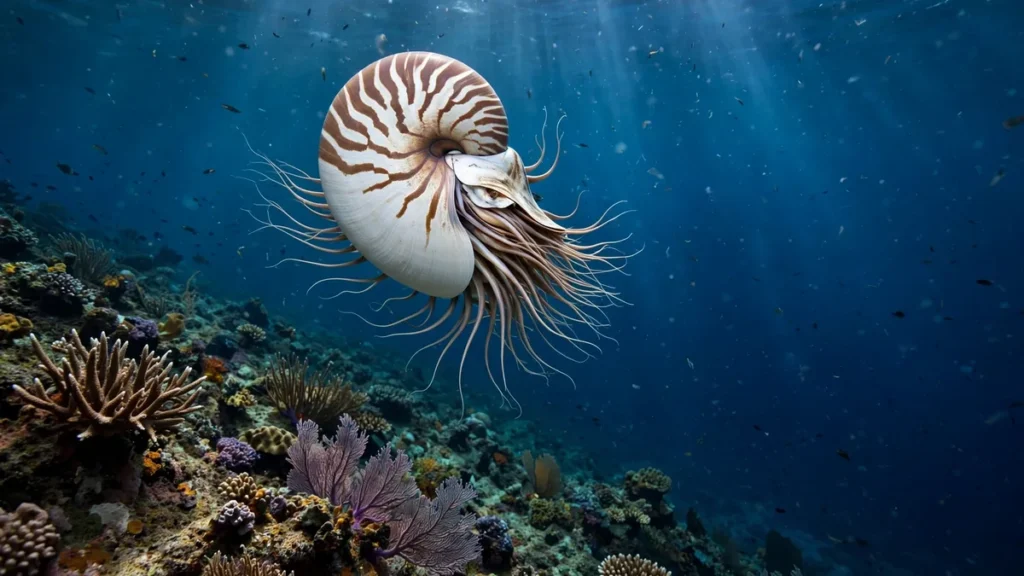
The chambered nautilus species is a living fossil drifting through the deep water of the Indo-Pacific, a cephalopod that still carries the coiled, chambered shell its ancestors wore hundreds of millions of years ago. If you are asking what a chambered nautilus is, the short answer is a slow, nocturnal sea animal, Nautilus pompilius, about 20 to 25 centimetres across the shell, that spends its days in deep water at 300 to 500 metres and rises towards shallower reef slopes at night to scavenge for shrimp, crabs and carrion, steering itself with jet propulsion and adjusting its buoyancy with the gas-filled chambers of its shell. It is not a snail, it is not an ammonite, and it is not a fast swimmer, yet it has outlived the dinosaurs, the ammonites and almost every other shelled cephalopod that ever lived, simply by drifting slowly through cold, dark water and minding its own business.
What makes the nautilus so fascinating is the shell itself, a piece of natural engineering that works like a submarine. Inside the spiral are about 30 sealed chambers, and a living tube called the siphuncle threads through them all, pumping liquid in and out so the animal can hover, rise and sink without effort. The animal itself lives only in the newest and largest chamber, with up to 90 thin tentacles, pinhole eyes with no lens at all, and a sharp beak for tearing food. This guide follows the whole animal: how it looks, where it lives, what it eats, how it behaves, how it breeds, and why a creature that survived for some 500 million years now needs international protection to survive the shell trade.
Key takeaways
- The chambered nautilus species is Nautilus pompilius, a cephalopod of the family Nautilidae, found on steep reef slopes across the Indo-Pacific from the Philippines and Indonesia to northern Australia, Fiji and southern Japan.
- Adults have a shell about 20 to 25 centimetres across, divided into about 30 gas-filled chambers, and they weigh roughly 0.5 to 1.2 kilograms.
- The nautilus has up to 90 tentacles with no suckers, pinhole eyes with no lens, and a sharp beak, and it finds food mostly by smell in the dark.
- It lives at depths of about 100 to 700 metres, resting deep by day and rising to shallower water at night, and its shell would implode at about 800 metres.
- The species is listed as Vulnerable by the International Union for Conservation of Nature and is on CITES Appendix II, which regulates the international trade in its shells.
The chambered nautilus species and their relatives
Chambered nautiluses belong to the family Nautilidae, the only living family of externally shelled cephalopods, and the family sits in the order Nautilida, alongside the extinct ammonites and the other shelled cephalopods of the ancient seas. The nautiloids were once one of the great groups of the oceans, with hundreds of species swimming in shallow seas all over the world, but today only a handful of species survive, all of them in the warm waters of the Indo-Pacific. They share the features that define the family: a coiled external shell divided into chambers, a siphuncle running through those chambers, many thin tentacles with no suckers, and simple pinhole eyes that work like a camera with no lens. Within the family, the chambered nautilus sits in the genus Nautilus, the best-known genus of the group, and it is the species most people picture when they hear the word nautilus.
The chambered nautilus, Nautilus pompilius, is the lead species of this guide, and it is the largest and most widespread nautilus of all, with a shell about 20 to 25 centimetres across and exceptionally large specimens reaching 25.4 centimetres. It lives on steep reef slopes across the Indo-Pacific, from the Andaman Sea east to Fiji and from southern Japan south to the Great Barrier Reef, at depths of about 100 to 700 metres, and it weighs roughly 0.5 to 1.2 kilograms, which is about the weight of a small bag of sugar. It is listed as Vulnerable by the International Union for Conservation of Nature, and its shell is white with brown stripes on the outside and lined with lustrous mother-of-pearl on the inside. Like the octopus, the chambered nautilus is a cephalopod, a cousin of the squids and cuttlefish, but the octopus gave up its shell long ago and lives fast and dies young, while the nautilus kept its shell, lives slowly, and can live for 15 to 20 years or more.
| Type | Animal | Where it lives | Best-known food | Length or Weight |
|---|---|---|---|---|
| Family | Nautiluses (Nautilidae) | Indo-Pacific reef slopes | Shrimp, crabs and carrion | About 10 to 25 cm across |
| Genus | True nautiluses (Nautilus) | Indo-Pacific | Shrimp, crabs and carrion | About 12 to 25 cm across |
| Species | Chambered nautilus (Nautilus pompilius) | Philippines to Fiji and Australia | Shrimp, crabs and carrion | Up to 25 cm across |
| Species | Bellybutton nautilus (Nautilus macromphalus) | New Caledonia | Shrimp, crabs and carrion | About 16 cm across |
| Species | Palau nautilus (Nautilus belauensis) | Palau | Shrimp, crabs and carrion | About 21 cm across |
| Species | Crusty nautilus (Allonautilus scrobiculatus) | Papua New Guinea | Shrimp, crabs and carrion | About 16 cm across |
The closest relatives of the chambered nautilus are the other living nautiluses, a small group of fewer than a dozen species in the genera Nautilus and Allonautilus, and the group as a whole ranges from about 10 centimetres to about 25 centimetres across the shell. The bellybutton nautilus, Nautilus macromphalus, is a small nautilus of New Caledonia that grows to about 16 centimetres across, with a distinctive open hollow, or umbilicus, at the centre of its shell, and it is the smallest of the true nautiluses. The Palau nautilus, Nautilus belauensis, is a large nautilus found only around Palau that grows to about 21 centimetres across, and it is one of the largest living nautiluses, living on steep reef slopes much like its better-known cousin. The crusty nautilus, Allonautilus scrobiculatus, is a nautilus of Papua New Guinea that grows to about 16 centimetres across, with a rough, hairy outer coating on its shell that sets it apart from the smooth shells of the true nautiluses, and it is a reminder that the whole family is a small, scattered remnant of a group that once filled the seas.
What chambered nautiluses look like
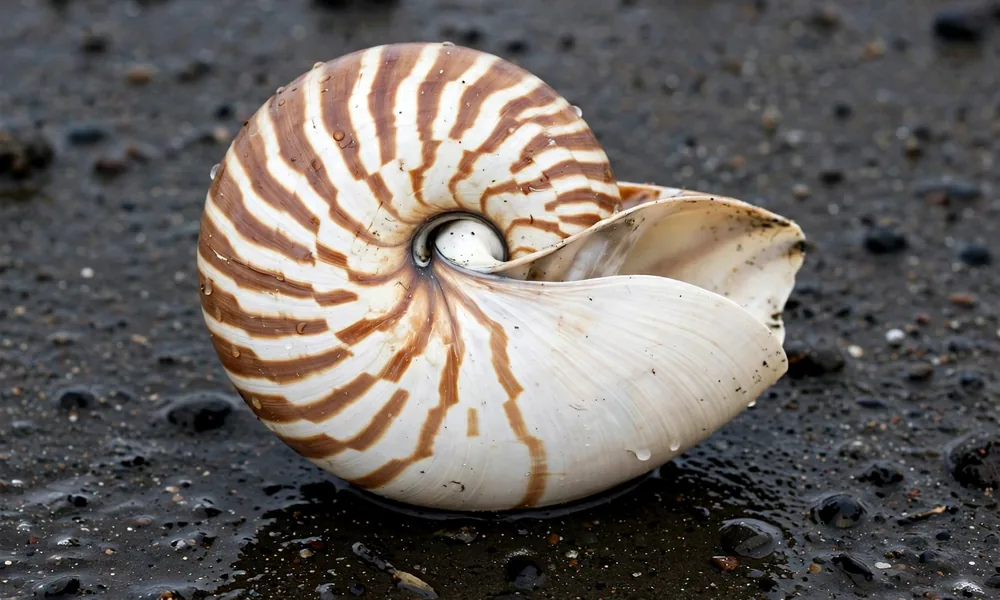
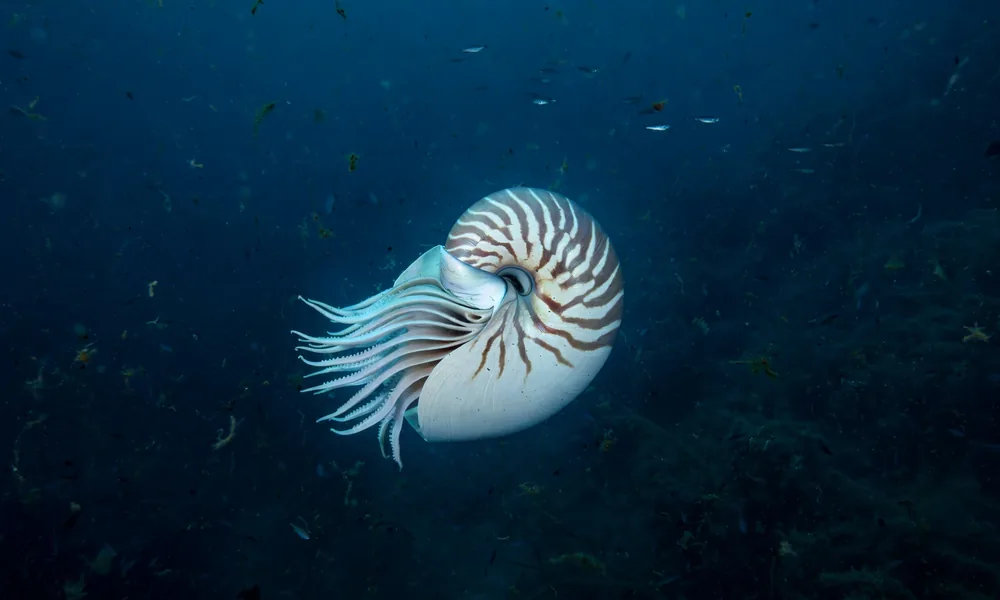
A chambered nautilus looks like a small submarine wearing a striped shell, and the shell is the first thing anyone notices. The shell is coiled into a flat spiral, smooth and white on the outside with dark brown stripes sweeping across the top, and pale underneath, a pattern called countershading that helps it blend into the dim water when seen from above or below. The opening of the shell is guarded by a tough, leathery hood, formed from two folded tentacles, that closes like a door when the animal pulls itself inside. Cut the shell open, and the inside is lined with mother-of-pearl, a shining, rainbow surface that has made nautilus shells prized as ornaments for centuries, and the spiral of the shell follows a neat logarithmic curve, growing wider with every turn.
The size of a chambered nautilus is modest for an animal with such a reputation, and the shell is the measure that matters. Adult shells are about 20 to 25 centimetres across, which is roughly the width of a dinner plate, and the largest specimens on record reach 25.4 centimetres. The animal inside weighs roughly 0.5 to 1.2 kilograms, and a dwarf population from the Sulu Sea in the Philippines is much smaller, with a mean shell diameter of only about 11.6 centimetres. The body itself lives only in the newest and largest chamber, the body chamber, while the older chambers behind it are sealed off by walls called septa and filled with a mixture of gas and liquid. A newly hatched nautilus has only about four chambers, and it adds new ones as it grows, sealing off the old ones behind it, until an adult carries about 30 or more.

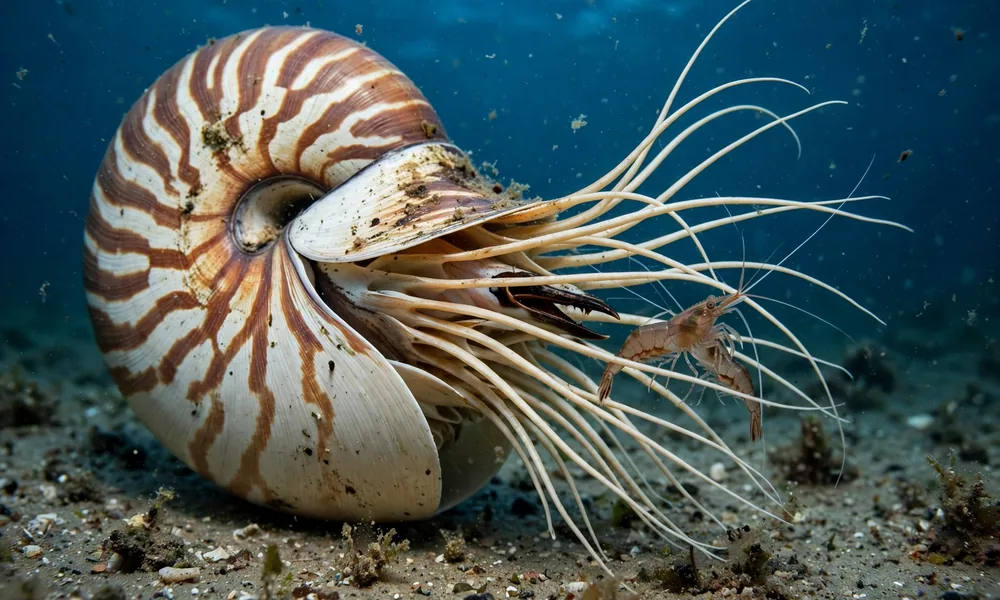
The head of the nautilus is a crown of tentacles, and it looks quite unlike the head of any other cephalopod. There are up to 90 thin, retractable tentacles arranged in rings around the mouth, and they have no suckers at all, unlike the arms of an octopus or a squid. Instead they are covered in sticky ridges that grip rough surfaces, and they are used to hold food and pass it to the mouth, where a sharp, parrot-like beak tears it into pieces and a file-like tongue called a radula shreds it further. The eyes are simple pinholes with no lens, more like a camera obscura than a camera, and they give only a coarse image, which is why the nautilus finds its food mostly by smell, using a pair of chemical-sensing organs called rhinophores near the eyes. The skin of the soft body is pale and speckled, and the whole animal can withdraw completely into its shell and shut the hood behind it when danger comes close.
Where chambered nautiluses live
Chambered nautiluses live in the warm waters of the Indo-Pacific, and they are found nowhere else on Earth in the wild. Their range runs from the Andaman Sea in the east Indian Ocean, through Indonesia and the Philippines, east to Fiji and the Solomon Islands, north to southern Japan and south to the Great Barrier Reef off northern Australia. They live on the steep outer slopes of coral reefs, where the seabed drops away quickly into deep water, and they are animals of the reef edge rather than the shallow lagoon, spending their lives on slopes where the water is cool, dark and rich in the dead animals they feed on. They are associated with reefs that fall away steeply, because a nautilus needs deep water close at hand to retreat into by day.

The habitat they choose is defined by depth, and the nautilus is a commuter between two worlds. By day it rests at depths of about 300 to 500 metres, where the water is cold and dark and predators are fewer, and as night falls it rises up the reef slope to feed in shallower water at about 100 to 150 metres. Tracked animals at Osprey Reef in the Coral Sea have been recorded from about 111 metres down to about 703 metres, and the shell itself sets a hard limit, imploding at about 800 metres where the pressure becomes too great. In a few places, such as New Caledonia and Vanuatu, nautiluses come up to as little as 5 metres at night, but that is the exception, and most of the time this is an animal of deep water that humans almost never see without a submersible or a baited trap.

What chambered nautiluses eat
Chambered nautiluses are scavengers first and hunters second, and their diet is written on the reef slope itself. The everyday food is shrimp, small crabs, dead fish and other carrion, and the nautilus finds it by smell in the dark, following the scent of a dead animal drifting down the slope. It is a nocturnal, opportunistic feeder, and it will take live prey when it can catch it, including small fish and the moulted shells of crustaceans, and it has even been known to eat another nautilus. The food is caught with the ring of thin tentacles, held tight against the beak, torn into pieces and shredded by the radula before it is swallowed. A nautilus does not chase its food, because it cannot, and it does not need to, because the reef slope delivers a steady rain of dead animals from above.
What the nautilus eats changes little as it grows, and that is part of what makes it such a survivor. The young hatch as tiny copies of the adults, already carrying a shell, and they feed on the same small crustaceans and carrion as their parents, only smaller. There is no larval stage drifting in the plankton, no metamorphosis and no change of diet, and a young nautilus is simply a small nautilus doing the same job on a smaller scale. The animal feeds mostly at night, when it rises to shallower water, and it rests by day in the deep, digesting what it found, and a nautilus that has fed well can go for some time without eating again.
How chambered nautiluses behave
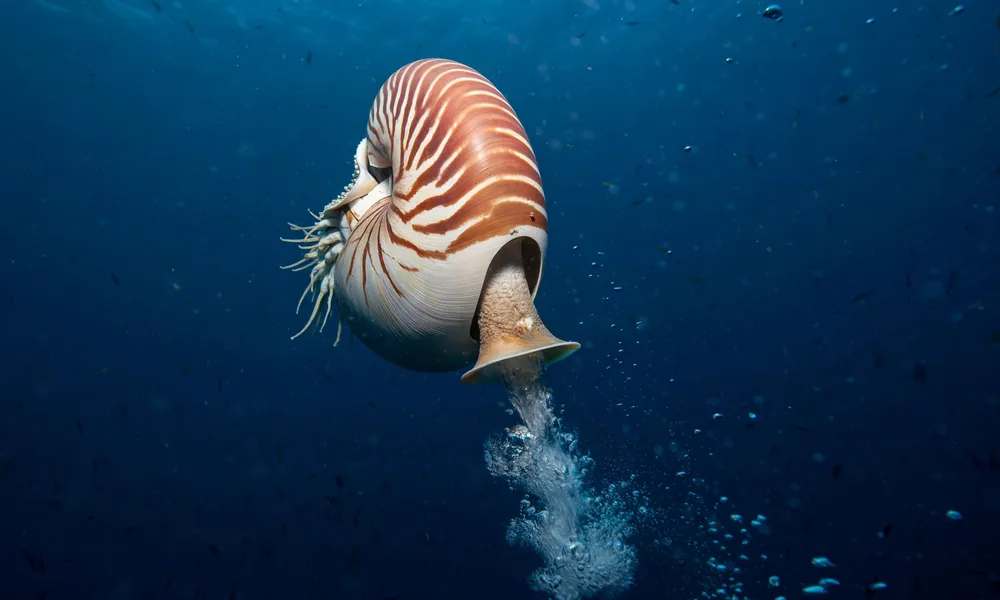
Chambered nautiluses are slow, solitary animals, and their day is split cleanly in two: rest deep by day, feed shallow by night. They drift rather than swim, hovering in the water with the help of their chambers, and they move by jet propulsion, pulling water into the mantle cavity inside the shell and blowing it out through a muscular, flexible funnel beneath the tentacles. The direction of the water stream decides the direction of travel, forwards, backwards or sideways, and the movement is a gentle see-saw rather than a dart, because a nautilus is a slow swimmer by cephalopod standards. They are solitary for most of the year, and they do not form groups or schools, though several animals may gather around the same piece of carrion or the same baited trap on a reef slope.
The most remarkable behaviour in the chambered nautilus is its control of buoyancy, and it is a trick no other living cephalopod can match. The chambers of the shell are connected by the siphuncle, a living tube that runs through them all, and the animal adjusts the balance of gas and liquid inside the chambers by pumping liquid out through the siphuncle, which lightens the shell and lets the animal rise, or letting liquid back in, which makes it heavier and lets it sink. The gas inside the chambers stays at about the same pressure as the air at the surface, no matter how deep the animal goes, and it is the liquid that does the work, not the gas. The result is an animal that can hover weightless in the water column for hours, neither rising nor sinking, spending almost no energy at all, and that is the secret of a life that can last for 20 years on a diet of carrion.
Breeding and life cycle
Chambered nautiluses breed slowly, and their whole life history is slow, which is both their strength and their weakness. They take a long time to reach sexual maturity, about 5 to 10 years, a very long time when compared with most other cephalopods, and the females lay only a few eggs at a time, often a dozen or fewer in a year, attaching each one to a hard surface such as rock or coral in deep water. The eggs are large, and they take a long time to develop, and when they hatch the young emerge as tiny copies of the adults, about 3 centimetres across, already carrying a shell with a few chambers and already able to swim and feed. There is no parental care after the eggs are laid, and the young are on their own from the moment they hatch.
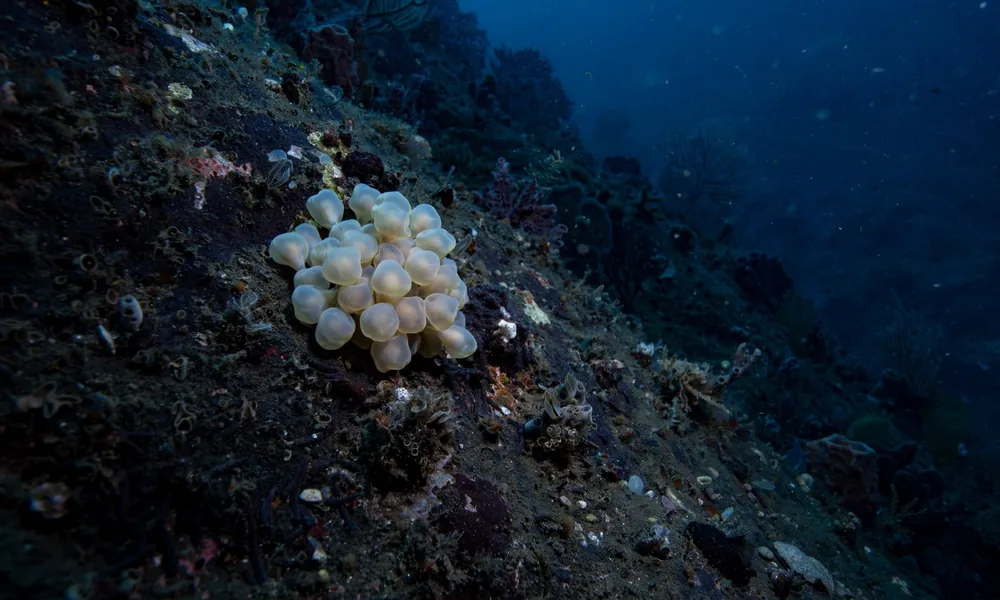
Under normal conditions the young grow slowly, adding new chambers to the shell as the body grows forwards, and each new chamber is sealed off by a septum as the animal moves into the next one. The animal grows throughout its life, but it grows slowly, and it does not reach full size for many years. In 2017, the Monterey Bay Aquarium in California managed to breed chambered nautiluses in captivity and film the young emerging from the egg, a rare glimpse of a life that is almost never seen in the wild. The young are independent from the day they hatch, feeding on small crustaceans and carrion on the reef slope, and a nautilus that survives its first years in the deep has a good chance of living for 15 to 20 years or more.

The nautilus is one of the longest-lived cephalopods, and its slow life is the key to its survival. Most octopuses and squids live for a year or two and die after breeding once, but a nautilus can breed over many years, laying a few eggs at a time, year after year, and that slow, steady reproduction has carried the family through some 500 million years of ocean history. The price of that slowness is that a population that is fished hard takes a very long time to recover, because each female produces so few young and each one takes so long to mature, and that is why the shell trade is such a serious threat.
Conservation status
The conservation status of the chambered nautilus is, on paper, a worrying one, and it is a recent change. The species is listed as Vulnerable by the International Union for Conservation of Nature, assessed in 2018, on the basis of trade-driven declines in the Philippines and other parts of its range, and it is also listed as Threatened under the United States Endangered Species Act, with the listing rule in force since October 2018. All nautilus species were added to CITES Appendix II in 2016, with the listing taking effect in January 2017, which means that international trade in nautilus shells now needs permits and is monitored. The listing is honest, and it is also incomplete, because nobody has a reliable global count of how many nautiluses are left, and the declines are known mostly from places where the shell fishery has been studied.

The main pressure is the shell trade. Nautilus shells have been collected for ornaments, jewellery and souvenirs for centuries, and the fishery uses baited traps set on reef slopes, catching the animals as they rise to feed at night. The shells are beautiful, and they fetch a good price, and in some places the fishing has been heavy enough to wipe out local populations, because a slow-breeding animal cannot replace what the traps take. The second pressure is the animal’s own life history, and a female that lays only a few eggs a year and takes 5 to 10 years to mature cannot rebuild a fished population quickly. The third pressure is the loss of reef habitat, and the nautilus needs steep, healthy reef slopes with deep water close by, and where reefs are damaged by warming seas, pollution or destructive fishing, the nautilus loses both its home and its food.
Best seasons for chambered nautilus watching
The best time to look for chambered nautiluses is at night, when the animals rise up the reef slope to feed, though no season will show you one from a beach. The nautiluses are present on the reef slopes all year round, so there is no wrong season in the strict sense, but the animals are most often seen by divers and researchers on calm nights, when the sea is flat and the water is clear, and a visit in the dry season, when the seas are at their calmest, gives the best chance of a boat trip out to the reef edge. In rough weather the traps and the submersibles stay ashore, and the nautilus stays deep, and nobody sees it at all.

The best hours are the first hours after dark, when the nautiluses are rising from the deep to feed on the reef slope and are at their shallowest. From about dusk until midnight, the animals are at their most active, drifting up the slope and following the scent of carrion, and they are at their most visible then, though visible still means very hard to find, because the water is dark and the animals are few. A research trip with baited traps, or a dive in a submersible, is the only realistic way to see one in the wild, and a visit to a public aquarium, where chambered nautiluses are kept in deep, cool tanks, is the way most people will ever meet this animal face to face.
Staying safe around chambered nautiluses
A chambered nautilus is not dangerous to people who leave it alone, and there is no safety warning that belongs to the animal itself beyond the obvious one: do not touch it, and do not take its shell. The nautilus has no venom, and its beak is far too small to harm a person, and it will not chase or threaten anyone, because it lives hundreds of metres down and it will never meet a swimmer in the way a reef fish might. The real danger runs the other way, and a nautilus brought to the surface too quickly can be harmed by the change in pressure, which is why researchers handle them gently and return them to the deep as fast as they can. The safest way to meet a nautilus is in an aquarium, where the animal is kept in cool, deep water and the glass does the work.
Chambered nautilus watching checklist
A little preparation turns a night on a reef slope into a real chance of seeing a chambered nautilus at its best, drifting pale in the dark water.
- A research trip or a submersible dive with a local marine team, in calm seas, when the water is clear and the reef slope is reachable.
- An evening trip after dark, when the nautiluses are rising from the deep to feed on the reef slope.
- A visit to a public aquarium with a deep, cool nautilus tank, so you can see one up close without going to sea at all.
- A red-filtered torch or a gentle light, so you can watch the animals without startling them in the dark.
- Binoculars and a camera that works in low light, so you can watch the reef slope without crowding the animals.
- A field guide to the cephalopods of the Indo-Pacific, so you can tell a chambered nautilus from its close relatives.
- Respect for the nautiluses and the reef, keeping your distance, keeping your hands off the animals, and leaving the reef as you found it.
Frequently asked questions
How big do chambered nautiluses get?
Chambered nautiluses have a shell about 20 to 25 centimetres across, and a good animal weighs roughly 0.5 to 1.2 kilograms. The largest specimens on record reach 25.4 centimetres across the shell, and a dwarf population from the Sulu Sea in the Philippines is much smaller, with a mean shell diameter of only about 11.6 centimetres, so a chambered nautilus is about the width of a dinner plate, and most of them are smaller than a football. The young hatch at about 3 centimetres across, already carrying a shell with a few chambers, and they grow slowly for many years before they reach full size.
What do chambered nautiluses eat?
A chambered nautilus eats shrimp, small crabs, dead fish and other carrion, which it finds by smell in the dark on the reef slope at night. The everyday food is shrimp and crabs, and the nautilus holds its food in its ring of thin tentacles and tears it apart with its sharp beak, shredding it further with its file-like radula before swallowing. It is a scavenger first and a hunter second, and it does not chase its food, because the reef slope delivers a steady rain of dead animals from above.
Where do chambered nautiluses live?
Chambered nautiluses live on steep reef slopes in the warm waters of the Indo-Pacific, from the Andaman Sea through Indonesia and the Philippines, east to Fiji and the Solomon Islands, north to southern Japan and south to the Great Barrier Reef off northern Australia. They live at depths of about 100 to 700 metres, resting at 300 to 500 metres by day and rising to about 100 to 150 metres at night to feed, and they need reefs that drop away steeply into deep water, because a nautilus without deep water close by has nowhere to retreat to by day.
How long do chambered nautiluses live?
Chambered nautiluses can live for 15 to 20 years or more, which makes them one of the longest-lived cephalopods of all. They take about 5 to 10 years to reach sexual maturity, a very long time when compared with most other cephalopods, and they breed slowly, with females laying only a few eggs at a time, often a dozen or fewer in a year. Most octopuses and squids live for a year or two and die after breeding once, while a nautilus can breed over many years, and that slow, steady life is the key to a lineage that has lasted for some 500 million years.
Can you keep a chambered nautilus as a pet?
You cannot, in any practical sense, and you should not try. Chambered nautiluses need deep, cool, pressurised seawater in a large tank, with a steady supply of shrimp and crabs and a reef slope to drift over, and no home aquarium can provide that. They are kept only in public aquariums with specialist staff, and even there they are difficult animals to keep, and a nautilus bought for its shell is a wild animal taken from a reef slope that may take a decade to replace. The best way to meet one is to visit a public aquarium and watch it drift in its tank.
How is this guide different from the camel spider guide?
This guide covers the chambered nautilus, a single species, Nautilus pompilius, a slow, deep-water cephalopod of Indo-Pacific reef slopes that drifts on jet propulsion, controls its buoyancy with gas-filled shell chambers and scavenges for shrimp and carrion at night, while our camel spider guide covers a fast, land-dwelling arachnid of hot deserts that runs down its prey on foot in the open air. One is a soft-bodied sea animal in a striped shell that you meet hundreds of metres down in the dark; the other is a swift desert hunter you meet on dry sand in the heat of the day.
Conclusion
The chambered nautilus species is a reminder that survival does not always belong to the fastest or the fiercest animal in the sea. A coiled shell with about 30 chambers, a tube that pumps liquid in and out to control buoyancy, up to 90 thin tentacles, pinhole eyes and a sharp beak have carried the nautilus through some 500 million years of ocean history, from seas full of ammonites to the reefs of today, and the animal is still drifting slowly up and down the reef slopes of the Indo-Pacific, feeding on carrion in the dark.
If you go looking for one, go on a calm night, go with a research team or a submersible, and go with patience, because the nautilus is a deep-water animal that does not come to you. Find a steep reef slope, wait for the dark, and watch for a pale spiral drifting up from the deep, and you will have met the chambered nautilus that turns a quiet stretch of deep water into a window on the ancient seas.