The coconut crab species is the largest land arthropod on Earth, a giant hermit crab that gave up the sea and learned to climb palm trees, crack coconuts and walk the beaches of tropical islands on legs a metre wide. If you are asking what a coconut crab is, the short answer is a huge terrestrial hermit crab, Birgus latro, weighing up to 4.1 kilograms with a leg span of up to 1 metre, that lives in coastal forests across the Indo-Pacific, hides by day in burrows and rock crevices, and comes out at night to forage for coconuts, fruit and carrion, climbing trees as high as 10 metres and using claws strong enough to tear a coconut husk apart. It is not a true crab in the ordinary sense, it is not a sea creature any more, and it is not an animal to pick up casually, yet it is one of the most extraordinary invertebrates alive, a hermit crab that outgrew its shell and became a giant.
What makes the coconut crab so fascinating is how completely it has left the sea behind. As a youngster it carries a borrowed snail shell like any other hermit crab, but as an adult it abandons the shell for good, its abdomen hardening into tough plates, and it breathes air through folded tissue in its gill chamber instead of gills, so an adult that is held underwater for long will drown. It can smell a fallen coconut from a long way off, it can lift objects as heavy as a small child, and it can live for 40 to 60 years, yet it still has to return to the sea to breed, because its larvae can only survive in salt water. This guide follows the whole animal: how it looks, where it lives, what it eats, how it behaves, how it breeds, and why a giant that rules its islands is now listed as Vulnerable.
Key takeaways
- The coconut crab species is Birgus latro, a terrestrial hermit crab of the family Coenobitidae, found on tropical islands and coasts across the Indian and Pacific Oceans.
- Adults weigh up to 4.1 kilograms, with a leg span of up to 1 metre and a body length of up to 40 centimetres, making the coconut crab the largest land arthropod known.
- The crab has enormously strong claws, with a measured pinching force of up to 1,765 newtons, and it uses them to tear husks from coconuts and break into the hard shell.
- It is a nocturnal omnivore and scavenger, eating coconuts, fruit, nuts, seeds, carrion and even rats and seabirds, and it climbs trees as high as 10 metres to find food.
- The species is listed as Vulnerable by the International Union for Conservation of Nature, assessed in 2018, and it is threatened by hunting, habitat loss and introduced predators.
The coconut crab species and their relatives
Coconut crabs belong to the family Coenobitidae, the family of land hermit crabs, and the family sits in the order Decapoda, alongside the true crabs, the lobsters, the shrimps and the prawns. The land hermit crabs are a small family of about a dozen species that live almost entirely on land, and they share the features that make a life ashore possible: a hardened abdomen in the adults, lungs that breathe air instead of gills, and a powerful sense of smell for finding food in the dark. Within the family, the coconut crab sits in the genus Birgus, and it is the only species in that genus, a giant that stands apart from its smaller cousins in every way that matters. The family as a whole ranges from small crabs a few centimetres across to the coconut crab itself, which is larger than any other land arthropod on the planet.
The coconut crab, Birgus latro, is the lead species of this guide, and it is the largest terrestrial arthropod known, with a weight of up to 4.1 kilograms, a leg span of up to 1 metre and a body length of up to 40 centimetres. It lives on tropical islands and coasts across the Indo-Pacific, from the coast of East Africa and the islands of the western Indian Ocean east through the western and central Pacific to the Tuamotu, Pitcairn and Line Islands, and it is also known as the robber crab and the palm thief, names it earned by stealing food and shiny objects from camps. It is listed as Vulnerable by the International Union for Conservation of Nature, and its shell is blue, purple, red or orange-brown, varying from island to island. Like the crab, the coconut crab is a decapod crustacean with ten legs and a hard exoskeleton, but the ordinary crab of a rock pool lives in the sea and swims, while the coconut crab lives on land, climbs trees and would drown if it stayed underwater for long.

| Type | Animal | Where it lives | Best-known food | Length or Weight |
|---|---|---|---|---|
| Family | Land hermit crabs (Coenobitidae) | Tropical coasts worldwide | Fruit, nuts and carrion | About 3 to 40 cm long |
| Genus | Coconut crabs (Birgus) | Indo-Pacific islands | Coconuts, fruit and carrion | Up to 4.1 kg in weight |
| Species | Coconut crab (Birgus latro) | East Africa to the Pacific | Coconuts, fruit and carrion | Up to 1 m leg span |
| Species | Caribbean hermit crab (Coenobita clypeatus) | Caribbean and Florida | Fruit, nuts and carrion | About 10 to 15 cm long |
| Species | Strawberry land hermit crab (Coenobita perlatus) | Indo-Pacific | Fruit, nuts and carrion | About 8 to 15 cm long |
| Species | Indonesian land hermit crab (Coenobita brevimanus) | East Africa to Indonesia | Fruit, nuts and carrion | About 15 to 20 cm long |
The closest relatives of the coconut crab are the other land hermit crabs of the genus Coenobita, a group of small to medium crabs that live on tropical coasts around the world, and the genus as a whole ranges from about 3 centimetres to about 20 centimetres long. The Caribbean hermit crab, Coenobita clypeatus, is a crab of the Caribbean and Florida that grows to about 10 to 15 centimetres long, with a reddish-brown shell and a large purple claw, and it is the hermit crab most often kept as a pet. The strawberry land hermit crab, Coenobita perlatus, is a bright red crab of the Indo-Pacific that grows to about 8 to 15 centimetres long, and it is named for its colour, which is the red of a ripe strawberry. The Indonesian land hermit crab, Coenobita brevimanus, is a large land hermit crab of East Africa, Indonesia and the Pacific that grows to about 15 to 20 centimetres long, with a big lilac claw, and it is the largest of the ordinary land hermit crabs, though it is still a small animal beside a coconut crab.
What coconut crabs look like
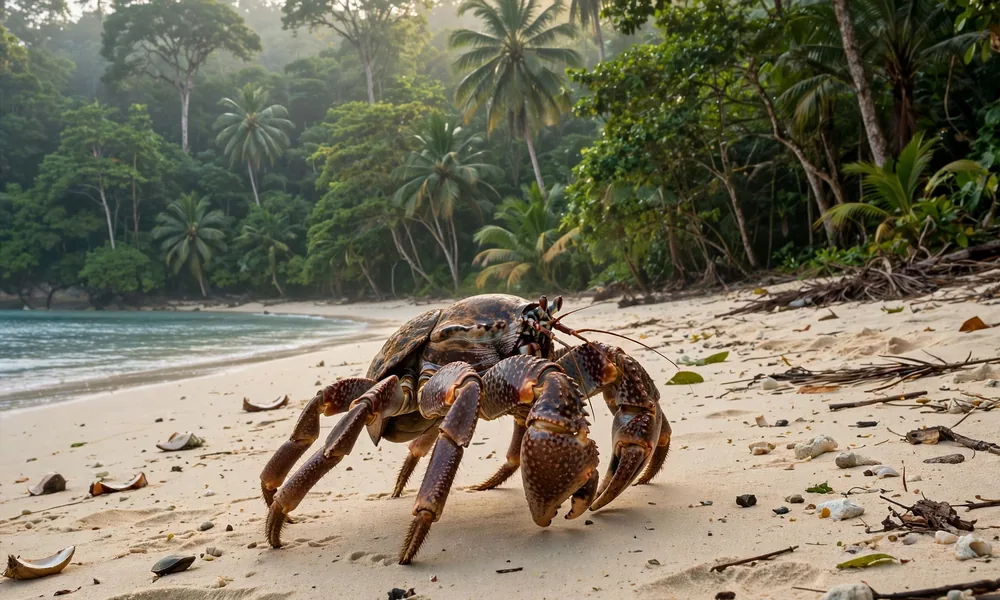
A coconut crab looks like a hermit crab that has been scaled up to the size of a small dog, and the size is the first thing anyone notices. The body is broad and heavily armoured, with a carapace up to 200 millimetres wide, five pairs of legs, and a pair of huge, uneven claws, the larger one used for crushing and the smaller one for cutting and tearing. The colour varies from island to island, and it can be blue, purple, red, orange or brown, sometimes all at once, with a violet sheen on the legs and a paler belly. The eyes sit on stalks that can be raised and lowered, and the antennae are long and sensitive, and the whole animal has a slow, deliberate way of moving that suits an animal with nothing much to fear.
The size of a coconut crab depends on the sex and the island, and the difference is easy to see once you know to look for it. Adult males are larger than females, and the biggest animals weigh up to 4.1 kilograms, which is about 9 pounds, with a leg span of up to 1 metre from the tip of one leg to the tip of another. The average animal is smaller, weighing about 2.5 kilograms with a leg span of about 91 centimetres, and the body itself, without the legs, can reach 40 centimetres long. The carapace may reach a length of 78 millimetres and a width of up to 200 millimetres, which is about the width of a dinner plate, and a crab that size is a heavy animal to lift, which is why islanders handle them with care. The young look quite different from the adults, and juveniles are small, soft-bodied animals that live in borrowed snail shells, only hardening into the armoured adult form after a year or two on land.
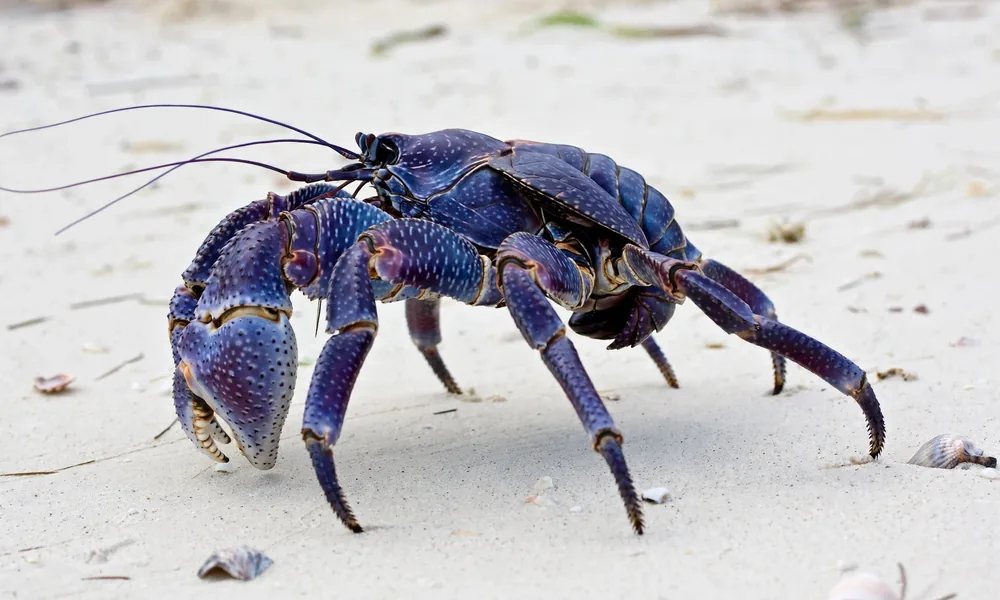
The claws are the most famous feature of the coconut crab, and they are stronger than they look. The larger claw is a crushing tool, and in wild crabs from Okinawa the greatest pinching force ever measured was 1,765 newtons, a force that rises with the size of the animal, and if the same relationship holds for the largest crabs, a 4 kilogram animal could pinch with a force of about 3,300 newtons, which is stronger than the bite of most land predators. The claws have serrated edges that work like teeth, and they are used to tear the husk from a coconut, to pound and rip through the hard shell, and to defend the crab against anything foolish enough to grab it. The walking legs are long and curved, with pointed tips that grip bark and rock, and the fourth pair of legs is smaller, while the tiny fifth pair is kept tucked inside the gill chamber, where it is used to clean the breathing organs.
Where coconut crabs live
Coconut crabs live on tropical islands and coasts across the Indo-Pacific, and they are found nowhere else on Earth in the wild. Their range runs from the coast of East Africa and the islands of the western Indian Ocean, including Aldabra, the Chagos Archipelago and the Seychelles, through the Christmas and Cocos Islands, east through Indonesia and Papua New Guinea, and on through the western and central Pacific to the Tuamotu, Pitcairn and Line Islands. They live in coastal forests and scrub, where there are palm trees, rock crevices and soil to dig in, and they are animals of the shoreline rather than the deep forest, though adults have been found as far as 6 kilometres inland where the ground is damp enough. They are associated with islands that have no large land predators, because a slow crab on open ground is easy prey where rats, pigs and dogs are common.
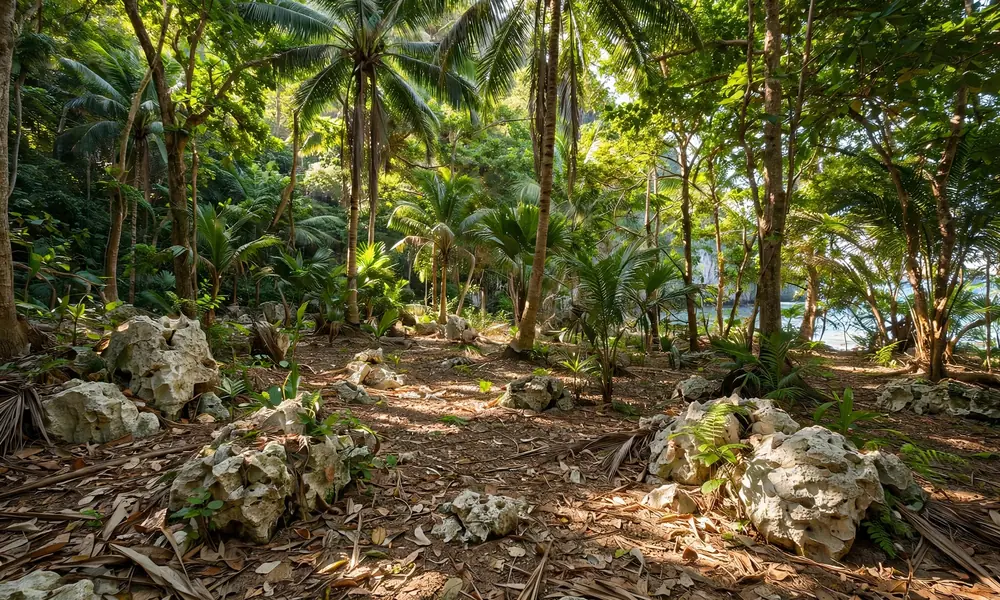
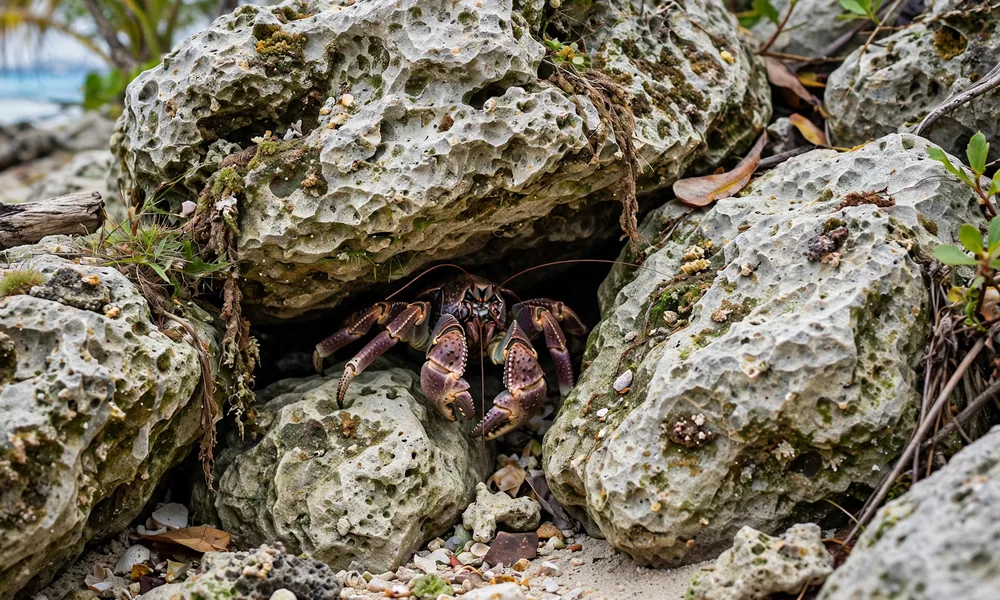
The habitat they choose is the land beside the sea, and they rarely go far from the coast at all. A coconut crab spends its days hidden in a burrow, a rock crevice or among the roots of a tree, and it comes out at night to forage, climbing palms and searching the leaf litter for fallen fruit. The burrows can be up to 1 metre long, and the crab lines them with coconut husk fibres to keep them damp, because a land crab still needs humidity to breathe. The air has to stay warm and moist, because a coconut crab dries out quickly, and the ground needs to be soft enough to dig in. A beach without palms, a forest without crevices and a coast without fresh water are all places where coconut crabs do not live.

What coconut crabs eat
Coconut crabs are omnivores and scavengers, and their diet is written on the forest floor itself. The everyday food is fleshy fruit, nuts and seeds, including coconuts and the fruit of the pandanus tree, and the crab will also eat the pith of fallen trees, carrion, other crabs and its own moulted exoskeleton. It climbs coconut palms to reach the nuts, and it uses its powerful claws to tear the husk away and break into the hard shell, though opening a coconut is hard work even for a crab this strong, and it takes time, pounding and tearing rather than a single effortless crack. The crab also eats fallen fruit on the ground, and it will hunt rats, other coconut crabs and even large seabirds such as boobies that it finds nesting on the ground, dragging them into its burrow to eat.

What the crab eats changes as it grows, and the change is a complete one. The larvae are tiny animals drifting in the plankton, less than 3 millimetres long, and they feed on the smallest creatures of the open sea. The juveniles that come ashore feed on small scraps on the beach, and they grow slowly, taking about five years to reach maturity. The adults, by contrast, eat almost anything they can find on land, and a crab that has climbed a palm for a coconut will not go back to the sea to eat. The sense of smell is the crab’s great tool for finding food, and it can detect the scent of a fallen coconut or a dead animal from a long way off, which is why crabs gather so quickly around a fresh fall of fruit.
How coconut crabs behave
Coconut crabs are night animals, and their day is split cleanly in two: hide by day, forage by night. They shelter by day in burrows, rock crevices and tree roots, and they are so still and so well hidden that a person can walk past a burrow and not know a crab is inside. As night falls they come out and begin to move through the forest, climbing, foraging and looking for a mate. They are solitary for most of the year, and they do not form groups or colonies, and each crab keeps to its own patch of forest, though several crabs may gather at the same fallen coconut on a good night.
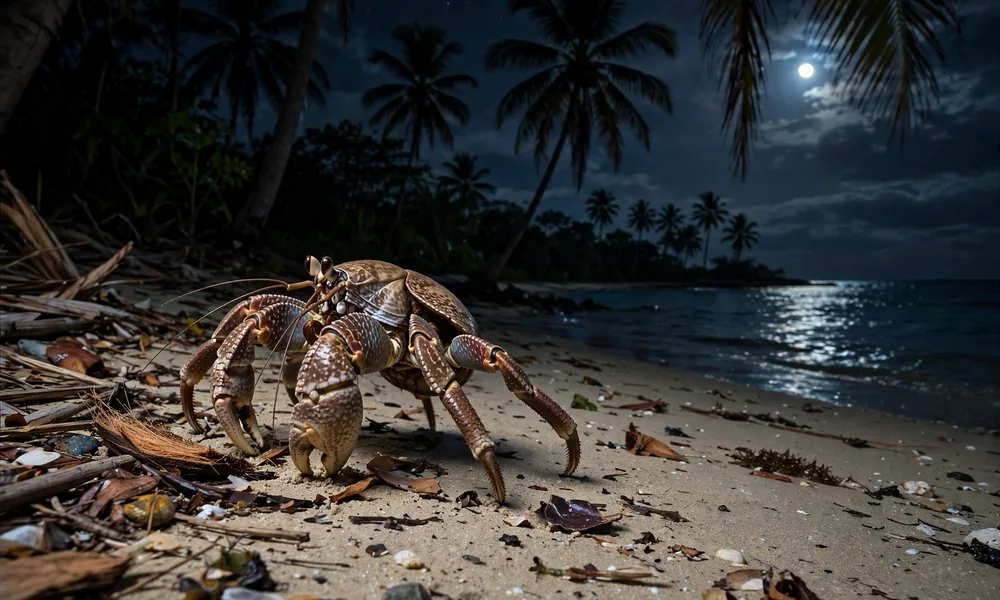
The most famous behaviour in the coconut crab is its climbing, and it is a trick that looks impossible for an animal of its size. The crab climbs palm trees as high as 10 metres, using its curved walking legs and their inward grip to hold the bark, and it can drop as far as 4 metres to the ground without harming itself, tucking its legs in and landing on the leaf litter. It climbs to reach coconuts and pandanus fruit, and it also climbs to escape the heat of the day and to find a safe place to rest. The crab is also a strong lifter, and it can carry objects as heavy as a small child, which is how it earned the name robber crab, because it will pick up food, tools and shiny objects from camps and carry them back to its burrow.
Breeding and life cycle
Coconut crabs breed on land but their young begin life at sea, and the whole cycle is tied to the ocean. Mating takes place on land, usually between May and September, and the female carries the fertilised eggs attached beneath her abdomen for about 25 to 45 days. A clutch can hold from about 45,000 to 250,000 eggs, with larger females carrying more, and when the eggs are ready to hatch the female walks down to the shore and releases the larvae into the sea. The larvae are less than 3 millimetres long, and they drift in the plankton for about three to four weeks, moulting through several stages before they become a glaucothoe, the transitional stage that settles on the seabed.
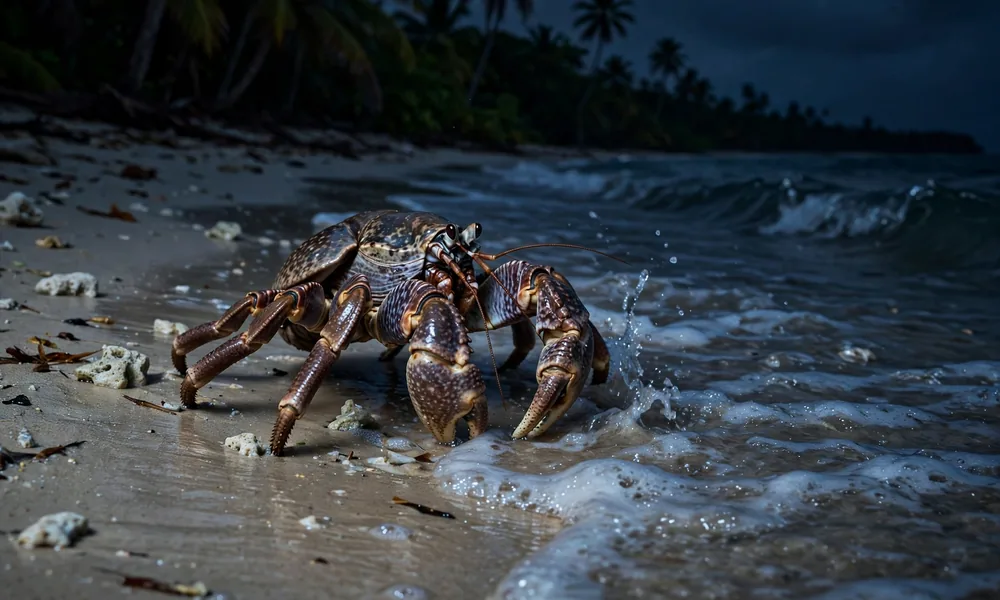
Under normal conditions the glaucothoe finds an empty snail shell on the seabed and moves into it, then comes ashore and begins the long move onto land. The young crabs carry their borrowed shells for one to two years, and when the animal reaches a thoracic length of about 10 millimetres its abdomen and thorax harden into a tough, calcified exoskeleton, and it discards the shell for good, a change no other hermit crab makes. Growth is very slow after that, and the crab moults once a year, digging a burrow up to 1 metre long in which to hide while its soft new shell hardens, staying in the burrow for 3 to 16 weeks, with larger crabs taking longer. The young are independent from the day they come ashore, and a crab that survives its first years on the beach has a good chance of living for 40 to 60 years.

The coconut crab is one of the longest-lived arthropods, and its slow life is the key to its size. It takes about five years to reach sexual maturity, and it keeps growing for decades after that, moulting once a year and adding a little size each time. A crab that lives for 60 years has moulted 60 times, and each moult is a dangerous moment, because the soft crab is helpless until its new shell hardens. The price of that slowness is that a population that is hunted hard takes a very long time to recover, because each female produces young only once a year and each one takes years to mature, and that is why the coconut crab is in trouble on so many islands.
Conservation status
The conservation status of the coconut crab is, on paper, a worrying one, and it is a recent change. The species is listed as Vulnerable by the International Union for Conservation of Nature, assessed in 2018, after a global reassessment moved it up from Data Deficient, on the basis of widespread declines on island after island. The listing is honest, and it is also incomplete, because nobody has a reliable global count of how many coconut crabs are left, and the declines are known mostly from places where the crabs have been studied, such as Christmas Island, where the population is one of the best known in the world.
The main pressure is hunting. Coconut crabs are eaten on many islands, and they are easy to catch at night with a torch, because they are slow, they come out in the open to forage, and they have no defence except their claws. The second pressure is habitat loss, and when coastal forest is cleared for farming, for building or for plantations, the palms go, the burrows are destroyed and the crabs lose both their food and their shelter. The third pressure is introduced predators, and rats, pigs, dogs and cats eat the young crabs and raid the burrows, while the crabs themselves, which evolved on islands with few predators, have no defence against them. The fourth pressure is the crab’s own life history, and a female that takes five years to mature and breeds only once a year cannot rebuild a hunted population quickly.
Best seasons for coconut crab watching
The best time to look for coconut crabs is the wet season, when the forest is damp and the crabs are out foraging in the open, though no season will show you one from a garden. The crabs are present on their islands all year round, so there is no wrong season in the strict sense, but the warm, wet months are the time when the leaf litter is dampest and the crabs are most active, and a visit in the early rains will show you crabs climbing palms and feeding on fallen fruit. In the dry season the crabs retreat into the dampest corners of the forest, into burrows and crevices beside the shore, and they are harder to find.
The best hours are the first hours after dark, when the crabs are out foraging in the forest and on the beach and the air is still damp from the day. From about dusk until midnight, the crabs are at their most active, climbing, feeding and looking for a mate, and they are at their most visible then, walking in the open where a careful observer with a torch can see them. A guided night walk with a local naturalist, in the wet season, is the best way to see one in the wild, and Christmas Island, where the crabs are protected and common, is one of the best places in the world to meet this animal face to face.
Staying safe around coconut crabs
A coconut crab is not dangerous to people who leave it alone, but it is an animal to respect, because its claws can do real damage. The crab has no venom, and it will not chase or threaten a person, but if it is picked up from the front or cornered, it can pinch hard enough to break skin and even to break a finger, and a large crab can hold on with a grip that is very hard to break. The safe rule is simple: never pick one up from the front, never put a hand or a foot near its claws, and never try to pull a crab off a tree by force. A crab will not meet a swimmer in the sea, because it lives on land and would drown if it stayed underwater for long, and the safest way to meet one is to watch it from a few steps away, with a torch, and let it go about its business.
Coconut crab watching checklist
A little preparation turns a night on a tropical island into a real chance of seeing a coconut crab at its best, big and blue on the sand in the moonlight.
- A guided night walk with a local naturalist in the wet season, when the forest is damp and the crabs are most active.
- An evening walk after dark, when the crabs are out foraging on the beach and their eyes shine back in a torch beam.
- Sturdy boots and long sleeves, so you can walk the rocky shore paths without slipping and without mosquito bites.
- A torch with a red filter or a gentle beam, so you can find the crabs without blinding them.
- Binoculars and a camera that works in low light, so you can watch the crabs without crowding them.
- A field guide to the crabs of the Indo-Pacific, so you can tell a coconut crab from a land hermit crab.
- Respect for the crabs and the island, keeping your distance, keeping your hands off the crabs, and leaving the beach as you found it.
Frequently asked questions
How big do coconut crabs get?
Coconut crabs weigh up to 4.1 kilograms, which is about 9 pounds, with a leg span of up to 1 metre from the tip of one leg to the tip of another. The average animal is smaller, weighing about 2.5 kilograms with a leg span of about 91 centimetres, and the body itself, without the legs, can reach 40 centimetres long. Males are larger than females, and the biggest crabs are found on islands where they are protected and left alone, while crabs on islands where they are hunted rarely reach full size.
What do coconut crabs eat?
A coconut crab eats coconuts, fruit, nuts and seeds, including the fruit of the pandanus tree, and it also eats carrion, other crabs and its own moulted exoskeleton. The everyday food is fallen fruit and coconuts, and the crab climbs palms to reach the nuts, tearing the husk away with its powerful claws and breaking into the hard shell to eat the white flesh inside. It will also hunt rats, other coconut crabs and even large seabirds such as boobies that it finds nesting on the ground, and it finds its food mostly by smell, which is why crabs gather so quickly around a fresh fall of fruit.
Are coconut crabs dangerous?
Coconut crabs are not venomous, and they will not chase or attack a person, but their claws can do real damage if they are grabbed or cornered. The largest claw can pinch with a measured force of up to 1,765 newtons, and a big crab can hold on with a grip that is very hard to break, so a bite from a coconut crab can break skin and even break a finger. The safe rule is to never pick one up from the front, never put a hand near its claws, and to watch it from a few steps away, and a crab that is left alone will simply walk away and go back to its burrow.
Where do coconut crabs live?
Coconut crabs live on tropical islands and coasts across the Indo-Pacific, from the coast of East Africa and the islands of the western Indian Ocean, including Aldabra, the Chagos Archipelago and the Seychelles, through the Christmas and Cocos Islands, east through Indonesia and Papua New Guinea, and on to the Tuamotu, Pitcairn and Line Islands. They live in coastal forests and scrub, where there are palm trees, rock crevices and soil to dig in, and they shelter by day in burrows up to 1 metre long and come out at night to forage, sometimes as far as 6 kilometres inland where the ground is damp enough.
Can you keep a coconut crab as a pet?
You cannot, in any practical sense, and you should not try. Coconut crabs need a large, warm, humid enclosure with deep soil to burrow in, palm trees to climb, fresh and salt water, and a diet of fruit, nuts and carrion, and they can live for 40 to 60 years, which is longer than most pets. They are also protected on many islands, and taking one from the wild is illegal in several countries, and a crab kept in a small tank will not thrive. The best way to meet one is to visit a tropical island where they are protected and watch one on a guided night walk.
How is this guide different from the chambered nautilus guide?
This guide covers the coconut crab, a single species, Birgus latro, a huge terrestrial hermit crab of tropical islands that climbs palm trees, cracks coconuts with claws that can pinch with a force of up to 1,765 newtons and lives for 40 to 60 years on land, while our chambered nautilus guide covers a slow, deep-water cephalopod of Indo-Pacific reef slopes that drifts on jet propulsion, controls its buoyancy with gas-filled shell chambers and scavenges for shrimp and carrion hundreds of metres down. One is a giant land crab you meet on a beach at night with a torch; the other is a shelled sea animal you meet in the dark water far below the reef.
This guide also goes further than our general crab guide, which covers crabs as a whole, from rock-pool crabs to swimming crabs to hermit crabs, in a single broad sweep. That guide is the place to start if you want to know what a crab is, while this guide stays with one species for its whole length, following the coconut crab from its land hermit crab relatives and its coconut-cracking claws through its island habitat, its night behaviour and its long, slow life to the seasons and the checklist that will help you see one for yourself.
Conclusion
The coconut crab species is a reminder that a crab does not need the sea to be a crab, and that an animal can give up the water altogether and still thrive. A body up to 40 centimetres long, a leg span of up to 1 metre, claws that can pinch with a force of up to 1,765 newtons, lungs that breathe air and a life that can last for 40 to 60 years have made the coconut crab the largest land arthropod on Earth, at home in the coastal forests of the tropical Indo-Pacific, from the islands off East Africa to the far Pacific.
If you go looking for one, go on a guided night walk in the wet season, go after dark, and walk slowly through the forest with your eyes on the leaf litter and the palm trunks. Find the fallen coconuts, watch for a great blue shape moving in your torch beam, and wait for the crab to climb, and you will have met the coconut crab that turns a quiet stretch of tropical island into a place of sudden, giant excitement.