The crown-of-thorns starfish species are the large, spiny starfish that eat living coral on the reefs of the Indo-Pacific, and they are the most argued-about animal on any coral reef. If you are asking what a crown-of-thorns starfish is, the short answer is a big, many-armed starfish, usually 25 to 35 centimetres across, covered in long, sharp, venomous spines, that climbs onto a living coral colony, pushes its stomach out over the coral and digests the living tissue off the skeleton, leaving a patch of bare white coral behind. On the Great Barrier Reef alone, crown-of-thorns starfish were responsible for about 42 per cent of the coral lost between 1985 and 2012, a share of the damage that has made the animal famous, feared and studied more than any other starfish.
What makes the crown-of-thorns so striking is the mismatch between its looks and its power. It is a slow animal, moving at about 35 centimetres a minute on hundreds of tiny tube feet, and it has no eyes to speak of, no brain and no bite, yet a single large adult can eat up to about 10 square metres of living coral in a year, and a female 40 centimetres across can release around 50 million eggs in a single breeding season. This guide follows the whole animal: how it looks, where it lives, what it eats, how it behaves, how it breeds, and why reef managers now send out dive teams to cull it by hand.
Key takeaways
- The crown-of-thorns starfish species covered here are the coral-eating starfish of the genus Acanthaster, led in this guide by Acanthaster planci, a species complex of at least four regional species that split roughly 2 to 4 million years ago.
- Adults are normally 25 to 35 centimetres across, with 14 to 21 arms, most often 16 to 21, and spines 4 to 5 centimetres long that carry a venom containing saponins, which makes a sting painful for days.
- A crown-of-thorns starfish eats living hard coral by pushing its stomach out over the colony and digesting the tissue, and a large adult can eat up to about 10 square metres of coral in a year.
- A female 40 centimetres across can release around 50 million eggs in a breeding season, and the larvae drift in the plankton for weeks before settling on the reef.
- On the Great Barrier Reef, coral cover fell from 28.0 per cent to 13.8 per cent between 1985 and 2012, and crown-of-thorns starfish were responsible for about 42 per cent of that loss, with storms causing 48 per cent and bleaching 10 per cent.
The crown-of-thorns starfish species and their relatives
Crown-of-thorns starfish belong to the phylum Echinodermata, the great group that also holds the sea urchins, the sea cucumbers and the brittle stars, and within it they sit in the class Asteroidea, the starfish, and the order Valvatida, alongside most of the familiar five-armed starfish of the shore. The crown-of-thorns of this guide are the coral-eating starfish of the family Acanthasteridae and the genus Acanthaster. Within the group, the starfish of this guide are led by Acanthaster planci, the crown-of-thorns starfish of the Indo-Pacific, and the name covers a complex of at least four regional species that split roughly 2 to 4 million years ago, with the form on the Great Barrier Reef now referred to as Acanthaster cf. solaris.
The crown-of-thorns starfish, Acanthaster planci, is the lead species of this guide, and it is the starfish that defines the whole coral-eating group in most people’s minds, largely because it is one of the largest starfish on any reef and the only one that specialises in eating living hard coral. It lives throughout the tropical Indo-Pacific, from the east coast of Africa and the Red Sea across to South-East Asia, northern Australia and the islands of the Pacific, on coral reefs in shallow water, and it grows to 25 to 35 centimetres across as an adult, with specimens of up to 60 centimetres, and even 80 centimetres, collected in the past. It is listed as Least Concern by the International Union for Conservation of Nature, because the species as a whole is widespread and abundant, even though its outbreaks can devastate a single reef. Its colour varies by region and by diet, from grey-green to red-brown in the Pacific and blue to pale red in the Indian Ocean, with red-tipped spines on the Great Barrier Reef and brilliant purple animals in the waters off Thailand. Like the animals in our coral guide, the crown-of-thorns is a creature of the reef, but the coral is the builder that lays down limestone and the starfish is the eater that takes it away, and a reef needs both, in balance, to stay alive.

| Type | Animal | Where it lives | Best-known food | Length or Weight |
|---|---|---|---|---|
| Family | Crown-of-thorns starfish (Acanthasteridae) | Tropical Indo-Pacific reefs | Living hard coral | Adults 25 to 35 cm across |
| Genus | Crown-of-thorns starfish (Acanthaster) | Indian Ocean and Pacific Ocean | Living hard coral | Up to 80 cm across |
| Species | Crown-of-thorns starfish (Acanthaster planci) | Indo-Pacific coral reefs | Living hard coral | 25 to 35 cm across |
| Species | Pacific crown-of-thorns (Acanthaster cf. solaris) | Great Barrier Reef | Living hard coral | Up to about 80 cm across |
| Species | Common starfish (Asterias rubens) | North-east Atlantic shores | Mussels and other shellfish | Up to 30 cm across |
| Species | Blue linckia starfish (Linckia laevigata) | Indo-Pacific reefs | Detritus and dead animals | Up to 30 cm across |
The closest relatives of the crown-of-thorns are the other starfish of the genus Acanthaster, a small genus of large, many-armed, spiny starfish that live only on tropical reefs, and the genus as a whole is set apart from other starfish by its size, its many arms and its diet of living coral. The Pacific form, Acanthaster cf. solaris, is the crown-of-thorns of the Great Barrier Reef, the animal at the centre of the outbreaks that have shaped the reef for more than sixty years, and it is the form that reef managers count and cull. The common starfish, Asterias rubens, is the starfish most people know from the shores of the north-east Atlantic, a five-armed animal up to 30 centimetres across that eats mussels and other shellfish by prising them open with its tube feet. The blue linckia starfish, Linckia laevigata, is a reef starfish of the Indo-Pacific, a smooth, bright blue animal up to 30 centimetres across that feeds on detritus and dead animals, and it shows what a starfish looks like when it has no spines and no taste for coral.
What crown-of-thorns starfish look like
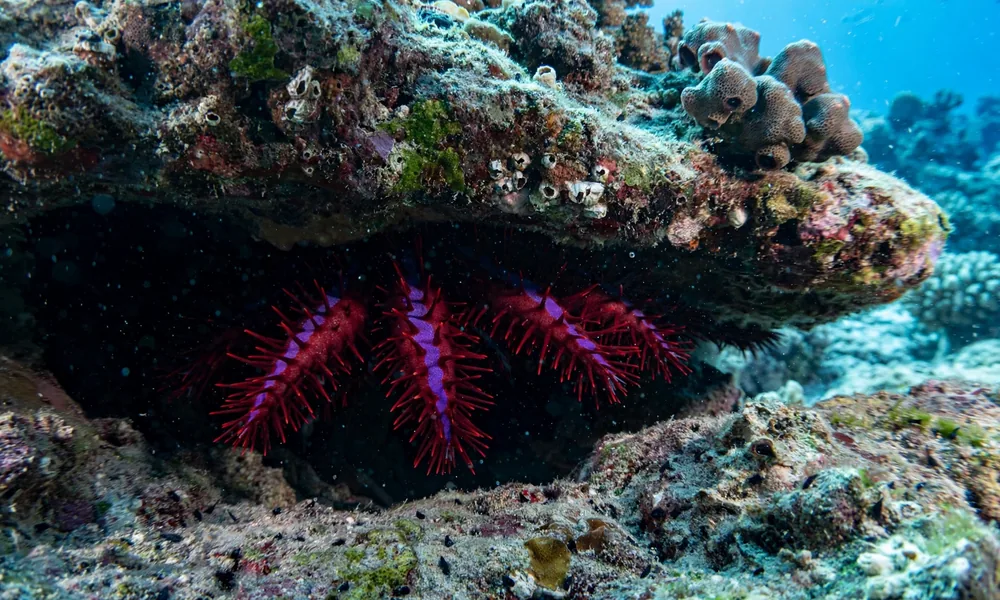
A crown-of-thorns starfish looks like a spiny cushion that has grown arms in every direction. The body is a broad, soft central disc ringed by many arms, and the whole upper surface is covered in long, stiff, very sharp spines, which is where the name comes from, because the spines look like the crown of thorns of the old story. A juvenile begins life with five arms, like an ordinary starfish, and it develops into an adult with an astounding 14 to 21 arms, most often 16 to 21, with arm numbers varying between places, and 14 to 18 given for the Great Barrier Reef. The spines are 4 to 5 centimetres long, and they are coated with tissue containing saponins, detergent-like toxins that make a puncture wound painful, swollen and slow to heal. The colour is grey-green to red-brown in the Pacific and blue to pale red in the Indian Ocean.
The size of a crown-of-thorns starfish depends on the reef it lives on and on the food it has had, and the difference across the group is large. Adults normally measure 25 to 35 centimetres across, and specimens of up to 60 centimetres, and even 80 centimetres, have been collected, which makes it nearly the largest species of starfish in the world. The young look quite different from the adults in shape if not in colour, and a newly settled starfish is a tiny five-armed animal, barely a millimetre or two across, that hides in the rubble and feeds on algae, and it may stay small for years before it switches to coral and grows fast.
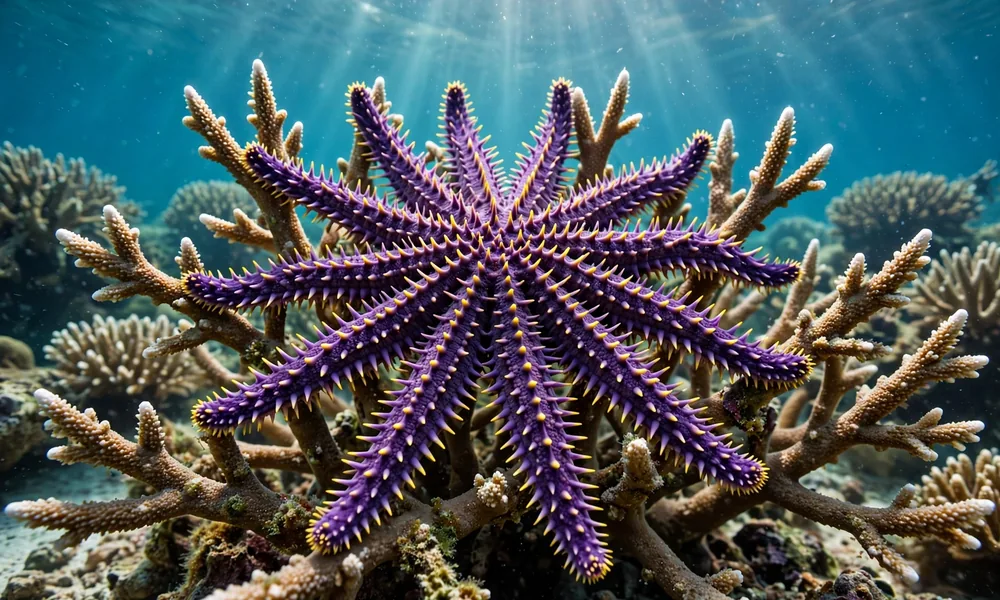
The spines are the part of a crown-of-thorns starfish that people remember, and they are also the part that keeps it alive. The spines are long, sharp and brittle, and they break off in the skin of anything that grabs the animal, leaving a splinter that carries venom with it, and a sting causes intense pain and swelling that can last for days, and people stung repeatedly risk a severe allergic reaction. The starfish can also regrow a lost arm, and a damaged animal will seal the wound and grow a new arm over time, though the new arm is smaller at first and takes months to catch up.
Where crown-of-thorns starfish live
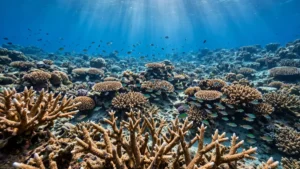
Crown-of-thorns starfish live on coral reefs in the tropical and subtropical Indian Ocean and Pacific Ocean, from the east coast of Africa and the Red Sea across to South-East Asia, northern Australia and the islands of the Pacific, and they are found nowhere else on Earth. Their range centres on the warm, shallow reefs where hard corals grow, and the largest numbers are found on the Great Barrier Reef off eastern Australia, where the animal has been studied more than anywhere else. They live in shallow water on the reef itself, on the reef slope, the reef crest and the lagoon floor, and they need warm water, clear water and living coral to eat, because without coral there is nothing for an adult to feed on.

The habitat a crown-of-thorns starfish chooses is the reef itself, and it rarely lives anywhere else. A starfish spends its days hidden in the darker caverns of the reef, under ledges and beneath coral heads, and it comes out at night to feed, crawling onto a coral colony and settling down to eat. The water has to stay warm, because the animal is a tropical reef creature through and through, and the water has to stay clear, because a reef smothered in sediment grows no coral for it to eat. At ordinary densities the animals are thin on the ground, about 6 to 20 starfish per square kilometre, which is less than one per hectare, and a diver can swim a whole reef and see none at all, which is how the reef is meant to be.
What crown-of-thorns starfish eat
Crown-of-thorns starfish are specialists, and their diet is written in the coral they live on. They feed almost entirely on the living tissue of hard corals, the stony corals of the order Scleractinia, and they prefer the fast-growing branching and table corals such as Acropora, though they will take almost any hard coral when the favoured ones run out. The starfish climbs onto a living coral colony using hundreds of tube feet, fits itself closely to the surface and everts its stomach, pushing it out through its mouth on the underside and spreading it across the coral to about its own diameter. Digestive enzymes dissolve the polyps’ tissue, which the starfish absorbs, leaving bare white skeleton that filamentous algae quickly colonise. A large adult can eat up to about 10 square metres of living coral in a year, and at ordinary densities that predation is part of reef ecology, but in an outbreak the same feeding, multiplied by thousands, can remove large areas of living coral.

What a crown-of-thorns starfish eats changes with its age, and the change happens as it grows. The larvae drift in the plankton and feed on microscopic algae, and the newly settled juveniles feed on crustose coralline algae, the pink crust that coats the reef rock, and they stay hidden in the rubble for about their first two years, coming out to feed on coral at night only when they are big enough. They feed by night and hide by day, and they move quickly for a starfish, averaging about 35 centimetres a minute on reefs, so that a hungry animal can cross a coral head in a single night.
How crown-of-thorns starfish behave
Crown-of-thorns starfish are night feeders, and their day is split cleanly in two: hidden by day, feeding by night. They spend the daylight hours in the darker caverns of the reef, under ledges and beneath coral heads, and they emerge at night to climb onto a coral colony and eat, and they are so still by day that a diver can swim straight past a reef and think there are no starfish there at all. As night falls they come out and begin to feed, and a reef with an outbreak comes alive with the slow movement of hundreds of spiny animals at once. They are solitary for most of their lives, and they do not form groups, and each animal keeps to its own patch of reef, though many animals may converge on the same coral head when food is scarce, and a group of starfish on a single table coral can strip it bare in days.

The most remarkable behaviour in a crown-of-thorns starfish is not a movement at all, and it is the way the animal eats. The starfish has no teeth and no bite, and it digests its food outside its body, spreading its stomach over the coral like a sheet and dissolving the living tissue where it lies, then drawing the liquefied food back into its body as it retracts the stomach. A starfish does not hunt, and it does not chase, and its whole behaviour is the behaviour of a slow grazer that lets the reef bring it food, crawling from colony to colony on its tube feet.

The outbreak is the behaviour that matters most, and it is what makes the crown-of-thorns famous. At ordinary densities, about 6 to 20 animals per square kilometre, the starfish is a natural part of the reef, eating the fast-growing corals and leaving room for the slower ones, which keeps the reef diverse. An outbreak is defined as the density at which the starfish eat coral tissue faster than the corals can grow, generally 30 or more adult starfish per hectare of reef, and at that density the animals can strip a reef of its living coral in months. The Great Barrier Reef has had major outbreaks in the 1960s, the late 1970s, the early 1990s and the 2010s, and it is now in its fourth major outbreak since the 1960s, and each outbreak has been followed by years of slow recovery as the coral grows back.
Breeding and life cycle
Crown-of-thorns starfish breed in the warm months, when the water is at its warmest and the currents are right, and the season follows the summer of each reef rather than a single calendar date. Mating takes place in midsummer, and the male and female starfish release millions of sperm and eggs into the water during the mating period, and the eggs are fertilised in the open water, and the adults do not come back to tend them. Fecundity is enormous and it scales with size: a female 40 centimetres across produces about 47 to 53 million eggs in a season, roughly a fifth to a quarter of her wet weight, and a single female can carry tens of millions of eggs in one breeding season, which is the source of an outbreak’s explosive power.
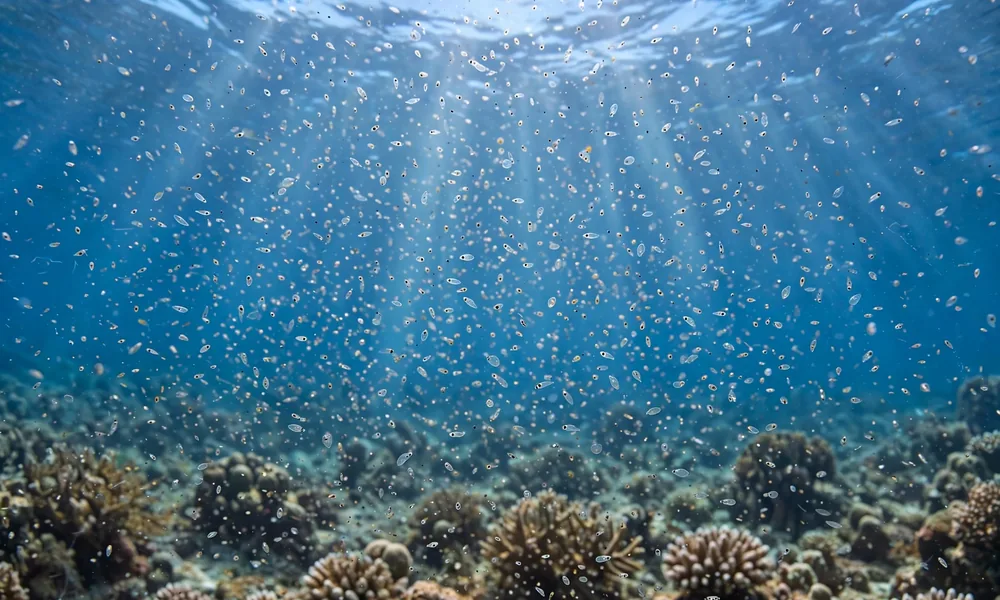
Under normal conditions the fertilised eggs develop into larvae called bipinnaria, about 0.5 to 0.9 millimetres long, and then brachiolaria, about 0.8 to 1.5 millimetres long, which drift in the plankton for weeks, feeding on the single-celled algae of the phytoplankton. The larvae swim and drift with the current, and they can drift between reefs, and when they are ready they settle on the sea floor, on the pink crust of coralline algae, and each one becomes a tiny five-armed starfish that begins to feed on the algae. Most crown-of-thorns starfish larvae do not survive their larval stage. They reach reproductive maturity within about two years, and the lifespan of a crown-of-thorns starfish is not known, though the animals are thought to live for several years on the reef.
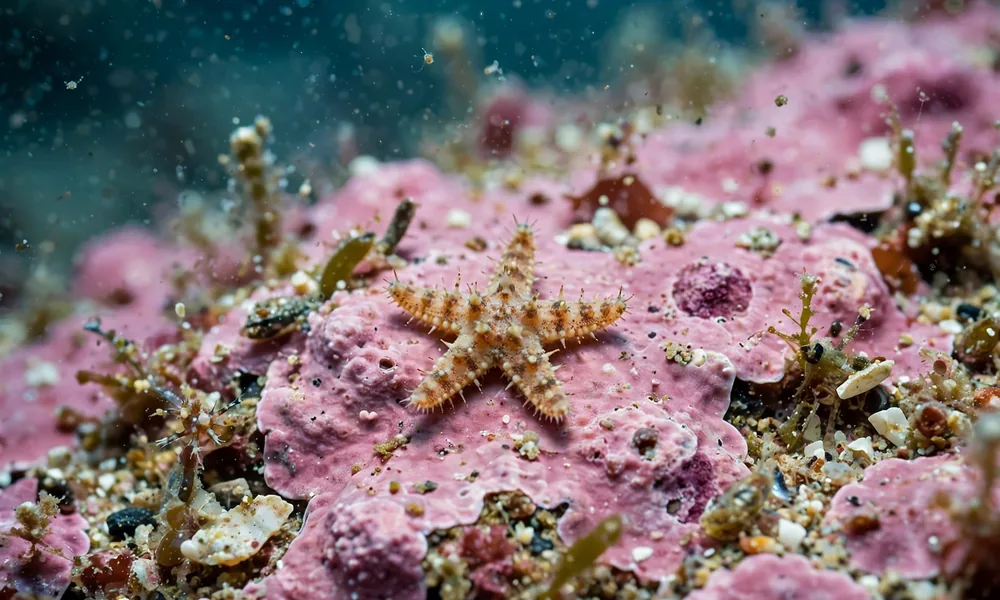
A starfish that survives its first two years on the reef has a good chance of seeing many seasons, and the largest animals on a reef are the oldest animals there, the ones that have outwaited every storm and every culling. The slow start is the reason an outbreak can seem to come from nowhere, because a favourable period for larval survival can precede a visible outbreak by years, as the juveniles wait in the rubble, small and hidden, until they are big enough to eat coral, and then they appear on the reef all at once. The high fecundity, the long time the larvae spend drifting, and the maturity within two years mean that a reef can go from a handful of animals to an outbreak in a single generation.
Conservation status
The conservation status of the crown-of-thorns starfish is, on paper, a comfortable one. The species is listed as Least Concern by the International Union for Conservation of Nature, in an assessment published in 2021, because it is widespread across the Indo-Pacific, abundant on many reefs, and not threatened as a species, even though its outbreaks can devastate a single reef. The animal is not the one that needs saving, and the reef is, and the conservation story of the crown-of-thorns is the story of the coral it eats, not of the starfish itself.
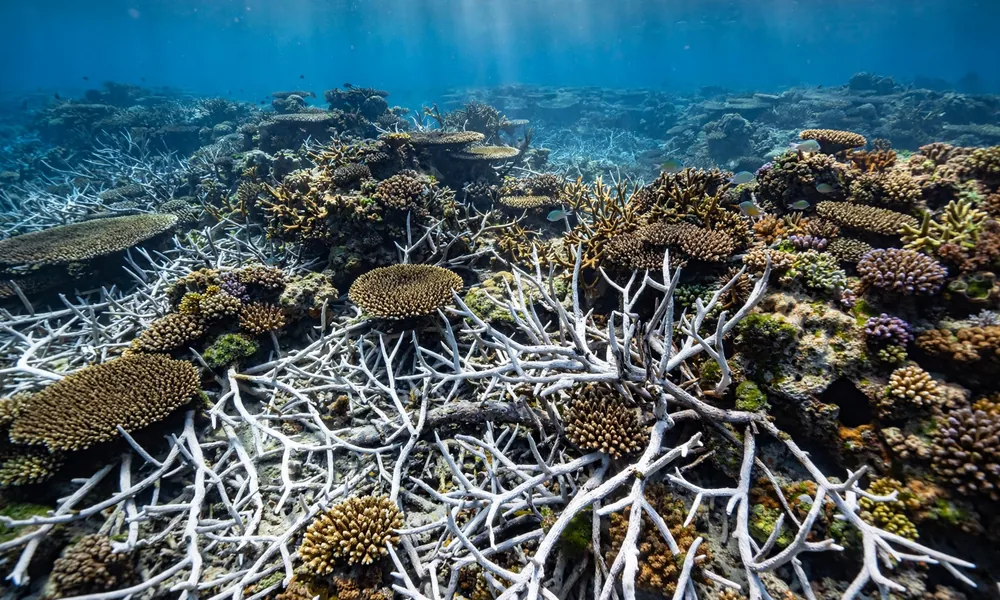
The main pressure on the reef is the outbreak itself, and the numbers are stark. On the Great Barrier Reef, coral cover fell from 28.0 per cent to 13.8 per cent between 1985 and 2012, and a study by the Australian Institute of Marine Science found that crown-of-thorns starfish were responsible for about 42 per cent of that decline, with storms causing 48 per cent and bleaching 10 per cent. The outbreaks are thought to be helped by nutrient runoff from the land, which feeds the phytoplankton that the larvae eat, so that more larvae survive, and by the loss of the predators that eat the starfish, including the giant triton snail, which is itself collected for its shell.
The answer is not a single fix, and it is the slow work of cleaner water running off the land, protected predators, and divers in the water culling the starfish by hand. The Great Barrier Reef Marine Park Authority created the Crown-of-Thorns Starfish Control Program in 2012, aimed at reducing populations to protect the reef, and trained dive teams now inject the starfish with vinegar or bile salts, which kills the animal without damaging the rest of the reef. Like the animals in our coral reef animals guide, the crown-of-thorns is one small part of a reef community that includes fish, turtles, rays and hundreds of other species, but the starfish is the eater that can undo in months what the coral took decades to build, and without the culling the reef would recover far more slowly.
Best seasons for crown-of-thorns starfish watching
The best time to look for crown-of-thorns starfish is the dry season, when the water is at its clearest and the sun is high, though no season will show you a starfish from a beach towel. The starfish are present on the reef all year round, so there is no wrong season in the strict sense, but the dry months are the time when the water is clearest and the reef is easiest to see, and a visit in the dry season will show you the reef at its best, with the starfish out feeding at night and the coral in full colour. A night dive with a local guide, in the dry season, is the best way to see a crown-of-thorns starfish in the wild, and the guide will know the reef slopes where the animals feed.

The best hours are the hours after dark, when the starfish come out of their hiding places and the reef comes alive, and the animals are at their boldest then, with their arms out and their stomachs spread over the coral. A guided night dive with a local guide, in the dry season, is the best way to see a crown-of-thorns starfish in the wild, and the guide will know the reefs where the animals are feeding and the ledges they hide under by day.
Staying safe around crown-of-thorns starfish
A crown-of-thorns starfish is dangerous to people who touch it, and the safety warning belongs to the spines, not to the animal’s temper. The spines are coated with tissue containing saponins, and a sting causes intense pain and swelling that can last for days, and the spines break off in the skin, and people stung repeatedly risk a severe allergic reaction, so culling work demands thick gloves and extreme caution. A starfish will not chase or threaten a person, and it will not bite, because it is slow and fixed to the reef while it feeds, but a hand on a coral head can brush against an animal hidden in a crevice, which is why divers are taught to look before they put a hand down, to wear thick gloves, and never to pick a crown-of-thorns starfish up.
Crown-of-thorns starfish watching checklist
A little preparation turns a night dive on a reef into a real chance of seeing crown-of-thorns starfish at their best, out feeding in the dry season.
- A guided night dive with a local guide in the dry season, when the water is clearest and the reef is at its best.
- A torch with a red filter, so you can see the starfish without dazzling them and driving them back under the ledges.
- Thick dive gloves, so you can steady yourself on the reef without touching a spine.
- A mask, fins and a wetsuit that fit well, so you can watch the reef without kicking up the bottom.
- Reef-safe sunscreen, so you can stay in the sun without poisoning the water the corals live in.
- A field guide to the starfish of the reef, so you can tell a crown-of-thorns starfish from a blue linckia starfish.
- Respect for the starfish and the reef, keeping your hands off every animal, keeping your fins off the coral, and leaving the reef as you found it.
Frequently asked questions
How big do crown-of-thorns starfish get?
Adults normally measure 25 to 35 centimetres across, and specimens of up to 60 centimetres, and even 80 centimetres, have been collected, which makes the crown-of-thorns nearly the largest species of starfish in the world. A juvenile begins life with five arms and develops into an adult with 14 to 21 arms, most often 16 to 21, with 14 to 18 given for the Great Barrier Reef, and the spines are 4 to 5 centimetres long.
What do crown-of-thorns starfish eat?
A crown-of-thorns starfish eats the living tissue of hard corals, the stony corals of the order Scleractinia, and it prefers the fast-growing branching and table corals such as Acropora, though it will take almost any hard coral when the favoured ones run out. It climbs onto a coral colony using hundreds of tube feet, pushes its stomach out through its mouth and spreads it across the coral, and digestive enzymes dissolve the polyps’ tissue, which the starfish absorbs, leaving bare white skeleton behind. A large adult can eat up to about 10 square metres of living coral in a year, and the juveniles feed first on crustose coralline algae before they switch to coral.
Are crown-of-thorns starfish venomous?
Yes, the spines are coated with tissue containing saponins, detergent-like toxins that make a puncture wound painful, swollen and slow to heal, and a sting causes intense pain and swelling that can last for days. The spines are long, sharp and brittle, and they break off in the skin of anything that grabs the animal, leaving a splinter that carries venom with it, and people stung repeatedly risk a severe allergic reaction. The venom is a defence, not a hunting tool, and the starfish does not use it to catch coral, which it digests with its stomach instead.
Where do crown-of-thorns starfish live?
Crown-of-thorns starfish live on coral reefs in the tropical and subtropical Indian Ocean and Pacific Ocean, from the east coast of Africa and the Red Sea across to South-East Asia, northern Australia and the islands of the Pacific, and they are found nowhere else on Earth. The largest numbers are found on the Great Barrier Reef off eastern Australia, where the form is referred to as Acanthaster cf. solaris, and they live in shallow water on the reef slope, the reef crest and the lagoon floor. At ordinary densities there are only about 6 to 20 animals per square kilometre, less than one per hectare, and an outbreak is generally 30 or more adult starfish per hectare of reef.
Can you keep a crown-of-thorns starfish as a pet?
You should not, and in practice almost nobody does, because the animal needs a living coral reef to feed on, and a tank cannot give it one. A crown-of-thorns starfish eats living hard coral, and a single large adult can eat up to about 10 square metres of coral in a year, so it would strip a home aquarium of coral in weeks, and it would also be a danger to anyone who put a hand in the tank, because its spines are venomous and break off in the skin. A starfish that is taken from a reef harms the reef it came from, and a starfish released where it does not belong could damage the local corals, because it eats whatever hard coral it finds.
How is this guide different from the crayfish guide?
This guide covers the crown-of-thorns starfish, a many-armed marine starfish led here by Acanthaster planci that lives on tropical coral reefs, hides under ledges by day, feeds at night by pushing its stomach out over living coral and digesting the tissue, and can release around 50 million eggs in a breeding season, while our crayfish guide covers the Tasmanian giant freshwater crayfish, Astacopsis gouldi, a clawed freshwater crustacean that lives in cool rivers and streams, hides under logs by day, feeds at night on rotting wood and small animals, and breeds so slowly that a female does not start until she is about 14 years old. One is a spiny eater of coral that can strip a reef in an outbreak; the other is a lone, clawed hunter of the stream bed that walks, digs and flips away from danger.
Conclusion
The crown-of-thorns starfish species are a reminder that an animal does not need to be big, or fast, or fierce to be unforgettable. A slow, spiny starfish with no brain and no bite, a stomach it pushes outside its body to eat, and a female that can release 50 million eggs in a season have made the crown-of-thorns the most argued-about animal on the reef, at home in the warm, clear seas from the Red Sea to the Great Barrier Reef.
If you go looking for one, go on a guided night dive in the dry season, go after dark, and drift slowly over the reef slope with a torch in your hand. Find the coral heads in the clear water, watch for the white feeding scars that give the animal away, and wait for a spiny disc to come out from under a ledge, and you will have met the starfish that turns a quiet stretch of reef into a battleground. Look, and do not touch.