The cuttlefish species are the chameleons of the sea, soft-bodied cephalopods that can change colour, pattern and even skin texture in less than a second. If you are asking what a cuttlefish is, the short answer is a marine mollusc of the order Sepiida, a cousin of the squid and the octopus, best known in the common cuttlefish, Sepia officinalis, a coastal hunter of the eastern Atlantic and the Mediterranean that grows to about 49 centimetres in mantle length and up to about 4 kilograms in weight. It has eight arms and two shooting tentacles, three hearts, blue-green blood and a W-shaped pupil, and it lives a short, brilliant life of only one or two years, spent hovering over sand and seagrass, ambushing crabs and small fish, and flashing messages across its skin.
What draws people to cuttlefish is not size or speed alone, though the largest of them, the giant cuttlefish, reaches a mantle length of about 50 centimetres and a weight of more than 10.5 kilograms. It is the intelligence behind the display. A cuttlefish can watch a diver, weigh up a crab, and decide in a heartbeat whether to vanish into the sand or to flare into stripes. This guide follows the whole animal: how it looks, where it lives, what it eats, how it behaves, how it breeds, and how to meet one safely in its own water.
Key takeaways
- The cuttlefish species number more than 120, all in the order Sepiida, and most belong to the large genus Sepia, led by the common cuttlefish, Sepia officinalis, of the eastern Atlantic and the Mediterranean.
- Most cuttlefish are 15 to 25 centimetres long, while the giant cuttlefish reaches about 50 centimetres in mantle length, up to about 1 metre in total length, and more than 10.5 kilograms in weight.
- A cuttlefish has eight arms and two tentacles, three hearts, blue-green blood, a W-shaped pupil, and skin packed with chromatophores that can change its colour and texture in less than a second.
- Cuttlefish eat crabs, shrimp, prawns and small fish, which they catch by shooting out two long tentacles, and they hunt mainly over sandy seabeds, seagrass meadows and rocky reefs in shallow coastal water.
- Most cuttlefish live only one or two years, breed once and then die, and the common cuttlefish is listed as Least Concern by the International Union for Conservation of Nature.
The cuttlefish species and their relatives
Cuttlefish belong to the order Sepiida, a group of marine cephalopods inside the class Cephalopoda and the phylum Mollusca, which makes them relatives of snails, clams and oysters as well as of squids and octopuses. More than 120 species of cuttlefish are currently recognised, grouped into five genera, and most of them sit in the family Sepiidae, with a small handful in the family Sepiadariidae. The best-known of them all is the common cuttlefish, Sepia officinalis, described by Carl Linnaeus in 1758, a large and well-studied species of the eastern Atlantic and the Mediterranean. Like the octopus, the cuttlefish is a clever, soft-bodied cephalopod with arms, suckers, a beak and an ink sac, but the octopus is a crawler that hides in a den and squeezes through cracks, while the cuttlefish is a hoverer that hangs in the water over the seabed, steering with a rippling fin and a jet of water.
| Type | Animal | Where it lives | Best-known food | Length or Weight |
|---|---|---|---|---|
| Family | Cuttlefish (Sepiidae) | Tropical and temperate coastal seas | Crabs, shrimp and small fish | Most 15 to 25 cm long |
| Genus | Cuttlefish (Sepia) | Eastern Atlantic, Mediterranean and Indo-Pacific | Crabs, shrimp and small fish | Most 15 to 25 cm long |
| Species | Common cuttlefish (Sepia officinalis) | Eastern Atlantic and Mediterranean | Crabs, shrimp and small fish | Up to 49 cm and 4 kg |
| Species | Giant cuttlefish (Ascarosepion apama) | Southern Australia | Crabs and fish | Up to 50 cm and over 10.5 kg |
| Species | Flamboyant cuttlefish (Metasepia pfefferi) | Indo-Pacific, Indonesia to Australia | Small crustaceans and fish | About 6 to 8 cm long |
The closest relatives of the common cuttlefish are the other members of the genus Sepia, a large group of shallow-water cuttlefish spread through the eastern Atlantic, the Mediterranean and the Indo-Pacific, and the differences between them are often a matter of size, colour and the shape of the cuttlebone inside. The giant cuttlefish, long known as Sepia apama and now often placed in the genus Ascarosepion as Ascarosepion apama, is the largest of them all, with a mantle length of about 50 centimetres, a total length of up to about 1 metre including the outstretched tentacles, and a weight of more than 10.5 kilograms, or 23 pounds. At the other end of the scale sits the flamboyant cuttlefish, Metasepia pfefferi, a small Indo-Pacific species only about 6 to 8 centimetres long that walks along the seabed on its arms, flashes yellow, pink and purple, and carries toxic flesh, which is a warning rather than a decoration. Each of them carries the same toolkit: a cuttlebone, eight arms, two tentacles and a skin that can change in a blink.
What cuttlefish look like
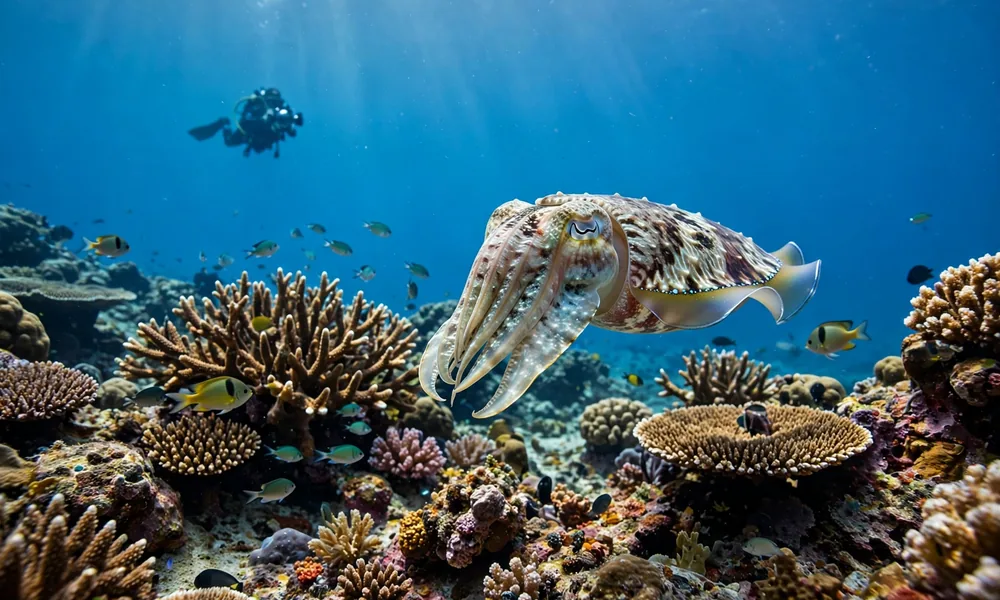
A cuttlefish looks like a squid that decided to stay close to the ground. The body is a broad, flattened oval called the mantle, with a narrow fin running all the way around its edge, rippling in waves to hold the animal still in the water or to ease it forward, backwards and sideways with a precision no fish can match. Inside the mantle sits the cuttlebone, a chalky, chambered internal shell made of aragonite, which the animal uses to control its buoyancy, letting gas and liquid in and out of its chambers to rise or sink without swimming.
The size of a cuttlefish depends on the species, and the range is wide. Most cuttlefish are 15 to 25 centimetres long, about the length of a hand, and the common cuttlefish is one of the larger kinds, reaching a mantle length of up to about 49 centimetres and a weight of up to about 4 kilograms, or 8.8 pounds, in temperate waters, while animals from subtropical seas are smaller and rarely pass 30 centimetres. The giant cuttlefish dwarfs them all, with a mantle of about 50 centimetres, a total length of up to about 1 metre, and a weight of more than 10.5 kilograms, which is heavier than a small dog. The smallest cuttlefish, the dwarf species of the Indo-Pacific, are only a few centimetres long, and the flamboyant cuttlefish, at about 6 to 8 centimetres, is barely longer than a finger, yet it is one of the most brightly coloured animals in the sea.
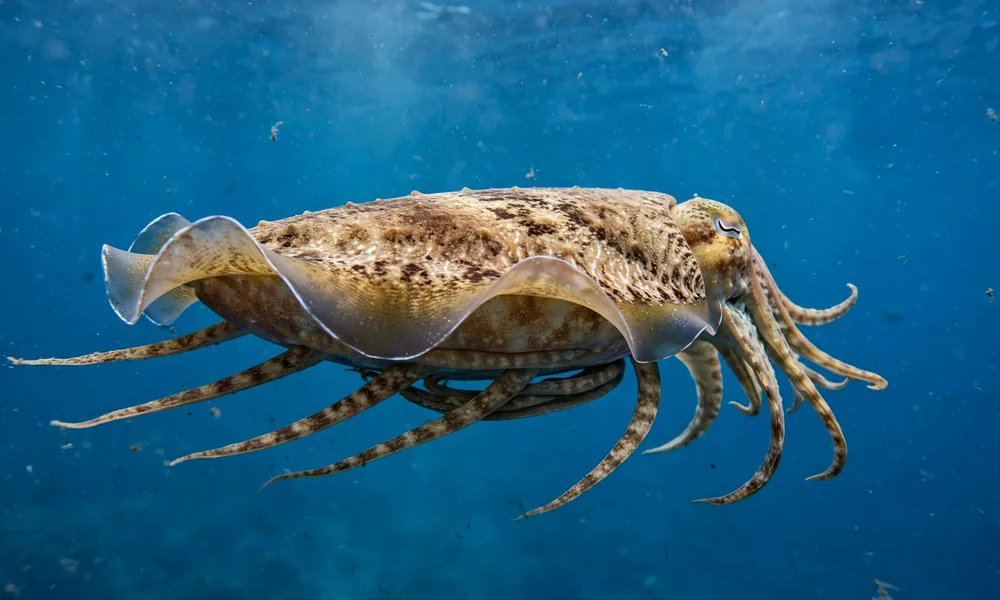
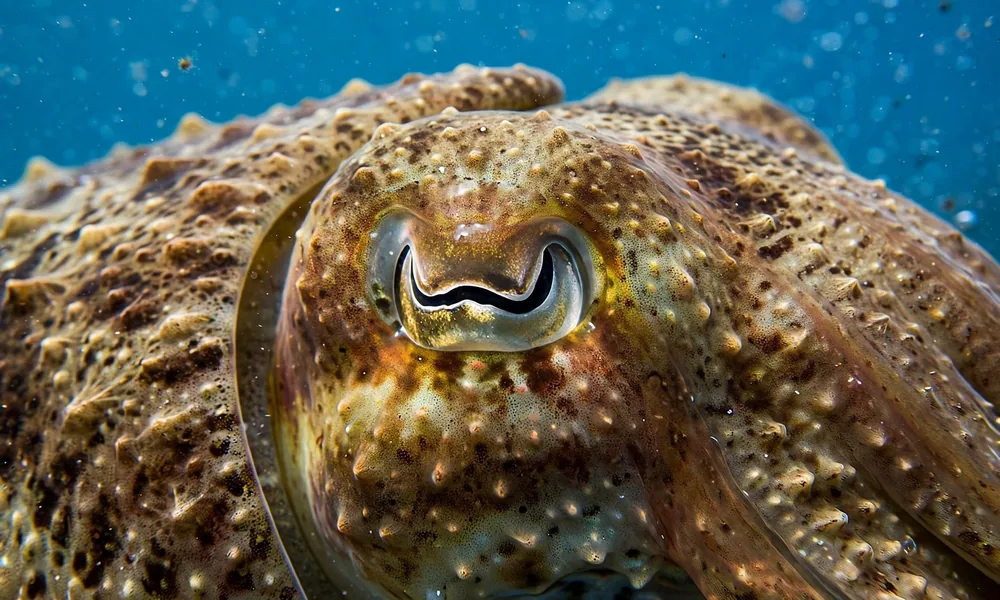
The skin is where a cuttlefish becomes extraordinary. It holds layers of colour-changing cells, and the top layer is made of chromatophores, tiny elastic sacs of red, yellow, brown and black pigment, each ringed by muscles under direct nerve control, which can expand a chromatophore by about 500 percent in well under a second. Beneath them sit iridophores and leucophores, cells that reflect and scatter light to make metallic greens, blues and whites, and there can be up to 200 chromatophores in a single square millimetre of skin. Muscles in the skin can also raise papillae, small bumps that change the texture to match rock, sand or algae, so a cuttlefish can copy not just the colour of its background but its roughness too.
The eyes are as strange as the skin. Each eye is large and highly developed, with a smoothly curving W-shaped pupil that no other common animal shares, and the animal can see almost all the way around itself and can perceive polarised light, which sharpens contrast in the water. Cuttlefish are, as far as laboratory studies can tell, colour-blind, yet they still match the colours of their surroundings, and one idea is that the W-shaped pupil uses chromatic aberration to infer colour from the way light bends. The blood is another surprise: it is green-blue, because it uses the copper-containing protein haemocyanin to carry oxygen instead of the red, iron-containing haemoglobin of vertebrates, and it is pumped by three separate hearts, two branchial hearts that send blood to the gills and one systemic heart that sends it around the rest of the body. Add a sharp beak hidden among the arms, a siphon for jet propulsion, and an ink sac for emergencies, and you have an animal built like no other on the reef.
Where cuttlefish live
Cuttlefish live in tropical and temperate coastal seas, and they are found across the eastern Atlantic, the Mediterranean, the Indo-Pacific and the waters of southern Australia, wherever the water is shallow enough and the seabed offers sand, seagrass or reef to hunt over. The common cuttlefish is native to the eastern Atlantic from the North Sea and the Baltic south to South Africa, and through the whole Mediterranean, and it is one of the most northerly cuttlefish, at home in water that would be too cold for its tropical cousins. The giant cuttlefish lives only around southern Australia, from Western Australia to New South Wales and Tasmania, while the pharaoh cuttlefish ranges through the Indo-Pacific from the Red Sea to Japan and northern Australia, and the flamboyant cuttlefish haunts the sandy slopes of Indonesia, Malaysia, the Philippines and northern Australia.

The habitat a cuttlefish chooses is the edge of the sea rather than the open ocean. It prefers shallow coastal water, usually from the surface down to about 50 metres, though the common cuttlefish can be found down to about 200 metres in the colder months, and it spends its time over sandy and muddy seabeds, in seagrass meadows, and around rocky reefs where crabs and small fish gather. The common cuttlefish is a migratory animal, spending the spring and summer inshore to spawn and then moving out to depths of 100 to 200 metres in autumn and winter, following the seasons as surely as any bird. Young cuttlefish stay in the shallows, where the water is warm and the food is small, and the adults move between the reef and the sand as the day changes, resting on the bottom by night and hunting by day.
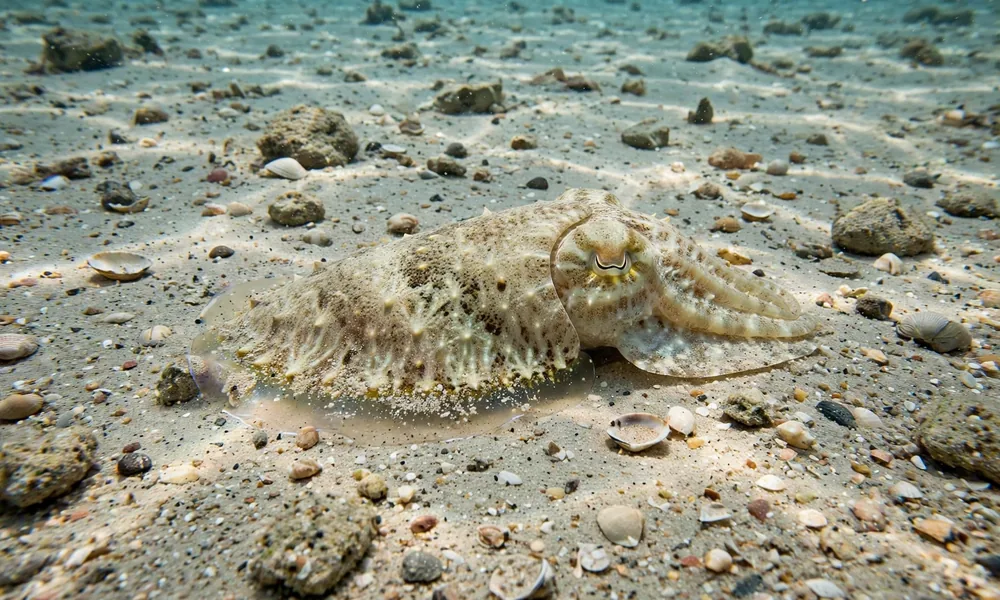
The water a cuttlefish needs is salty, clear enough for its eyes to work, and rich in the small animals it eats, and it avoids water that is too fresh, too murky or too cold for its kind. It is a creature of the seabed rather than the open water column, hovering a few centimetres above the sand, settling onto the bottom to rest, and burying itself in the sand when it wants to vanish altogether. The best cuttlefish water of all is a shallow bay where sand, seagrass and reef meet, with the sun reaching the bottom and the tide bringing fresh prey twice a day.
What cuttlefish eat
Cuttlefish are hunters, and their diet is written in the seabed they patrol. The everyday food of the common cuttlefish is crabs, shrimp, prawns and small fish, along with molluscs and other small animals of the sand and seagrass, and a big giant cuttlefish will take larger crabs and fish that a smaller cuttlefish could never manage. They hunt by day, when their eyes work best, and they use stealth rather than speed, drifting towards prey with the fin rippling and the body held low, then striking in a flash. The two tentacles shoot out faster than the eye can follow, the suckers at their clubbed tips grip the prey, and the arms fold around it and pull it to the beak, where it is bitten and eaten. It is one of the fastest strikes in the sea, and it is over before the prey knows it has been seen.

What a cuttlefish eats changes as it grows, and the change follows the size of its arms and tentacles. Hatchlings only a few millimetres long eat tiny crustaceans and plankton in the shallows, and as they grow they take bigger prey, moving from small shrimp to crabs and then to fish large enough to be worth the chase.
The hunting style of a cuttlefish is the reason it is so different from its cousins, and it is also the reason it is so successful. A squid is an open-water swimmer that chases its food through the water column, and an octopus is a crawler that pries crabs out of cracks, but a cuttlefish is a hoverer and an ambusher, holding still over the seabed, watching, and striking only when the prey is close enough to catch. When it needs to move fast it can jet away, forcing water through its siphon in bursts of up to about 25 kilometres per hour, and when it needs to escape it can release a cloud of ink, darkening the water and leaving a false body of ink behind while it jets away in the confusion.
How cuttlefish behave
Cuttlefish are solitary animals, and their day is spent alone, hunting, resting and watching. They do not form schools or groups, and they do not guard a territory, though a good hunting patch may be used by the same animal for days at a time. They are shy of people and will usually move away from a diver, though a curious animal may hover and watch, changing colour as it studies the strange visitor, and a cuttlefish that feels cornered will flash a warning pattern, release ink, and jet away in a burst of speed.
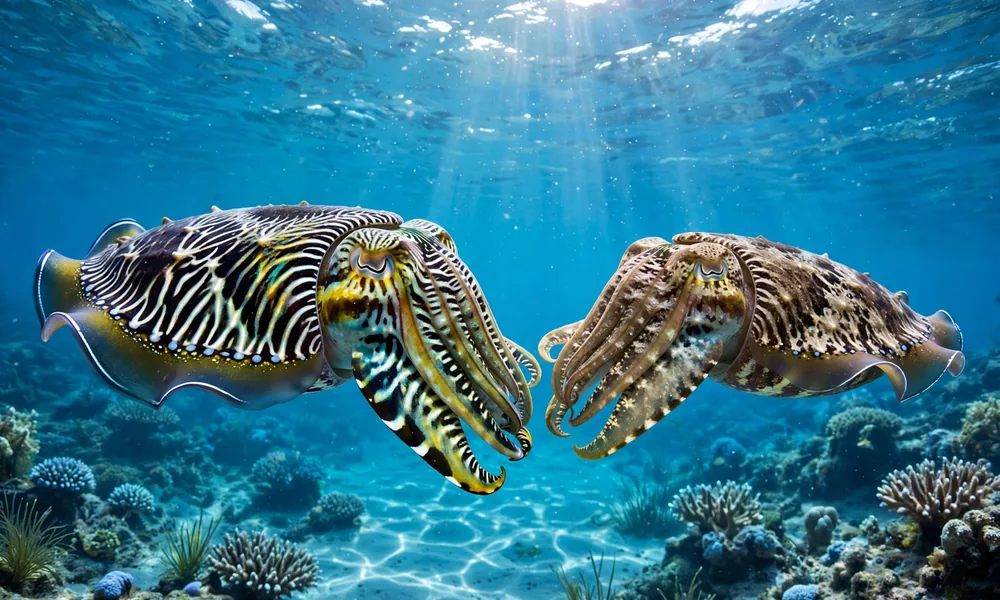
The most famous behaviour in the cuttlefish is its colour change, and it is a trick that no fish can match. The animal can go from sand-brown to striped black and white in a fraction of a second, can copy the speckles of a rock or the stripes of a shell, and can even show two patterns at once, one on each side of its body. Males in the breeding season are the showiest of all, flashing zebra stripes, rippling waves of colour and pulsing bands to impress females and to warn off rivals, and a small male may even disguise himself as a female, wearing her mottled pattern on one side while courting her with the other, slipping past a big rival that never sees him coming. The display is not just decoration: it is camouflage, courtship, warning and hunting, all in the same skin, and it is controlled by the brain directly, with nerves running to each chromatophore.

Cuttlefish are also among the cleverest of invertebrates, with one of the largest brain-to-body size ratios of any invertebrate, and they behave like it. They use that brain in the wild to plan an ambush, to pick the best camouflage for a new background, and to outwit a rival male. A cuttlefish is a thinking hunter, watching and deciding, and divers who spend time with them come away convinced that the animal was watching them back.
Breeding and life cycle
Cuttlefish breed once in their lives, and their life cycle is a short, fast story, with a single breeding season at the end of one or two years of growing. The common cuttlefish gathers inshore in spring and summer to spawn, and the males compete for females with displays of stripes and ripples, the biggest and brightest males winning the best places on the reef. Mating takes place head to head, and the male passes packets of sperm to the female, who stores sperm from several males and chooses which to use when she lays her eggs. A female may mate with several males, which makes the breeding season a busy and competitive time on the reef.

The most famous breeding gathering in the world belongs to the giant cuttlefish, which comes together in the upper Spencer Gulf of South Australia, around Point Lowly near Whyalla, in the only known mass spawning aggregation of any cuttlefish on Earth. In a normal year tens of thousands gather on the boulder reef there between May and August, and the males outnumber the females by up to 11 to one, which makes for fierce and spectacular competition, with males flashing, shoving and posturing for hours.
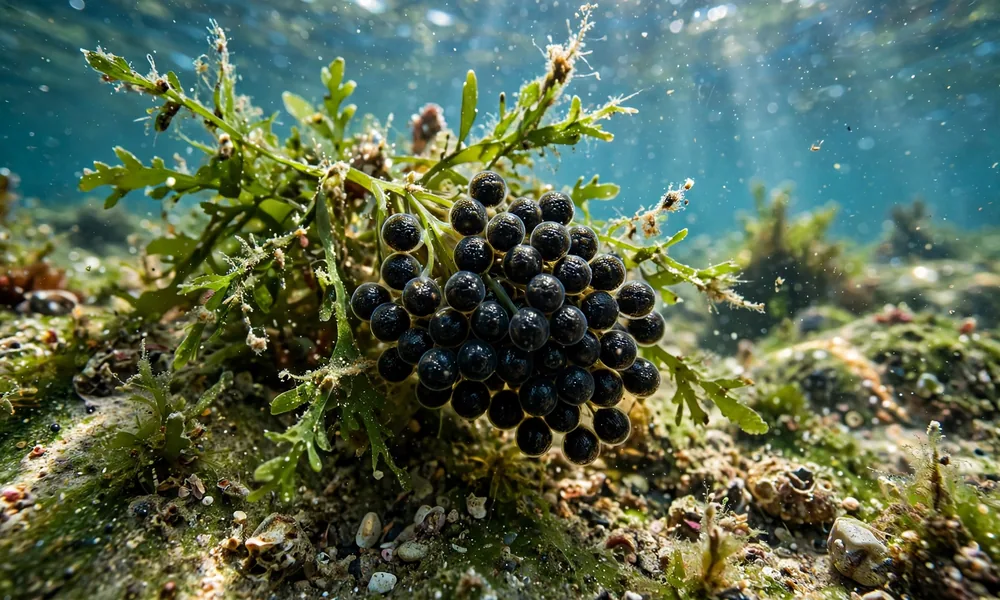
The eggs a female lays depend on the species, and the numbers are generous. A common cuttlefish female lays several hundred eggs over a few days, each one a lemon-shaped, leathery egg about 8 to 10 millimetres across, blackened with ink and attached in grape-like clusters to seaweed, shells and debris in shallow water, and they hatch in one to two months. A giant cuttlefish female lays between 100 and 300 eggs, each fixed one at a time under a rock, and they take three to five months to hatch. The hatchlings are tiny, only about 6 to 8 millimetres long, yet they look like miniature adults, with arms, tentacles, a cuttlebone and a working ink sac, and they grow fast, reaching about 25 millimetres in their first two months. They receive no care from their parents, and the adults die soon after breeding, which is the rule for cuttlefish: they are semelparous, breeding once and then dying.
Conservation status
The conservation status of the cuttlefish is, for the best-known species, reassuring, though it is far from complete. The common cuttlefish, Sepia officinalis, has been assessed by the International Union for Conservation of Nature as Least Concern, in an assessment dated 15 March 2009 and published in 2012, because it has a wide range and its numbers are not falling overall, even though it is the focus of large-scale commercial fisheries, above all in the Mediterranean and off the west coast of Africa, where some stocks are close to being overexploited. Many other cuttlefish species have never been assessed at all, which means that their true status is unknown, and the group as a whole is watched more for its fisheries than for its rarity. The common cuttlefish is not listed by the Convention on International Trade in Endangered Species, and it carries no special conservation status in the United States.
The main pressure on cuttlefish is fishing, and it is a heavy one. Cuttlefish are caught in large numbers for food in the Mediterranean, in East Asia and off West Africa, and in some regions the catch is close to the maximum the stock can bear. The giant cuttlefish was fished hard in South Australia in the 1990s, with commercial catches of around 200 tonnes a year in 1995 and 1996 and 245 tonnes in 1997, which led to closures from 1998, and a ban on taking cuttlefish in northern Spencer Gulf was reinstated in 2022 and became law on 22 December 2025. Habitat loss is the second pressure: the seagrass meadows and rocky reefs where cuttlefish lay their eggs are damaged by trawling, coastal building and pollution, and warming water may shift where each species can live. The 2026 Whyalla gathering collapsed, with the official estimate falling to 1,811 animals, the lowest on record, after a harmful algal bloom pushed into the upper gulf, and a 90-day exclusion zone was put in place from 1 July 2026 to protect the breeding site. The health of the coastal sea matters to cuttlefish as much as it matters to the fish and the corals they share the shallows with.
Best seasons for cuttlefish watching
The best time to look for cuttlefish is the breeding season, when the animals come inshore in large numbers and are out in the open, displaying and hunting in the shallows. In the Mediterranean and the eastern Atlantic, the common cuttlefish gathers inshore in spring and summer to spawn, and the animals are easiest to find from late spring through the summer, when the water is warm and the seagrass is thick. In southern Australia the giant cuttlefish gathers at Point Lowly between May and August, with June and July the best months, when the breeding season is in full swing and tens of thousands of animals cover the reef. In the cooler months the adults move out to deeper water, and only the eggs and the young remain inshore.

The best hours are the daylight hours, when the cuttlefish are out hunting over the sand and the water is clear enough to see them, and a snorkel over a sandy bay or a seagrass meadow in the breeding season, with a local guide or a dive centre to ask, is the best way to meet one. The cuttlefish is so well known that National Geographic keeps a live profile of the cuttlefish, and a guided reef dive or a visit to a marine centre, in the warm season, is the best way to see one without ever having to chase it through the water yourself.
Staying safe around cuttlefish
A cuttlefish is not dangerous to people who meet it in the water, and there is no safety warning that matters more than the obvious one: do not grab one, do not corner one, and do not try to take one home. A cuttlefish has a sharp beak hidden among its arms, and a large animal that feels trapped can give a painful bite, while the flamboyant cuttlefish carries toxic flesh that should never be eaten or handled carelessly. The ink is harmless to skin but can cloud a mask, and a jetting cuttlefish can startle a snorkeller who is too close. The safest way to meet a cuttlefish is to float quietly above the sand, keep your hands to yourself, and let the animal come to you, and if it flashes a warning pattern or releases ink, give it room and let it go.
Cuttlefish watching checklist
A little preparation turns a trip to a shallow bay into a good chance of meeting a cuttlefish at its best, in the warm shallows it hunts.
- A visit in the breeding season, in spring and summer in the Mediterranean and from May to August in southern Australia, when the cuttlefish come inshore.
- A mask, snorkel and fins, so you can float quietly over the sand and seagrass without disturbing the animals below.
- A wetsuit for the water temperature, so you can stay in long enough to watch a cuttlefish hunt without getting cold.
- An underwater camera, so you can photograph the colour changes without touching the animal or chasing it.
- A local dive centre or guide, so you know which bays hold cuttlefish and which reefs are protected.
- A field guide to the cuttlefish of the region, so you can tell a common cuttlefish from a giant cuttlefish or a flamboyant cuttlefish.
- Respect for the sea and the animals in it, keeping your distance, keeping your hands off any cuttlefish, and leaving the bay as you found it.
Frequently asked questions
How big do cuttlefish get?
Cuttlefish vary a great deal in size, and the species matters more than the group. Most cuttlefish are 15 to 25 centimetres long, about the length of a hand, and the common cuttlefish, Sepia officinalis, is one of the larger kinds, reaching a mantle length of up to about 49 centimetres and a weight of up to about 4 kilograms, or 8.8 pounds, in temperate waters. The giant cuttlefish is the largest of them all, with a mantle length of about 50 centimetres, a total length of up to about 1 metre including the outstretched tentacles, and a weight of more than 10.5 kilograms, or 23 pounds. The smallest cuttlefish are only a few centimetres long, and the flamboyant cuttlefish, at about 6 to 8 centimetres, is barely longer than a finger.
What do cuttlefish eat?
A cuttlefish eats crabs, shrimp, prawns and small fish, which it takes over sandy seabeds, seagrass meadows and rocky reefs with its two shooting tentacles. The everyday food of the common cuttlefish is crabs, shrimp and small fish, along with molluscs and other small animals of the sand and seagrass, and a big giant cuttlefish will take larger crabs and fish. The young eat tiny crustaceans and plankton in the shallows, and the adults take bigger prey as their tentacles lengthen, stunning each one with a fast strike and pulling it to the beak, where it is bitten and eaten.
Are cuttlefish dangerous to people?
No, cuttlefish are not dangerous to people who leave them alone, and they are shy animals that would rather hide or jet away than fight. A large cuttlefish that feels trapped can give a painful bite with the sharp beak hidden among its arms, and the flamboyant cuttlefish carries toxic flesh that should never be eaten, but neither animal hunts people, and neither one will attack a swimmer or a diver who keeps a respectful distance. The safest way to meet a cuttlefish is to float quietly, keep your hands to yourself, and let it come to you.
Where do cuttlefish live?
Cuttlefish live in tropical and temperate coastal seas, across the eastern Atlantic, the Mediterranean, the Indo-Pacific and the waters of southern Australia, wherever the water is shallow and the seabed offers sand, seagrass or reef to hunt over. The common cuttlefish is native to the eastern Atlantic from the North Sea and the Baltic south to South Africa, and through the whole Mediterranean, and it prefers shallow coastal water, usually from the surface down to about 50 metres, moving out to depths of 100 to 200 metres in autumn and winter. The giant cuttlefish lives only around southern Australia, and the flamboyant cuttlefish haunts the sandy slopes of Indonesia, Malaysia, the Philippines and northern Australia.
Can you keep a cuttlefish as a pet?
You can keep a cuttlefish in a home aquarium, but it is a difficult and short-lived pet, and most people should not try. A cuttlefish needs a large tank with constantly moving seawater, a steady supply of live crabs, shrimp and small fish, and careful handling by someone who understands cephalopods, and even in a good tank it will live only one or two years, breed once, and die. It is also an animal that needs space to hunt and hide, and it will ink the tank if it is startled, so it belongs in the sea or in a professional marine centre, not in a small home tank, and anyone who wants to see one should visit an aquarium or a marine centre instead.
How is this guide different from the crown-of-thorns starfish guide?
This guide covers the cuttlefish, a group of more than 120 species of colour-changing cephalopods, led by the common cuttlefish, Sepia officinalis, a clever hunter of sandy seabeds and seagrass meadows that hovers over the bottom, strikes with two shooting tentacles, and lives only one or two years, while our crown-of-thorns starfish guide covers a single spiny starfish of coral reefs that crawls slowly across the coral, eats living polyps, and can devastate a reef when its numbers explode. One is a fast, thinking hunter you meet hovering over the sand; the other is a slow, armoured grazer you meet spread across the coral.
Conclusion
The cuttlefish species are a reminder that the cleverest animal on the reef does not need size, or teeth, or speed to be remarkable. A broad oval mantle, a rippling fin, eight arms and two tentacles, three hearts and blue-green blood, and a skin that can change colour, pattern and texture in less than a second have made the common cuttlefish one of the most studied animals in the sea, at home in the shallow coastal waters from the North Sea to South Africa and through the whole Mediterranean.
If you go looking for one, go in the breeding season, go to a shallow bay where sand, seagrass and reef meet, and watch the bottom with your eyes open. Find the warm shallows over sand, look for the mottled shape that is almost not there, and give it all the room in the world, and you will have met the cuttlefish that turns a quiet stretch of coast into a place of sudden, intelligent colour.