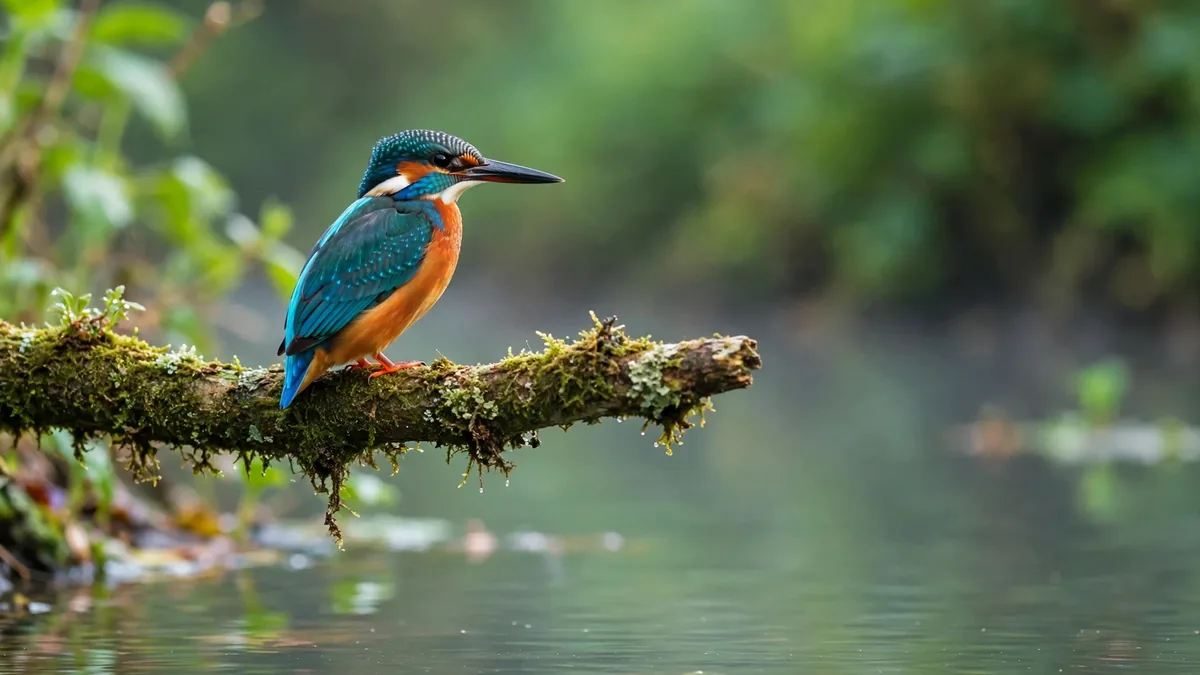
The kingfisher species are the members of the bird family Alcedinidae, about 118 species of small to medium-sized, brightly coloured birds found on every continent except Antarctica. If you are asking how many kingfisher species there are, the answer is about 118, divided into three subfamilies and 19 genera, and the best-known of them all is the common kingfisher, Alcedo atthis, the blue-and-orange fisher of European rivers.
There is no single bird called the kingfisher. The name covers a whole family, and its members range from the African pygmy kingfisher, barely 12 centimetres long, to the giant kingfisher of Africa, 42 to 46 centimetres long. Some dive for fish, others hunt insects and lizards far from water. What they share is a large head, a long, dagger-like bill, short legs and a stubby tail.
Key takeaways
- Kingfishers are the family Alcedinidae, about 118 species in three subfamilies and 19 genera, found almost worldwide except Antarctica.
- The common kingfisher, Alcedo atthis, is 16 to 17 centimetres long, weighs 34 to 46 grams, and eats more than half its body weight in fish every day.
- River kingfishers dive for fish, water kingfishers do the same in the Americas and Africa, and tree kingfishers mostly hunt insects, lizards and small mammals on land.
- Kingfishers nest in burrows dug into earth banks, and the common kingfisher usually lays six or seven eggs in a chamber at the end of the tunnel.
- Most kingfisher species are listed as Least Concern, but a few island species are threatened, and no reliable total population figure exists for the family.
What makes a kingfisher a kingfisher
A kingfisher is built for a sudden strike. Its head is large and its bill is long, straight and pointed, like a dagger, while its legs are short and its tail is short, so the body looks compact and top-heavy. The common kingfisher shows the family pattern at its brightest: a metallic blue-green back, wings and crown, orange underparts, a white patch on the neck, and orange-red legs.
Its eyes are made for hunting through water. A kingfisher judges the depth of a fish before it dives, allowing for the way light bends at the surface of the water, and a clear third eyelid, called the nictitating membrane, closes over each eye as it enters the water. The bill enters the water with barely a splash, a shape engineers copied for the nose of the Japanese Shinkansen bullet train.
The kingfisher species and their relatives
The kingfisher family Alcedinidae sits in the order Coraciiformes, alongside bee-eaters, rollers and motmots, and its name was introduced by the French naturalist Constantine Samuel Rafinesque in 1815. The family is divided into three subfamilies. The river kingfishers, Alcedininae, are the oldest branch, with about 35 species, including the common kingfisher. The water kingfishers, Cerylinae, hold only nine species, among them the belted, giant and pied kingfishers. The tree kingfishers, Halcyoninae, are the largest group, with about 70 species, including the kookaburras and the paradise kingfishers.
The exact total depends on the checklist used, with counts of 114 to 118 species in recent lists, so about 118 is the figure most often quoted. Kingfishers are most diverse in the tropics of Asia, Africa and Australasia, and only six species occur naturally in the Americas, all of them water kingfishers. Like the grey-crowned crane, another bird of wetlands, the common kingfisher depends on clean, slow-moving water.
| Subfamily | Animal | Where it lives | Best-known food | Length or Weight |
|---|---|---|---|---|
| River | Common kingfisher (Alcedo atthis) | Europe, Asia and North Africa | Small fish | About 16 to 17 cm long |
| River | African pygmy kingfisher (Ispidina picta) | Woodland in sub-Saharan Africa | Insects | About 12 to 13 cm long |
| Water | Giant kingfisher (Megaceryle maxima) | Large rivers in sub-Saharan Africa | Fish and crabs | About 42 to 46 cm long |
| Water | Belted kingfisher (Megaceryle alcyon) | North America | Small fish | About 28 to 35 cm long |
| Water | Pied kingfisher (Ceryle rudis) | Africa and southern Asia | Fish and aquatic insects | About 25 to 29 cm long |
| Tree | Laughing kookaburra (Dacelo novaeguineae) | Eastern and south-western Australia | Lizards, snakes and mice | About 40 to 45 cm long |
How kingfishers live
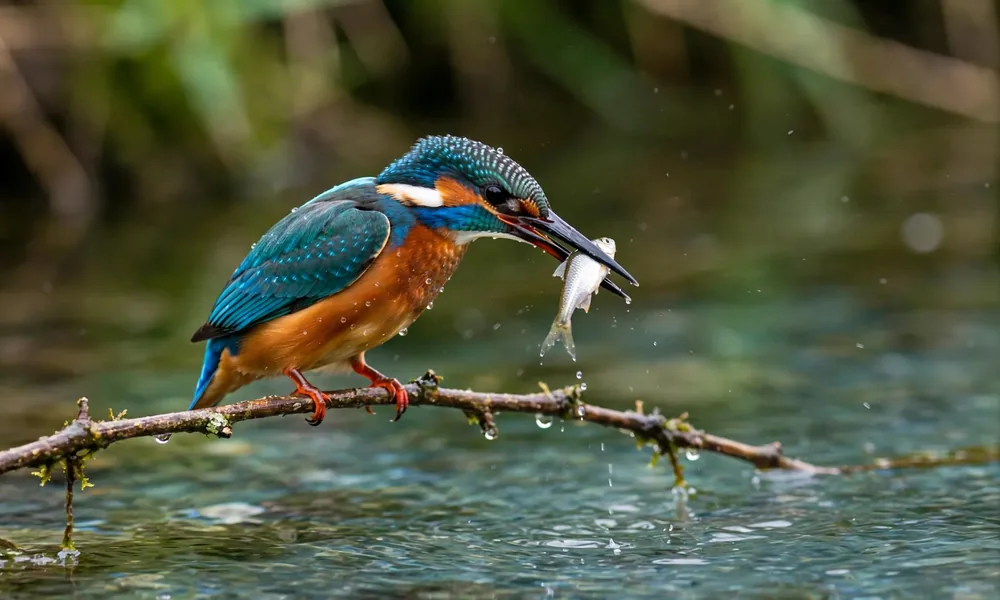
The fishing kingfishers hunt from a perch, usually a branch, reed or post one or two metres above clear, slow-moving water. The bird sits still, watching, and bobs its head to judge the depth of its prey. When it strikes, it drops headfirst at a steep angle with its wings folded back, grabs the fish in its bill, and is back in the air within a second or two. Back on its perch it beats a larger fish against the branch, swallows it headfirst, and later regurgitates a pellet of bones and scales. A common kingfisher needs more than half its body weight in food each day, which means ten or more successful dives, and far more when it is feeding chicks.
The tree kingfishers hunt quite differently, swooping from woodland perches to snatch insects, lizards, frogs, small snakes and mice from the ground, and the pied kingfisher can even hover over open water before diving. Kingfishers are fiercely territorial, and a common kingfisher will defend a stretch of river from other kingfishers. Outside the breeding season most kingfishers live alone, and pairs form only to nest.
Breeding starts with a burrow. A pair digs a tunnel into a steep earth bank, often a metre long, ending in a chamber where the female lays her eggs, usually six or seven for the common kingfisher. There is no nest lining, and the eggs lie on a bed of regurgitated fish bones. Both parents take turns incubating the eggs for about three weeks, and the chicks fledge after roughly three to four weeks in the nest. A pair may raise two or even three broods in a season.
Where kingfishers live
Kingfishers live almost everywhere there is water or woodland to hunt in, from tropical rainforest to desert rivers. The common kingfisher ranges across Europe, Asia and North Africa, favouring slow-moving rivers, clear streams, canals, lakes and ponds with overhanging branches and steep banks for nesting. The belted kingfisher covers most of North America, the giant kingfisher the large rivers of sub-Saharan Africa, and the pied kingfisher the wetlands of Africa and southern Asia.
The tree kingfishers spread further from water. The woodland kingfisher of Africa lives in savanna and woodland, the laughing kookaburra in the eucalyptus forests, farmland and suburbs of Australia, and the paradise kingfishers in the rainforests of New Guinea. Like the gyrfalcon, a hunter that needs open country and wild prey, kingfishers need a landscape that still works: clean water, fish, perches and undisturbed banks.
Most kingfisher species are listed as Least Concern on the IUCN Red List, and the common kingfisher is widespread, though its numbers are thought to be slowly falling. The threats are local and concrete: polluted water, rivers straightened and stripped of banks, and hard winters that freeze the fishing grounds. A few island species are in real trouble, among them the Guam kingfisher, which is extinct in the wild and survives only in captive breeding programmes.
Best seasons for kingfisher watching
The best time to look for a common kingfisher is in the colder months, from autumn through to early spring, when the leaves are off the trees and the bird is easier to spot on a bare branch. Summer is good too, especially at dawn, when parents carry fish to the nest. A quiet stretch of river with low perches, a steep bank and clear water is the place to wait.
Staying safe around kingfishers
Kingfishers are small, shy birds, and they pose no danger to people. Keep your distance, stay quiet, and never disturb a nesting bank: a flushed kingfisher wastes energy it needs for fishing, and a disturbed pair may abandon the burrow. Watch from a path or a hide, use binoculars, and do not wade into the river or climb the bank.
If you find a nest hole in a riverbank, note the place and move on, and never block the entrance or linger nearby. Keep dogs on a lead beside rivers where kingfishers hunt, and leave dead branches overhanging the water where they are, because those are the perches the birds use. A good sighting is one the bird never notices.
Kingfisher watching checklist
A slow walk beside a quiet river, with patience and a pair of binoculars, is all it takes to find the family jewel.
- A slow-moving river, stream, canal or lake with clear water and low overhanging branches.
- A steep earth bank nearby, where a pair may have dug a nesting burrow.
- Binoculars, because kingfishers are small and often seen first as a flash of blue in flight.
- An early morning or late afternoon visit, when the birds are hunting most actively.
- Quiet clothing in muted colours, and a slow, still approach along the bank.
- A camera with a fast shutter, for the split-second dive from perch to water.
- Respect for the nesting bank, keeping dogs on a lead and never blocking a burrow entrance.
Frequently asked questions
How many kingfisher species are there?
There are about 118 kingfisher species in the family Alcedinidae, divided into three subfamilies and 19 genera. The exact number depends on the checklist used, with recent counts ranging from 114 to 118 species, and new genetic studies still split or merge a few of them.
What does a kingfisher eat?
It depends on the subfamily. River and water kingfishers eat mostly small fish, along with aquatic insects, tadpoles, shrimps and small crabs, while tree kingfishers eat insects, lizards, frogs, small snakes and mice, and rarely touch fish at all.
Where do kingfishers nest?
Kingfishers nest in burrows dug into steep earth banks, usually beside water. A pair digs a tunnel that can be a metre long, ending in a chamber where the female lays her eggs on a bed of regurgitated fish bones, with no nest lining at all.
Do kingfishers migrate?
Most kingfishers do not migrate far. The common kingfisher is mainly resident, though northern birds move south in hard winters, and the belted kingfisher leaves the coldest parts of Canada and Alaska for warmer waters further south.
How is this guide different from the king penguin guide?
This guide covers the kingfisher family, about 118 small to medium-sized birds that hunt from perches beside rivers and in woodland, while our king penguin species guide covers the king penguin, a single large, flightless seabird of the Southern Ocean that swims for fish and stands nearly a metre tall. One is a family of darting, colourful hunters; the other is one tall penguin that never flies.
Are kingfishers endangered?
Most kingfisher species are listed as Least Concern, including the common kingfisher, though its numbers are thought to be slowly falling. A few island species are threatened, and the Guam kingfisher is extinct in the wild, surviving only in captive breeding programmes.
Conclusion
The kingfisher species are a family of about 118 birds, from a 12-centimetre pygmy to a 46-centimetre giant, and from river divers to woodland hunters that never touch a fish.
If you go looking for one, find a quiet river at dawn, watch the low branches, and wait for the blue flash. The common kingfisher will do the rest.