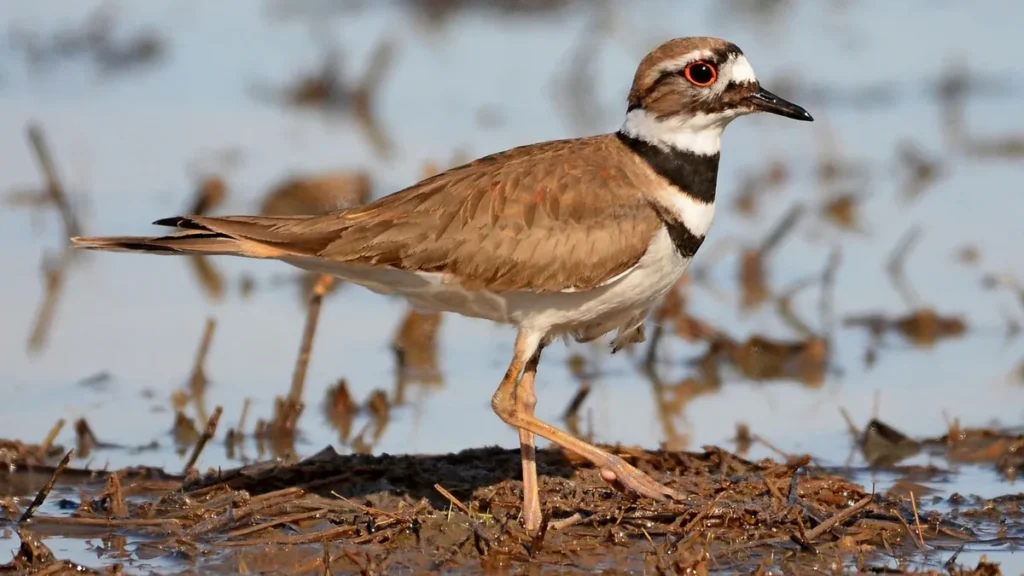
The killdeer species is a single species, Charadrius vociferus, a noisy, long-tailed plover that lives across North America and is best known for the broken-wing act it performs to lure intruders away from its nest. If you are asking how many killdeer species there are, the answer is one, and it is the largest of the ringed plovers, a shorebird that spends far more of its life on dry land than on the shore.
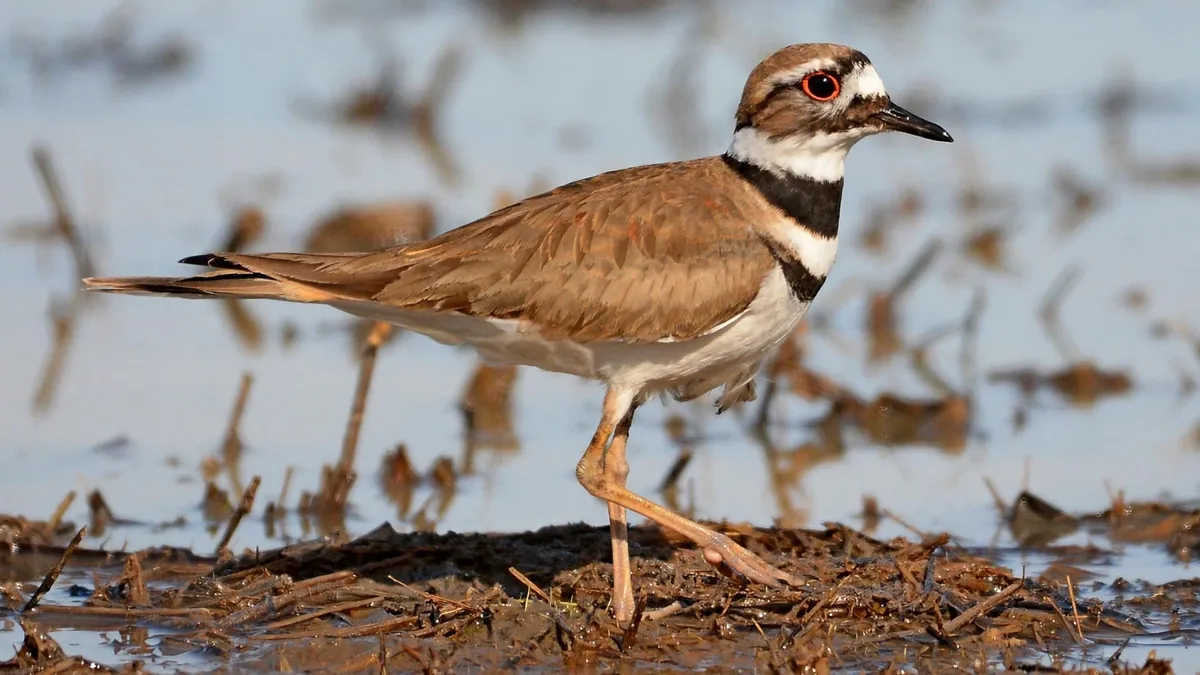
The killdeer gets its name from its loud, piercing call, a shrill kill-dee or dee-dee-dee. It is brown above and white below, with two bold black bands across its chest, a white forehead, a black cap and a bright orange-red ring around the eye, and in flight it shows a bold white wing stripe and a bright orange rump. Males and females look alike.
Key takeaways
- There is one killdeer species, Charadrius vociferus, the largest of the ringed plovers and a member of the plover family.
- Adults are about 20 to 28 centimetres long and weigh roughly 75 to 128 grams, with two black breast bands, a white forehead and an orange-red eye ring.
- Killdeer live across North America, from Alaska and Canada to Mexico and the Caribbean, nesting on open ground from gravel car parks to flat rooftops.
- They eat insects, earthworms, beetles and snails, hunting with a run, stop and peck rhythm on fields and muddy edges.
- The species is listed as Near Threatened, its numbers falling even though it remains one of the most familiar shorebirds in North America.
What makes a killdeer a killdeer
A killdeer is a tall, slender plover with a round head, a large dark eye, a short neck and a fairly long tail, and it stands about 20 to 28 centimetres long, roughly the size of an American robin, though it weighs far less, at about 75 to 128 grams. Its upperparts are warm brown, its underparts white, and the two black bands across its chest are the mark that sets it apart from every other ringed plover, each of which wears only one. Its legs are pale and its short bill is black.
The bird is almost always on the move, and its way of feeding is easy to recognise: it runs a few quick steps across open ground, stops dead, tilts its head as if listening, then pecks, and runs again. It sometimes quivers one foot in shallow water or wet mud to stir up small prey. When alarmed it bobs its tail and takes flight, flashing the white wing stripe and the bright orange rump.
The killdeer species and their relatives
The killdeer belongs to Charadrius, a large genus of small plovers found on shores and open ground around the world, and it is the only member of the genus with two breast bands. Three subspecies are recognised: the nominate form across most of North America, a Caribbean form, and a South American form in Peru and Chile. The name vociferus means loud-voiced.
Its closest relatives are the other ringed plovers, and telling them apart is mostly a matter of counting breast bands and checking size. The semipalmated plover and the piping plover both wear a single band and are smaller, while the Wilson’s plover wears one wide band and has a heavier bill. Young killdeer wear only one band at first, and the second appears as they grow adult plumage.
| Type | Animal | Where it lives | Best-known food | Length or Weight |
|---|---|---|---|---|
| Genus | Ringed plovers (genus Charadrius) | Shores and open ground worldwide | Insects and other small invertebrates | About 15 to 28 cm long |
| Species | Killdeer (Charadrius vociferus) | North and Central America | Earthworms, beetles, grasshoppers | About 20 to 28 cm long |
| Species | Semipalmated plover (Charadrius semipalmatus) | North America, winters in South America | Marine worms, insects, crustaceans | About 17 to 20 cm long |
| Species | Wilson’s plover (Charadrius wilsonia) | Coasts of the Americas | Crabs, insects, marine worms | About 18 to 20 cm long |
| Species | Piping plover (Charadrius melodus) | Beaches of North America | Marine worms, insects, crustaceans | About 15 to 18 cm long |
| Species | Common ringed plover (Charadrius hiaticula) | Europe, Asia and Africa | Insects, crustaceans, molluscs | About 18 to 20 cm long |
How killdeer live
Killdeer feed almost entirely on small animals they find on the ground. Earthworms, beetles, grasshoppers, caterpillars, spiders, snails and freshwater shrimps make up most of the diet, with seeds taken now and then. They hunt by day in fields, lawns, pastures and along muddy edges, and on bright moonlit nights outside the breeding season they will feed after dark as well. They often follow the plough to pick up worms and insects it turns over.
The nest is no nest at all, just a shallow scrape in the ground, usually on gravel, sand or bare earth, sometimes on a flat rooftop, a driveway or the edge of a car park, lined with a few pebbles or bits of shell. The female usually lays four eggs, buff-coloured and blotched with dark brown, blending well with the stones around them. Both parents incubate for about 24 to 28 days, the male usually sitting at night.
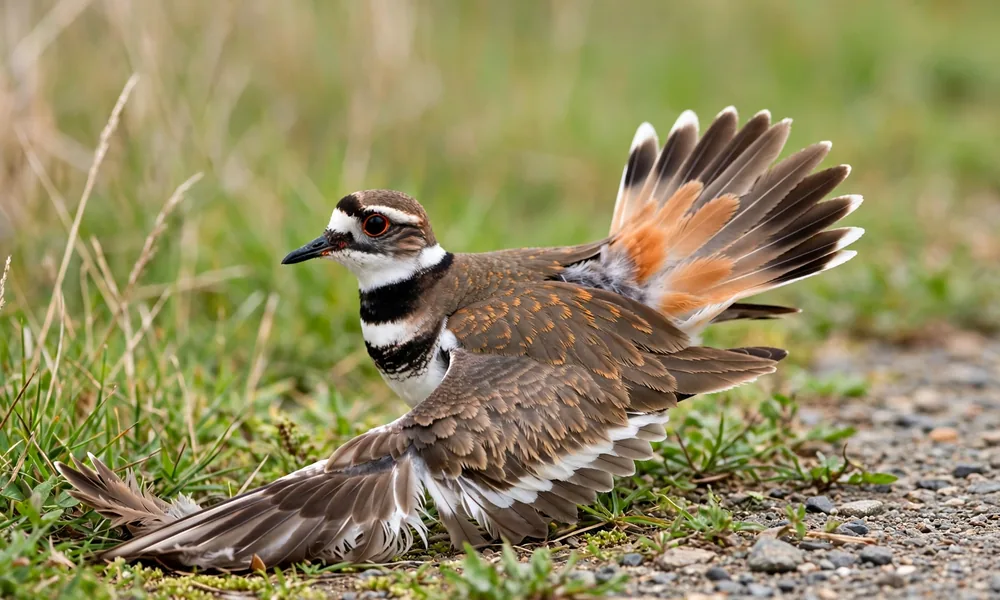
The chicks are precocial, hatching covered in down with their eyes open, and within hours of hatching they can run after their parents and pick up food for themselves. The family leaves the scrape within a day, and the young can fly at about 25 to 31 days old. If a fox, a dog or a person comes too close, a parent performs the famous broken-wing display, dragging a wing along the ground and fluttering away from the nest as if injured, then flying off once the intruder has been led far enough away. Faced with cattle, it may fluff itself up, fan its tail and rush at the animal.
Where killdeer live
Killdeer breed across almost the whole of North America, from Alaska and northern Canada south through the United States to Mexico, and they also breed in the Caribbean and along the west coast of South America as far as Chile. Northern birds are migrants, arriving in the middle latitudes with the first warmth of spring and heading south again in late summer and autumn, while birds in the southern United States and further south stay put all year. A few strays have even reached western Europe.
Despite being classed as a shorebird, the killdeer is often found far from the sea. It favours open ground with short vegetation: playing fields, lawns, golf courses, gravel pits, mudflats, riverbanks and the edges of lakes and ponds. It is less at home on ocean beaches than most shorebirds, and it thrives where people have opened up the land.
The killdeer is still common, but its numbers are falling. The IUCN moved it from Least Concern to Near Threatened in July 2024, after its population fell by more than a fifth over three generations, and the global population is estimated at about 2.3 million birds. The decline is linked to the loss of open, grassy habitats and intensive farming, and the bird is protected in the United States by the Migratory Bird Treaty Act and in Canada by the Migratory Birds Convention Act. Predators include foxes, raccoons, gulls and owls, which take eggs, chicks and adults alike.
Best seasons for killdeer watching
The best time to look for killdeer is spring and early summer, from March to July, when the birds are breeding, calling loudly and performing their distraction displays on open ground. Early morning is best, when they feed busily on lawns and playing fields, and in late summer small flocks gather before migration. In the southern United States they can be found in any month.
Staying safe around killdeer
A killdeer is a small, harmless bird, and the danger runs the other way: its nest is a scrape on open ground, and its eggs are so well camouflaged that a careless footstep can crush them. If a killdeer is calling loudly, bobbing its tail or dragging a wing in front of you, you are almost certainly standing near a nest or chicks, so back away slowly and give the bird room. Keep dogs on a lead in open fields during the breeding season.
Never try to pick up a chick, even one that looks abandoned, since killdeer chicks feed themselves from their first day and their parents are usually watching from a short distance away. A bird flushed from its eggs will usually return within minutes once you have moved away.
Killdeer watching checklist
A little preparation turns a walk across a playing field into a real chance of seeing North America’s noisiest plover at work.
- A spring visit, from March to July, when killdeer are breeding and calling.
- An open, short-grass place to look: a playing field, a lawn, a gravel car park or a muddy lake edge.
- Binoculars, for a close view of the double breast band and the orange-red eye ring.
- Early morning, when killdeer feed busily and the light shows the brown upperparts at their best.
- Sturdy shoes, since the best places to look are gravel paths, muddy edges and rough grass.
- Patience and a quiet approach, because a crowded killdeer will fly off calling loudly.
- Respect for ground nests: if a bird starts its broken-wing act, back away and leave the scrape alone.
Frequently asked questions
How many killdeer species are there?
There is one killdeer species, Charadrius vociferus, the largest of the ringed plovers. Three subspecies are recognised, across North America, the Caribbean and western South America, but they are all the same species.
Why is it called a killdeer?
The name comes from its loud, piercing call, which sounds like kill-dee or kill-deer repeated over and over. It has nothing to do with deer.
What does a killdeer eat?
A killdeer eats mostly small invertebrates, above all earthworms, beetles, grasshoppers, caterpillars, spiders and snails, with freshwater shrimps and the occasional seed as well. It hunts on foot with a run, stop and peck rhythm, and sometimes quivers a foot in wet mud to stir up prey.
Are killdeer dangerous?
No, killdeer are not dangerous to people. They are small, ground-nesting birds whose only defence is noise and distraction, and they would far rather lure you away from their nest with a broken-wing act than confront you.
How is this guide different from the kea guide?
This guide covers the killdeer, a small, ground-nesting plover of North American fields and shores that eats insects and worms and defends its nest with a broken-wing act, while our kea species guide covers the kea, a large, intelligent parrot of the New Zealand mountains that lives in alpine forests and probes the ground with its long, curved bill. One is a shorebird that nests in a scrape on the ground; the other is a mountain parrot that nests in burrows and rock crevices.
Are killdeer endangered?
No, not in the strict sense. The killdeer is listed as Near Threatened on the IUCN Red List, one step below Vulnerable, after its numbers fell by more than a fifth over three generations. It is still common across North America, but the decline is the reason it was moved off the Least Concern list in July 2024.
Conclusion
The killdeer species is a small bird with an outsized personality: one species, Charadrius vociferus, a double-banded plover that nests in a scrape on the ground and defends it with noise, bluff and a broken wing.
If you go looking for one, go in spring and listen first. The shrill kill-dee will usually find you before you find the bird, and the double breast band will tell you what it is.