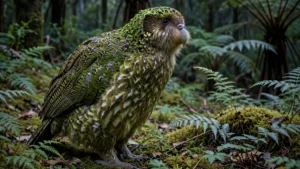
The kea species is a single species, Nestor notabilis, a large, olive-green parrot that lives only in the mountains of New Zealand and is the only true alpine parrot in the world. If you are asking how many kea species there are, the answer is one, and it is listed as Endangered, with a wild population in the low thousands that is still falling.
The kea, called the clown of the mountains, is famous for its curiosity, intelligence and mischief. It solves puzzles, uses tools, plays in the snow, and investigates cars, backpacks and boots at mountain car parks, pulling at windscreen wipers and rubber seals. Beneath the playfulness is a bird in trouble, killed in large numbers for bounty in the past and now threatened by the predators that hunt its nests.
Key takeaways
- There is one kea species, Nestor notabilis, the only kea species in the genus Nestor and the only true alpine parrot in the world.
- Adult kea are about 48 centimetres long and weigh roughly 800 to 1,000 grams, with olive-green plumage and vivid orange-red underwings.
- Kea live in the mountains of South Island, New Zealand, from high forest up into the alpine zone, often above 600 metres.
- They are omnivores and problem solvers, eating roots, berries, insects and carrion, and famously investigating anything new.
- The species is listed as Endangered, with an estimated 3,000 to 7,000 birds left in the wild, and its numbers are still falling.
What makes a kea a kea
A kea is a large, strongly built parrot about 48 centimetres long, with a long, sharply curved upper beak that is longer in males than in females. Its plumage is olive-green with dark-edged feathers, giving it a scaled look, and its underwings and rump are scarlet-orange, so a bird in flight suddenly shows bright orange against the grey rock. Its call, a long, descending keee-a, gave the bird its name.
Its intelligence sets it apart from most birds. Kea solve multi-step puzzles, work together to open latches, use sticks as tools, and learn by watching other kea. That curiosity is also its weakness around people, because a bird that investigates everything will chew lead flashing on a roof or get hit by a car. It belongs to the New Zealand parrot family, Nestoridae, and our African grey parrot guide covers another famously clever parrot, an African forest bird, while the kea applies the same kind of brain to a cold mountain life.
The kea species and their relatives
The kea belongs to Nestor, a genus of New Zealand parrots that also holds the kaka, Nestor meridionalis, a brown forest parrot, and the extinct Norfolk kaka. The kea moved into the mountains and became the alpine specialist, while the kaka stayed in the lowland forest. Its more distant cousin is the kakapo, the flightless night parrot, which split from the same family line much earlier.
The species has no recognised subspecies, and it lives only on South Island, New Zealand, across the Southern Alps and the Kaikoura Ranges, from Kahurangi to Fiordland. Kea were once far more numerous, but from the late 1860s until the early 1970s farmers paid a bounty for them, blaming them for attacking sheep, and tens of thousands were killed. The kea received full legal protection in 1986, but its numbers had already fallen sharply, and introduced predators have kept the pressure on ever since.

| Type | Animal | Where it lives | Best-known food | Length or Weight |
|---|---|---|---|---|
| Genus | Kea and kaka (genus Nestor) | Forests and mountains of New Zealand | Nectar, fruit, roots and insects | About 45 to 48 cm long |
| Species | Kea (Nestor notabilis) | Mountains of South Island, New Zealand | Roots, berries, insects and carrion | About 800 to 1,000 g |
| Species | Kaka (Nestor meridionalis) | Forests of New Zealand | Nectar, fruit, insects and seeds | About 45 cm long |
| Species | Kakapo (Strigops habroptilus) | Predator-free islands of New Zealand | Rimu fruit, leaves and buds | About 2 to 4 kg for males |
| Species | African grey parrot (Psittacus erithacus) | Rainforests of central Africa | Seeds, nuts, fruit and berries | About 33 cm long |
| Species | Sulphur-crested cockatoo (Cacatua galerita) | Woodlands of Australia and New Guinea | Seeds, nuts, fruit and insects | About 44 to 55 cm long |
How kea live
Kea are omnivores, and their diet changes with the season and the altitude. They dig for roots and bulbs, eat leaves, berries, seeds and nectar, pick insects and larvae from bark and soil, and scavenge carrion. In winter they move lower to find food, and in summer they range high above the treeline.
They are social birds, living in loose flocks that gather at food sources and at mountain car parks. Young kea play constantly, chasing each other, sliding in the snow and pulling at anything loose, and that play is how they learn the skills they need as adults.
Breeding takes place in winter and spring, which is unusual for a parrot, and the nest is usually a burrow or crevice under tree roots or among boulders, lined with wood chips. The female lays two to four eggs and incubates them alone for about three to four weeks, while the male brings her food, and the chicks stay in the nest for about thirteen weeks before they fledge. Young birds do not breed until they are three or four years old, and kea can live for well over twenty years, with birds in captivity reaching fifty.
Where kea live
Kea live only in the mountains of South Island, New Zealand, in the Southern Alps and the Kaikoura Ranges, across about 3.5 million hectares from Kahurangi to Fiordland. They use high-altitude beech forest, subalpine scrub and alpine tussock, usually above 600 metres and up to about 2,000 metres, and they are best known at Arthur’s Pass, Aoraki, also called Mount Cook, and Fiordland National Park.
Their greatest threat is predation of eggs and chicks by stoats and possums, which reach the nests kea build on the ground and in rock crevices. Lead poisoning is another serious danger, because kea chew the lead flashing on mountain huts and roofs. Cars and dogs add further losses, and the birds that visit car parks are most at risk, because they learn to expect food from people and lose their caution around traffic.
The kea is listed as Endangered on the IUCN Red List and as Nationally Endangered in New Zealand. The total population is estimated at 3,000 to 7,000 birds, including about 4,000 mature birds, and the trend is still falling. Conservation work focuses on trapping stoats and possums around nesting areas, replacing lead on huts, and teaching visitors not to feed kea. Readers planning a trip can start with our New Zealand animals guide, which covers the wider wildlife of the mountains the kea calls home.
Best seasons for kea watching
Kea can be seen all year, but the best time is the warmer months, roughly November to April, when the mountain roads are clear, the days are long, and the birds are active around the high passes. In winter the kea are still there, playing in the snow, but the weather is harsh and the birds move lower to find food. Your best chance is early in the morning at a mountain car park or lookout, where a flock may arrive to investigate the cars.
Staying safe around kea
A kea is not dangerous to people, but it is a powerful bird with a strong beak, and it should always be watched from a respectful distance. Never feed a kea, because fed birds lose their fear of people and are far more likely to be hit by a car or to chew lead. Keep food and rubbish locked away, close your car windows, and do not leave backpacks, boots or cameras where a curious kea can reach them.
If a kea lands on your car, stay calm and wait for it to leave, rather than shooing it away or starting the engine while it is on the vehicle. Keep dogs on a lead in kea country, and stay on marked tracks, because nests are hidden in burrows and rock crevices that are easy to damage. If you see a kea that is injured or behaving strangely, contact the Department of Conservation or the Kea Conservation Trust, rather than handling the bird yourself.
Kea watching checklist
A little preparation turns a drive over a mountain pass into a real chance of seeing the only alpine parrot in the world.
- A visit to Arthur’s Pass, Aoraki, also called Mount Cook, or Fiordland, where kea are seen most often.
- A trip in the warmer months, roughly November to April, when the roads are clear and the days are long.
- An early morning start at a mountain car park or lookout, where flocks gather to investigate.
- Binoculars, because kea often perch on rocks and ridges above the road before they come down.
- Warm, windproof clothing and sturdy boots, for cold and changeable mountain weather.
- A camera with a zoom lens, for close views of the orange underwings without approaching the birds.
- Food and rubbish locked away, and car windows closed, so the kea stay wild and safe.
Frequently asked questions
How many kea species are there?
There is one kea species, Nestor notabilis, the only kea species in the genus Nestor. It lives only in the mountains of South Island, New Zealand, and it is the only true alpine parrot in the world.
Why is the kea called the clown of the mountains?
The name comes from its playful, curious behaviour, from sliding in the snow to investigating cars and backpacks at mountain car parks. Kea are among the most intelligent of birds, solving puzzles and using tools, and their playfulness is how young birds learn the skills they need.
What does a kea eat?
A kea eats roots, bulbs, leaves, berries, seeds and nectar, as well as insects, larvae and carrion, and its diet changes with the season and the altitude. In winter it moves lower to find food, and in summer it ranges high above the treeline, digging and probing with its long, curved beak.
Are kea dangerous?
Kea are not dangerous to people, and they would rather investigate than attack, but they are strong birds with powerful beaks that can damage cars, roofs and gear. They should always be watched from a distance and never fed, because a fed kea loses its caution around people and traffic.
How is this guide different from the kakapo guide?
This guide covers the kea, a flying, olive-green parrot of the high mountains that lives in flocks, solves puzzles and investigates cars at mountain passes, while our kakapo species guide covers the kakapo, a flightless, nocturnal parrot that walks the forest floor at night on predator-free islands. One is a bold mountain bird you can watch at a car park; the other is a shy night bird you cannot visit at all.
Are kea endangered?
Yes. The kea is listed as Endangered on the IUCN Red List and as Nationally Endangered in New Zealand, with an estimated 3,000 to 7,000 birds left in the wild and numbers still falling. Stoats and possums prey on its nests, lead poisoning harms birds that chew hut roofs, and conservation work now focuses on trapping predators and removing lead from mountain buildings.
Conclusion
The kea species is a bird that makes the mountains feel alive: one species, Nestor notabilis, a clever, playful parrot that lives where snow falls and few other parrots could survive.
If you go looking for one, go in the warmer months, go early, and keep your food locked away. Find a kea flashing its orange underwings above a mountain pass, and you will see why it is called the clown of the mountains.