The kakapo species is a single species, Strigops habroptilus, a large, flightless, nocturnal parrot that lives only in New Zealand and is the heaviest parrot in the world. If you are asking how many kakapo species there are, the answer is one, and it is the only living member of its genus, listed as Critically Endangered, with the whole world population in the low hundreds.
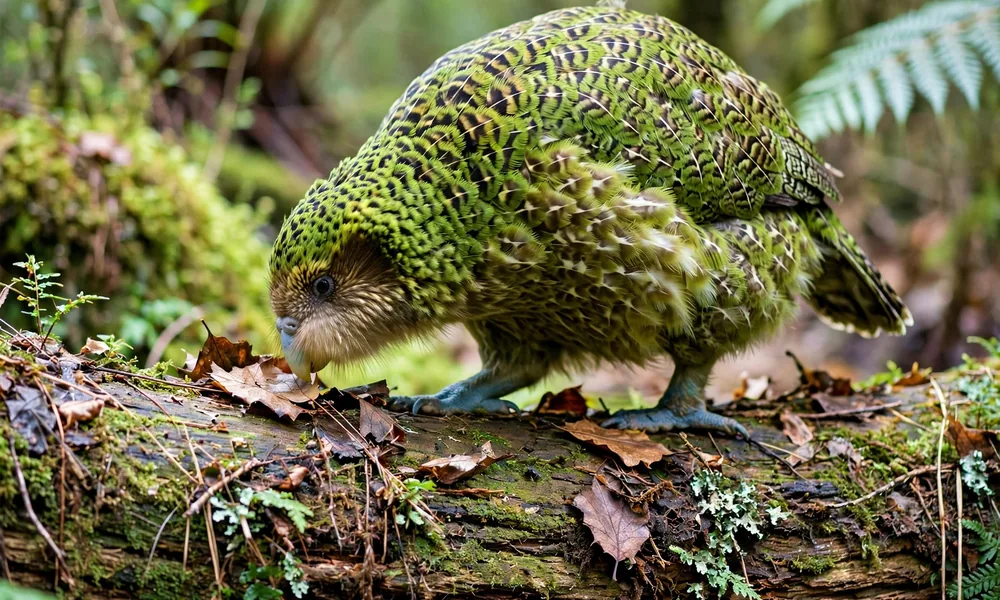
The kakapo, also written kākāpō and known in Māori as the night parrot, looks at first glance like a small owl that has been dressed in moss. The mottled yellow-green and black plumage, pale owl-like facial disc and large grey beak sit above a strong, walking body. It cannot fly at all, yet it climbs trees with ease and can live for many decades.
Key takeaways
- There is one kakapo species, Strigops habroptilus, the only living member of the genus Strigops and the heaviest parrot in the world.
- Adult males can weigh up to about 4 kilograms, females are smaller, and the moss-green, mottled plumage hides the bird on the forest floor.
- Kakapo are nocturnal and flightless, climbing trees at night and walking long distances through the forest instead of flying.
- They breed only in years when rimu trees produce a heavy crop of fruit, with males calling from display grounds and females raising the chicks alone.
- The species is listed as Critically Endangered, with every surviving bird individually known, named and watched over on predator-free islands.
What makes a kakapo a kakapo
A kakapo is a big, round-bodied parrot with short wings, a short tail and powerful grey legs built for walking and climbing. Its head and body measure about 59 to 64 centimetres, and males, at roughly 2 to 4 kilograms, are much heavier than females, which usually weigh about 1.4 to 2.5 kilograms. The soft feathers are yellow-green barred with black and brown, so a bird standing still among ferns is almost invisible, and the bird has a strong, sweet, musty smell that is unusual among parrots.
Its wings are too small and its breastbone too flat to support flight, so it uses them for balance when climbing and as a parachute when dropping from a tree. Its sense of smell is unusually keen for a bird. It belongs to the New Zealand parrot family, Strigopidae, and like other parrots it has a strong, curved beak and feet with two toes pointing forwards and two backwards. Our African grey parrot guide covers a very different parrot, a clever African forest bird that flies well and talks, while the kakapo has given up flight altogether.
The kakapo species and their relatives
The kakapo belongs to Strigops, a genus with a single living species. Its closest living relatives are the kea and the kaka, the other New Zealand parrots in the family Strigopidae, but the kakapo split from their line millions of years ago and evolved alone in a land with no ground-dwelling mammalian predators, so flight became a cost it no longer needed to pay.
The species has no recognised subspecies, and it once lived throughout New Zealand, from the coast to the mountains on both main islands. That range collapsed after people arrived, first with Māori hunting and the rats and dogs they brought, then with the stoats, cats, possums and rats introduced by European settlers. By the 1970s it was thought almost gone, until a small population was found on Stewart Island.
| Type | Animal | Where it lives | Best-known food | Length or Weight |
|---|---|---|---|---|
| Genus | Kakapo (genus Strigops) | Forests of New Zealand | Leaves, fruit and seeds | About 59 to 64 cm long |
| Species | Kakapo (Strigops habroptilus) | Predator-free islands of New Zealand | Rimu fruit, leaves and buds | About 2 to 4 kg for males |
| Species | Kea (Nestor notabilis) | Mountains of South Island, New Zealand | Roots, berries, insects and carrion | About 48 cm long |
| Species | Kaka (Nestor meridionalis) | Forests of New Zealand | Nectar, fruit, insects and seeds | About 45 cm long |
| Species | African grey parrot (Psittacus erithacus) | Rainforests of central Africa | Seeds, nuts, fruit and berries | About 33 cm long |
| Species | Sulphur-crested cockatoo (Cacatua galerita) | Woodlands of Australia and New Guinea | Seeds, nuts, fruit and insects | About 44 to 55 cm long |
How kakapo live
Kakapo are herbivores, eating leaves, buds, flowers, fruit, seeds, bark and roots, with rimu fruit holding a special place in their lives. Rimu trees fruit heavily only in mast years, roughly every two to four years, and it is in those years that kakapo breed. The birds feed at night, walking slowly through the forest and climbing into trees, and they often leave neat piles of chewed plant fibre behind them.
Males gather at display grounds called leks, where each male clears a shallow bowl in the ground and calls through the night with deep, booming notes that can carry for kilometres. Females visit the leks, choose a mate, and then leave to raise the chicks entirely alone. A female lays one to four eggs in a hollow log, burrow or rock crevice, incubates them for about a month, and feeds the chicks for about ten to twelve weeks until they leave the nest.
Kakapo are long-lived, with many living for sixty years or more, and some may reach ninety. That slow pace makes every breeding season precious, because a female may breed only a handful of times in her life, and only in mast years. Every kakapo alive today is known to the recovery team by name, fitted with a radio transmitter, and checked regularly.
Where kakapo live
Kakapo now live only on a small number of predator-free islands off New Zealand, where stoats, rats, cats and possums have been removed and kept out. The main breeding populations are on Whenua Hou, also called Codfish Island, near Stewart Island, on Pukenui, also called Anchor Island, in Fiordland, and on Te Kākahu-o-Tamatea, also called Chalky Island. Smaller numbers live on other managed islands, and the long-term aim is to return kakapo to large, fenced mainland sanctuaries.
These islands are not open to the public, because even a single rat reaching shore could destroy the population, so there is no wild kakapo watching in the ordinary sense. The forests the birds need are dense native bush with rimu and other fruiting trees, ground cover for hiding by day, and hollow logs and burrows for nesting.
The kakapo is listed as Critically Endangered on the IUCN Red List and as Nationally Critical in New Zealand. In 1995 only 51 birds were known to survive, and the population has since grown into the low hundreds, with about 250 birds in 2025. That recovery is the work of the Kakapo Recovery Programme, run by the New Zealand Department of Conservation with Ngāi Tahu, which moves birds between islands, hand-rears chicks when needed, and guards every nest. The greatest threats that remain are predators reaching the islands, disease, and low genetic diversity, so the birds will need close care for many years yet. Readers planning a trip can start with our New Zealand animals guide, which covers the wider wildlife of the islands the kakapo calls home.
Best seasons for kakapo watching
There is no public watching season for wild kakapo, because the islands where they live are closed to visitors and the birds are nocturnal, shy and intensively managed. The best time to follow their story is during a rimu mast breeding season, roughly every two to four years, when the Kakapo Recovery Programme shares news of booming males, nesting females and new chicks.
Staying safe around kakapo
A kakapo is a gentle bird that poses no danger to people, and people pose a far greater danger to it, so the rules around kakapo are about protecting the bird, not the visitor. Never try to visit a kakapo island without permission, never land a boat on a predator-free island, and never carry food, soil or plants ashore, because rats and seeds travel in luggage and could undo decades of work.
Stay on marked tracks in the wider New Zealand bush, keep dogs out of reserves unless they are allowed, and clean your boots and gear before entering a pest-free area. If you find a sick or injured native bird, do not handle it yourself; contact the Department of Conservation or a local wildlife rescue service.
Kakapo watching checklist
Wild kakapo cannot be visited, so this checklist is about following their recovery properly, and about seeing the New Zealand forest they come from.
- Follow the Kakapo Recovery Programme updates during a rimu mast breeding season, when new chicks are announced.
- Learn the story of the 1995 low of 51 birds, so the recovery into the low hundreds makes sense.
- Visit a public mainland sanctuary in New Zealand, where other native forest birds can be seen safely.
- Walk a rimu forest track by day and look for chewed plant fibre and the signs of night-feeding birds.
- Listen after dark in a permitted forest reserve for the deep booming calls of other night birds.
- Support predator-free work by checking bags and boats before visiting any New Zealand island.
- Share only official news and photographs, because the birds themselves must not be disturbed for a closer look.
Frequently asked questions
How many kakapo species are there?
There is one kakapo species, Strigops habroptilus, the only living member of the genus Strigops. It lives only in New Zealand, it is flightless and nocturnal, and it is the heaviest parrot in the world.
Why is the kakapo flightless?
The kakapo lost the power of flight because it evolved in New Zealand before ground-dwelling mammalian predators arrived, so there was nothing on the ground it needed to escape by flying. Over millions of years its wings shrank, its breastbone flattened, and its body grew heavy and strong for walking and climbing, which served it well until rats, stoats and cats were introduced.
What does a kakapo eat?
A kakapo eats leaves, buds, flowers, fruit, seeds, bark and roots, with rimu fruit especially important because breeding follows heavy rimu crops. It feeds at night, climbing into trees and walking the forest floor, and it leaves neat piles of chewed plant fibre where it has fed.
How long do kakapo live?
Kakapo are very long-lived, with many birds living for sixty years or more, and some may reach ninety. That long life is balanced by slow breeding, since females breed only in rimu mast years, roughly every two to four years, and raise their chicks alone.
How is this guide different from the jabiru guide?
This guide covers the kakapo, a flightless, nocturnal parrot of New Zealand that walks the forest floor at night and breeds only in rimu mast years, while our jabiru species guide covers the jabiru, a tall, flying stork of the Americas that wades in wetlands and nests high in trees. One is a moss-green parrot that never flies; the other is a black-and-white stork with a wingspan wider than a person is tall.
Are kakapo endangered?
Yes. The kakapo is listed as Critically Endangered on the IUCN Red List and as Nationally Critical in New Zealand, with the whole population in the low hundreds. Every bird is individually known, named and monitored by the Kakapo Recovery Programme on predator-free islands, and the species still depends on that care for its survival.
Conclusion
The kakapo species is a bird that should not exist by the usual rules: one species, Strigops habroptilus, a parrot that cannot fly, finds food by smell at night, and lives for decades on a handful of small islands.
It survives because people noticed in time, and because every bird is now known by name. Follow the recovery, respect the closed islands, and the night parrot may yet return to the mainland forests it once filled.