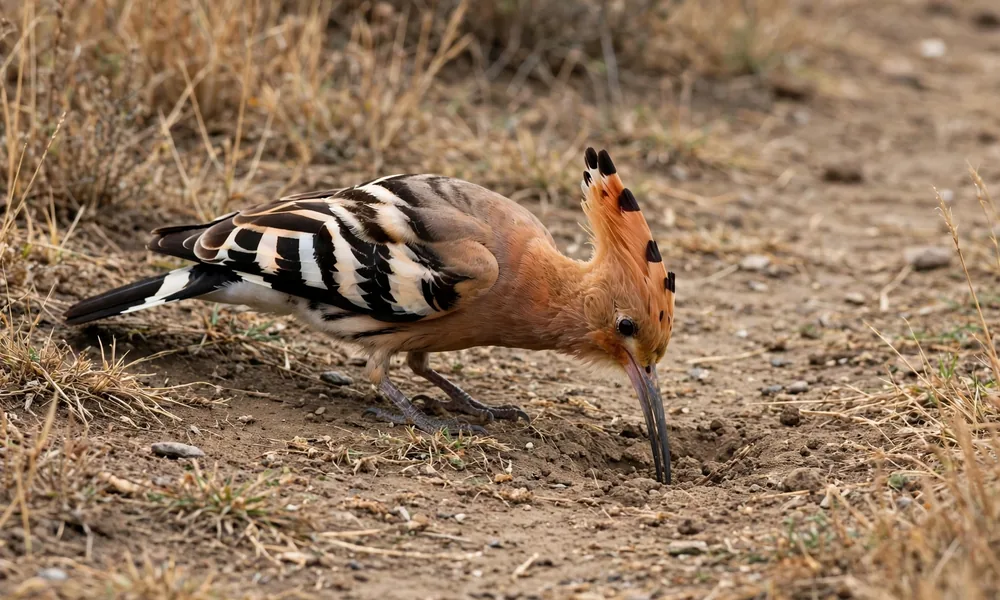
The hoopoe species is a single species, Upupa epops, the Eurasian hoopoe, a cinnamon-coloured bird with a tall fan crest and a long, downcurved bill that spends most of its life walking the ground and probing the soil for insects. If you are asking how many hoopoe species there are, the answer is one in the sense this guide uses the name, and it is one of the most recognisable birds of Europe, Asia and Africa.
The hoopoe is named after its own voice, a soft oop-oop-oop that carries across open grassland on a still morning. It was a sacred bird in ancient Egypt, painted on tomb walls thousands of years ago, and in 2008 it was chosen as the national bird of Israel.
Key takeaways
- The hoopoe species is Upupa epops, the Eurasian hoopoe, a cinnamon bird with black-and-white wings, a fan crest and a long downcurved bill.
- Adults are 25 to 32 centimetres long, with a wingspan of 44 to 48 centimetres and a weight of 46 to 89 grams.
- Hoopoes live across Europe, Asia and Africa, in open country with bare ground for feeding and holes for nesting.
- They eat mostly insects, probing the soil with a bill that can open underground, and raise their young in tree holes and wall cavities.
- The species is listed as Least Concern, though numbers fall where old trees and insect-rich grassland disappear.
What makes a hoopoe a hoopoe
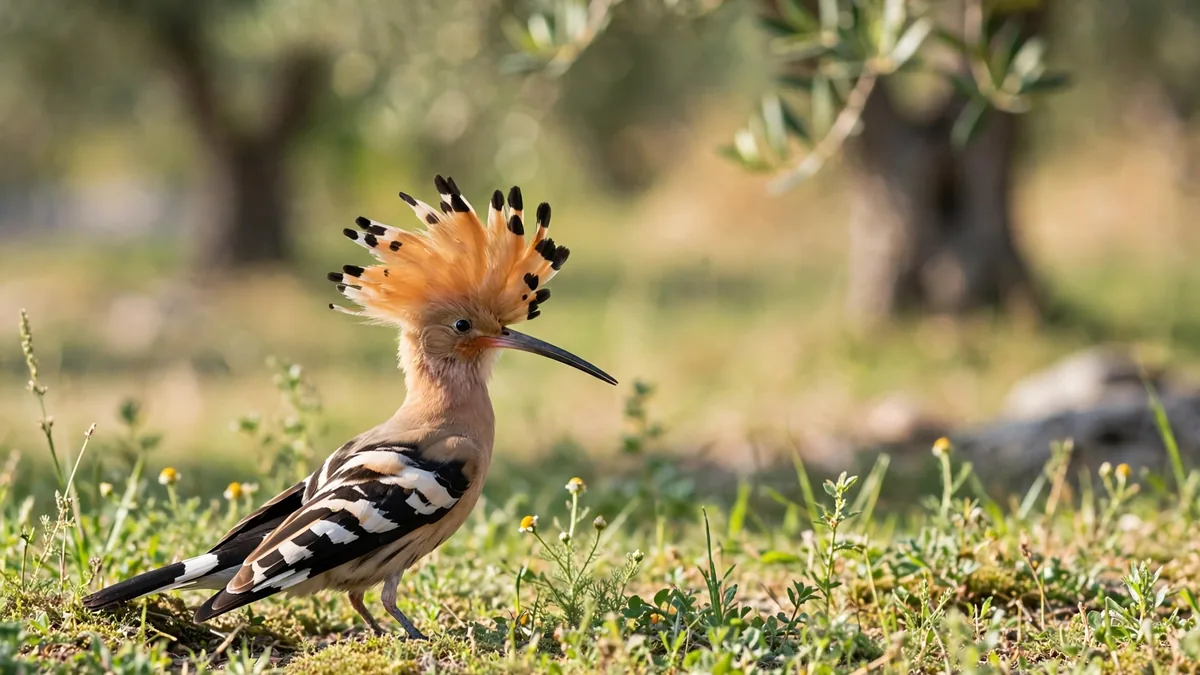
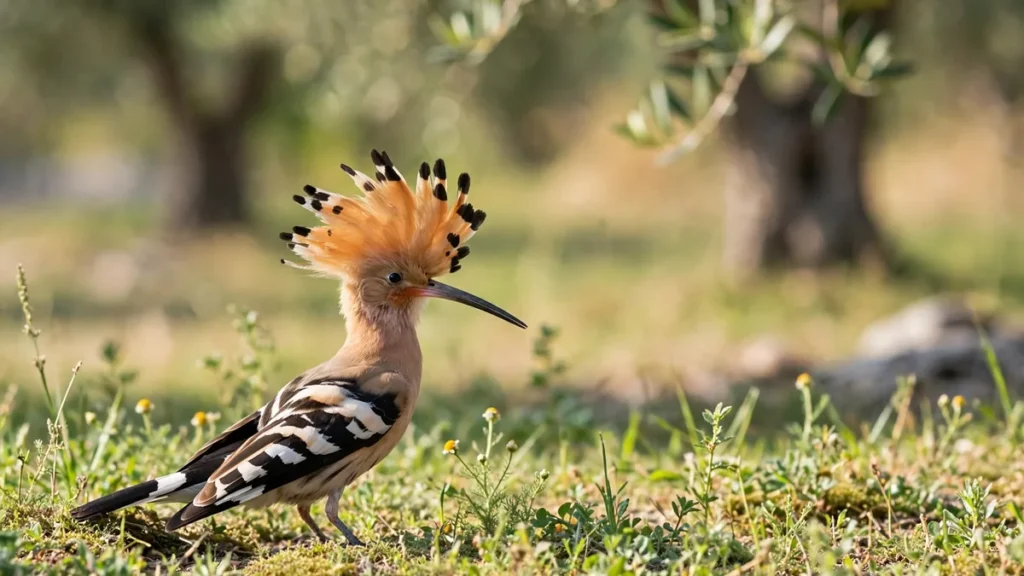
A hoopoe is a medium-sized bird, 25 to 32 centimetres long, with a warm cinnamon head, neck and breast, black-and-white barred wings and tail, and a broad white band across a black tail. Its most famous feature is the tall crest, a fan of cinnamon feathers tipped with black that lies folded along the head and opens suddenly when the bird is excited, alarmed or displaying. Its bill is long, thin and slightly downcurved, black with a fawn base, and it can open the bill even when it is pushed deep into the soil.
Its flight is slow and undulating, like a giant butterfly, because the broad, rounded wings half close at the end of each beat. Its call is a soft oop-oop-oop, sometimes given in twos or fours, and it may be the origin of both the English name and the scientific name, though the French huppee, meaning crested, is another likely source. Males and females look alike, and young birds are duller, with a shorter crest and bill.
The hoopoe species and their relatives
The hoopoe belongs to Upupa, a small genus in the family Upupidae, and Upupa epops is the most widespread member of it. The African hoopoe and the Madagascar hoopoe were long treated as subspecies of Upupa epops, but they are now usually treated as separate species, which is why this guide covers the Eurasian hoopoe alone. Several subspecies of the Eurasian hoopoe are recognised, differing in size and in the depth of their cinnamon colour.
The hoopoe family sits in the order Bucerotiformes, alongside the hornbills, and the two groups share a long bill and a taste for insects, though a hoopoe is a bird of open ground and a hornbill is mostly a bird of trees. Its closest living relatives are therefore the hornbills of Africa and Asia, not the woodpeckers it is sometimes confused with at a glance.
| Type | Animal | Where it lives | Best-known food | Length or Weight |
|---|---|---|---|---|
| Genus | Hoopoes (genus Upupa) | Open country of Europe, Asia and Africa | Insects from the soil | About 25 to 32 cm long |
| Species | Eurasian hoopoe (Upupa epops) | Europe, Asia and northern Africa | Crickets, beetles and grubs | About 25 to 32 cm long |
| Species | African hoopoe (Upupa africana) | Sub-Saharan Africa | Insects, small lizards and frogs | About 28 cm long |
| Species | Madagascar hoopoe (Upupa marginata) | Madagascar | Insects and small reptiles | About 32 cm long |
| Species | Trumpeter hornbill (Bycanistes bucinator) | Forests of eastern and southern Africa | Fruit and insects | About 50 to 58 cm long |
| Species | Southern ground hornbill (Bucorvus leadbeateri) | Savannas of southern Africa | Insects, frogs and small mammals | About 90 to 100 cm long |
How hoopoes live
Hoopoes are insect eaters for almost all practical purposes, and they feed alone, walking across bare ground or short grass and probing the soil, leaf litter and animal dung with the long bill. Common prey includes crickets, grasshoppers, beetles, earwigs, cicadas, ants and caterpillars, usually 20 to 30 millimetres long, and the bird tosses its prey into the air and catches it before swallowing. Small reptiles, frogs, seeds and berries are taken only occasionally.
Hoopoes are active by day, and on warm days they sunbathe, spreading their wings and tail flat against the ground and tilting the head up, a posture long mistaken for a defensive display. They are strong fliers despite the slow, butterfly-like beat, and northern birds travel long distances at night. They are generally solitary outside the breeding season, defending a feeding territory with the call and with raised crests.
Hoopoes nest in a hole, usually in a tree or a wall, but also in a nest box, a haystack, a cliff crevice or an abandoned burrow, using almost no nesting material. The female lays four to twelve eggs and incubates them for 15 to 18 days while the male brings her food. The nest is famous for its smell: the female and the chicks produce a foul-smelling fluid from a gland near the tail, and nestlings can squirt it at intruders to keep predators away. The young leave the nest after about four weeks and are fed by both parents for a time afterwards.
Where hoopoes live
Hoopoes live across a huge range, breeding through Europe and Asia and across northern Africa. Birds from Europe and northern Asia are migrants: they travel south to the tropics for the winter, and those breeding in Europe usually winter in the Sahel belt of sub-Saharan Africa, migrating mostly at night. African populations further south are sedentary and stay in the same place all year.
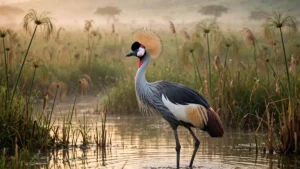
A hoopoe needs two things above all: bare or lightly vegetated ground on which to forage, and vertical surfaces with cavities in which to nest. Those needs are met in heathland, wooded steppe, savanna and grassland, and in forest glades, orchards, vineyards, parks and traditional farmland. In African grassland and farmland, hoopoes share the open ground with birds such as the grey-crowned crane, though the crane is a bird of wetlands and the hoopoe is a bird of dry, bare soil.
The hoopoe is listed as Least Concern on the IUCN Red List, with a very large range and a population estimated at 5 to 10 million individuals. Numbers are falling in parts of Europe where old trees with nest holes are felled, grassland is ploughed or sprayed, and insect prey grows scarce. Nest boxes and patches of bare, unsprayed ground are the simplest ways to help them.
Best seasons for hoopoe watching
The best time to look for hoopoes in Europe is spring and summer, roughly April to September, when the migrants have returned and the males call from low perches. Early morning is best, when the birds walk the bare ground in the open, and a warm, dry summer brings the most grasshoppers and the most hoopoes. In southern Africa, where the birds do not migrate, they can be seen all year, and the dry season makes them easier to spot.
Staying safe around hoopoes
A hoopoe is a harmless bird that would rather fly away than meet a person, and it has no defence beyond its foul-smelling nest. Watch from a distance with binoculars, never approach a nest hole, and never reach into one, because a disturbed nest may be abandoned and the smell is hard to wash off. Keep dogs on a lead near known nest trees, since a dog can flush a bird from its hole.
If you find a nest hole, enjoy it from well away and do not return every day, because repeated visits can draw predators to the site. Stay on marked paths in orchards and farmland, ask before crossing private land, and never handle a hoopoe, which is protected by law in most of Europe. If you meet a bird on a path, stop and give it room to walk away, which it will usually do at a stately pace.
Hoopoe watching checklist
A little preparation turns a walk through open country into a real chance of seeing a hoopoe at close range.
- A spring or summer visit to open grassland, heathland, an orchard or a vineyard, where the ground is bare in patches.
- An early morning start, when hoopoes walk open ground and call from low perches.
- Binoculars, because a hoopoe on the ground is easy to miss until it moves or raises its crest.
- An ear tuned for the soft oop-oop-oop call, which carries further than the bird is visible.
- Patience on bare paths and short turf, where the birds probe the soil for insects.
- A camera with a zoom lens, for close views from a distance without approaching a nest.
- Respect for nest holes and private land, because a disturbed nest may be abandoned.
Frequently asked questions
How many hoopoe species are there?
There is one hoopoe species in this guide, Upupa epops, the Eurasian hoopoe. The African hoopoe and the Madagascar hoopoe were once counted as subspecies of the same species, but they are now usually treated as separate species, so the Eurasian hoopoe stands alone here.
Why is it called a hoopoe?
The name comes from the bird’s call, a soft oop-oop-oop that sounds like hoopoe when written down. The scientific name Upupa is also an imitation of the call, and the French name huppee, meaning crested, is another possible source for the English word.
What does a hoopoe eat?
A hoopoe eats mostly insects, above all crickets, grasshoppers, beetles, earwigs, caterpillars and ants, which it finds by probing the soil, leaf litter and dung with its long bill. It also takes small reptiles and frogs on occasion, and seeds and berries in small amounts.
Are hoopoes dangerous?
No, hoopoes are harmless to people and would rather fly away than confront anyone. Their only defence is the foul-smelling fluid that the female and the chicks produce in the nest, which nestlings can squirt at intruders, so admire them from a distance and never reach into a nest hole.
How is this guide different from the hoatzin guide?
This guide covers the hoopoe, a cinnamon, crested bird of open ground in Europe, Asia and Africa that eats insects from the soil and nests in tree holes, while our hoatzin species guide covers the hoatzin, a leaf-eating bird of the Amazon rainforest that climbs with wing claws as a chick and smells of manure. One probes dry soil with a long bill; the other ferments leaves in its crop like a cow.
Are hoopoes endangered?
No, not in the strict sense. The hoopoe is listed as Least Concern on the IUCN Red List, with a very large range and a population estimated at 5 to 10 million individuals. Numbers are falling in parts of Europe where nest holes and insect-rich grassland are lost, but the species as a whole is not threatened.
Conclusion
The hoopoe species is a bird that needs no introduction once you have seen it: one species, Upupa epops, a cinnamon bird with a fan crest, a long bill and a voice that gave it its name.
If you go looking for one, go in spring, go early, and listen for the oop-oop-oop across the bare ground. Find a hoopoe probing the soil in the morning sun, and you will see why it has been praised and protected for thousands of years.