The kookaburra species are the large, terrestrial tree kingfishers of the genus Dacelo, native to Australia and New Guinea and famous for a loud call that sounds like human laughter. If you are asking how many kookaburra species there are, the classic answer is four, laughing, blue-winged, spangled and rufous-bellied, and the best known of them, the laughing kookaburra, is the bird most Australians hear at dawn and dusk.
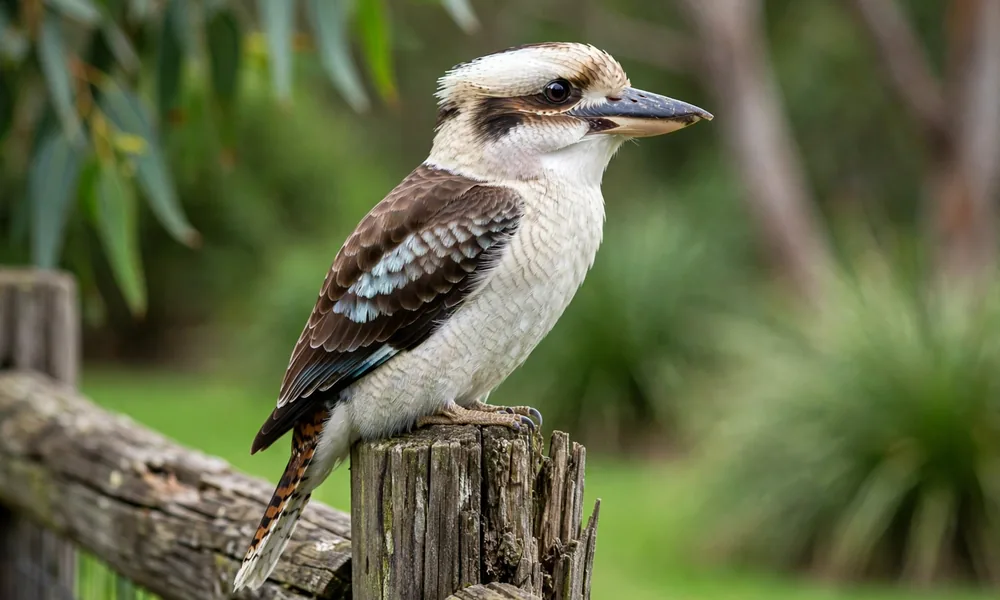
A kookaburra breaks every rule people expect of a kingfisher. It rarely fishes, it hunts on land, and it is one of the largest kingfishers in the world, about 40 to 45 centimetres long in the laughing species, with a big head, a heavy bill and mottled brown-and-white plumage. Its name comes from the Wiradjuri word guuguubarra, an imitation of its call.
Key takeaways
- There are four classic kookaburra species in the genus Dacelo: laughing, blue-winged, spangled and rufous-bellied, with a fifth, the shovel-billed, added by recent genetic studies.
- The laughing kookaburra is about 40 to 45 centimetres long, weighs roughly 300 to 500 grams, and is one of the largest kingfishers in the world.
- Kookaburras are terrestrial hunters that eat lizards, snakes, mice, insects and other small animals, and they rarely catch fish.
- Laughing and blue-winged kookaburras live in family groups, where grown offspring stay to help their parents raise the next brood.
- All kookaburra species are listed as Least Concern, and no reliable total population figure exists for the genus.
What makes a kookaburra a kookaburra
A kookaburra is a kingfisher built for the ground, not the river. It has the family shape, a large head, a long, heavy bill and a stocky body, but its plumage is muted: a pale cream head with a dark brown stripe through the eye, mottled brown wings, and white or pale underparts. The laughing kookaburra has a pale rump with a hint of blue, the blue-winged has bright blue panels on its wings, rump and tail, the spangled has white spots and pale blue-green flecks across dark brown plumage, and the rufous-bellied has a reddish-brown belly.
The call is the giveaway. A family of laughing kookaburras throws back its head and lets out a chorus of chuckles, cackles and whoops that rises and falls like laughter, usually at dawn and dusk, to mark its territory. The blue-winged call is higher and harsher, more like a screeching trill. Like the hoatzin, another loud, tree-dwelling bird, a kookaburra is often found by ear first.
The kookaburra species and their relatives
The genus Dacelo was introduced by the English zoologist William Elford Leach in 1815, and the laughing kookaburra is its type species. Kookaburras belong to the kingfisher family Alcedinidae, in the tree kingfisher subfamily Halcyoninae, alongside the paradise kingfishers and the shovel-billed kookaburra. The four classic species are the laughing kookaburra, Dacelo novaeguineae, the blue-winged kookaburra, Dacelo leachii, the spangled kookaburra, Dacelo tyro, and the rufous-bellied kookaburra, Dacelo gaudichaud.
One correction matters. A molecular study published in 2017 found that the shovel-billed kookaburra, long placed in its own genus Clytoceyx, belongs inside Dacelo, so many modern lists count five kookaburra species, not four. This guide follows the classic four as its core, and includes the shovel-billed in the table below as the fifth.
| Type | Animal | Where it lives | Best-known food | Length or Weight |
|---|---|---|---|---|
| Genus | Kookaburras (genus Dacelo) | Australia and New Guinea | Lizards, snakes and mice | About 28 to 47 cm long |
| Species | Laughing kookaburra (Dacelo novaeguineae) | Eastern and south-western Australia | Lizards, snakes, mice and insects | About 40 to 45 cm long |
| Species | Blue-winged kookaburra (Dacelo leachii) | Northern Australia and southern New Guinea | Arthropods, snails and small vertebrates | About 38 cm long |
| Species | Spangled kookaburra (Dacelo tyro) | Southern New Guinea and the Aru Islands | Insects and small vertebrates | About 33 cm long |
| Species | Rufous-bellied kookaburra (Dacelo gaudichaud) | Lowland New Guinea | Arthropods and small vertebrates | About 30 to 35 cm long |
| Species | Shovel-billed kookaburra (Dacelo rex) | Upland New Guinea | Earthworms, lizards and frogs | About 33 cm long |
How kookaburras live
Kookaburras hunt from a perch, usually a branch, a fence post or a power line, with the prey on the ground below. A kookaburra sits still, watching, then swoops down to seize a lizard, a snake, a mouse, a large insect or a frog, and carries it back to the perch. It kills larger prey by beating it against the branch, then swallows it whole, headfirst. It eats fish only rarely, and it does not dive.
Laughing and blue-winged kookaburras live in family groups, usually a breeding pair plus several grown offspring from earlier years, who stay to help feed and defend the next brood. This cooperative breeding is unusual among kingfishers, and it makes the dawn chorus a family affair, with the whole group calling together to defend its territory. The rufous-bellied kookaburra usually lives as a simple pair, and less is known about the spangled kookaburra, which is rarely seen.
Breeding starts with a nest in a tree hollow, or in a termite mound, which the birds excavate to make a chamber. The rufous-bellied kookaburra nests in an active termite nest, sometimes 40 metres up a tree, and lays two eggs, fed by both parents. Laughing kookaburras usually lay two or three eggs, and the young stay with the family for a year or more. Kookaburras can live for about 20 years in the wild.
Where kookaburras live
Kookaburras live in Australia and New Guinea, in habitats from humid forest to dry savanna, and in suburbs with tall trees. The laughing kookaburra is native to eastern Australia, and was introduced to south-western Australia, Tasmania and parts of New Zealand, where it is now well established. It lives in eucalyptus forest and woodland, on farmland and in city parks and gardens, wherever there are tall trees and nest hollows. The blue-winged kookaburra lives across northern Australia and southern New Guinea, usually away from water where its range overlaps with the laughing kookaburra.
The other two classic species are birds of New Guinea. The spangled kookaburra lives in southern New Guinea and the Aru Islands, in wooded savanna and monsoon forest, hunting from a perch one to four metres high. The rufous-bellied kookaburra lives in the lowlands of New Guinea, in monsoon and riverine forest, mostly below 500 metres, and also on Saibai Island in the Torres Strait. Like the gyrfalcon, a hunter of open country, kookaburras need room to hunt and tall trees to perch and nest in.
All four classic kookaburra species, and the shovel-billed, are listed as Least Concern on the IUCN Red List, and all are fairly common across most of their ranges. Habitat loss is the main concern, as old trees with hollows are cleared and woodland is broken up, and in towns, kookaburras are sometimes hurt by eating poisoned mice or by flying into windows. No reliable total population figure exists for the genus, because the New Guinea species are spread across remote forest that is hard to survey.
Best seasons for kookaburra watching
Kookaburras can be seen all year round in Australia. The best time of day is dawn and dusk, when the family chorus is loudest and the birds are most active, perched high and calling. In the breeding season, from spring into summer, the family groups are busiest, carrying food to the nest. A walk through a eucalyptus woodland or a suburban park with tall trees at first light is the surest way to hear one.
Staying safe around kookaburras
Kookaburras are not dangerous to people, and they are famously tame in Australian parks and gardens, where they will perch close by and watch you. Do not feed them, though, because a fed kookaburra can become bold enough to snatch food from a hand or a plate, and its heavy bill can give a sharp nip.
Watch from a few metres away, keep dogs on a lead, and never disturb a nest hollow or a termite mound where a pair is breeding. If a kookaburra swoops at you, it is almost certainly defending a nest nearby, so walk calmly away and give it room. Leave old trees and dead branches standing where it is safe to do so, because those are the perches and nest sites the birds need.
Kookaburra watching checklist
A dawn walk through eucalyptus woodland, with ears open for the laughing chorus, is the best way to find a kookaburra.
- A eucalyptus woodland, park or garden with tall trees and open ground below.
- A dawn or dusk visit, when the family chorus is loudest and the birds are most active.
- Binoculars, for a close look at the eye-stripe, the blue wing panels and the barred tail.
- A quiet approach, because a calling family will fall silent if you get too close.
- A fence post, dead branch or power line to watch, since kookaburras hunt from a perch.
- A camera ready for the head-back calling pose, with the bill wide open.
- Respect for the birds and their nest hollows, with no feeding and dogs kept on a lead.
Frequently asked questions
How many kookaburra species are there?
There are four classic kookaburra species in the genus Dacelo: laughing, blue-winged, spangled and rufous-bellied. A molecular study published in 2017 moved the shovel-billed kookaburra into Dacelo as well, so many modern lists count five species.
Why do kookaburras laugh?
Kookaburras do not laugh because they are amused. The laughing chorus is a territorial call, made by a family group together, usually at dawn and dusk, to warn other kookaburras that the territory is taken. The sound gave the bird its name, from the Wiradjuri word guuguubarra.
What does a kookaburra eat?
A kookaburra eats lizards, snakes, mice, frogs, large insects, snails and earthworms, and sometimes the young of other birds. It hunts on land from a perch, beats larger prey against a branch, and swallows it whole, and it rarely catches fish.
Are kookaburras kingfishers?
Yes. Kookaburras are terrestrial tree kingfishers in the family Alcedinidae, in the subfamily Halcyoninae. They are the largest kingfishers in the world in the laughing species, but they hunt on land instead of diving for fish.
How is this guide different from the kingfisher guide?
This guide covers the kookaburras, a small genus of four classic species of large, land-hunting tree kingfishers from Australia and New Guinea, while our kingfisher species guide covers the whole kingfisher family, about 118 species worldwide, from tiny river divers to giant water kingfishers. One is a single genus famous for laughing; the other is the entire family it belongs to.
Are kookaburras endangered?
No. All four classic kookaburra species are listed as Least Concern on the IUCN Red List, and all are fairly common across most of their ranges. The main concern is habitat loss, as old trees with nest hollows are cleared and woodland is broken up.
Conclusion
The kookaburra species are four classic birds of the genus Dacelo, large, land-hunting kingfishers that call like laughter at dawn and dusk across Australia and New Guinea.
If you go looking for one, go at first light, listen for the chorus, and look up. A laughing kookaburra on a high branch, head thrown back, is a sound and a sight you will not forget.