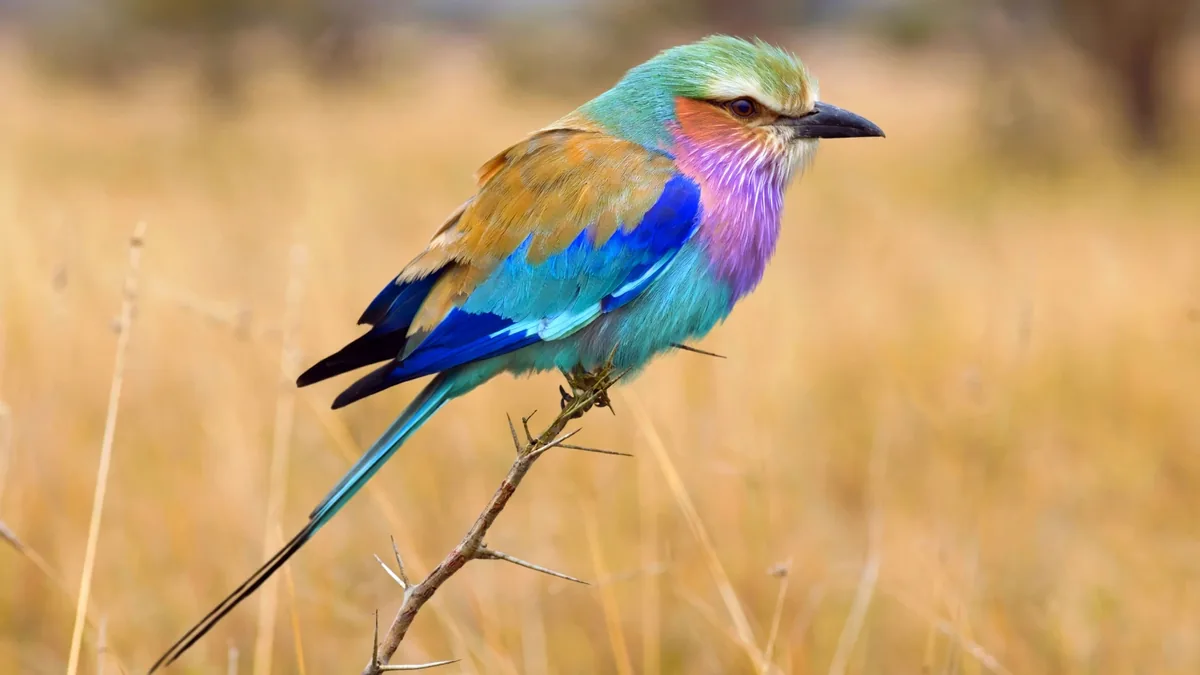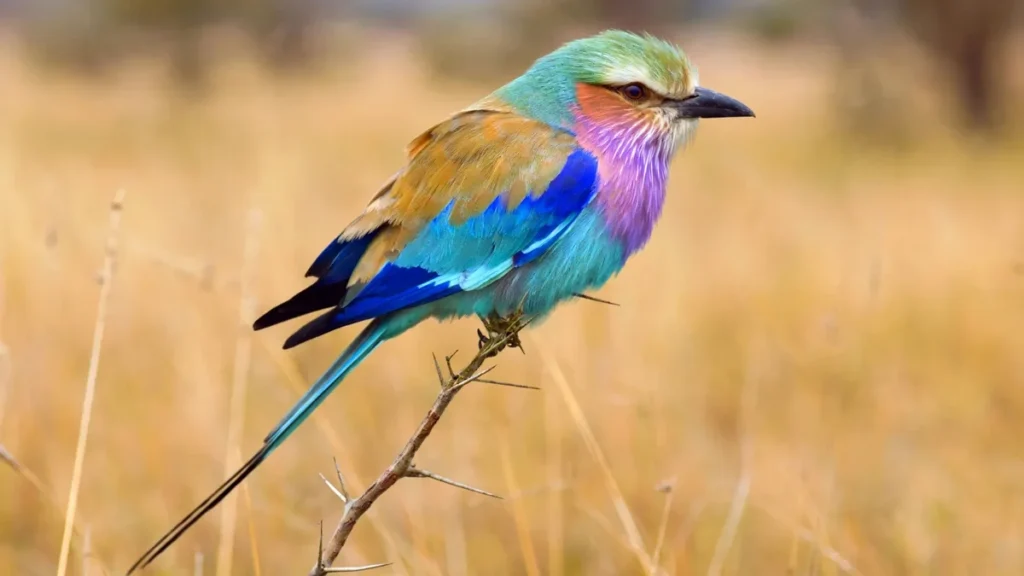
The lilac-breasted roller species is a single species, Coracias caudatus, one of the most colourful birds of Africa and the national bird of both Kenya and Botswana. If you are asking how many lilac-breasted roller species there are, the answer is one, and it is a jewel of the open savanna, whose lilac breast, turquoise wings and long tail streamers make it unmistakable.
The roller is named for its flight, not its colour. In the breeding season the male climbs high, then dives and rolls from side to side in a rocking, tumbling display, flashing his blue wings and calling harshly. It is one of the most watched displays in African birdwatching, performed from the same dead branch the bird uses as a hunting perch.
Key takeaways
- The lilac-breasted roller species is Coracias caudatus, a single species with two subspecies, and the national bird of Kenya and Botswana.
- Adults are 36 to 38 centimetres long including their tail streamers, with a wingspan of 50 to 58 centimetres and a weight of about 100 grams.
- Lilac-breasted rollers live in open savanna and woodland across eastern and southern Africa.
- They hunt from a perch, swooping to the ground for insects, lizards and small snakes, and nest in natural tree holes.
- The species is listed as Least Concern, with a large range and a population thought to be stable.
What makes a lilac-breasted roller a lilac-breasted roller
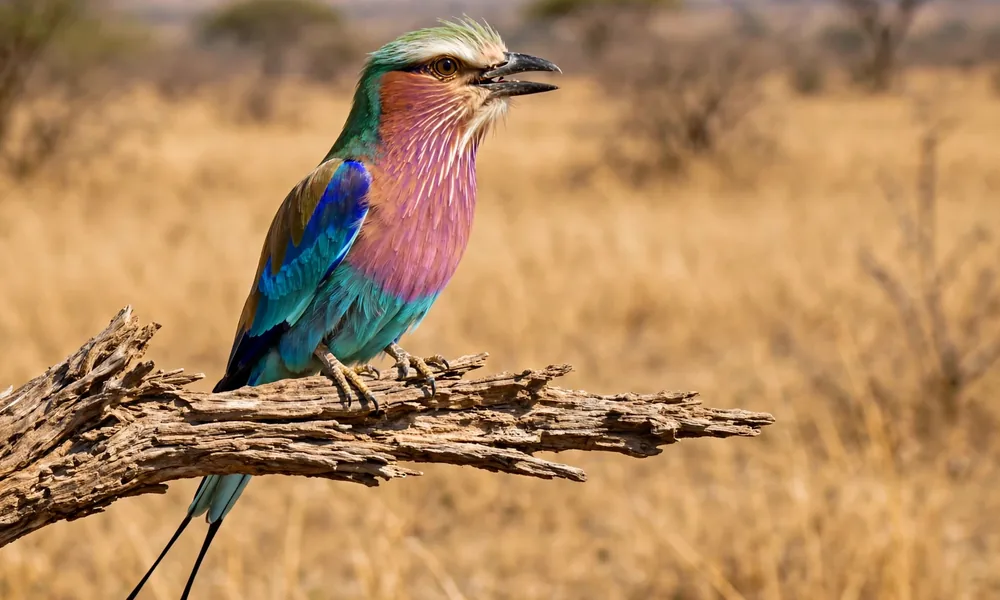
A lilac-breasted roller is a medium-sized bird that carries eight colours at once, and no other African bird looks quite like it. The breast is lilac, the crown and belly are turquoise, the head is green, the wings are deep blue with a paler blue band, and the long tail ends in two black streamers, 8 to 9 centimetres long, that trail behind in flight. The bill is stout and black, the eye is dark with a pale stripe above it, and the feet are syndactyl, with the second and third toes fused, a feature found in all rollers. Males and females look alike; young birds are duller.
Its flight is strong and direct, and its voice is a harsh, crow-like rak, rak, often given from the perch or in the display. The display itself is the bird’s signature: the male flies up steeply, then tips forward and dives, rolling from side to side and rocking on spread wings, sometimes calling all the way down, before pulling out and climbing again. It is this rolling flight that gave the whole family its name.
The lilac-breasted roller species and their relatives
The lilac-breasted roller belongs to Coracias, a genus of nine species in the family Coraciidae, the rollers, and it is one of the most widespread members of the genus. Two subspecies are recognised: the nominate race, C. c. caudatus, the bird of southern and eastern Africa, largely non-migratory, though it disperses after breeding into woodland and sandy country before returning at the start of the rains, and C. c. lorti, the lilac-throated roller, which lives in the Horn of Africa and migrates from north-east Kenya to north-west Somalia to breed from late April to mid-September.
The roller’s closest relatives are the other members of Coracias, such as the European roller, which visits Africa as a migrant, the Abyssinian roller of the Sahel belt and the Indian roller of Asia. Rollers sit in the order Coraciiformes, alongside the kingfishers and the bee-eaters, and the three groups share a stout bill, a perch-and-wait way of hunting and a taste for bright colour. No reliable global population total exists, and numbers are thought to be stable across most of its range.
| Type | Animal | Where it lives | Best-known food | Length or Weight |
|---|---|---|---|---|
| Genus | Rollers (genus Coracias) | Open woodland of Eurasia, Africa | Insects and small animals | About 30 to 38 cm long |
| Species | Lilac-breasted roller (Coracias caudatus) | Eastern and southern Africa | Grasshoppers, beetles and lizards | About 36 to 38 cm long |
| Species | European roller (Coracias garrulus) | Europe, west Asia, Africa | Insects and small vertebrates | About 29 to 32 cm long |
| Species | Abyssinian roller (Coracias abyssinicus) | Sahel belt of Africa | Insects and small lizards | About 28 to 30 cm long |
| Species | Indian roller (Coracias benghalensis) | South and South-East Asia | Insects, frogs and lizards | About 30 to 34 cm long |
| Species | Broad-billed roller (Eurystomus glaucurus) | Forests of sub-Saharan Africa | Flying insects | About 29 to 30 cm long |
How lilac-breasted rollers live
Lilac-breasted rollers are carnivores, and they hunt from a perch, sitting conspicuously at the top of a tree, a pole or a wire and scanning the ground below. When prey is spotted, the bird swoops down, snatches it in the bill and carries it back to the perch to eat. Grasshoppers and beetles dominate the diet, but spiders, scorpions, centipedes and millipedes are taken too, along with lizards, frogs, small snakes, small birds and rodents. They also follow grass fires for the insects fleeing the flames.
Rollers are monogamous, believed to mate for life, and the pair defends a large territory together. The male’s rolling display is part of courtship, and the pair nests in a natural hole in a tree, sometimes one hollowed out by a woodpecker, laying two to four eggs that both parents incubate for about 22 to 24 days. They are fiercely protective of the nest, diving at raptors, crows and even people who come too close, and the young leave the nest a few weeks after hatching.
They are birds of the day, usually seen alone or in pairs, and they spend much of their time on the same favourite perches, returning again and again between hunting flights. Like the kingfisher, they hunt by waiting and watching, though their prey is on dry ground rather than in water. Their loud, cackling call carries far across the savanna, and it is often the first sign of a roller nearby.
Where lilac-breasted rollers live
Lilac-breasted rollers live across a wide sweep of eastern and southern Africa, from the Red Sea coast of Eritrea through Ethiopia, Kenya, Tanzania, Zambia, Malawi and Zimbabwe to Namibia, Botswana and north-eastern South Africa, and they are vagrants to the southern Arabian Peninsula. They are most abundant in Kenya, and in Namibia they occur everywhere except the Namib Desert, too dry and treeless for them.
A lilac-breasted roller needs two things above all: open country in which to hunt, and scattered trees or high perches from which to watch it. Those needs are met in open savanna, thornveld, grassland and open woodland, and they may enter sub-desert steppe or open grassland wherever a perch is available. They live from sea level up to about 2,000 metres, avoiding dense forest and true desert, though in protected areas they are often seen along road verges.
The lilac-breasted roller is listed as Least Concern on the IUCN Red List, with a very large range and a population thought to be stable. No major threats face the species at present, though local numbers can fall where large cavity-bearing trees are felled or open woodland is heavily transformed, since the birds need holes for nesting and perches for hunting.
Best seasons for lilac-breasted roller watching
The best time to look for lilac-breasted rollers in southern Africa is the dry season, roughly May to September, when the grass is short and the birds perch in the open. The rolling display is at its best in the breeding season, in the southern spring, when males perform again and again above their territory, and early morning is the finest time of day, when the birds are hunting hard.
Staying safe around lilac-breasted rollers
A lilac-breasted roller is a harmless bird to people, and it would rather fly to another perch than meet a person. Watch from a distance with binoculars, and never approach a nest hole, because a breeding pair will dive at an intruder and may abandon a nest that is visited too often. Keep to the roads and paths of the reserves you visit, and do not climb nest trees or cut branches near a nest.
If a roller dives at you, it is a warning that you are too close to a nest, so back away calmly and give the pair room. Stay on marked paths in farmland and on reserve roads, ask before crossing private land, and never handle a lilac-breasted roller, which is protected by law across much of its range, including Kenya and Botswana, where it is the national bird.
Lilac-breasted roller watching checklist
A little preparation turns a drive through open savanna into a real chance of seeing Africa’s most colourful bird.
- A dry-season visit to open savanna or woodland with scattered trees, where perches are plentiful and the birds are easiest to spot.
- An early morning start, when lilac-breasted rollers hunt hard and the light catches their colours.
- Binoculars, because a roller on a distant branch is easy to miss until its colours catch the sun.
- A watch on bare branches, fence posts and wires, where the birds sit to scan the ground for prey.
- Patience near a hunting perch, since a roller will often return to the same branch again and again.
- A camera with a zoom lens, for close views of the colours and the display without approaching a nest.
- Respect for nest holes and breeding pairs, because a disturbed pair may abandon its eggs.
Frequently asked questions
How many lilac-breasted roller species are there?
There is one lilac-breasted roller species, Coracias caudatus, and it has two subspecies: the nominate C. c. caudatus of southern and eastern Africa and C. c. lorti, the lilac-throated roller, of the Horn of Africa. The two differ slightly in the colour of the throat, but they are one species.
Why is it called a roller?
The name comes from the bird’s display flight, in which the male climbs high, then dives and rolls from side to side, rocking on spread wings. The whole family is named for this tumbling, rolling flight, and the lilac-breasted roller performs it more boldly than most of its relatives.
What does a lilac-breasted roller eat?
A lilac-breasted roller eats mostly insects, above all grasshoppers and beetles, along with spiders, scorpions, centipedes and millipedes. It also takes lizards, frogs, small snakes, small birds and rodents, swooping from a perch to snatch prey from the ground and carrying it back to the branch to eat.
Is the lilac-breasted roller a national bird?
Yes, twice over. The lilac-breasted roller is the national bird of Kenya and of Botswana, two of the countries where it is most abundant.
How is this guide different from the kori bustard guide?
This guide covers the lilac-breasted roller, a small, jewel-coloured bird of the African savanna that perches high, hunts insects from a branch and rolls in display flight, while our kori bustard species guide covers the kori bustard, a huge, ground-living bird that walks the grassland and is one of the heaviest flying birds in the world. One is a 100-gram flash of colour; the other can weigh 18 kilograms.
Are lilac-breasted rollers endangered?
No, not in the strict sense. The lilac-breasted roller is listed as Least Concern on the IUCN Red List, with a very large range and a population thought to be stable. Local numbers can fall where large cavity-bearing trees are felled or open woodland is heavily transformed, but the species as a whole is not threatened.
Conclusion
The lilac-breasted roller species needs no introduction once you have seen it: one species, Coracias caudatus, a flash of lilac, turquoise and blue over the African savanna, and the national bird of two countries.
If you go looking for one, go in the dry season, go early, and watch the bare branches and wires along the road. Find a lilac-breasted roller on its perch in the morning sun, and you will see why it is called the most beautiful bird in Africa.