The jabiru species is a single species, Jabiru mycteria, a giant stork that stands taller than most people and is the tallest flying bird in the Americas. If you are asking how many jabiru species there are, the answer is one, and it is the only living member of its genus.
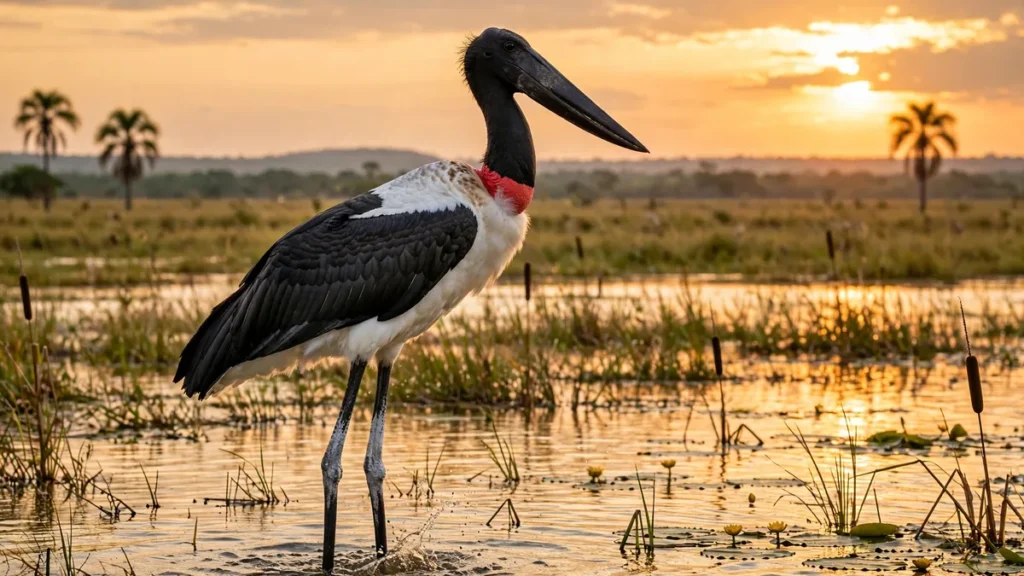
The jabiru is a bird you do not forget once you have seen it: white head and body, black wings and tail, a bright red band across the neck, and a huge black bill, up to 35 centimetres long. It stands in the shallows of the Pantanal with its bill held open to the water, waiting for a fish to swim into its mouth.
Key takeaways
- There is one jabiru species, Jabiru mycteria, the only living member of its genus and the tallest flying bird in the Americas.
- Adults stand 120 to 140 centimetres tall, with a wingspan of 2.3 to 2.8 metres, a huge black bill up to 35 centimetres long and a red neck band.
- Jabirus live in the wetlands of Central and South America, from Mexico to Argentina, and are most common in the Pantanal of Brazil.
- Their diet is mostly fish, frogs, snakes, snails and insects, caught by wading in shallow water with the bill held open.
- The species is listed as Least Concern, with an estimated 10,000 to 25,000 birds, though it is nowhere abundant.
What makes a jabiru a jabiru
A jabiru is a huge stork, white on the head, neck and body, with black wings, a black tail and black legs, and a band of bare red skin across the lower neck. The bill is black, broad and slightly upturned, ending in a sharp point, and it is one of the largest bills of any bird: 25 to 35 centimetres long, heavy and chisel-like, built for seizing fish and frogs. The head is white and featherless, and the legs are long and black, made for wading.
Adults are 120 to 140 centimetres long and weigh 4.3 to 9 kilograms, and the sexes differ more than in any other stork: males are about 25 per cent larger than females, and a large male can stand as tall as 1.53 metres. The folded wing measures 58.5 to 73 centimetres, and the lower leg 28.5 to 39 centimetres. The species belongs to the stork family, Ciconiidae.
The jabiru species and their relatives
The jabiru belongs to Jabiru, a genus with a single living species, and its name comes from the Tupi-Guarani language of Brazil, where jabiru means a swollen neck. It is one of only three storks found in the Americas, alongside the wood stork and the maguari stork, and it is by far the largest of the three. Its closest relatives are the other great storks of the world: the saddle-billed stork of Africa, the black-necked stork of Asia and Australia, and the marabou of Africa.
All of these great storks share the same plan: a huge bill, long legs, a heavy body and a taste for fish, frogs and carrion in warm wetlands. The jabiru stands out for its height, its red neck band, and its enormous nest, a platform of sticks used again and again for years, growing bigger with every season.

| Type | Animal | Where it lives | Best-known food | Length or Weight |
|---|---|---|---|---|
| Genus | Jabiru (genus Jabiru) | Wetlands of the Americas | Fish, frogs | About 120 to 140 cm tall |
| Species | Jabiru (Jabiru mycteria) | Mexico to Argentina | Fish, frogs, carrion | About 120 to 140 cm, 4.3 to 9 kg |
| Species | Wood stork (Mycteria americana) | USA to Argentina | Fish, frogs, crayfish | About 85 to 115 cm, 2 to 3 kg |
| Species | White stork (Ciconia ciconia) | Europe, Africa, western Asia | Frogs, insects, small mammals | About 100 to 115 cm, 2.3 to 4.4 kg |
| Species | Marabou stork (Leptoptilos crumenifer) | Sub-Saharan Africa | Carrion, fish, small animals | About 120 to 130 cm, 4.5 to 8 kg |
How jabirus live
Jabirus eat mostly fish, frogs, snakes, snails, insects and other invertebrates, and they will also take small mammals, fresh carrion and dead fish. They feed by wading slowly through shallow water, holding the great bill open at about 45 degrees to the surface, and they detect prey more by touch than by sight: when a fish brushes the inside of the bill, it snaps shut. Fish of 8 to 20 centimetres are the usual catch, though birds have taken fish of 500 grams and eels up to 80 centimetres long.
Jabirus feed by day, often alone or in pairs but sometimes in large groups where the fishing is good. They are strong fliers, soaring on thermals, and they are not truly migratory, though they wander widely through the year, and a few have turned up as far north as Texas in the United States. Pairs stay together for life, often seen together even outside the breeding season, which is unusual among storks.
Breeding takes place in the dry season, when falling water levels concentrate fish in the shrinking pools. The nest is a huge platform of sticks built high in a tall tree, 15 to 30 metres above the ground, and it is enlarged at every succeeding season, growing to a metre wide and 1.8 metres deep. Both parents build, incubate and feed the young, the clutch is usually two to five eggs, and the chicks fledge at roughly 100 to 110 days old. Jabirus live for about 30 years in the wild.
Where jabirus live
Jabirus live in the wetlands of the Americas, from Mexico through Central America and across much of South America to Argentina, everywhere except west of the Andes, where the mountains bar the way. They are most common in the Pantanal, the vast seasonally flooded plain of Brazil, Bolivia and Paraguay, and in the Eastern Chaco of Paraguay, and they are also found in the Llanos of Venezuela and Colombia and the marshes of Belize. They prefer open wetlands: flooded savannas, freshwater marshes, shallow rivers and ponds, always with tall trees nearby for nesting.
The species is listed as Least Concern on the IUCN Red List, because it has a very large range and shows no evidence of an overall decline. The population is estimated at 10,000 to 25,000 birds, with roughly 6,700 to 17,000 adults, but the jabiru is nowhere abundant: it is widespread and thinly spread, with densities of only 0.05 to 0.16 birds per square kilometre recorded in Nicaragua and Honduras. Its greatest threats are the draining and disturbance of wetlands and nesting sites, and it was once hunted for meat and feathers before it was protected: Belize gave it full protection in 1973, and it is listed on CITES Appendix I, which bans international commercial trade.
Like the flamingo, another tall wading bird of shallow lagoons, the jabiru depends on wetlands that still flood and drain with the seasons. Where the water rises and falls naturally, fish concentrate in the pools as the dry season advances, and the jabiru can feed and raise its young. Where wetlands are drained for farming, the bird simply moves on, and there are fewer places left to go.
Best seasons for jabiru watching
The best time to look for jabirus is the dry season, roughly June to September in the Pantanal, when the floodwaters fall, the fish are concentrated in the remaining pools, and the great storks gather to feed. The Transpantaneira road in Brazil, which runs for more than 100 kilometres across the Pantanal, is one of the best places in the world to see them, and the birds are often standing in the roadside pools within a few metres of the track. In Belize, Crooked Tree Wildlife Sanctuary is the classic site, with jabirus seen there from December to May.
Staying safe around jabirus
A jabiru is a large, powerful bird with a bill that can be 35 centimetres long and sharp enough to seize a snake, so it should always be watched from a distance and never approached, fed or cornered. Adults will defend their nests fiercely, so keep well away from nesting trees and never climb towards one. Watch from a vehicle or a hide, and use binoculars.
If you meet a jabiru on foot, stop and give it room, moving slowly so it can walk or fly away. Never try to handle a chick or a bird that looks injured: tell the reserve wardens instead. Keep dogs on a lead near wetlands, and never wade into deep water in jabiru country, where caimans share the same pools.
Jabiru watching checklist
A little preparation turns a drive across the Pantanal into a real chance of seeing the tallest flying bird in the Americas at close quarters.
- A dry-season trip to the Pantanal, roughly June to September, when the floodwaters fall.
- A drive along the Transpantaneira road in Brazil, where jabirus feed in roadside pools within metres of the track.
- Binoculars, because the birds are often spotted far out in the marsh before they come closer.
- An early start, since jabirus feed in the morning and soar as the day warms up.
- Light, long-sleeved clothing, a hat and insect repellent, for sun and mosquitoes.
- A camera with a zoom lens, for close views of the red neck band and huge black bill.
- Respect for the wetlands and their wardens, because a nesting tree disturbed is a season lost.
Frequently asked questions
How many jabiru species are there?
There is one jabiru species, Jabiru mycteria, the only living member of the genus Jabiru and one of only three storks found in the Americas, alongside the wood stork and the maguari stork.
Why is it called a jabiru?
The name jabiru comes from the Tupi-Guarani language of Brazil, where it means a swollen neck, a nod to the bird’s thick neck and the red band across it.
What does a jabiru eat?
A jabiru eats mostly fish, frogs, snakes, snails and insects, and will also take small mammals, fresh carrion and dead fish. It hunts by wading through shallow water with its bill held open, snapping shut when a fish brushes the inside of the bill.
How big is a jabiru?
A jabiru is the tallest flying bird in the Americas, standing 120 to 140 centimetres tall, with a wingspan of 2.3 to 2.8 metres and a weight of 4.3 to 9 kilograms. Males are about 25 per cent larger than females.
How is this guide different from the Humboldt penguin guide?
This guide covers the jabiru, a giant stork of the warm wetlands of the Americas that wades for fish and nests in tall trees, while our Humboldt penguin species guide covers the Humboldt penguin, a flightless seabird of the cold Pacific coast that swims after anchovies and nests in burrows.
Are jabirus endangered?
No. The jabiru is listed as Least Concern on the IUCN Red List, with an estimated population of 10,000 to 25,000 birds and no evidence of an overall decline. It is protected by law across much of its range and listed on CITES Appendix I, which bans international commercial trade, but wetland loss remains its main threat.
Conclusion
The jabiru species is a bird of the great wetlands: one species, Jabiru mycteria, the tallest flying bird in the Americas, wading the shallows of the Pantanal with a bill like a chisel and a nest like a platform in the sky.
If you go looking for one, go in the dry season, drive the Transpantaneira at dawn, and watch the roadside pools for a jabiru standing in the shallows, red neck band bright in the morning light.