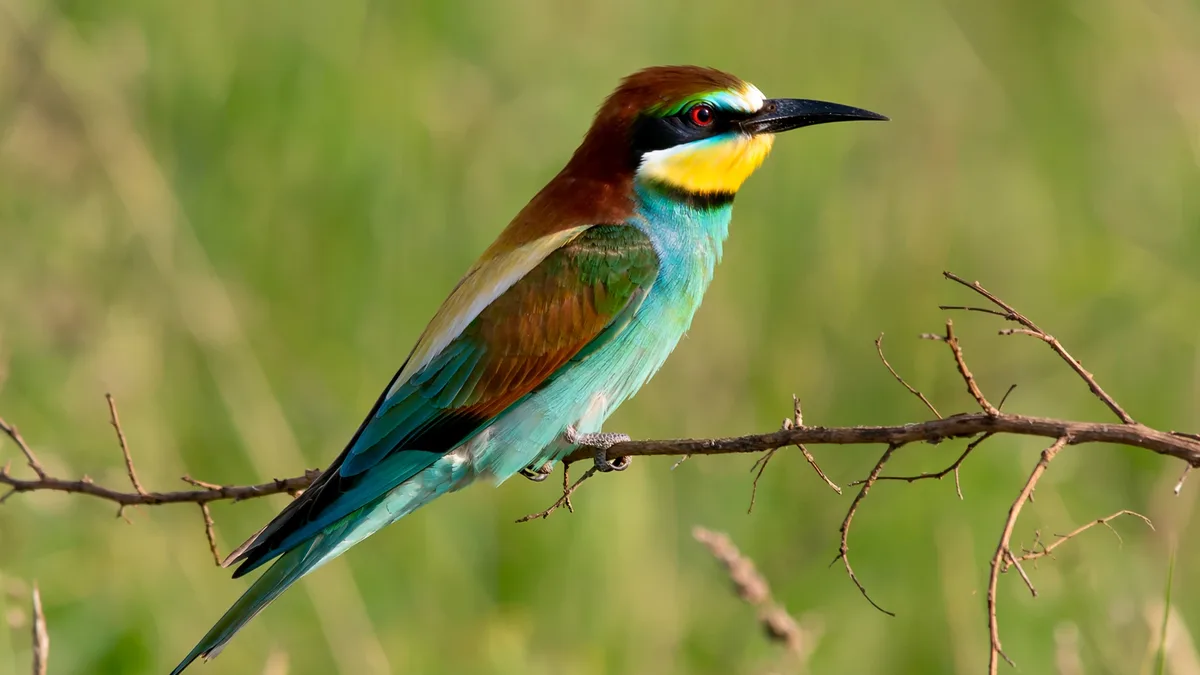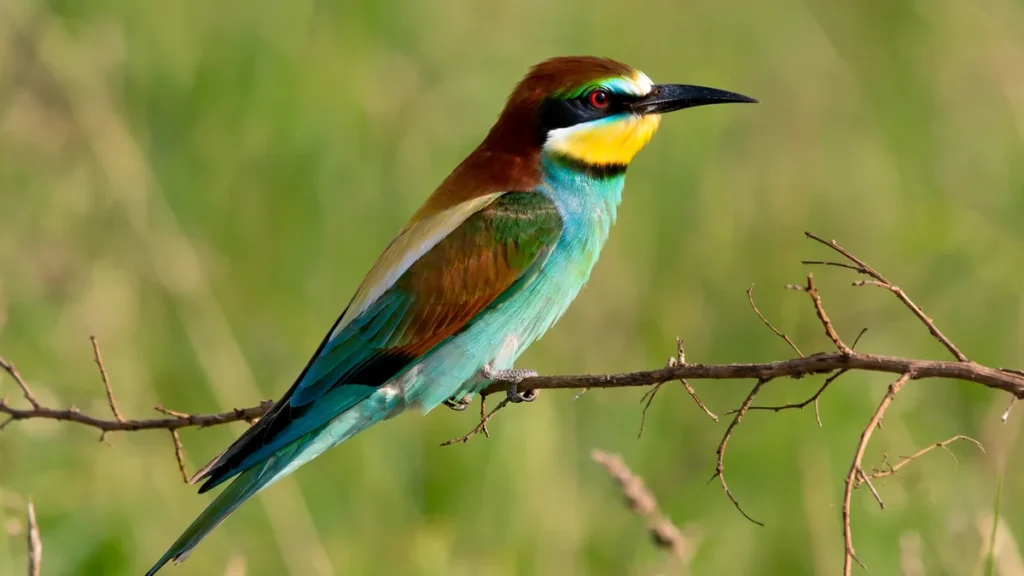
The bee-eater species number about 31, a family of brightly coloured birds called the Meropidae, and they are some of the most vivid birds in the world, with green, blue, yellow and chestnut plumage and a long, slightly curved bill built for snatching bees and wasps out of the air. If you are asking how many bee-eater species there are, the answer is about 31: there are about 31 recognised bee-eater species in the family Meropidae, spread across Africa, Asia, southern Europe and Australia.
A bee-eater is an aerial hunter that spends its days on a perch, watching the sky, then darting out to catch a flying insect and returning to the same branch to eat it. Bee-eaters nest in burrows dug into sandy banks and cliffs, often in noisy colonies, and they are famous for the neat trick they use on stinging prey, beating a bee against a branch and rubbing off its sting before swallowing it.
Key takeaways
- There are about 31 bee-eater species in the family Meropidae, in three genera.
- Bee-eaters catch bees, wasps and other flying insects on the wing, then rub off the sting before eating them.
- Most bee-eaters are between 15 and 30 centimetres long, with the European bee-eater measuring about 27 to 29 centimetres.
- Bee-eaters nest in burrows dug into sandy banks, cliffs or flat ground, often in colonies.
- Most bee-eater species are listed as Least Concern, though the blue-moustached bee-eater is Near Threatened.
What makes a bee-eater a bee-eater
A bee-eater is a slim, brightly coloured bird with a long, slightly downcurved black bill, a black band through the eye, pointed wings, and a long tail that often ends in two thin streamers. Most bee-eaters are between 15 and 30 centimetres long, and their colours are among the boldest of any bird family: the European bee-eater wears chestnut, yellow and turquoise, the southern carmine bee-eater is a deep rosy red, and the rainbow bee-eater of Australia mixes green, blue and chestnut. The sexes look alike in most species.
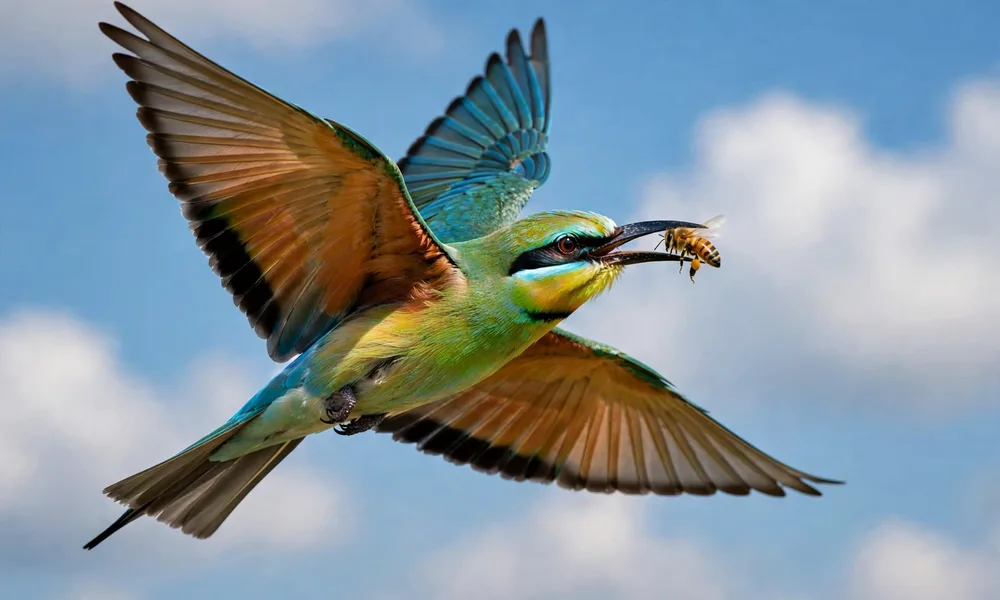
The bill is the tool that defines the family. A bee-eater uses its long bill like a pair of tweezers, snapping a bee or wasp out of the air, then returning to a perch to deal with the sting. Like other barn swallows, which also hunt insects on the wing, a bee-eater is a master of the air, but it hunts from a lookout perch rather than feeding endlessly in flight.
The bee-eater species and their relatives
There are about 31 bee-eater species. They belong to the family Meropidae, which holds three genera: Nyctyornis, the two bearded bee-eaters of Asian forests; Meropogon, the single purple-bearded bee-eater of Sulawesi; and Merops, the large genus that holds all the rest, from the European bee-eater to the little bee-eater. About 20 of the 31 species live in Africa, several more live only in Asia, and one, the rainbow bee-eater, lives in Australia.
The best-known members of the family are the European bee-eater, which breeds across southern Europe and winters in Africa; the southern carmine bee-eater, which nests in huge colonies in the riverbanks of southern Africa; the rainbow bee-eater, the only bee-eater in Australia; the little bee-eater, the smallest of the family at about 15 to 17 centimetres; the white-fronted bee-eater of African rivers; and the green bee-eater of Asia. The blue-cheeked bee-eater is another wide-ranging member, breeding from North Africa to Central Asia.
| Type | Animal | Where it lives | Best-known food | Length or Weight |
|---|---|---|---|---|
| Family | Bee-eaters (family Meropidae) | Africa, Asia, southern Europe and Australia | Bees, wasps and flying insects | About 15 to 30 cm long |
| Species | European bee-eater (Merops apiaster) | Southern Europe, winters in Africa | Bees, wasps and dragonflies | About 27 to 29 cm long |
| Species | Southern carmine bee-eater (Merops nubicoides) | Southern and East Africa | Bees, wasps and grasshoppers | About 24 to 27 cm long |
| Species | Rainbow bee-eater (Merops ornatus) | Australia and New Guinea | Bees, wasps and flying insects | About 23 to 28 cm long |
| Species | Little bee-eater (Merops pusillus) | Sub-Saharan Africa | Bees, wasps and small insects | About 15 to 17 cm long |
| Species | White-fronted bee-eater (Merops bullockoides) | Sub-Saharan Africa | Bees, wasps and flying insects | About 23 cm long |
| Species | Green bee-eater (Merops orientalis) | South and Southeast Asia | Bees, wasps and flying insects | About 16 to 18 cm long |
How bee-eaters live
Bee-eaters are birds of open country and sunny days. A bee-eater spends much of the day on an exposed perch, a bare branch, a wire or a fence post, watching for flying insects, and when it spots one it launches into the air, twists and turns after its prey, and snaps it up in its bill before gliding back to the same perch. Like other blue jays, which are bold and noisy, bee-eaters are social birds, and many species feed, roost and nest together in loose groups.
Bees and wasps make up much of the diet, along with dragonflies, beetles, butterflies and grasshoppers, and a bee-eater handles a stinging insect with care, beating it against the perch and rubbing it back and forth to squeeze out the venom and remove the sting before swallowing it head first. A bee-eater can eat hundreds of insects in a single day, and beekeepers sometimes grumble, though a colony takes only a tiny share of the bees in a district.
Breeding is a busy, noisy season, and the pair digs a nesting burrow into a sandy bank, a cliff face, a quarry wall or even flat ground, tunnelling a metre or more into the earth with bill and feet. The female lays four to six round white eggs in a bare chamber at the end of the tunnel, and both parents share the incubation for about three weeks. The chicks are fed by both parents, and in several species grown young from an earlier brood stay on as helpers, bringing food to the nest. Most bee-eaters live only a few years in the wild.
Where bee-eaters live
Bee-eaters live across the warm parts of the Old World and Australia, from the meadows and river valleys of southern Europe through the savannas of Africa to the forests and farmland of Asia and the open country of Australia. They are birds of open ground with scattered trees and bare perches, and they need sandy banks or cliffs nearby for their burrows, so they are commonest near rivers, quarries, road cuttings and eroded banks.
Africa holds the most bee-eaters, with about 20 of the 31 species living there, and the savannas of East and southern Africa are the richest place in the world to see them, with several species sharing the same river valley. Asia holds the green bee-eater, the blue-tailed bee-eater and the bearded bee-eaters of the forests, while Australia has a single species, the rainbow bee-eater, which breeds in burrows dug into sandy ground across the continent.
Many bee-eaters are migrants. The European bee-eater breeds across southern Europe and North Africa in the summer and flies south to sub-Saharan Africa for the winter, crossing the Mediterranean and the Sahara in flocks, and the rainbow bee-eater moves north in the Australian winter. Most bee-eater species are listed as Least Concern, though the blue-moustached bee-eater of Borneo is listed as Near Threatened, and some populations fall when riverbanks are levelled or quarries are filled in.
Best seasons for bee-eater watching
The best time to look for bee-eaters is the breeding season, when the birds are at their brightest and noisiest around their nesting colonies. In southern Europe that means May to July, when European bee-eaters are feeding young at their burrows, and in southern Africa the best months are often September to December, when the carmine bee-eaters gather at riverbanks in their thousands. On a warm, still morning the birds hunt busily from their perches, and a colony at a sandy bank is the surest place.
Staying safe around bee-eaters
A bee-eater is a wild bird with a sharp bill, but it is not dangerous to people, and it almost never comes close enough to cause trouble. Keep your distance from nesting banks, never put a hand into a burrow, and never stand in front of a colony for long, because a bee-eater that is disturbed may leave its nest and its eggs may chill. If you watch bee-eaters at a riverbank, stay on the far side and let them come to you.
Bee-eater watching checklist
A little preparation turns a visit to a sunny river valley into a real chance of seeing a bee-eater, so pack for sun, dust and long quiet hours.
- Sun protection and a hat, for standing in open country in the heat of the day.
- Binoculars, because bee-eaters hunt from perches and are best watched from a distance.
- A camera with a zoom lens, for the bright colours and the hunting flights without getting close.
- A visit to a sandy riverbank or quarry, where the nesting colonies dig their burrows.
- A plan to be out in the morning, when the birds are most active and the insects are flying.
- Patience and silence, because bee-eaters are shy birds and a noisy group will send them away.
- A field guide to birds, for telling a European bee-eater from a blue-cheeked bee-eater at a glance.
Frequently asked questions
How many bee-eater species are there?
There are about 31 bee-eater species in the family Meropidae, in three genera. About 20 of them live in Africa, several more live only in Asia, and one, the rainbow bee-eater, lives in Australia.
Do bee-eaters really eat bees?
Yes. Bee-eaters catch bees and wasps on the wing, along with dragonflies, beetles and other flying insects. Before swallowing a bee, a bee-eater beats it against a perch and rubs it back and forth to remove the sting and squeeze out the venom.
Where do bee-eaters nest?
Bee-eaters nest in burrows dug into sandy banks, cliffs, quarry walls or flat ground. The pair digs a tunnel a metre or more long, and the female lays four to six white eggs in a bare chamber at the end of it.
Do bee-eaters migrate?
Many do. The European bee-eater breeds in southern Europe and flies south to sub-Saharan Africa for the winter, crossing the Mediterranean and the Sahara, and the rainbow bee-eater moves north in the Australian winter. Some African species stay in one place all year.
How is this guide different from the alligator gar species guide?
This guide covers the bee-eater family, about 31 colourful birds that hunt bees and wasps on the wing and nest in burrows in sandy banks, while our alligator gar species guide covers the alligator gar, a huge freshwater fish that lives in the rivers of North America and eats fish and crustaceans. Bee-eaters fly through sunny meadows and river valleys, and the alligator gar swims in slow, warm rivers.
Are bee-eaters endangered?
Most are not. Most bee-eater species are listed as Least Concern, because they are widespread and common, though the blue-moustached bee-eater of Borneo is listed as Near Threatened. Colonies can suffer when nesting banks are levelled or quarries are filled in.
Conclusion
The bee-eater species show how much colour and skill one bird family can hold: about 31 species of aerial hunters, with jewel-bright plumage, a neat trick for disarming bees, and a life spent between a sunny perch and a burrow in a sandy bank.
If you go looking for one, go to a river valley in the breeding season, go quietly, and go with patience. Watch a bee-eater dart out from its perch, snap a bee from the air and rub off the sting, and you will understand why it has earned its place as one of the most loved birds of the warm world, and why keeping its riverbanks standing matters most.