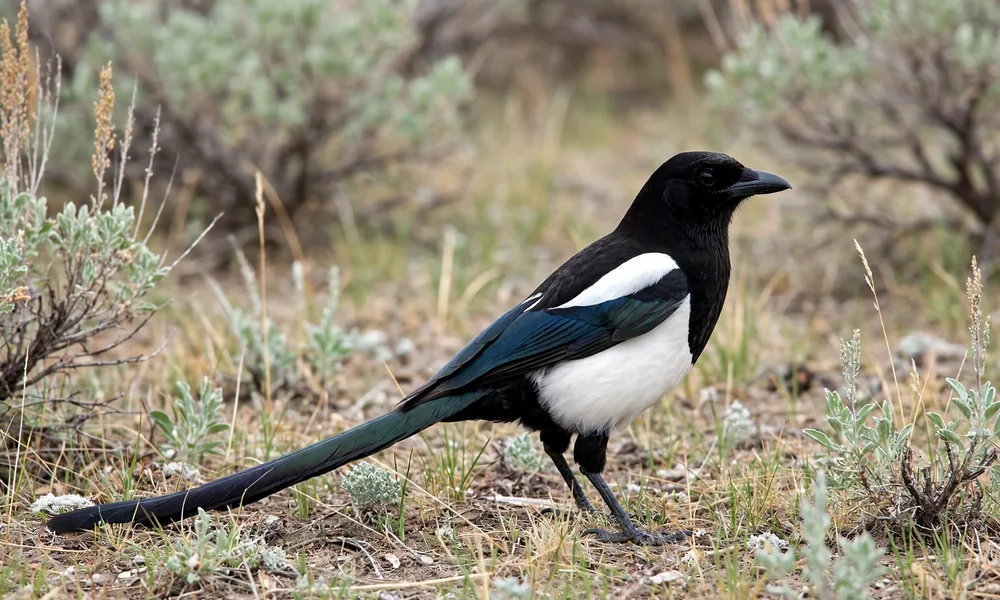
The black-billed magpie species number one, a single species called Pica hudsonia, also known as the American magpie, and it is a long-tailed black-and-white corvid of western North America, with a black bill, a white belly and shoulders, and a tail almost as long as its body. If you are asking how many black-billed magpie species there are, the answer is one: there is one recognised black-billed magpie species in the world, and every black-billed magpie alive today belongs to it.
The black-billed magpie lives in the meadows, grasslands and sagebrush plains of the West, where it walks and hops on the ground, follows cattle and wolves for food, and builds one of the few domed nests of any North American bird. It is a noisy, clever bird, familiar on fence posts and in barnyards across the Rocky Mountains and the northern plains.
Key takeaways
- There is one black-billed magpie species, Pica hudsonia, also called the American magpie.
- Black-billed magpies measure 45 to 60 centimetres long, weigh 145 to 210 grammes, and have a wingspan of 56 to 61 centimetres.
- Black-billed magpies eat insects, fruit, grain, small mammals, eggs and carrion, and they pick ticks off cattle.
- Black-billed magpies build large domed nests of sticks, usually near the top of a tree, with 6 to 7 eggs inside.
- Black-billed magpies are listed as Least Concern, though their numbers have fallen by about 38 percent since 1966.
What makes a black-billed magpie a black-billed magpie
A black-billed magpie is a mid-sized corvid with a black head, neck and back, a white belly and shoulders, and wings and a tail that shine with green and blue iridescence in the sun. It measures 45 to 60 centimetres from bill to tail, and about half of that length is the long tail itself, which trails behind the bird in flight and gives it away at a glance. Its wingspan is 56 to 61 centimetres, and it weighs 145 to 210 grammes.
The black bill is the mark that sets it apart from its closest relative, the yellow-billed magpie of California, which has a yellow bill and a shorter tail. Like other blue jays, which are also clever and noisy corvids, the black-billed magpie is a bold bird, but it is longer-tailed and more black-and-white than any jay, and it walks on the ground far more than most relatives do.
The black-billed magpie species and their relatives
There is one black-billed magpie species. It belongs to the genus Pica, the magpies, and to the corvid family, the crows, jays and ravens, and it shares that genus with the yellow-billed magpie of California and the Eurasian magpie of Europe and Asia. The black-billed magpie is the only magpie that lives across the whole of western North America, from Alaska to New Mexico.
The yellow-billed magpie is its closest relative, a bird of central California with a yellow bill and a yellow patch behind the eye, while the Eurasian magpie is the Old World magpie of European parks and gardens. The American crow is a plain black corvid that shares the magpie’s fields and towns, the common raven is a much larger black corvid of the mountains and deserts, and Clark’s nutcracker is a grey corvid of the high pine forests that, like the magpie, caches food for the winter.
| Type | Animal | Where it lives | Best-known food | Length or Weight |
|---|---|---|---|---|
| Species | Black-billed magpie (Pica hudsonia) | Western North America | Insects, fruit, grain and carrion | About 45 to 60 cm long, 145 to 210 g |
| Close relative | Yellow-billed magpie (Pica nuttalli) | Central California | Insects, fruit and carrion | About 43 to 54 cm long |
| Close relative | Eurasian magpie (Pica pica) | Europe and Asia | Insects, fruit, eggs and carrion | About 44 to 48 cm long |
| Close relative | American crow (Corvus brachyrhynchos) | North America | Insects, grain, eggs and carrion | About 40 to 50 cm long |
| Close relative | Blue jay (Cyanocitta cristata) | Eastern and central North America | Nuts, seeds, insects and eggs | About 22 to 30 cm long |
| Close relative | Common raven (Corvus corax) | Northern hemisphere | Carrion, insects and small animals | About 54 to 67 cm long |
| Close relative | Clark’s nutcracker (Nucifraga columbiana) | Western North American mountains | Pine seeds and insects | About 27 to 30 cm long |
How black-billed magpies live
Black-billed magpies are birds of open country and company. A black-billed magpie lives in loose flocks that gather at roosts, feeding grounds and carrion, and the birds keep up a stream of harsh chattering calls as the flock moves. Like other American robins, which also forage on lawns and fields, the magpie spends much of its day on the ground, walking and hopping with its long tail cocked up behind it, but it will stand its ground against crows and squirrels that threaten its nest.
Grasshoppers, beetles, wild fruit and grain make up much of the diet, along with small mammals such as squirrels and voles, the eggs and young of other birds, and carrion, and a black-billed magpie eats by probing the soil for worms and insects, flipping cow dung to find beetles underneath, and picking ticks off the backs of cattle and moose. It also follows wolves and coyotes to scavenge from their kills, and it caches food in small pits dug into the soil for the hard winter months.
Breeding is a long and careful season, and the pair builds a large domed nest of sticks near the top of a tree, a shrub or even a utility pole, with a mud cup inside lined with grass. The male gathers the sticks for the outside and the female builds the cup, and the two work together for five to seven weeks to finish a nest typically about 76 centimetres high and 51 centimetres wide. The female lays 6 to 7 eggs, and she alone sits on them for 16 to 21 days, while the male brings her food, and the chicks stay in the nest for three to four weeks. Black-billed magpies in the wild live for about six to seven years.
Where black-billed magpies live
The black-billed magpie lives in western North America, from coastal southern Alaska and the Yukon through the prairies of Canada and down the Rocky Mountains to New Mexico, northern Arizona and western Texas. It is a non-migratory bird, staying in the same country all year, and its range stops where the summers grow too hot and humid, which is why it is absent from California west of the Cascades and Sierra Nevada, where the yellow-billed magpie takes its place.
Open country with clumps of trees is the key requirement. A black-billed magpie needs meadows, grasslands and sagebrush plains with thickets along streams for nesting, and open ground for feeding, so it returns to the same thickets and farm fields year after year, and it is equally at home in suburbs, barnyards and around grain elevators. In winter the birds gather near feedlots, landfills and barns.
Black-billed magpies are listed as Least Concern, because they are still widespread and common, though their numbers have fallen by about 38 percent between 1966 and 2019. The main pressures are the loss of riparian thickets, the clearing of sagebrush, and the poisons used against ground squirrels and other pests, which can kill the magpies that eat them.
Best seasons for black-billed magpie watching
There is no closed season, because black-billed magpies are active all year, but the best time to look for them depends on what you want to see. The best months are often April to June, when breeding is at its peak and the pairs are busy building their domed nests and feeding chicks. In winter the birds gather in noisy flocks at roosts and around barnyards, and a cold morning in a meadow with cattle is a sure place to find them.
Staying safe around black-billed magpies
A black-billed magpie is a wild bird with a strong bill, and it can give a painful peck to a person who comes too close to its nest, though black-billed magpies almost never attack people. Keep your distance, never touch a magpie, and never walk through a nesting thicket, because a magpie that is disturbed may leave its nest and its eggs may chill and die. If you see black-billed magpies in a meadow, stay on the path, stay calm, and let them come to you.
Black-billed magpie watching checklist
A little preparation turns a visit to a western meadow into a real chance of seeing a black-billed magpie, so pack for wind, sun and long quiet hours.
- Sun protection and a hat, for standing in open grassland in the western sun.
- Binoculars, because the flocks are wide-ranging and the birds are best watched from a distance.
- A camera with a zoom lens, for the iridescent wings and the long trailing tail without getting close.
- A visit to a meadow with a stream, where the nesting thickets run along the water.
- A plan to be out in the morning, when the magpies are most active and heading out to feed.
- Patience and silence, because magpies are wary birds and a noisy group will send them away.
- A field guide to corvids, for telling a black-billed magpie from a yellow-billed magpie at a glance.
Frequently asked questions
How many black-billed magpie species are there?
There is one black-billed magpie species, Pica hudsonia. It is also called the American magpie, and it lives across western North America, from Alaska to New Mexico, in meadows, grasslands and sagebrush plains.
What do black-billed magpies eat?
Black-billed magpies eat grasshoppers, beetles, wild fruit and grain, along with small mammals, eggs and carrion. They pick ticks off cattle, flip cow dung to find beetles, and scavenge from the kills of wolves and coyotes.
Why do black-billed magpies build domed nests?
Black-billed magpies are one of the few North American birds that build a domed nest, a large stick structure with a roof over a mud cup. The dome shelters the eggs and chicks from rain and from predators, and the pair builds it together over five to seven weeks.
Can black-billed magpies talk?
Black-billed magpies are noisy birds with a wide range of harsh chattering calls, but they do not copy human speech the way some captive magpies can. Their calls keep the flock together, warn of predators, and mark the nesting territory.
How is this guide different from the bee-eater species guide?
This guide covers the single black-billed magpie species, a long-tailed black-and-white corvid that lives in western North America and builds domed stick nests, while our bee-eater species guide covers about 31 bee-eater species, colourful birds that hunt bees and wasps on the wing and nest in burrows in sandy banks. The magpie walks the meadows of the Rockies, and the bee-eaters fly the sunny river valleys of Africa, Asia and Australia.
Are black-billed magpies endangered?
No. Black-billed magpies are listed as Least Concern, because they are still widespread and common, though their numbers have fallen by about 38 percent between 1966 and 2019. The loss of streamside thickets and the poisons used against pests are the main threats.
Conclusion
The black-billed magpie species shows how much character one long-tailed bird can hold: a single species of corvid, with a black bill, a white belly, an iridescent tail, and a life spent between the sagebrush meadow and a domed nest in a treetop.
If you go looking for one, go to a western meadow in the breeding season, go quietly, and go with patience. Watch a black-billed magpie hop across the grass with its tail cocked high and you will understand why it has earned its place as one of the most loved birds of the West, and why keeping its streamside thickets standing matters most.