The kori bustard species is a single species, Ardeotis kori, the largest flying bird native to Africa and one of the heaviest flying birds in the world. If you are asking how many kori bustard species there are, the answer is one, a grey-brown giant of the open savanna that spends most of its life walking the grassland on long yellow legs.
The kori takes its name from kgori, its name in Setswana, the language of Botswana, where the bird is a familiar sight on the open plains. A male in full display is one of the great sights of African birdwatching: he inflates his throat to four times its normal size, raises his tail and lets out a deep, booming call that carries far across the grassland.
Key takeaways
- The kori bustard species is Ardeotis kori, a single species with two subspecies and the largest flying bird native to Africa.
- Males are 105 to 135 centimetres long, with a wingspan of 230 to 275 centimetres and a weight of 7 to 18 kilograms.
- Kori bustards live in open grassland, savanna and light woodland across southern and eastern Africa.
- They eat insects, small vertebrates, seeds and berries, and the female raises the young alone in a ground scrape.
- The species is listed as Near Threatened, with numbers falling where grassland is lost and power lines cross its flight paths.
What makes a kori bustard a kori bustard
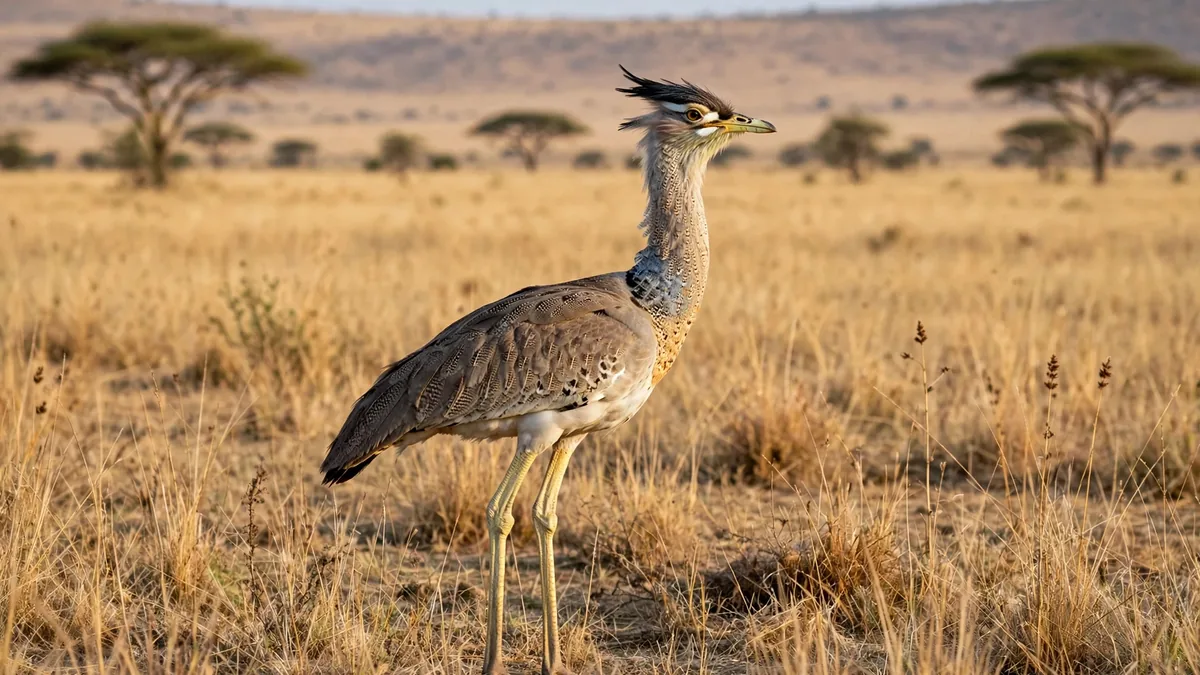
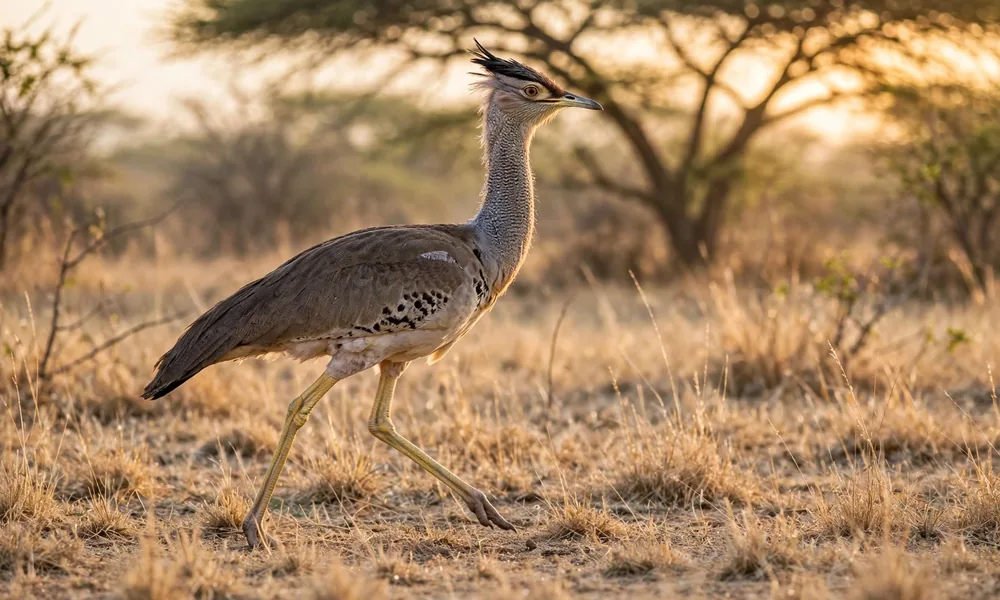
A kori bustard is a huge, heavy bird that is unmistakable once seen well. Its plumage is cryptically coloured, mostly grey and brown, finely patterned with black and white, so a bird standing still in dry grass can vanish. It has a long, thick grey neck, a dark crest, a white cheek patch and a pale eye, and long yellowish legs with only three toes, made for walking rather than perching. The bill is short and sturdy, built for picking food from the ground.
The male is much larger than the female, often more than twice her weight, and he is the second largest bird in Africa after the ostrich, which cannot fly at all. Despite its great weight, a kori bustard can fly, though take-off is a heavy, running affair and it flies with slow, deep wingbeats, usually only when it must. On the ground it is a strong walker and a fast runner, and its call is a low, booming oom, more drum than bird.
The kori bustard species and their relatives
The kori bustard belongs to Ardeotis, a small genus of large bustards in the family Otididae, and the only member of the genus found south of the Sahara. Two subspecies are recognised: the nominate race, A. k. kori, the relatively pale bird of southern Africa, found in Botswana, Zimbabwe, Namibia, southern Angola, South Africa and Mozambique, and A. k. struthiunculus, the bird of eastern Africa, from Ethiopia and Somalia south through Kenya and Tanzania to Zambia and northern Mozambique.
The bustards are an Old World family of heavy ground birds, and the kori’s closest relatives are the other large members of Ardeotis, such as the Arabian bustard and the Australian bustard. Among all bustards, only the male great bustard of Europe and Asia reaches similar weights, so the two are rivals for the title of heaviest living flying bird. No reliable global population total exists, and numbers are thought to be falling slowly across much of its range.
| Type | Animal | Where it lives | Best-known food | Length or Weight |
|---|---|---|---|---|
| Genus | Bustards of genus Ardeotis | Open country of Africa, Asia, Australia | Insects and small animals | Up to about 135 cm long |
| Species | Kori bustard (Ardeotis kori) | Savannas of southern and eastern Africa | Insects, lizards and seeds | Males 105 to 135 cm, 7 to 18 kg |
| Species | Arabian bustard (Ardeotis arabs) | Sahel belt and Arabian Peninsula | Insects, seeds, small animals | About 92 to 120 cm long |
| Species | Australian bustard (Ardeotis australis) | Grassland of Australia, New Guinea | Insects, lizards and seeds | About 100 to 140 cm long |
| Species | Great bustard (Otis tarda) | Grassland of Europe and Asia | Insects, plants and small animals | Males 90 to 105 cm, up to about 16 kg |
| Species | Ludwig’s bustard (Neotis ludwigii) | Dry grassland of southern Africa | Insects and seeds | About 85 cm long |
How kori bustards live
Kori bustards are omnivores, feeding by walking slowly across open ground and snapping at anything that moves. Insects dominate the diet, above all locusts, grasshoppers and beetles, but they also take lizards, small snakes, young birds and eggs, small mammals, seeds, berries, gum from acacia trees and carrion. They often follow grazing animals and grass fires for the insects flushed from cover.
Breeding is the male’s great performance. Males gather loosely on display grounds, where each one inflates his throat to four times its normal size, raises his neck and tail, droops his wings and lets out a deep, booming call. A male may mate with many females and takes no part in raising the young, so the display is his whole contribution.
The female makes almost no nest, scraping a shallow hollow in bare ground and laying one or two eggs, which she incubates alone for 23 to 24 days. The chicks hatch covered in down and leave the scrape soon afterwards, following their mother through the grass and freezing flat at her warning call. They stay with her for months. The largest confirmed male ever recorded, a bird shot in South Africa in 1936, weighed 18.14 kilograms, which is why the Guinness Book of Records lists the kori among the heaviest flying birds ever weighed.
Where kori bustards live
Kori bustards live across a wide sweep of southern and eastern Africa, from southern Angola, Namibia, Botswana, Zimbabwe and South Africa north through Zambia, Mozambique, Tanzania and Kenya to Ethiopia and Somalia. They are birds of open country, absent from dense forest and true desert, and most numerous in the great protected grasslands, where the ground stays open.
A kori bustard needs two things above all: open ground on which to walk and feed, and room to take off, since a bird of this weight cannot launch itself from thick cover. Those needs are met in grassland, savanna and light woodland, in semi-desert and on dry pans, and in grazing land where the grass is kept short. In East Africa it shares the plains with birds such as the grey-crowned crane, though the crane keeps to wetlands and the bustard to dry ground.
The kori bustard is listed as Near Threatened on the IUCN Red List, a status it has held since 2013, and on Appendix II of CITES. Its range is very large, so it is not close to extinction, but numbers are falling where grassland is ploughed or fenced, where hunting continues, and where power lines cross its flight paths, which a heavy bird in slow flight cannot always clear. It is now uncommon outside the major protected areas, which hold the strongest populations.
Best seasons for kori bustard watching
The best time to look for kori bustards in southern Africa is the dry season, roughly May to September, when the grass is short and the birds stand out against the bare ground. Early morning and late afternoon are best, when the birds walk and feed in the open, and the breeding display peaks in the warm months after the rains. In East Africa they can be seen all year, and the dry months make them easier to find.
Staying safe around kori bustards
A kori bustard is a harmless bird that would rather walk away than meet a person, and it has no defence beyond its size, its camouflage and its speed on foot. Watch from a vehicle or from a distance with binoculars, never approach a displaying male, and never walk up to a nest scrape, because a disturbed female may abandon her eggs, leaving the chicks easy prey.
Stay on the roads and tracks of the reserves you visit, and follow the rules of the park, since a flushed bird may fly into a power line or a fence. Keep dogs on a lead near known bustard ground, give a feeding bird room, and never handle a kori bustard, which is protected by law across much of its range.
Kori bustard watching checklist
A little preparation turns a drive through open savanna into a real chance of seeing the heaviest flying bird on earth.
- A dry-season visit to open savanna or grassland in a large reserve, where short grass makes the birds easiest to spot.
- An early morning or late afternoon start, when kori bustards walk and feed in the open.
- Binoculars or a spotting scope, because a bustard standing still in dry grass can vanish.
- A vehicle used as a hide, since the birds are far more relaxed when watched from a car.
- An ear tuned for the low, booming call of a displaying male, which carries further than the bird.
- A camera with a zoom lens, for close views from a distance without approaching a display ground.
- Respect for display grounds, nest scrapes and park rules, because a disturbed bird may abandon its eggs.
Frequently asked questions
How many kori bustard species are there?
There is one kori bustard species, Ardeotis kori, with two subspecies: the nominate A. k. kori of southern Africa and A. k. struthiunculus of eastern Africa. The two differ slightly in colour and range, but they are one species.
Why is it called a kori bustard?
The name kori comes from kgori, the name for the bird in Setswana, the language of Botswana, where the bustard is a familiar bird of the plains. Bustard itself is an old word for these heavy, ground-living birds, from the Latin avis tarda, meaning slow bird, a nod to their deliberate walk.
What does a kori bustard eat?
A kori bustard eats almost anything it can catch or pick up, above all insects such as locusts, grasshoppers and beetles. It also takes lizards, small snakes, young birds and eggs, small mammals, seeds, berries, gum from acacia trees and carrion, and it often follows grazing animals and grass fires for the insects they flush.
Can kori bustards fly?
Yes, kori bustards can fly, although they do so reluctantly and only when they must. Take-off is a heavy, running affair, and they fly with slow, deep wingbeats, but once airborne they cover long distances. Males are so heavy that the largest may be close to the practical limit of what a flying bird can weigh.
How is this guide different from the kookaburra guide?
This guide covers the kori bustard, a huge, ground-living bird of the African savanna that eats insects and small animals and displays with an inflated throat, while our kookaburra species guide covers the kookaburra, a stocky Australian kingfisher that perches in trees, eats lizards and snakes, and is famous for its laughing call. One is the heaviest flying bird on earth; the other is a tree kingfisher with a laugh.
Are kori bustards endangered?
Not in the strict sense, but they are heading in the wrong direction. The kori bustard is listed as Near Threatened on the IUCN Red List, with numbers falling where grassland is ploughed, hunting continues and power lines cross its flight paths. It is now uncommon outside the major protected areas.
Conclusion
The kori bustard species needs no introduction once you have seen it: one species, Ardeotis kori, a grey-brown giant of the African savanna and one of the heaviest flying birds in the world.
If you go looking for one, go in the dry season, go early, and scan the open grassland from your vehicle. Find a kori bustard striding through the morning grass, and you will see why it holds its place as the great heavyweight of the African plains.