The mourning dove species is a single species, Zenaida macroura, a slender grey-brown dove with a long pointed tail, black spots on its wings and a soft, mournful coo that drifts over gardens, fields and city parks across North America. If you are asking how many mourning dove species there are, the answer is one, and it is one of the most abundant and widespread birds on the continent, found from southern Canada to Panama.
The mourning dove is named for its voice, a slow coo-OO-oo-oo-oo that sounds like a lament, and it is a bird most people know without knowing it: the gentle shape on the telephone wire at dawn, the soft wings whistling overhead, the pair picking seeds beneath a bird feeder.
Key takeaways
- The mourning dove species is Zenaida macroura, a slender grey-brown dove with a long pointed tail and black spots on its wings.
- Adults are 23 to 34 centimetres long, with a wingspan of 37 to 45 centimetres and a weight of 96 to 170 grams.
- Seeds make up about 99 percent of the diet, gathered from the ground, and the birds swallow grit to grind them.
- They live in open and semi-open habitats across North America, from Canada to Panama, including gardens, farms and towns.
- The species is listed as Least Concern, with a global population estimated at about 150 million mature individuals.
What makes a mourning dove a mourning dove
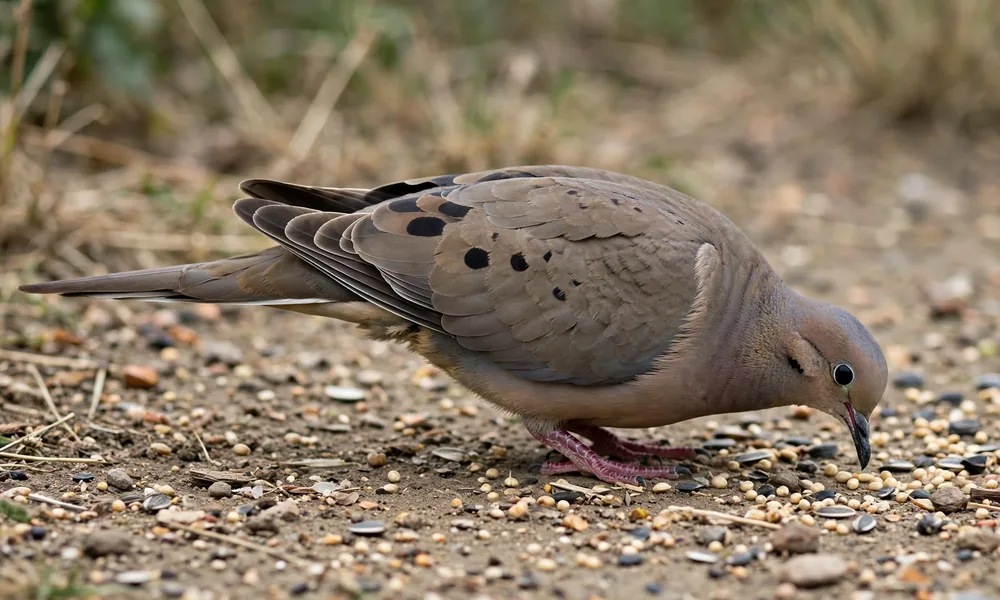
A mourning dove is a slim, soft-looking bird, 23 to 34 centimetres long, with a small round head, a long pointed tail and smooth grey-brown plumage, lighter and pinkish below in the male. The wings carry a few black spots, the outer tail feathers are tipped with white, and the eye is dark with a pale blue ring around it. In flight the pointed wings make a soft whistling sound, and the tail shows a white edge as the bird banks away. Males are a little brighter, with a pinker breast and a bluish crown, while young birds are duller and scaly-looking.
The voice is the bird’s signature: a slow, mournful coo-OO-oo-oo-oo, given by the male from a high perch, which is where the name mourning dove comes from. It is a gentle sound, nothing like the harsh calls of most garden birds, and it has made the dove a symbol of peace and of sorrow in North American folk tradition. They repeat the coo through the morning and again in the evening.
The mourning dove species and their relatives
The mourning dove belongs to Zenaida, a small genus of New World doves in the family Columbidae, and it is the most widespread member of the genus by far. Five subspecies are usually recognised, differing slightly in size and colour, from the pale birds of the Caribbean to the larger, darker birds of the western United States.
Its closest relatives are the other Zenaida doves of the Americas, above all the white-winged dove of the southern United States and Mexico, told apart by the white band on its wing, and the Zenaida dove of the Caribbean. The eared dove of South America is a more distant cousin in the same genus, and the familiar rock dove, the ancestor of the city pigeon, is a close relative in the wider family. All of them share the small head, the soft plumage and the habit of feeding on the ground.
| Type | Animal | Where it lives | Best-known food | Length or Weight |
|---|---|---|---|---|
| Genus | Zenaida doves (genus Zenaida) | Open country, the Americas | Seeds from the ground | About 23 to 34 cm long |
| Species | Mourning dove (Zenaida macroura) | North America, from Canada to Panama | Grass and weed seeds | About 23 to 34 cm long |
| Species | White-winged dove (Zenaida asiatica) | Southern USA and Mexico | Seeds and fruit | About 29 to 31 cm long |
| Species | Zenaida dove (Zenaida aurita) | Caribbean islands | Seeds and small fruit | About 25 to 28 cm long |
| Species | Eared dove (Zenaida auriculata) | South America | Seeds and grain | About 22 to 28 cm long |
| Species | Rock dove (Columba livia) | Worldwide, in towns and cliffs | Seeds and scraps | About 29 to 37 cm long |
How mourning doves live
Mourning doves are seed eaters above all else, and about 99 percent of their food is seeds: grass and weed seeds, and the waste grain of crops such as wheat, maize, millet and sunflower. They feed on the ground, walking slowly and pecking up seeds one by one, and they do not scratch the soil as a sparrow does. A dove fills its crop quickly, then flies to a safe perch to digest at leisure, and it regularly swallows small pieces of grit, which sit in the gizzard and help grind the hard seed coats. Unlike most birds, a mourning dove can drink by suction, dipping its bill into the water and drawing it up without lifting its head.
Mourning doves are gentle, social birds, often seen in pairs or small flocks, perching together on wires and feeding side by side on the ground. They are strong, direct fliers, and the pointed wings can carry them at about 88 kilometres per hour when they are startled into a fast escape. Northern birds migrate south in autumn and return in spring, while birds in the southern United States and Mexico stay put all year.
Mourning doves form monogamous pairs, and the male courts the female with bowing displays and a soft coo from a high perch. The nest is famously flimsy, a loose platform of twigs built in a tree, a shrub, on a ledge or even on the ground. The female lays two white eggs, and both parents take turns incubating them for about 14 days. The chicks, called squabs, are fed on crop milk, a rich substance produced in the parent’s crop, and they leave the nest after about 12 to 14 days. In warm areas a single pair may raise as many as five or six broods in one year, more than almost any other North American bird.
Where mourning doves live
Mourning doves live across almost the whole of North America, breeding from southern Canada through the United States and Mexico to Panama, and on the Caribbean islands. They are birds of open and semi-open country, and they are found in grassland, prairie, desert, farmland, forest clearings and the edges of woodland. They have taken to human landscapes with ease, and they are now among the commonest birds of gardens, suburbs, parks and city streets.
A mourning dove needs little more than open ground, a supply of seeds and a safe place to nest, and it finds all three in the most ordinary places: a lawn beneath a feeder, a stubble field or a quiet garden. They share the ground beneath feeders with the American robin, which pulls worms from the same lawns, though the robin works the soil while the dove gathers seeds, and they share the evening wires with the barn owl, which begins its hunt as the doves settle to roost.
The mourning dove is listed as Least Concern on the IUCN Red List, assessed in 2024, with about 150 million mature individuals, as estimated by Partners in Flight. It is also the most hunted game bird in North America, with more than 20 million birds shot each year in the United States, yet the population remains enormous because the birds breed so fast. Numbers have slipped slowly in the United States and Canada, but the species is still one of the most abundant birds on the continent.
Best seasons for mourning dove watching
Mourning doves can be seen all year across most of their range, but spring and summer are best, from April to September, when males coo from high perches and pairs are busy at their flimsy nests. Early morning is best, when the birds sit on wires in the first light and then drop to the ground to feed, and a garden with a feeder is often the easiest place of all.
Staying safe around mourning doves
A mourning dove is a gentle bird that poses no danger to anyone, and it would rather fly away than meet a person, so give it space. Watch from a distance with binoculars, never approach a nest, and never handle a dove or a squab, because a disturbed nest may be abandoned.
If you find a nest, enjoy it from well away and do not return every day, because repeated visits can draw predators to the site. Stay on marked paths, ask before crossing private land, and never handle a mourning dove, which is protected by law across the United States, Canada and Mexico.
Mourning dove watching checklist
A little preparation turns a morning in the garden or the park into a real chance of seeing a mourning dove.
- A spring or summer visit to a garden, a park or an open field with bare ground.
- An early morning start, when doves sit on wires and call.
- Binoculars, because a grey-brown dove on the ground is easy to miss.
- An ear tuned for the slow coo-OO-oo-oo-oo call, which carries further than the bird is visible.
- Patience beneath feeders, where the doves gather fallen seeds.
- A camera with a zoom lens, for close views from a distance.
- Respect for nests and private land, because a disturbed nest may be abandoned.
Frequently asked questions
How many mourning dove species are there?
There is one mourning dove species, Zenaida macroura. Five subspecies are usually recognised, differing slightly in size and colour, but they are all the same species.
Why is it called a mourning dove?
The name comes from the bird’s call, a slow coo-OO-oo-oo-oo that sounds mournful, like a lament. The scientific name Zenaida honours Zenaida, the wife of the French ornithologist Charles Lucien Bonaparte, while macroura means long-tailed.
What does a mourning dove eat?
A mourning dove eats almost entirely seeds, about 99 percent of its diet, above all grass and weed seeds, and the waste grain of crops such as wheat, maize, millet and sunflower. It also swallows grit to help grind the seeds, and only very rarely eats snails or insects.
Are mourning doves dangerous?
No, mourning doves are gentle and harmless to people and would rather fly away than confront anyone. They have no defence beyond speed in flight, so admire them from a distance and never approach a nest.
How is this guide different from the loggerhead shrike guide?
This guide covers the mourning dove, a gentle grey-brown seed eater of North American gardens and fields, while our loggerhead shrike species guide covers the loggerhead shrike, a masked hunter of the same open country that drops from a perch onto insects and mice and impales its prey on thorns. One gathers seeds from the ground; the other hangs its dinner on a fence.
Are mourning doves endangered?
No, mourning doves are not endangered. They are listed as Least Concern on the IUCN Red List, with about 150 million mature individuals, and they remain one of the most abundant birds in North America, despite being the continent’s most hunted game bird.
Conclusion
The mourning dove species is a bird that needs no introduction once you have heard it: one species, Zenaida macroura, a soft grey-brown dove with a long tail, black wing spots and a voice that gave it its name.
If you go looking for one, go in spring, go early, and listen for the slow coo from the wire above the garden. Find a mourning dove feeding quietly in the morning sun, and you will see why this gentle bird is one of the best-loved sounds of North America.