The barn owl species is a single species, Tyto alba, a pale ghost owl of barns, fields and open country, and one of the most widespread land birds on Earth. If you are asking how many barn owl species there are, the answer is one: there is only one barn owl species in the world, though it is split into several subspecies, and every barn owl alive today belongs to it.
The barn owl belongs to the family Tytonidae, the barn owls, and it lives on every continent except Antarctica, in open country, farmland and grassland. Its pale heart-shaped face, its white underparts and its silent flight make it one of the most recognisable owls in the world.
Key takeaways
- There is only one barn owl species, Tyto alba, and it lives on every continent except Antarctica.
- Barn owls hunt by hearing alone, and they can catch a mouse in total darkness by the sound of its movements.
- Barn owls fly in total silence, thanks to the soft fringes on their feathers, so their prey never hears them coming.
- Barn owls do not hoot like other owls — they give a long harsh screech that has earned them the name ghost owl.
- Barn owls are listed as Least Concern, though their numbers are falling in many places as old barns disappear.
What makes a barn owl a barn owl
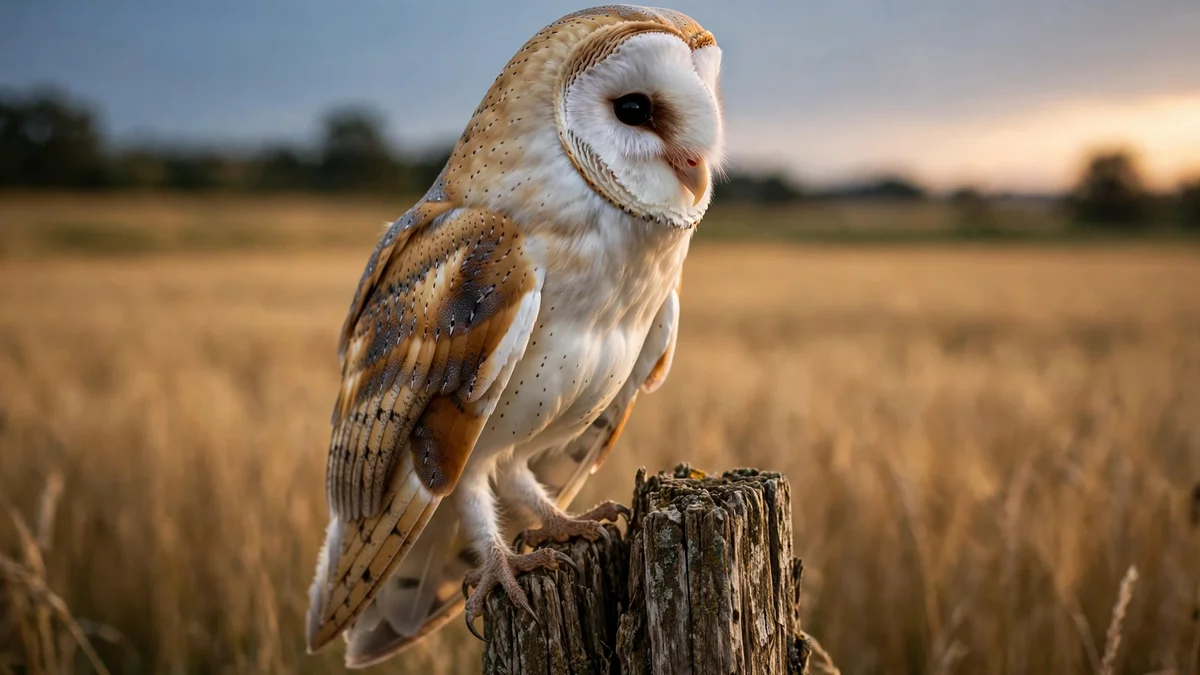
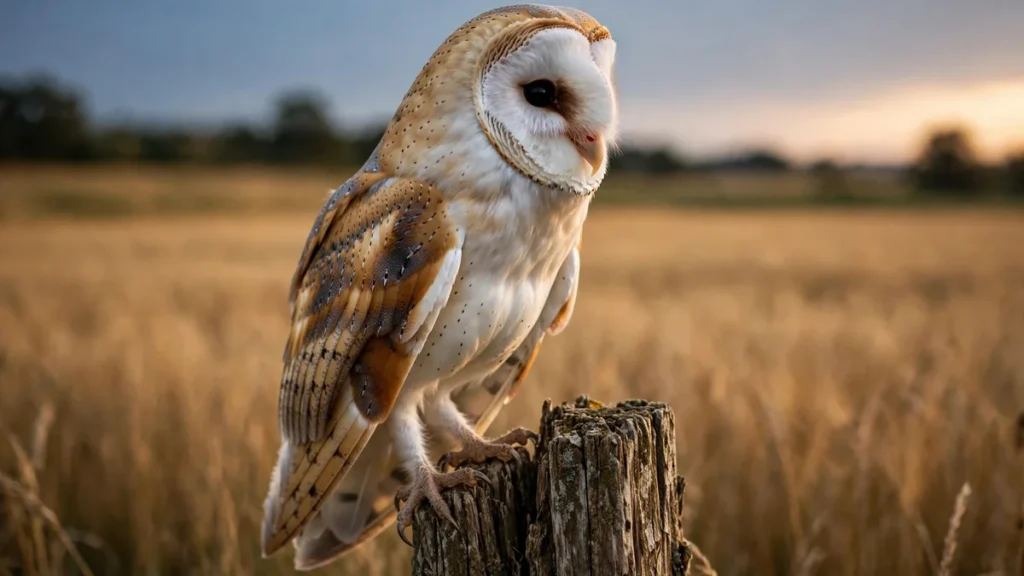
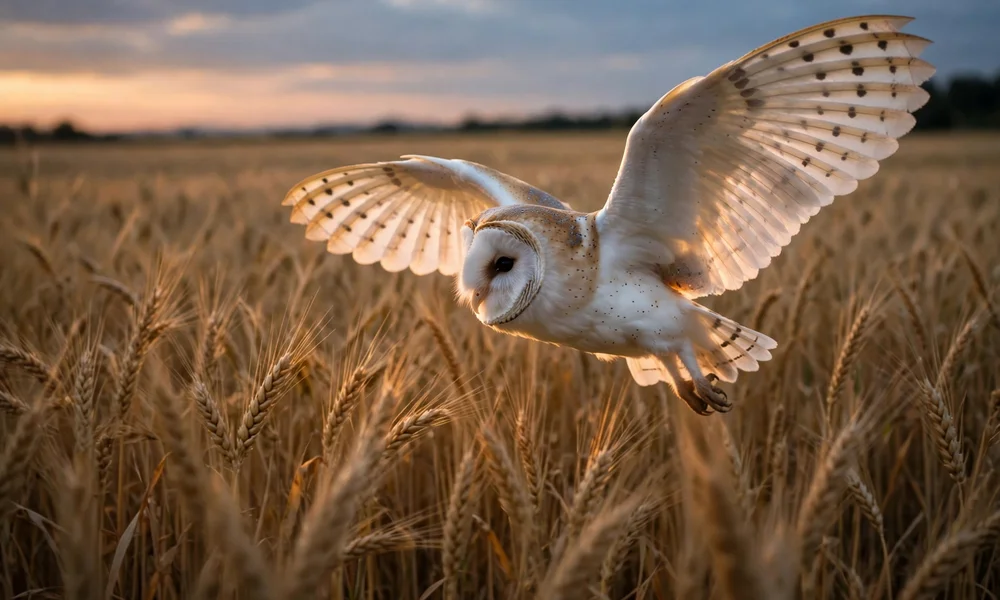
A barn owl is a medium-sized pale owl with a heart-shaped white face, dark eyes, a white or pale buff belly and golden-buff wings speckled with grey, and it measures roughly 33 to 39 centimetres long, with a wingspan of 80 to 95 centimetres, and usually weighs between 250 and 450 grammes, depending on sex and region.
The face defines the barn owl: a heart-shaped disc of stiff feathers that works like a satellite dish, funnelling sound into its ears, which are set at different heights on its head so it can pinpoint a sound in three dimensions. Its feathers have soft fringes that break up the air as it flies, so it hunts in total silence, and its hearing is so sharp that it can catch a mouse in complete darkness by the sound of its movements. Like other owls, the barn owl has large eyes for seeing in the dark, but it is its hearing, not its sight, that makes it such a deadly hunter.
The barn owl species and their relatives
Tyto alba is the only barn owl species, and it is split into several subspecies, including the western barn owl of Europe, the American barn owl of the Americas and the eastern barn owl of Asia and Australia. Barn owls in different parts of the world look slightly different, with paler birds in the north and darker birds in the south, but they are all the same species.
The snowy owl is the barn owl’s most famous relative, a white owl of the Arctic that hunts by day, while the great horned owl is a large owl with ear tufts that lives across the Americas. The tawny owl is a brown owl of European woodland, the long-eared owl is a slim owl with tall ear tufts, and the short-eared owl is a pale owl that hunts over open moorland. The burrowing owl is a small owl that lives in burrows on the ground, and the elf owl is the smallest owl in the world.
| Type | Animal | Where it lives | Best-known food | Length or Weight |
|---|---|---|---|---|
| Species | Barn owl (Tyto alba) | Open country worldwide except Antarctica | Mice, voles and shrews | 33 to 39 cm, 250 to 450 g |
| Close relative | Snowy owl | Arctic tundra | Lemmings and voles | 52 to 71 cm, 1.6 to 3 kg |
| Close relative | Great horned owl | Americas, forests and deserts | Rabbits, mice and birds | 46 to 64 cm, 0.9 to 2.5 kg |
| Close relative | Tawny owl | European woodland | Mice, voles and small birds | 37 to 43 cm, 330 to 590 g |
| Close relative | Long-eared owl | Woodland across the northern hemisphere | Voles and mice | 31 to 37 cm, 190 to 430 g |
| Close relative | Short-eared owl | Open moorland and grassland worldwide | Voles and mice | 34 to 43 cm, 206 to 475 g |
| Close relative | Burrowing owl | Grassland of the Americas | Insects and small rodents | 19 to 28 cm, 140 to 240 g |
How barn owls live
Barn owls are creatures of the open field. A barn owl lives alone or in a pair, hunting over rough grassland, farmland and marsh by night and roosting in a barn, a hollow tree or a cliff by day, and it stays in the same area all year, rarely travelling far. Like other snowy owls, it is a hunter of the dark, but unlike the snowy owl it hunts only at night, and it can catch more than 1,000 mice in a single year.
Mice and voles make up most of the diet, along with shrews, rats and small birds, and a barn owl eats about three to four mice every night. It hunts by flying low and slow over the grass, listening for the rustle of a mouse, and then dropping silently onto its prey with its talons spread, swallowing the mouse whole and coughing up the bones and fur as a pellet.
Breeding happens in spring and summer, and the pair nests in a barn, a hollow tree or a nest box, laying 4 to 7 white eggs on the bare floor. The female incubates the eggs for about 30 days, and the chicks are born white and downy, fed by both parents for about 60 days before they fledge. The young stay with their parents for a few weeks, learning to hunt, and then leave to find their own territories. Barn owls live for around 4 years in the wild on average, and up to 15 years in the best cases.
Where barn owls live
The barn owl lives in open country on every continent except Antarctica, from the farmland of Europe to the grasslands of Australia, and it is most common in farmland, grassland and marsh, where mice and voles are plentiful. It is seen regularly in the barns and church towers of England, in the fields of North America, and in the outback of Australia, where it hunts over the red desert at night.
Open country is the key requirement. A barn owl needs rough grassland to hunt in, and a barn, a hollow tree or a cliff to nest in, so it follows the mice as they move with the seasons, and when the grass is cut or the barns are pulled down the owls have nowhere to live.
The species is listed as Least Concern, and its numbers are stable in most regions. The main pressures are the loss of old barns to development, the loss of rough grassland to intensive farming, and poisoning from rat poison, which kills owls that eat poisoned mice.
Best seasons for barn owl watching
There is no closed season, because barn owls are active all year, but the best time to look for them depends on where you go. In Britain the best months are often May to August, when the owls are breeding and hunting at dusk to feed their chicks. In North America the best months are often the summer, when the owls hunt over the fields at dawn and dusk, and in Australia the best months are often the dry season, when the mice are plentiful.
Staying safe around barn owls
A barn owl is a wild bird with sharp talons and a hooked beak, and it can hurt a person, though barn owls almost never attack people. Keep your distance, never approach a barn owl nest, and never try to catch an owl, because a frightened bird may abandon its eggs and the chicks may die. If you see barn owls hunting, stay on the path and watch with binoculars, because owls that are disturbed may leave their hunting ground for good.
Barn owl watching checklist
A little preparation turns a field visit into a real chance of seeing a barn owl, so pack for dusk, open fields and long quiet hours.
- Binoculars with good low-light performance, for picking a pale owl out of the dusk.
- A camera with a fast lens, because barn owls should always be watched from a distance.
- Warm clothes, because the best watching is in the cold evening air.
- A torch with a red filter, for finding your way without disturbing the owls.
- A field guide to owls, for telling a barn owl from a tawny owl at a glance.
- A plan to be out at dusk, when the owls leave their roosts to hunt.
- Patience and silence, because barn owls are shy birds and a noisy group will send them away.
Frequently asked questions
How many barn owl species are there?
There is one barn owl species, Tyto alba. It is split into several subspecies, including the western barn owl of Europe, the American barn owl of the Americas and the eastern barn owl of Asia and Australia, but they are all the same species.
Why do barn owls not hoot?
Barn owls do not hoot like other owls because they belong to a different family, the barn owls, and they communicate with a long harsh screech instead. The screech has earned them the name ghost owl, and people once thought the sound came from ghosts in old barns.
How do barn owls hunt in total darkness?
Barn owls hunt in total darkness by hearing alone. Their heart-shaped faces funnel sound into their ears, which are set at different heights, so they can pinpoint a mouse in three dimensions, and they can catch a mouse by the sound of its movements, even under snow or thick grass.
Can you keep a barn owl as a pet?
No. A barn owl is a wild bird that needs open country, eats mice every night, and is fully protected by law in every country where it lives. Barn owls in rescue centres are there to recover from injury, and they are not pets.
How is this guide different from the Andean condor species guide?
This guide covers the single barn owl species, a pale ghost owl that hunts mice by sound in the dark, while our Andean condor species guide covers the single Andean condor species, a giant vulture that soars over the Andes on wings 3.3 metres across. The barn owl weighs less than half a kilogramme and hunts at night, and the condor weighs up to 15 kilogrammes and soars by day.
Are barn owls endangered?
Barn owls are listed as Least Concern, so they are not classed as endangered. Their numbers are falling in many places as old barns disappear and rough grassland is lost, and poisoning from rat poison is a growing threat.
Conclusion
The barn owl species shows how much grace one bird can hold: a single species of pale ghost owl, with a heart-shaped face, silent wings and hearing sharp enough to catch a mouse in total darkness.
If you go looking for one, go at dusk to a field with an old barn, go quietly, and go with patience. Watch a barn owl glide silently over the grass and you will understand why it has earned its place as the ghost owl of the fields, and why keeping its barns and its grassland matters most.