The Andean condor species is a single species, Vultur gryphus, a giant vulture of the Andes mountains, and one of the largest flying birds in the world. If you are asking how many Andean condor species there are, the answer is one: there is only one Andean condor species in the world, and every Andean condor alive today belongs to it.
The Andean condor belongs to the family Cathartidae, the New World vultures, and it lives in the Andes mountains and the Pacific coast of western South America, from Venezuela to Tierra del Fuego. Its black plumage, its white collar, its bald head and its enormous wings make it one of the most recognisable birds on Earth.
Key takeaways
- There is only one Andean condor species, Vultur gryphus, and it is the only living member of its genus.
- Andean condors have a wingspan of up to 3.3 metres, the largest of any land bird, and they can soar for hours without flapping.
- Andean condors are scavengers that eat carrion, cleaning the mountains of dead animals and stopping disease from spreading.
- Andean condors are among the longest-lived birds on Earth, living for more than 50 years in the wild and up to 79 years in captivity.
- Andean condors are listed as Vulnerable, with only about 6,700 mature birds left in the wild.
What makes an Andean condor an Andean condor
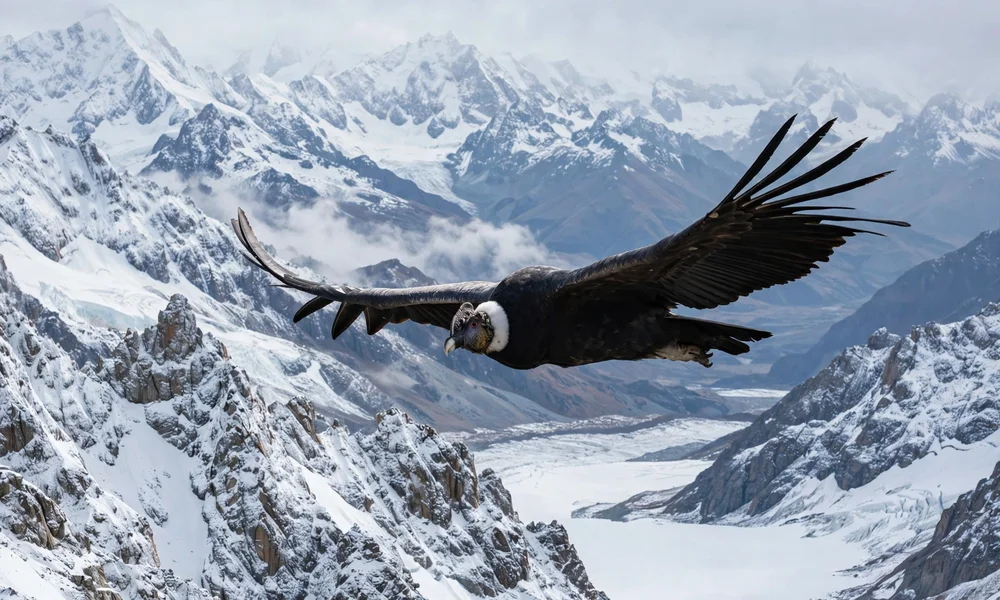
An Andean condor is a huge vulture with black plumage, a white ruff around its neck, a bald pinkish head and a wingspan of up to 3.3 metres, and it measures roughly 100 to 130 centimetres long and usually weighs between 11 and 15 kilogrammes, with males larger than females. The male has a fleshy comb, or caruncle, on top of its head, and its eyes are brown, while the female has no comb and red eyes.
The wings define the Andean condor: the largest wings of any land bird, with a surface area greater than any other bird alive, which let it soar for hours on mountain thermals without flapping. It flaps its wings for only about 1 per cent of its flight time, and one bird was tracked flying for more than five hours without a single flap, covering 172 kilometres. Like other eagles, the Andean condor has a hooked beak for tearing meat, but its feet are flat and weak, built for walking rather than gripping, because it never kills its own food.
The Andean condor species and their relatives
Vultur gryphus is the only Andean condor species, and it is the only living member of its genus. Andean condors in different parts of the Andes form separate populations, from Venezuela to Patagonia, but they are all the same species, and the birds move freely along the mountain chain following the carrion.
The California condor is the Andean condor’s closest relative, a slightly smaller vulture of North America that was saved from extinction by captive breeding, while the king vulture is a colourful vulture of the Central and South American rainforest. The turkey vulture is a common vulture of the Americas with a red head, the black vulture is a dark vulture that lives in flocks, and the bearded vulture, or lammergeier, is a mountain vulture that drops bones onto rocks to break them. The griffon vulture is a large vulture of Europe and Africa, and the Egyptian vulture is a small white vulture that uses tools to break eggs.
| Type | Animal | Where it lives | Best-known food | Length or Weight |
|---|---|---|---|---|
| Species | Andean condor (Vultur gryphus) | Andes mountains and Pacific coast | Carrion of large animals | 100 to 130 cm, 11 to 15 kg |
| Close relative | California condor | Mountains of western North America | Carrion of large animals | 109 to 140 cm, 8 to 14 kg |
| Close relative | King vulture | Central and South American forests | Carrion | 71 to 81 cm, 3 to 4.5 kg |
| Close relative | Turkey vulture | Americas, from Canada to Argentina | Carrion | 62 to 81 cm, 0.8 to 2 kg |
| Close relative | Black vulture | Americas, from USA to Argentina | Carrion and rubbish | 56 to 68 cm, 1.2 to 2 kg |
| Close relative | Bearded vulture | Mountains of Europe, Africa and Asia | Bones and carrion | 94 to 125 cm, 4.5 to 7.8 kg |
| Close relative | Griffon vulture | Europe, Africa and Asia | Carrion of large animals | 93 to 120 cm, 6.5 to 11 kg |
How Andean condors live
Andean condors are creatures of the high mountains. An Andean condor lives alone or in small groups, soaring over the Andes by day and roosting on cliff ledges by night, and it can travel more than 200 kilometres in a single day without flapping its wings. Like other South American animals, it follows the seasons, moving up and down the mountains as the weather changes.
Carrion makes up almost the whole diet, along with the occasional sick or newborn animal, and an Andean condor eats by tearing meat from a carcass with its hooked beak. It finds food by sight, soaring high above the mountains and watching for other vultures, and it can eat up to 3 kilogrammes of meat in a single sitting, then go for days without food. It plays an important part in the mountains, cleaning up dead animals and stopping disease from spreading.
Breeding happens every two years, and the pair nests on an inaccessible rock ledge, usually at elevations up to 5,000 metres, laying one or two white eggs on the bare rock. Both parents incubate the egg for about 54 to 58 days, and the chick is born grey and downy, fed by both parents for six months before it can fly. The young stay with their parents for a year or more, learning where the carcasses are, and Andean condors live for more than 50 years in the wild, and up to 79 years in captivity, among the longest lives of any bird.
Where Andean condors live
The Andean condor lives in the Andes mountains and the adjacent Pacific coast of western South America, from Venezuela through Colombia, Ecuador, Peru, Bolivia and Chile to Argentina and Tierra del Fuego, and it is most common in the high Andes of Peru, Bolivia and Argentina. It is seen regularly in the Colca Canyon in Peru, one of the deepest canyons in the world, where the condors soar on the morning thermals.
High mountains are the key requirement. An Andean condor needs open country with strong thermals to soar on, and cliffs to nest and roost on, so it follows the mountain chain as the weather changes, and when the mountains are disturbed the condors have nowhere to live. It depends on large animals to die in the open, and it soars over the grasslands, the deserts and the coast, looking for carcasses.
The species is listed as Vulnerable, and its numbers are falling across its range. The main pressures are poisoning from lead in carcasses killed by hunters, the loss of wild land to farming, and persecution by farmers who wrongly blame condors for killing livestock. Only about 6,700 mature condors remain in the wild, and the species is feared extinct in Venezuela, with no more than 340 birds left in northern South America.
Best seasons for Andean condor watching
There is no closed season, because Andean condors are active all year, but the best time to look for them depends on where you go. In Peru the best months are often the dry season, from about May to October, when the condors soar on the morning thermals in the Colca Canyon. In Argentina the best months are often the summer, when the birds are breeding and easy to find near their nests.
Staying safe around Andean condors
An Andean condor is a wild bird with a hooked beak and sharp claws, and it can hurt a person, though condors almost never attack people. Keep your distance, never approach a condor nest, and never try to feed a condor, because a frightened bird may abandon its nest and the chick may die. If you see condors soaring, stay on the path and watch with binoculars, because condors that are disturbed may leave their roosting cliffs for good.
Andean condor watching checklist
A little preparation turns a mountain visit into a real chance of seeing an Andean condor, so pack for cold, wind and long quiet hours.
- Binoculars with good low-light performance, for picking a huge bird out of the mountain sky.
- A camera with a long lens, because condors should always be watched from a distance.
- Warm clothes and a windproof jacket, because the best watching is in the cold mountain mornings.
- Water and snacks for long days, because the best sightings come after hours of waiting.
- A field guide to birds of prey, for telling an Andean condor from a vulture at a glance.
- A plan to be out in the morning, when the condors soar on the thermals.
- Patience and silence, because condors are shy birds and a noisy group will send them away.
Frequently asked questions
How many Andean condor species are there?
There is one Andean condor species, Vultur gryphus. It is the only living member of its genus, and its closest relative is the California condor of North America. No second Andean condor species is recognised.
How big is an Andean condor?
An Andean condor has a wingspan of up to 3.3 metres, the largest of any land bird, and it weighs up to 15 kilogrammes. Its wings have the largest surface area of any bird alive, which lets it soar for hours without flapping, and it is the largest bird of prey in the world.
What do Andean condors eat?
Andean condors eat carrion, the dead bodies of large animals such as deer, cattle, llamas and seals. They find food by sight, soaring high above the mountains, and they clean up dead animals, which stops disease from spreading across the mountains.
Can you keep an Andean condor as a pet?
No. An Andean condor is a wild bird that needs the high Andes, eats carrion by the kilogramme, and is fully protected by law in every country where it lives. Condors in zoos need huge aviaries with cliffs and thermals, and they are not pets.
How is this guide different from the mako shark species guide?
This guide covers the single Andean condor species, a giant vulture that soars over the Andes on wings 3.3 metres across, while our mako shark species guide covers two mako shark species, the fastest sharks in the sea, which hunt tuna in the open ocean. The condor flies on mountain thermals and eats carrion, and the mako swims at 74 kilometres per hour and eats fast fish.
Are Andean condors endangered?
Andean condors are listed as Vulnerable, so they are not classed as endangered, but their numbers are falling. Only about 6,700 mature condors remain in the wild, and poisoning from lead in carcasses is the main threat.
Conclusion
The Andean condor species shows how much majesty one bird can hold: a single species of giant vulture, with wings wider than any other land bird, a life spent soaring over the highest mountains on Earth, and a place in the folklore of five nations. It is one of the largest flying birds in the world, and it has lived in the Andes for millions of years.
If you go looking for one, go in the dry season to the Colca Canyon in Peru, go quietly, and go with patience. Watch an Andean condor soar over the canyon without flapping its wings and you will understand why it has earned its place as the king of the Andes, and why keeping its mountains matters most.